
Hide TV Wires in the Wall: Outlet Options and Permit Rules
Key Takeaways
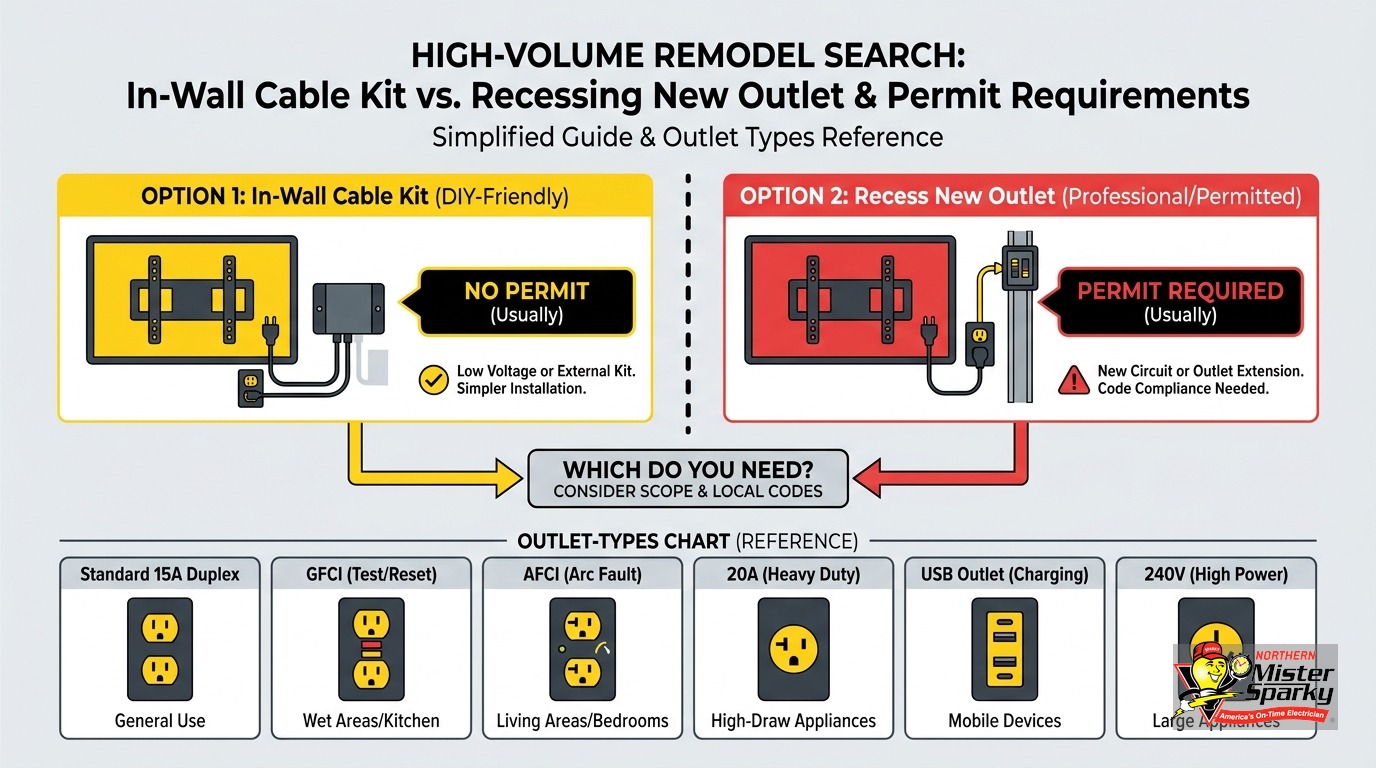
- The phrase “hide TV wires in wall outlet” describes two distinct projects with different legal requirements: a UL-listed in-wall cable kit (typically no permit) and a new recessed outlet with new wiring (permit required in Minnesota).
- Running your TV’s stock power cord through drywall violates NEC 400.12. That is a code violation, not a style preference.
- A listed in-wall cable kit is legal because the cord travels inside a listed assembly borrowing from an existing outlet. It does not add new wiring from the panel.
- A new recessed outlet adds new wiring. That requires a permit, an inspection, and AFCI arc-fault protection on the circuit under NEC 210.12.
- Owner-occupants of a single-family home in Minnesota can pull their own electrical permit. Landlords and renters cannot.
- Permits filed before August 17, 2026 fall under the 2023 NEC. Permits filed on or after that date fall under the 2026 NEC.
- Unpermitted electrical work shows up in buyer inspections and can stall or kill a home sale.
- Ready to do it right? Call 763-200-5956 or book online.
What does “hide TV wires in wall outlet” actually mean?
Short answer: The phrase covers two distinct projects with very different legal categories. Option one uses a listed in-wall cable kit to borrow from an existing outlet, typically without a permit. Option two installs a brand-new recessed outlet with fresh wiring, which requires a permit in Minnesota. Both look identical from the couch.
Most homeowners searching for how to hide TV wires in a wall outlet are imagining the finish: a clean outlet plate behind the TV, no cords drooping to the floor. That finish is achievable with either method. The path you choose, however, determines whether you need a permit, whether an inspector must sign off, and whether you can legally do the work yourself.
The top search results for this topic treat it as an aesthetics problem. They stop at “use a UL-listed kit” or “run cords through the wall.” None of them explain why those two approaches land in different legal categories. None mention that pushing any cord through drywall is a code violation. This post covers the full picture, including the Minnesota-specific permit rules that apply right now.
Why can’t you just push a TV cord through the wall?
Short answer: NEC 400.12, items 2 and 5 prohibit flexible cords from running through holes in walls or being concealed inside wall cavities. Your TV’s power cord is a flexible cord. Pushing it through drywall is a code violation. The neatness of the hole does not matter.
This surprises a lot of homeowners. The cord enters at floor level, travels up inside the wall cavity, and exits behind the TV. Nothing is spliced. Nothing is wired together. It feels harmless.
The National Electrical Code does not see it that way. NEC Article 400 classifies flexible cords separately from permanent wiring methods. Flexible cords are rated for open, visible use. They are not rated for concealment inside building cavities. When a cord is run through drywall, it can be pinched against a stud, abraded by the edge of a hole over time, or overheat without any visible warning sign. A fire that starts inside a wall cavity is invisible until it has spread.
Standard residential wiring uses Romex, a nonmetallic sheathed cable rated for in-wall installation. A TV power cord is not Romex. It is not rated for that environment, and no amount of care in the installation changes that.
This prohibition covers every flexible cord: the stock cable that ships with your TV, extension cords, and power bricks. If it is a flexible cord, it cannot legally pass through a hole in drywall.
How does a UL-listed in-wall cable kit stay legal?
Short answer: A listed kit does not pass a flexible cord through the wall. It routes the cord inside a listed assembly rated for in-wall use. Power enters from an existing outlet at the bottom and surfaces at a new outlet plate behind the TV. No new wiring runs from the panel. That distinction is the legal difference.
Products like PowerBridge work because the cord travels inside a listed assembly, not as exposed flexible cord. The kit includes two outlet plates. The lower plate connects to an existing receptacle in the wall. The upper plate surfaces behind the TV. The assembly bridging them carries a UL or ETL listing for in-wall use.
Because no new circuit is created and no wiring runs from the panel, most jurisdictions classify this as a repair or like-for-kind replacement rather than new electrical work. That means no permit is typically required.
A few conditions must be met for the installation to hold up under inspection:
- The kit must carry a UL or ETL listing for in-wall use. Generic kits without a listing mark do not qualify.
- The existing outlet below must be on a circuit with enough capacity for the TV and any associated equipment.
- The cord inside the wall must stay inside the listed assembly. Running it outside the pathway voids the legal distinction.
- Low-voltage cables run alongside the power wiring must be in-wall rated. More on that below.
One limitation: the kit does not add outlet capacity. You still have one circuit feeding the area. If you are planning a more involved home theater setup, that is a separate conversation.
The kit approach works well for a living-room TV on a flat interior wall with an existing outlet nearby. It is harder to use on an above-fireplace installation, where the wall cavity above the firebox may be restricted by fire blocking or require a longer run. If your TV is going above a fireplace, our post on TV outlet wiring above a fireplace covers what that project involves.
What is a recessed outlet, and how is it different?
Short answer: A recessed outlet installs flush into the wall directly behind the TV mount, with a new cable running from that box to the panel or an existing circuit. It adds a new outlet location. That is new wiring. New wiring requires a permit in Minnesota.
The visual finish looks similar to the cable kit approach. The outlet sits flush behind the mount. Cords disappear. From the front of the TV, you cannot tell which method was used.
From behind the wall, the difference is significant. A recessed outlet has a box set into the drywall. A cable runs from that box back to the panel’s wiring. An electrician installs that cable to code: correct wire gauge, correct stapling intervals, correct connector fittings at the box. An inspector verifies the work before the wall closes.
The recessed outlet approach tends to produce a cleaner result. There are no plates at two different heights on the wall. There is no lower plate to patch around furniture. For a TV that will stay in one location permanently, or for a custom media wall, this is the better build. It requires the permit and inspection path, but the result is a clean installation with a paper trail.
Does adding a new outlet behind your TV require a permit in Minnesota?
Short answer: Yes. Any added circuit, added outlet, or relocated electrical box crosses from minor repair into permitted work under Minnesota law. A new recessed outlet behind your TV is a new outlet. You must pull a permit before the work starts.
Minnesota electrical permits are administered by the Department of Labor and Industry (DLI) for most suburbs. That includes Bloomington, Maple Grove, Plymouth, Woodbury, Brooklyn Park, and Blaine. Minneapolis and St. Paul operate their own Authorities Having Jurisdiction.
In St. Paul, homeowners must appear in person with a signed affidavit to obtain an electrical permit. The process is not complicated, but it is not available online. Minneapolis residents file with DLI directly.
One very local detail: if you live in Deephaven or Woodland, Minnetonka stopped handling permits for those cities as of January 1, 2026. Residents now file with their own municipal office. If you have pulled permits through Minnetonka before, confirm the current process before starting.
Our electrical permit in Minnesota guide walks through the process step by step: what to bring, where to file, and what the inspection covers.
What is AFCI protection, and when does it apply to this project?
Short answer: AFCI stands for arc-fault circuit interrupter. Under NEC 210.12, any new 15A or 20A 125V outlet added to a living room, family room, bedroom, or hallway requires arc-fault protection. A new outlet behind your TV in a living area triggers this requirement. A DIYer who skips it will fail the inspection.
Arc-fault protection detects a type of electrical fault that standard circuit breakers miss. A standard breaker trips when current exceeds the rated amperage. An arc fault is different. It occurs when a damaged or loose wire creates an intermittent arc. The current may stay below the trip threshold. The arc still generates enough heat to ignite surrounding material inside the wall.
AFCI breakers detect the arc’s electrical signature and trip before a fire starts. They have been required in bedrooms since the late 1990s. NEC coverage has expanded over subsequent editions to include living rooms, family rooms, hallways, and other common areas.
For a TV outlet project: if you are adding a new outlet to a living room or family room, the circuit serving that outlet must have an AFCI breaker. If the existing circuit already has one, nothing changes. If it does not, the electrician swaps one in during the installation. The inspector will check this.
Our AFCI breaker requirements guide explains which rooms are covered, which NEC edition governs your project right now, and what the inspector is looking for.
Minnesota’s NEC edition transition: timing your permit right
Minnesota is in the middle of a code edition change. Permits filed before August 17, 2026 fall under the 2023 NEC. Permits filed on or after August 17, 2026 fall under the 2026 NEC.
That transition date matters right now. If you have not yet pulled a permit for your TV outlet project, the 2026 NEC governs your inspection. The 2026 edition includes updates to AFCI and GFCI coverage. Your electrician will know which checklist applies to your specific project and jurisdiction.
For a standard living-room outlet addition, the practical difference between editions is modest. The AFCI requirement for living areas was already in place under the 2023 NEC. But if you are doing additional work alongside the TV outlet, such as adding circuits or addressing panel capacity, the edition transition affects the full scope of what the inspector reviews.
An electrician working in the Twin Cities right now can tell you exactly which requirements apply to your project before you pull the permit. That conversation before the permit saves a re-inspection conversation after.
Can a homeowner do this work without a licensed electrician?
Short answer: Owner-occupants of a single-family home they live in may pull their own electrical permit and perform the work themselves. Rental properties, condos, and homes you do not occupy as your primary residence require a licensed electrician.
The DLI homeowner exemption is a real, widely used provision. It is not a loophole. Minnesota recognizes that homeowners maintain their own homes. The exemption covers the hands doing the work. It does not eliminate the permit requirement. You still pull the permit before starting. You still get the inspection.
Here is the practical sequence for a homeowner DIY outlet installation:
- Pull the permit before touching anything.
- Do the rough-in: run the cable, set the box, make the connections.
- Call for a rough-in inspection. The inspector checks the work before the wall closes.
- Close the wall and finish the trim.
- Call for a final inspection.
The rough-in inspection is the critical step. Skip it and you either reopen the wall later or carry unpermitted work. Neither outcome is good.
If you are not comfortable doing the rough-in yourself, or if the project involves a new circuit from the panel, our outlet installation service handles the full scope: permit, installation, and inspection.
One important note: the DIY exemption covers owner-occupied single-family homes. If you are a landlord, a tenant, or if you own a condo, a licensed electrician must do the work. The exemption does not apply.
What about low-voltage cables like HDMI and coax?
Short answer: HDMI, coax, and other low-voltage cables run inside a wall must be CL2 or CL3 rated. Standard cables purchased online are typically not in-wall rated. Check the cable jacket for the CL2 or CL3 marking before running anything through drywall.
This requirement applies to both approaches: the cable kit and the new outlet. It is one of the most commonly skipped steps in a DIY TV wall installation.
The CL2 and CL3 ratings indicate the cable is built to resist heat buildup inside a confined wall space. A standard HDMI cable is engineered for open use on a desk or behind a TV stand. Inside drywall, it is a different thermal environment. Standard cables are not rated for that.
The rating is printed on the cable jacket. Look for “CL2,” “CL3,” or “In-Wall Rated” printed along the length of the cable. If you cannot find that marking, the cable is not rated for in-wall use.
In-wall rated HDMI and coax cables are widely available and not significantly more expensive than standard versions. Buy the right cable before the wall goes up. Pulling a cable through a closed wall is a much more involved project than running one before the drywall is patched.
For coax: RG6 sold specifically for in-wall use carries the appropriate rating. The same jacket-label rule applies. Check before you run it.
Why unpermitted electrical work can cost you at closing
Unpermitted electrical work surfaces during buyer inspections. It can stall or kill a deal, and correction after the fact happens on the buyer’s timeline.
Here is how it plays out. A buyer’s inspector finds an outlet that does not appear in the permit record. The buyer’s agent flags it. Now you are negotiating a repair credit, scheduling a re-inspection, or watching the deal fall apart. In a competitive Twin Cities market, buyers have options. An unpermitted outlet is a reason to walk.
Fixing it after the sale falls through means the wall opens again. An inspector comes out on the permit office’s schedule, not yours. If closing is three weeks out, that is a painful position.
The permit fee for a single outlet addition is modest. The cost of renegotiating a sale, or losing one, is not. Pull the permit. Get the inspection. When the house goes on the market, the permit record is clean.
How to hide TV wires in a wall outlet: choosing the right approach
Your decision comes down to a few clear questions.
Is there an existing outlet below or near the TV location? If yes, a UL-listed in-wall cable kit is likely the right move. No permit is typically required. The project is done in a few hours. Use a kit with a UL or ETL listing mark, confirm the existing circuit can handle your load, and use in-wall rated low-voltage cables.
Do you want a single clean plate directly behind the TV with no second plate lower on the wall? A new recessed outlet produces the cleaner finish. Budget for a permit, AFCI compliance on the circuit, and either a licensed electrician or a properly permitted DIY project.
Is your home a rental, condo, or investment property? A licensed electrician is required. The homeowner exemption does not apply.
Is the TV going above a fireplace? That is a more involved cable run. Read the post on TV outlet wiring above a fireplace before planning the installation.
Our team is locally owned and operated in the Twin Cities. We pull permits, handle inspections, and do the job right the first time, no malarky. Call 763-200-5956 or book online. We will tell you exactly which approach fits your home, your panel, and your timeline. We will be there when we say we will. That is the “America’s On-Time Electrician(R)” promise, backed by the UWIN(R) 100% satisfaction guarantee.
Frequently Asked Questions
Does hiding TV wires in the wall require a permit in Minnesota? +
Can I run my TV's power cord through the wall? +
What is AFCI protection and does my TV outlet project need it? +
Can a Minnesota homeowner pull their own electrical permit for this work? +
Need an electrician now?