
In-Wall Speaker Wiring Installation: Minnesota's Rules Explained
Key Takeaways
- In-wall speaker wiring installation in Minnesota requires a Power Limited Technician (PLT) license and a low-voltage permit. Most states require neither.
- Minnesota adopted the 2026 NEC on August 17, 2026. Any permit pulled now runs under the new code.
- Use CL2 or CL3 cable for standard in-wall runs. Plenum spaces require CL2P or CL3P. Standard CL2 is not permitted in a plenum ceiling.
- Low-voltage wire must stay at least 2 inches from power conductors when run exposed. Route it in conduit and the gap rule does not apply.
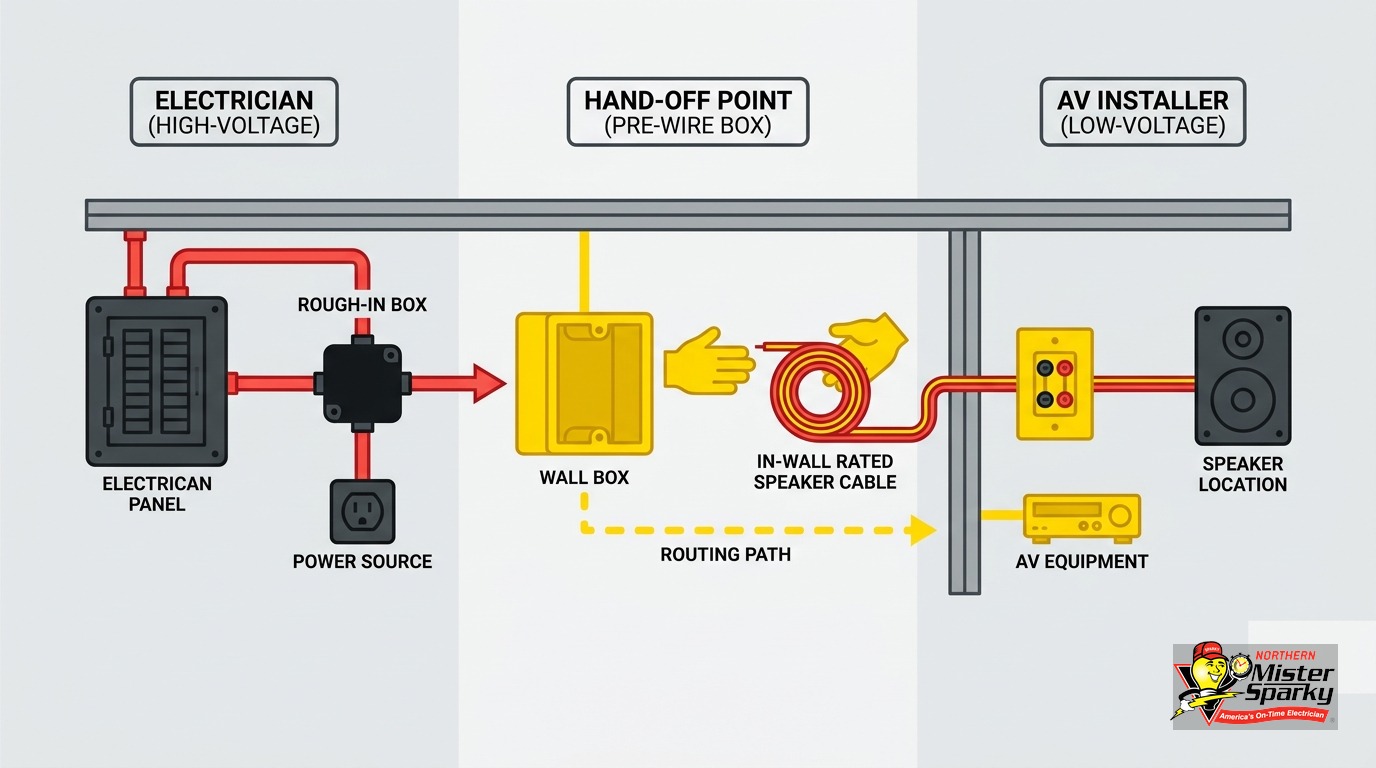
- The electrician owns rough-in infrastructure: conduit paths, power separation, fire-rated penetrations, and permit coordination. The AV installer takes over from there.
- High-powered amplifiers and AV receivers may need a dedicated circuit. That is always electrician work.
- Call 763-200-5956 or book online before your AV installer schedules rough-in. The sequence matters.
What Is In-Wall Speaker Wiring Installation?
In-wall speaker wiring installation is the process of routing rated speaker cable inside finished walls and ceilings to connect a receiver or amplifier to wall- or ceiling-mounted speakers without visible wiring.
It looks clean and protects the cable from foot traffic and furniture damage. It also puts the wire inside a wall cavity, which is why the NEC and Minnesota law treat it differently from a speaker sitting on a shelf with a cord at the baseboard.
The moment wire goes into a wall or ceiling, it crosses into regulated territory. The cable must carry the correct rating for the space it passes through. It must stay separated from power conductors. If it crosses a fire-rated assembly, that opening must be sealed with listed firestop material. And in Minnesota, the person doing the work must be licensed to do it.
This post walks through each of those layers. It starts with the one almost every national guide skips: Minnesota’s licensing requirement.
Why Minnesota Requires a PLT License - Most States Don’t
Minnesota is one of only a few states that requires AV and audio installers to hold a Power Limited Technician (PLT) license from the Minnesota Department of Labor and Industry. Most states treat in-wall low-voltage work as unlicensed territory.
If you hired a handyman or an out-of-state AV company to fish speaker wire through your walls, and they did not carry a PLT license, that work was not code-compliant in Minnesota. It does not matter how clean the installation looks.
The Minnesota DLI publishes the full licensing and inspection chart for electrical work in the state. It covers both the individual PLT license (required for the technician doing the work) and the Technology Systems Contractor (TSC) license (required for the business they work for). Neither is the same as a standard electrician’s license. Both exist because Minnesota decided in-wall low-voltage work carries enough risk to warrant state oversight.
This matters for you as a homeowner for two reasons.
First, unlicensed in-wall work can create problems when you sell the house. An unpermitted installation flagged during a pre-sale inspection gives the buyer a negotiating lever. It can also complicate an insurance claim.
Second, the PLT and TSC system is how Minnesota ensures the person fishing wire through your walls knows the code requirements: separation from power circuits, cable ratings, and firestopping at rated assemblies. Those are not cosmetic rules.
Our role at Northern Mister Sparky is the upstream half of that equation. We are licensed electricians. We handle power infrastructure, conduit routing, fire-rated penetrations, and permit coordination. The AV installer with their PLT takes it from there.
What Does the Electrician Handle?
The electrician’s scope covers everything that touches power or requires permit coordination: conduit paths, power separation, fire-rated penetrations, dedicated amplifier circuits, and low-voltage permit coordination for your municipality.
Here is what that looks like in practice.
Conduit routing. For a larger home theater or multi-room audio build, we may install empty conduit runs in the walls before drywall goes up. The AV installer then pulls speaker wire through the conduit during finish work. This keeps power and low-voltage wire in separate pathways and makes future upgrades far easier than fishing through a finished wall.
Separation from power conductors. NEC Article 725 governs Class 2 and 3 circuits, which include speaker wire. NEC 725.136(A) prohibits Class 2 and 3 conductors from sharing any enclosure, raceway, or cable with power or Class 1 conductors. Where speaker wire runs exposed - not in conduit or NM cable - it must maintain at least 2 inches of physical separation from power wiring per NEC 725.136(I). If either conductor is in conduit or NM cable, the 2-inch gap rule does not apply.
An electrician knows where the power circuits run inside your walls. The AV installer fishing speaker wire does not always know that. That gap in knowledge is a real risk, and it is one reason the two trades need to coordinate before rough-in.
Fire-rated penetrations. When any cable passes through a fire-rated wall, floor, or ceiling assembly, NEC and the International Building Code require the opening to be sealed with an approved firestop system. The cable alone does not maintain the assembly’s rating. We handle those penetrations. A firestop collar or intumescent sealant around the cable bundle is standard practice.
Dedicated circuits for amplifiers. A high-powered AV receiver or amplifier can draw significant current. If your system is large, it may need its own dedicated circuit. That is always licensed electrician work. We size the circuit, pull the permit, and install it before the AV installer arrives.
Permit coordination. In Minnesota, low-voltage permits are required for in-wall audio work. We can clarify what is required in your specific city before work begins. Getting the permit question answered upfront avoids a much harder conversation after the walls are closed.
What Does the AV Installer Take Over?
Once the rough-in infrastructure is in place, the AV installer picks up the rest. Their scope includes fishing cable through walls and conduit, terminating speaker wire at wall plates and binding posts, routing cable to the receiver location, and dressing and labeling all runs. They also calibrate the system after installation.
The AV installer selects the routing path within the wall cavity, working around insulation, blocking, and any conduit the electrician placed. If your home has a finished basement with a suspended ceiling, the cable path matters for the rating too. That is the next topic.
Which Cable Rating Does Your Project Need?
CL2 or CL3 is the standard for in-wall speaker wiring in a residential dwelling. Any run through a plenum space - an air-handling ceiling used as a return-air path - requires CL2P or CL3P. Standard CL2 in a plenum ceiling is a code violation.
The Blue Jeans Cable NEC reference covers the full hierarchy clearly. Here is the short version:
- CL2 and CL3: Permitted for in-wall runs in standard wall cavities and non-plenum ceilings. CL3 can always substitute for CL2. The reverse is not true.
- CL2X and CL3X: A residential-grade, smaller-diameter variant permitted in 1- and 2-family dwellings without a raceway, per NEC 725.61(E)(3).
- CL2P and CL3P: Required for any run through a plenum space. These cables use low-smoke, low-flame materials that meet the air-handling space standard under NEC 725.61(A).
- CMP: The top of the substitution hierarchy. CMP can go anywhere CL3P, CL3R, CL3, or CL3X is permitted.
How do you know if your ceiling is a plenum? The tell is whether the space above the ceiling is used as the return-air path for the HVAC system. A finished drywall ceiling over an attic is not a plenum. A suspended tile ceiling with HVAC return air circulating above the tiles usually is. If you are not sure, ask before anyone buys cable.
One more installation rule: when low-voltage cable must cross a power circuit, run it at a right angle to the power conductor. Crossing at 90 degrees reduces inductive coupling and the noise it can introduce into the audio signal.
How Far Must Low-Voltage Wire Stay from Power Conductors?
At least 2 inches of physical separation is required when speaker wire runs exposed alongside power conductors, per NEC 725.136(I). If either conductor is in a raceway or NM cable, the 2-inch gap rule does not apply.
This is one of the most common violations in DIY in-wall speaker installations. Homeowners fish speaker wire through the same stud bay as a 14/2 power circuit, landing it inches away, without realizing that proximity can introduce hum into the audio signal and put the installation out of code compliance.
The practical fix is usually conduit. Routing speaker wire through a dedicated low-voltage conduit - separate from any power raceway - satisfies NEC 725.136(A) and eliminates the need to measure the 2-inch gap. It also makes future cable pulls far easier.
If you are building a new home or finishing a basement, coordinate with us early. Rough-in conduit is fast and inexpensive to install before drywall. It is expensive and disruptive to add afterward.
For more on conduit choices in residential wiring, see our post on conduit vs. Romex for residential wiring.
What About Firestopping?
When speaker wire or any low-voltage cable passes through a fire-rated wall or floor assembly, the penetration must be sealed with approved firestop material. The cable does not carry the fire rating on its own.
Every DIY guide on in-wall speaker installation skips this step. It matters.
A fire-rated assembly - the wall between an attached garage and living space, or a floor between living levels - carries a defined fire-resistance rating. Drilling through it and running cable creates an opening that removes that rating unless you seal it with a listed firestop product. Approved materials include intumescent caulk, firestop collars, and foam sealants specifically rated for cable penetrations. Standard spray foam is not a firestop material.
Our team handles fire-rated penetrations as part of rough-in. If your AV installer is running cable through a garage-to-house wall or across a floor assembly, that work needs coordination with the electrician before drywall closes. It is not something to patch after the fact.
Do You Need a Permit for In-Wall Speaker Wiring Installation in Minnesota?
Yes. Minnesota requires a low-voltage permit for in-wall audio wiring. This is not common nationally - most states treat it as unlicensed work - but Minnesota law requires it.
Permit requirements vary slightly by municipality. Saint Paul processes low-voltage power circuit permits through its PAULIE permitting platform (updated August 31, 2026). Permits expire if work does not commence within 180 days of issuance.
Minnesota homeowners can also apply for electrical permits directly through the DLI permit portal, though the licensed installer typically coordinates this.
If you are buying a home with in-wall speakers already installed, it is worth asking whether a permit was pulled. Unpermitted work can surface during a pre-sale inspection. Our post on Minnesota electrical permits covers what to expect and how to resolve open permits before a sale.
The 2026 NEC: What Changed?
Minnesota adopted the 2026 NEC effective August 17, 2026. Any permit pulled on or after that date - including low-voltage permits for in-wall speaker wiring - must comply with the 2026 code as published by the MN DLI. Licensing exams transitioned to the 2026 NEC on September 8, 2026.
The cable rating rules under Articles 640 and 725 are not dramatically different in the 2026 cycle, but the adoption is recent enough that some installers and inspectors are still in transition. If someone pulls a permit for your project this fall, that permit is under 2026 NEC. Make sure the installer is current on the new code before work begins.
What to Ask Before You Schedule
Getting the sequence right saves money and avoids reopening finished walls. Settle these questions before anyone shows up with wire.
Is the AV installer PLT-licensed? In Minnesota, they must be. Ask for their license number and verify it through the MN DLI if there is any doubt.
Does the project include an amplifier or receiver that warrants a dedicated circuit? If yes, the electrician needs to be on-site before the AV installer. We install the circuit first; the AV installer connects to it.
Are any cable runs passing through a fire-rated assembly? Garage-to-house walls and inter-floor assemblies are the most common locations. If yes, firestopping is part of scope and must be coordinated with the electrician, not handled after the fact.
Does the home have a plenum ceiling? If the suspended ceiling in your basement or great room is an air-return plenum, every cable segment through that space must be CL2P or CL3P. Standard CL2 is not compliant there.
Has a low-voltage permit been pulled? In Minnesota, it is required. If no one has mentioned a permit, ask directly.
If you are planning a larger home theater build, our post on home theater dedicated circuit planning covers what goes into sizing the electrical side. For homes being set up for multi-room audio or whole-home AV infrastructure before drywall, smart home pre-wiring covers what to plan during rough-in.
Ready to Start? Call Northern Mister Sparky.
In-wall speaker wiring installation in Minnesota is not a single-trade job. The electrician and the AV installer share scope, and the sequence matters. Rough-in infrastructure - conduit paths, power separation, fire-rated penetrations, dedicated amplifier circuits - has to be in place before the AV installer fishes wire.
We are locally owned and operated in the Twin Cities. Our team coordinates permit work, handles the electrical rough-in, and hands off cleanly to your AV installer so the project moves in the right order and no walls need to be reopened.
Call us at 763-200-5956 or book online. We will walk through what your project needs before anyone picks up a drill.
Frequently Asked Questions
Do I need a permit for in-wall speaker wire in Minnesota? +
What cable rating do I need for in-wall speaker wire? +
What does an electrician do before the AV installer arrives? +
Need an electrician now?