
Fish House Electrical Wiring Minnesota: Code and Safety
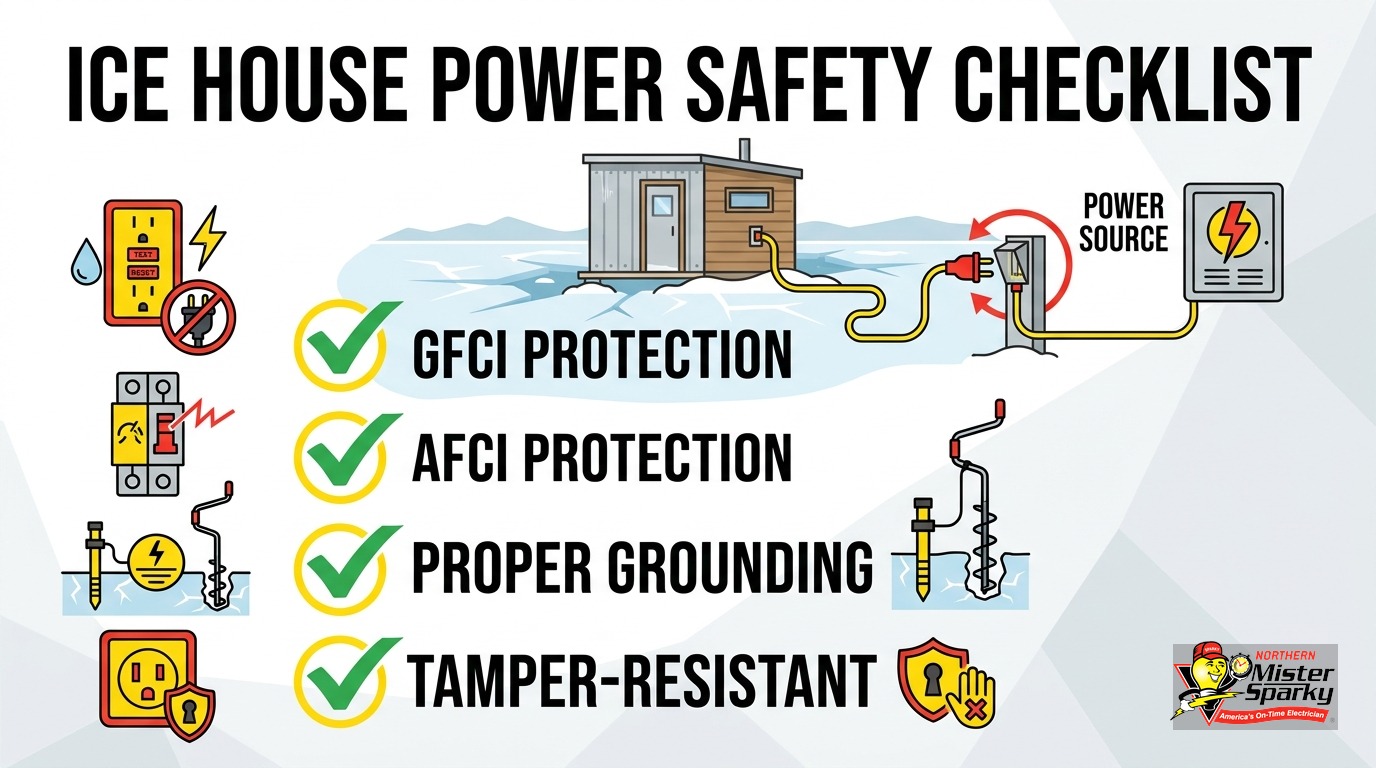
Key Takeaways
- Fish house electrical wiring in Minnesota is governed by the NEC and administered through the Minnesota Department of Labor and Industry (DLI) permit process.
- Every outlet in a fish house requires GFCI protection. The structure qualifies as a wet or damp location under NEC 210.8.
- Minnesota adopted the 2026 NEC, effective August 17, 2026. Any permit filed on or after that date must meet the new code.
- Shore power connections require a DLI electrical permit. Homeowners can pull it online themselves.
- Running a generator inside or adjacent to a sealed fish house is a documented carbon monoxide kill scenario. The generator stays outside, always.
- Electric Shock Drowning is a recognized hazard near any energized structure over water. Proper grounding and GFCI protection are not optional extras.
- Our team handles fish house wiring from permit to inspection. Call 763-200-5956 or book online before ice season starts.
What Does the NEC Require for Fish House Electrical Wiring in Minnesota?
Short answer: NEC 210.8 requires GFCI protection on every 125V and 250V outlet in a wet or damp location. A fish house on ice qualifies. Shore power connections also fall under NEC Article 555, which requires GFCI on all shore-power receptacles and limits feeder ground-fault protection to 100 milliamps. Both apply to your ice house.
The NEC has no chapter labeled “ice house wiring.” It does have clear rules for wet and damp locations, and a fish house qualifies under both.
NEC 210.8 requires GFCI protection for all 125V and 250V receptacles in wet or damp locations. This requirement expanded significantly in the 2020 NEC cycle, and it covers every outlet in your fish house. There is no exception for low-use circuits or shelters you visit only on weekends.
Shore power connections, where a cord or hardwired circuit runs from shore out to the ice house, trigger NEC Article 555. That article governs marinas and boatyards, and its logic applies directly to any structure receiving shore power while positioned near water. The key requirements: GFCI on all receptacles tied to shore power, and a separate ground-fault protection device on the feeder set at no more than 100 milliamps. A standard circuit breaker handles overcurrent. It does not protect against the milliamp-level leakage that causes Electric Shock Drowning.
Minnesota adopted the 2026 NEC, effective August 17, 2026. Any permit pulled on or after that date must comply with the new code. Earlier permits run under the 2023 NEC. If you are planning fish house wiring work this fall before the opener, the 2026 code governs your installation.
Older fish houses wired under an earlier code are not automatically grandfathered when you do new work. Any time a permit is pulled for changes, the new work must meet current code. That is also a good reason to have a licensed electrician walk through the existing wiring and verify it meets the standard under which it was installed.
Do You Need a Permit for Fish House Electrical Wiring in Minnesota?
Short answer: Yes. Any wiring installed in a fish house, including shore power connections and hardwired circuits, requires a Minnesota DLI electrical permit. Homeowners can pull their own permit online for work they do themselves. A licensed electrician pulls it under their contractor license before starting work.
Minnesota electrical permits are not issued by city building departments. They come from the Department of Labor and Industry statewide. The permit requirement applies from Duluth to Worthington.
The permit triggers an inspection. A state electrical inspector reviews the installation and verifies GFCI protection, grounding, and circuit sizing all meet code. The inspector checks these things before you energize the system. That step protects you. An uninspected shore power connection with a ground fault can push current into the water. An uninspected generator inlet can allow carbon monoxide back-feed into the shelter.
Portable setups that bring a generator and plug into a power strip, with no installed wiring in the structure, occupy a gray zone. The moment you install a fuse panel, wire receptacles into the walls, or add any hardwired circuit, a permit is required.
Skipping the permit creates financial risk beyond the safety concern. An unpermitted electrical installation can void a homeowner’s insurance claim if a fire or injury occurs. It can also surface as a problem during a property sale.
For a broader look at how Minnesota’s permit process works, see our guide to electrical permits in Minnesota.
Which Power Setup Is Right for Your Fish House?
Short answer: Portable houses typically use a generator for simplicity. Permanent houses use shore power for convenience. Many permanent houses have both, with a hardwired exterior inlet and an interlock so the two sources cannot be live at the same time. The wiring approach differs for each, and both have code requirements that must be met.
Your power source shapes every other electrical decision. Here is how each option works and what the code requires.
Generator only: The generator lives outside, period. You connect a cord from the exterior generator through a weatherproof power inlet mounted on the outside wall. Inside, the inlet feeds a fuse panel or small breaker box. GFCI outlets protect every receptacle. A CO detector monitors the air inside. The generator never runs through an interior extension cord or a door gap.
Shore power only: A locking, weather-rated power cord or a conduit and wire run connects from a shore pedestal or cabin outlet to the ice house. The inlet on the fish house is rated for the current draw. Inside, every outlet is GFCI-protected. A ground-fault protection device on the feeder handles low-level leakage. The structure is bonded and grounded.
Both sources with an interlock: An interlock prevents the shore power inlet and the generator inlet from being active at the same time. Running two power sources without an interlock can backfeed the generator, damage equipment, and create hazards for anyone working nearby. The interlock is a code requirement and a safety essential.
One additional factor: removal deadlines. Minnesota Statute 97C.355 requires fish houses off the ice by the first Monday in March on southern Minnesota waters and the third Monday in March on northern waters. Border waters have their own dates. A permanent shore power trench or buried ground rod that cannot be easily disconnected for seasonal removal needs to be designed into the plan from the start.
How Many Circuits Does a Fish House Actually Need?
Short answer: Most fish houses run well on one 20-amp circuit for lighting and general receptacles, and a second 20-amp circuit for a small heater or other high-draw appliance. Larger permanent houses with electric heat, a water system, or multiple high-draw loads need a load calculation and may need a small subpanel.
Circuit planning for a fish house follows the same logic as any structure. You calculate the load, apply the 80% rule for continuous loads, and size circuits so they handle demand without tripping or overheating.
A basic setup typically includes:
- One 15- or 20-amp circuit for lighting and general-use GFCI-protected receptacles
- One 20-amp circuit for a small electric heater or battery charger
- A dedicated circuit for a hardwired CO detector if a generator inlet is present
A larger permanent fish house with electric radiant floor heat, a small water heater, a television, and an ice auger charging station adds up quickly. Your electrician performs a load calculation before specifying the panel size or the shore power feeder gauge. This keeps breakers from tripping every time two appliances run at once, and it keeps wiring from overheating under sustained load.
A small breaker box or fuse panel is the correct way to organize these circuits. Daisy-chaining extension cords through a fish house is a fire hazard. Even a four- or six-space panel gives you organized, protected circuits and a clear way to shut everything down.
Does Carbon Monoxide Risk Change How You Wire a Fish House?
Short answer: Yes, directly. The generator must stay outside, connected through a hardwired exterior power inlet. Placing the inlet on the outside wall and installing an interlock keeps carbon monoxide out of the shelter by design. A hardwired CO detector on a dedicated circuit inside rounds out the safety package.
Carbon monoxide has killed ice anglers in Minnesota. A woman died and four others were hospitalized on Lake Wilmert in Martin County after CO built up in their shelter. In a sealed 6-by-8-foot ice house, a generator running inside or directly adjacent to a vent can produce lethal CO concentrations within 45 to 60 minutes.
The electrically correct approach prevents this at the source. The generator stays outside and well away from any vents, doors, or windows. Power enters through a hardwired exterior inlet box rated for the generator output. Inside, the inlet feeds the panel, and the panel distributes to GFCI-protected receptacles and hardwired loads. The cord is connected from outside. CO stays outside.
The interlock matters just as much. If the fish house has both a shore power connection and a generator inlet, the interlock prevents both from being active simultaneously. Without it, connecting shore power while the generator is running creates a dangerous backfeed condition.
A hardwired CO detector on a dedicated circuit is the right permanent installation for any fish house that uses a generator inlet. Battery-powered units work as a stopgap. But batteries fail in cold weather, and a hardwired unit eliminates that vulnerability. Our carbon monoxide detector service covers hardwired installation and proper placement for enclosed structures.
What Is Electric Shock Drowning and Does It Apply to Ice Houses?
Short answer: Electric Shock Drowning (ESD) occurs when a wiring fault pushes stray current into water near an energized structure. Fresh water’s higher resistance concentrates the voltage gradient and makes ESD more dangerous, not less. Any fish house with a shore power connection near open water is a potential ESD source without proper grounding and GFCI protection in place.
ESD has killed swimmers and dogs at lakes and marinas across the country. The NFPA documents it as a recognized hazard. The Minnesota DLI links to the NFPA’s ESD resource directly from its electrical codes page.
Here is why it applies to fish houses specifically. As spring approaches and ice weakens, open water appears near or around ice houses. If the shore power wiring has a ground fault, a small persistent current leak, that current enters the water and creates a voltage gradient around the structure. A swimmer or child entering that water cannot see the gradient or feel it in time to pull back. Their muscles lock and they drown.
The code requirements for shore power connections are precisely what prevents ESD:
- GFCI on every outlet eliminates receptacles as a fault source
- Proper bonding and grounding of the fish house frame and components limits stray current paths
- Ground-fault protection on the feeder, set at no more than 100 milliamps, catches low-level leakage before it reaches the water
Standard 15-amp or 20-amp breakers do not provide this protection. They trip on overcurrent, not on the milliamp-level leakage that causes ESD. A separate GFCI breaker or ground-fault protection device at the supply side handles it.
If your fish house has outlets that were wired without GFCI protection, correct that before the next ice season. Our guide to GFCI outlet requirements explains what is required and how a licensed electrician brings an existing installation up to code.
What Does a Proper Shore Power Connection Require?
Short answer: A proper shore power connection requires a locking, weather-rated inlet on the fish house exterior, a correctly sized cord or conduit run from the supply, GFCI protection on every receptacle inside, a ground-fault protection device (100 milliamp maximum) on the feeder circuit, and bonding and grounding of the structure. A DLI permit and inspection are required before first use.
Most DIY guides stop at “run a heavy extension cord from the cabin to the fish house.” That is not a shore power connection. That is a setup likely to fail, and when it does, the failure mode is a fire, an electrocution, or a stray current problem in the water.
A proper shore power connection has several distinct components, each of which matters.
The inlet: A locking, weatherproof inlet rated for the actual current draw. Common residential ice house options are L5-30 (30-amp, 120V) or L14-30 (30-amp, 240V) depending on the load profile. A standard three-prong extension cord connector is not appropriate for a seasonal shore power hookup.
Correct wire gauge: The wire from shore to the fish house must be sized for the load and the run length. Voltage drop over a long run of undersized wire causes overheating, nuisance trips, and shortened equipment life. A licensed electrician runs the load calculation and specifies the correct wire gauge before ordering materials.
Ground-fault protection on the feeder: This is the step most DIY installs skip. A 30-amp breaker at the cabin protects against overcurrent. It does not trip on the milliamp-level leakage that causes Electric Shock Drowning. A GFCI breaker or a dedicated ground-fault protection device at the supply side, rated to trip at 100 milliamps or less, handles this. It is a code requirement for shore power feeders under NEC Article 555.
Grounding and bonding the structure: The metal frame of the fish house, the panel enclosure, and any metallic components must be bonded together and connected to a proper ground. This limits stray current paths.
For background on how bonding and grounding work together, our post on electrical bonding and grounding explained covers the concepts in plain language.
What Should You Ask Before Hiring a Fish House Electrician?
Short answer: Ask whether they hold a current Minnesota electrical license, whether they will pull the DLI permit before starting work, whether they know NEC 210.8 and Article 555, and whether they can install a hardwired CO detector in the same visit. An electrician who suggests skipping the permit is not the right hire for this job.
Fish house wiring is a specialty. Not every licensed electrician has built a shore power connection or wired a structure designed to move seasonally on and off a frozen lake. A few direct questions tell you quickly whether the contractor has done this before.
Minnesota license: All electrical work in Minnesota requires a licensed electrician or a homeowner pulling a permit for their own residence. Ask for the license number and verify it through the DLI contractor lookup.
Permit first: A licensed electrician pulls the permit before starting work, not after the job is done. If a contractor suggests pulling the permit after the fact or skipping it to save money, move on.
Code fluency: Ask about GFCI requirements for wet locations and the 100 milliamp ground-fault protection limit on shore power feeders. An experienced electrician knows both without looking them up. These are the two code provisions most likely to be missed on a fish house installation.
CO detector installation: If the house uses a generator inlet, a hardwired CO detector should be part of the same job. Ask whether they install it in the same visit, so you are not scheduling a second trip.
Seasonal design awareness: The removal deadlines under Minnesota Statute 97C.355 shape the wiring design for permanent houses. An electrician who knows the rules thinks about seasonal teardown and reassembly when they design the system.
Northern Mister Sparky is locally owned and operated in the Twin Cities. Our licensed team handles fish house electrical wiring in Minnesota from permit application to final inspection. We know the DLI process, the 2026 NEC requirements, and the practical realities of building an electrical system around a Minnesota ice season. No malarky.
Call 763-200-5956 or book online to get on the schedule before the lakes freeze.
Frequently Asked Questions
Do I need a permit for fish house electrical wiring in Minnesota? +
Is GFCI protection required in a fish house? +
Can I run a generator inside my ice house? +
What is Electric Shock Drowning and does it apply to ice houses? +
Need an electrician now?