
Outdoor Outlet Installation Cost: Twin Cities 2026 Guide
Key Takeaways
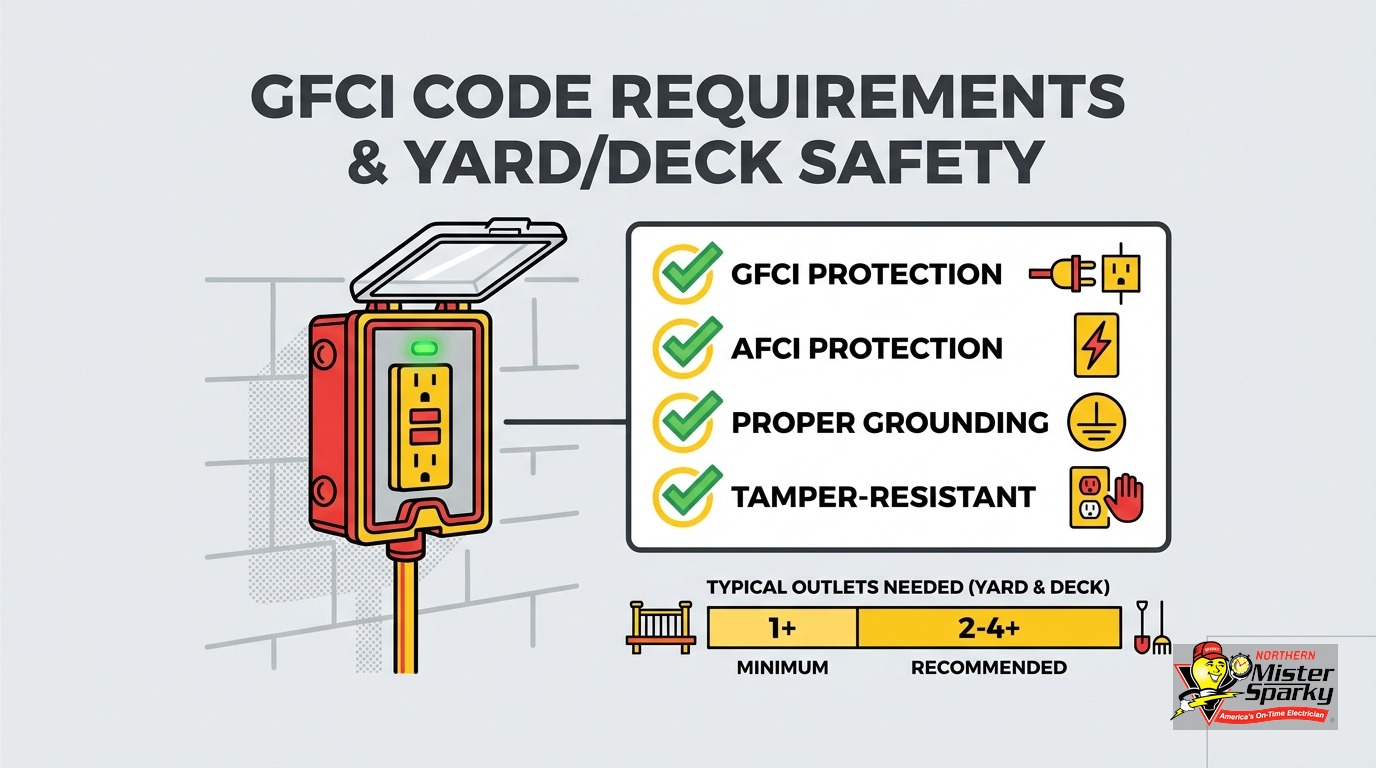
- The NEC minimum is one outlet at the front and one at the rear of your home, plus one on any deck or porch with 20 or more square feet of usable area.
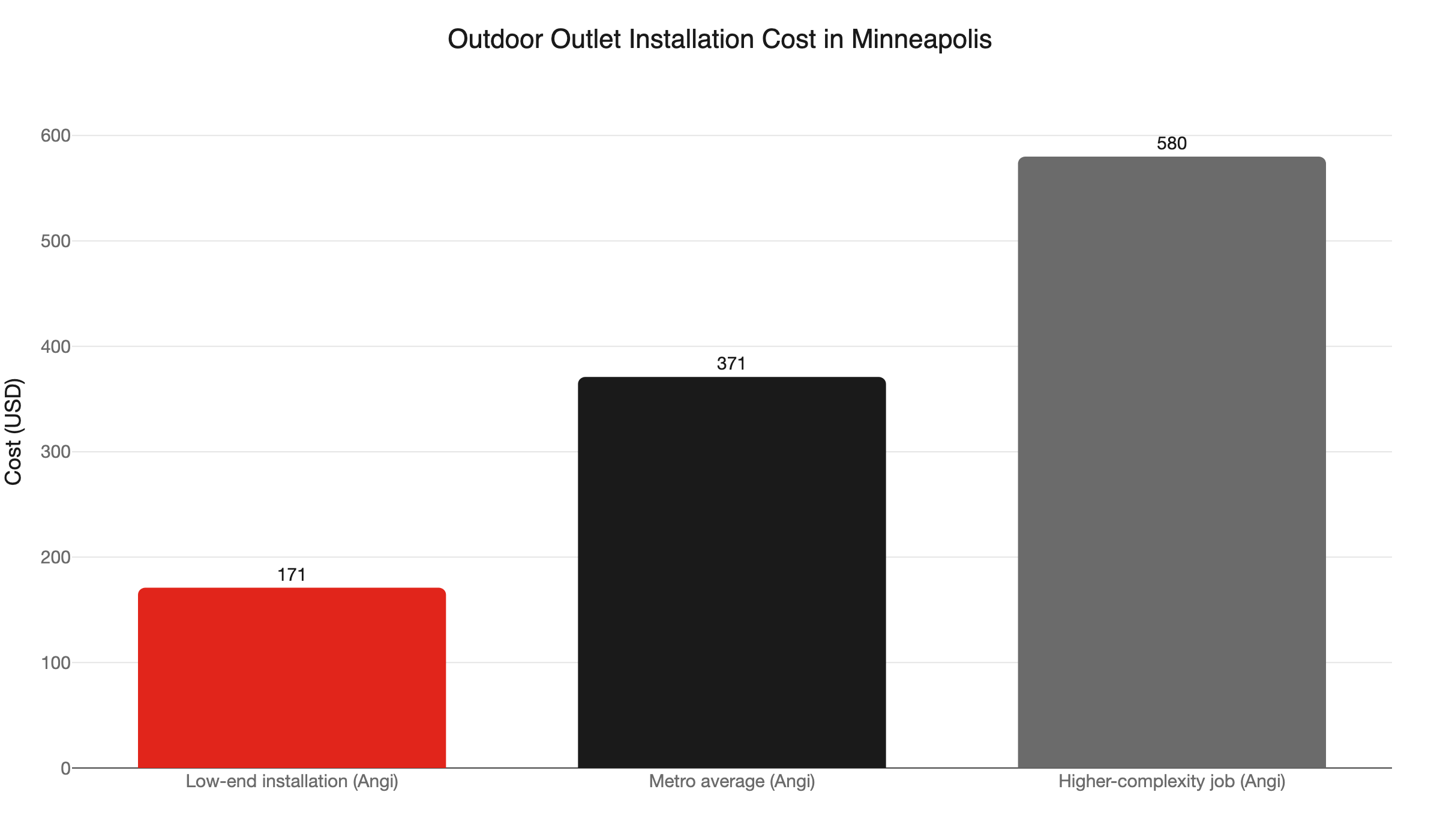
- In Minneapolis, outdoor outlet installation averages $371 per outlet, with a typical range of $171-$580.
- A new dedicated outdoor circuit adds $250-$900 to the project, depending on panel distance and complexity.
- Minnesota adopted the 2023 NEC effective February 10, 2026. All new outdoor outlet work must meet the updated standards.
- Every outdoor outlet requires GFCI protection and a weather-resistant (WR) receptacle.
- Wet locations, such as an open yard or exposed deck face, need a while-in-use bubble cover. Covered porches only need a standard weatherproof cover when the outlet is not in use.
- Minnesota state permit fees start at $81 minimum for a simple outdoor outlet job.
- Most Twin Cities decks genuinely need 3-4 outlets for comfortable outdoor living, not just the code minimum.
Your backyard string lights run off one extension cord. The outdoor speaker is on another. The holiday eave lights need a third. Most Twin Cities homes were wired when “outdoor outlet” meant a single socket by the back door. That was fine in 1985.
Today’s outdoor living demands more power in more places. Outdoor outlet installation is one of the more affordable electrical upgrades a homeowner can make. The tricky part is knowing how many outlets you actually need, what Minnesota code requires as of 2026, and what honest outdoor outlet installation cost looks like here in the metro.
We will break all of it down.
How Many Outdoor Outlets Does Your Home Actually Need?
NEC 210.52(E)(1) sets the floor: one outlet at the front of your home and one at the rear, each no higher than 6.5 feet above grade. Any deck or porch with 20 or more square feet of usable area also requires at least one outlet. That is the code minimum, not a practical target.
Most homes in the Twin Cities have exactly those two code-minimum outlets. That was adequate in 1985. It is rarely adequate now.
A typical 20x16-foot deck powers string lights over a pergola, a beverage cooler, a Bluetooth speaker, a phone charger, and an outdoor ceiling fan. Running all of that from one rear-wall socket means long extension cords, daisy-chained power strips, and a serious fire hazard. The U.S. Consumer Product Safety Commission estimates extension cords cause roughly 3,300 residential fires per year in the U.S.
A practical outlet layout for a typical Twin Cities deck looks like this:
- One outlet per entertainment zone. Dining area, lounge area, and grill station each get their own socket.
- One outlet for overhead string lights. Keeps that circuit off the same socket as high-draw appliances.
- One weather-facing outlet on the exterior wall for holiday eave lights or seasonal power tools.
- One outlet near any future outdoor kitchen or hot tub pad, even if those are years away. Rough it in now while the wall is accessible.
NEC 210.52(E)(3) was updated in the 2020 code cycle. It now requires at least one outlet on any deck with 20 or more square feet of usable area attached within 4 inches of the dwelling. The 2020 cycle removed the old requirement that the outlet be accessible from inside the home. More decks now trigger this rule than did a decade ago.
For most customers adding outlets to a standard Twin Cities deck, the practical answer is 3-4 outlets. Installing all of them in one visit saves significantly over scheduling separate service calls.
What Does Outdoor Outlet Installation Cost in the Twin Cities?
Minneapolis homeowners typically pay $171-$580 per outdoor outlet. The local average is $371, based on Angi metro data. A new dedicated circuit from your electrical panel adds $250-$900 to the project total. The range is wide. Wiring distance, panel capacity, wall material, and the number of outlets being added all shape the labor picture.
Here is how the numbers break down by scenario:
Tapping an existing interior circuit Tapping a nearby interior circuit is the most affordable path. Homewyse estimates $271-$404 per outdoor receptacle for a standard job as of May 2026, with simple circuit taps landing toward the lower end of that range.
Standard outdoor outlet, average job For a single outlet with moderate wire routing, the Minneapolis average is $371. Licensed electricians in the metro charge $50-$150 per hour, with a minimum service call of $100-$200. That minimum call fee is exactly why adding two or three outlets in one visit is far more cost-efficient than scheduling separate trips.
New dedicated circuit Outdoor kitchens, a full deck retrofit, or any substantial new load often means running a new circuit from the panel. A new dedicated outdoor circuit runs $250-$900 depending on distance and complexity. Wire costs $7-$10 per linear foot, and the footage adds up quickly across a large yard or detached space.
What is not in these numbers Minnesota permit fees are a separate line item, covered below. And if your panel is near capacity, a panel upgrade conversation is worth having before adding new outdoor circuits. Our guide on signs you need an electrical panel upgrade covers the warning signs.
What Goes Into Every Outdoor Outlet Installation?
Understanding what your electrician installs, and why, helps you ask better questions and spot corners being cut.
Weather-resistant (WR) receptacles Every 15A and 20A nonlocking outdoor outlet installed under the current NEC must be a weather-resistant (WR) type. These receptacles use moisture-resistant materials and internal mechanisms that resist intrusion even when no cover is installed. The WR marking is required by code regardless of what cover goes over the outlet. A standard indoor receptacle in an outdoor box is a code violation and a moisture problem waiting to happen.
GFCI protection Under NEC 210.8(F), all outdoor receptacles on dwelling units served by single-phase branch circuits at 150 volts-to-ground or less and 50 amps or less must have GFCI protection. The 2023 NEC expanded this rule to cover 125V-250V range outlets, not just the standard 125V receptacles the older rule targeted.
GFCI protection can come from a breaker in the panel, a GFCI device at the first outlet in the run, or another listed method. The test and reset buttons must be readily accessible. We walk every homeowner through the reset location after every job. For a deeper look at how GFCI protection works, see our post on GFCI outlet requirements explained.
Weatherproof outlet boxes The outlet itself sits in a listed weatherproof box mounted to the exterior wall or structure. The box must be sealed at all penetrations to prevent moisture from wicking back into the wall cavity. This detail gets skipped on rushed jobs and causes rot and corrosion over time.
The installation Your electrician identifies the best circuit to tap or plans the new circuit run. They locate the entry point, install the weatherproof box, fish or run wire, make the connections, and install the WR GFCI outlet and cover. A simple add-on to an existing circuit typically takes one to two hours. A new circuit run from the panel takes longer, depending on distance and obstacles.
Does Your Outdoor Outlet Need a Weatherproof Cover?
Yes. All outdoor outlets need some form of weatherproof cover. The type depends on whether the location is classified as damp or wet. Wet locations, like an open yard or exposed deck face, require a while-in-use (bubble) cover that seals the opening whether or not a cord is plugged in. Damp locations, like a covered porch, need a standard weatherproof cover when the outlet is not in use.
Wet vs. damp: the code line
A damp location is a partially protected space: a covered porch, an eave soffit, a carport ceiling. These require a weatherproof cover when the outlet is not in use. A standard flip-cover plate meets this requirement.
A wet location is open and exposed: an open yard, an uncovered deck face, a foundation outlet exposed to rain and snow. These require a while-in-use cover. The bubble-style housing seals around the cord and stays weathertight even with a plug inserted.
Under NEC 406.9(B)(1), 15A and 20A receptacles in wet locations require a listed enclosure that is weatherproof whether or not a plug is inserted. Any outlet box hood used must be listed and marked “extra-duty” per ANSI/UL 514D. A 2023 NEC clarification also added that hinged covers must be able to open at least 90 degrees after installation.
Minnesota winters stress covers harder than most states
Freeze-thaw cycles crack plastic housings that hold up fine in milder climates. Gaskets harden and lose their seal over time. If your outdoor outlet has an older cover and you live in Maple Grove, Blaine, or Woodbury, where temperatures routinely drop to -20F, ask us to inspect the gasket and housing condition during any outdoor service visit. A degraded cover turns a code-compliant outlet into a moisture and corrosion problem.
An outlet at the front of your house that is exposed to wind-driven sleet off the street is a wet location. A socket tucked under a deep soffit on a covered back porch is a damp location. If you are unsure which applies to your situation, ask your electrician before they spec the cover. The wrong cover is a code violation on inspection.
Do You Need a Permit to Install an Outdoor Outlet in Minnesota?
Yes. Minnesota homeowner permit fees start at $25 for the permit itself, plus a $55 minimum inspection fee and a $1 surcharge. That is an $81 minimum out-of-pocket cost for a simple outdoor outlet job. If you hire a licensed electrician, they pull the permit on your behalf. If you live in Minneapolis or St. Paul, check with your city before filing anything with the state.
The 2023 NEC is now in effect in Minnesota
Minnesota adopted the 2023 NEC without amendments, effective February 10, 2026. Any permit filed on or after that date must comply with the 2023 NEC. That includes the expanded GFCI requirements and the while-in-use cover standards described above. Work permitted before February 10 fell under the 2020 NEC and is not grandfathered for future additions on the same circuit.
Minnesota homeowners may pull their own permit and perform their own electrical work on property they own and occupy, provided they personally do all of the work. The inspection still happens either way. If the work fails inspection, corrections typically cost more than the labor you saved.
Minneapolis and St. Paul: check with your city first
Approximately 66 Minnesota cities have adopted local electrical inspection authority with their own permit forms and fee schedules. Minneapolis and St. Paul are likely among them. If your city runs its own program, you file with the city, not with the Minnesota Department of Labor and Industry. Confirm before filing. For a full walkthrough of the state and local permit process, see our guide on pulling an electrical permit in Minnesota.
Minnesota is already reviewing the 2026 NEC for future adoption. The Board of Electricity voted unanimously to proceed. Work you permit today under the 2023 NEC will not need to be redone when the 2026 cycle arrives, but any additions or modifications after adoption will need to meet the newer standard.
What Drives Outdoor Outlet Installation Cost Up or Down?
The biggest cost drivers are wiring distance from the panel, wall material, conduit requirements for exposed or below-grade runs, and whether your panel has room for a new circuit. Adding all your outlets in one visit is almost always more cost-efficient than scheduling separate service calls. Plan locations before the electrician arrives, not after.
Panel capacity
If your panel is full or near capacity, adding outdoor circuits may require a breaker replacement or panel upgrade first. This is the scenario that pushes a job from the $300 range into the $700-$900+ range. An electrician will evaluate available breaker slots during the assessment. If you have been noticing signs you need an electrical panel upgrade, do that conversation before booking outdoor outlet work.
Wall material and routing
Wood-frame walls are easiest to fish wire through. Brick veneer, stone, and stucco all require different penetration techniques and add labor time. This comes up frequently in older Minneapolis and St. Paul neighborhoods built with brick exterior construction.
Conduit for exposed or below-grade runs
Below-grade wire runs, like an outdoor circuit crossing a yard to reach a garden shed or a landscape feature, require conduit and often a trench. Wire costs $7-$10 per linear foot, and longer runs add up quickly. If you are considering a detached structure on your property, ask about a subpanel quote rather than treating it as a simple outdoor outlet add-on.
Bundling jobs saves real money
If we are already at your home for another electrical job, adding outdoor outlets in the same visit is significantly cheaper than a separate service call. This applies whether you are having panel work done, adding an EV charging circuit, or opening any other job where the electrician is on-site and the panel is already evaluated. Plan all locations at the start of the project conversation, not after the estimate is written.
When Does an Outdoor Outlet Need Its Own Dedicated Circuit?
A dedicated circuit is required any time a device specifies one: hot tubs, outdoor kitchens with a refrigerator or microwave, EV chargers, and most large landscape lighting systems all qualify. It is also the right call when existing outdoor circuits trip frequently. Frequent breaker trips mean the circuit is already overloaded, and adding more load makes the situation worse, not better.
A standard 20A outdoor circuit handles most deck and patio loads without issue: string lights, speakers, phone chargers, a portable fan. The math changes when high-draw appliances enter the picture.
An outdoor refrigerator or freezer draws 1-2 amps at steady state but surges on compressor start. A countertop microwave pulls 7-10 amps at full power. Add both to a circuit already running overhead lights and a speaker. You are near the 20A limit before anything unusual happens. A single heavy cook session trips the breaker and sends your guests inside.
A hot tub is in a separate category: typically a 240V, 50A or 60A dedicated circuit with its own outdoor disconnect. That is a different project with a different quote from a standard deck outlet addition.
For most Twin Cities homeowners outfitting an existing deck, one new 20A circuit is enough to feed 3-4 general-purpose outlets comfortably. If your plans include any large appliance now or in the next few years, mention it at the start of the conversation. Running both circuits in one visit costs far less than a second service call later.
Ready to Add Outdoor Outlets to Your Twin Cities Home?
Outdoor outlet installation done right means correct covers, proper GFCI protection, a weather-resistant receptacle, and a licensed Minnesota inspection. It means your outlets handle our winters without corrosion and do not trip breakers on the Fourth of July.
We are locally owned and operated in the Twin Cities and your America’s On-Time Electrician(R). Every job is backed by the UWIN(R) 100% satisfaction guarantee. We pull the permit, do the work, and pass the inspection. No malarky.
Call us at 763-200-5956 or book your appointment online. We serve Minneapolis, St. Paul, Bloomington, Brooklyn Park, Woodbury, Blaine, Maple Grove, Plymouth, and the broader Twin Cities metro.
Frequently Asked Questions
How much does outdoor outlet installation cost in Minneapolis? +
How many outdoor outlets does my home actually need? +
Do outdoor outlets in Minnesota need GFCI protection? +
Need an electrician now?