Pellet Stove Electrical Requirements: A Twin Cities Guide
Key Takeaways
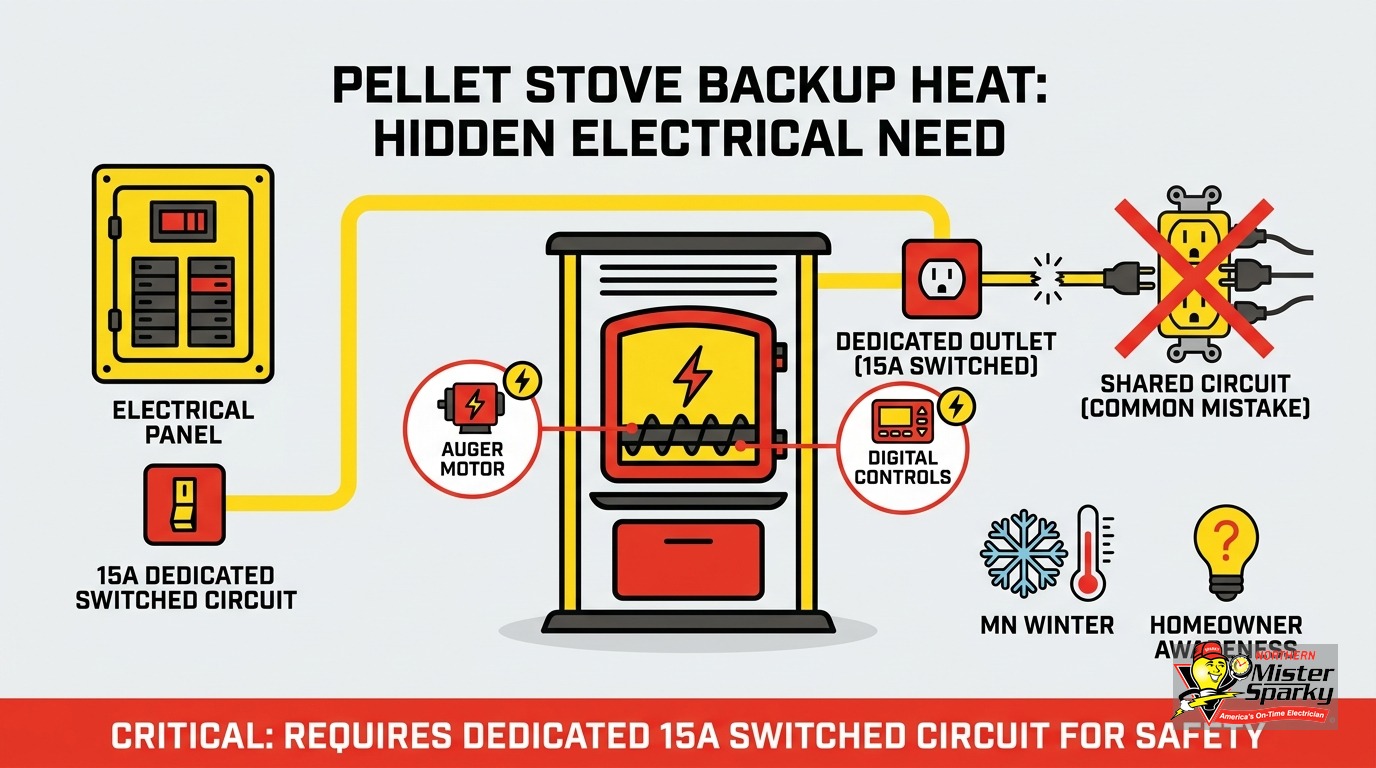
- Pellet stoves need a dedicated 15A, 120V circuit on its own breaker - not a shared outlet.
- Any new circuit in Minnesota requires an electrical permit filed before work begins.
- Circuits in living rooms, family rooms, dens, and finished basements must include a combination-type AFCI breaker.
- A switched outlet gives you a safe, accessible disconnect without moving the stove.
- Control board damage from voltage surges is a documented, costly failure mode. Surge protection is not optional.
- A pellet stove shuts down completely during a power outage. Pure-sine-wave backup power is the only safe solution.
- Minnesota adopted the 2026 NEC on August 17, 2026. Permits filed today are under the new rules.
What Are the Electrical Requirements for a Pellet Stove?
A pellet stove needs a dedicated 15A, 120V circuit on its own breaker. It also needs a properly grounded outlet and AFCI protection if installed in a living area. Most manufacturers specify a switched outlet as well.
Most homeowners picture a pellet stove as something close to a wood stove: heavy, mechanical, and barely electrical. That picture is wrong. A pellet stove is a continuous-load appliance. It draws power from startup to shutdown without interruption.
Five components draw power at any given moment:
- The control panel, which runs the operating logic
- The auger motor, which moves pellets from the hopper into the burn pot
- The air intake fan, which feeds combustion air
- The exhaust fan, which vents combustion gases outside
- The room blower, which circulates warm air into your living space
Cut power to any of these mid-cycle and the stove faults. Pellets can back up in the auger tube. Combustion gases may not vent properly. The stove is designed to run on clean, stable, dedicated power.
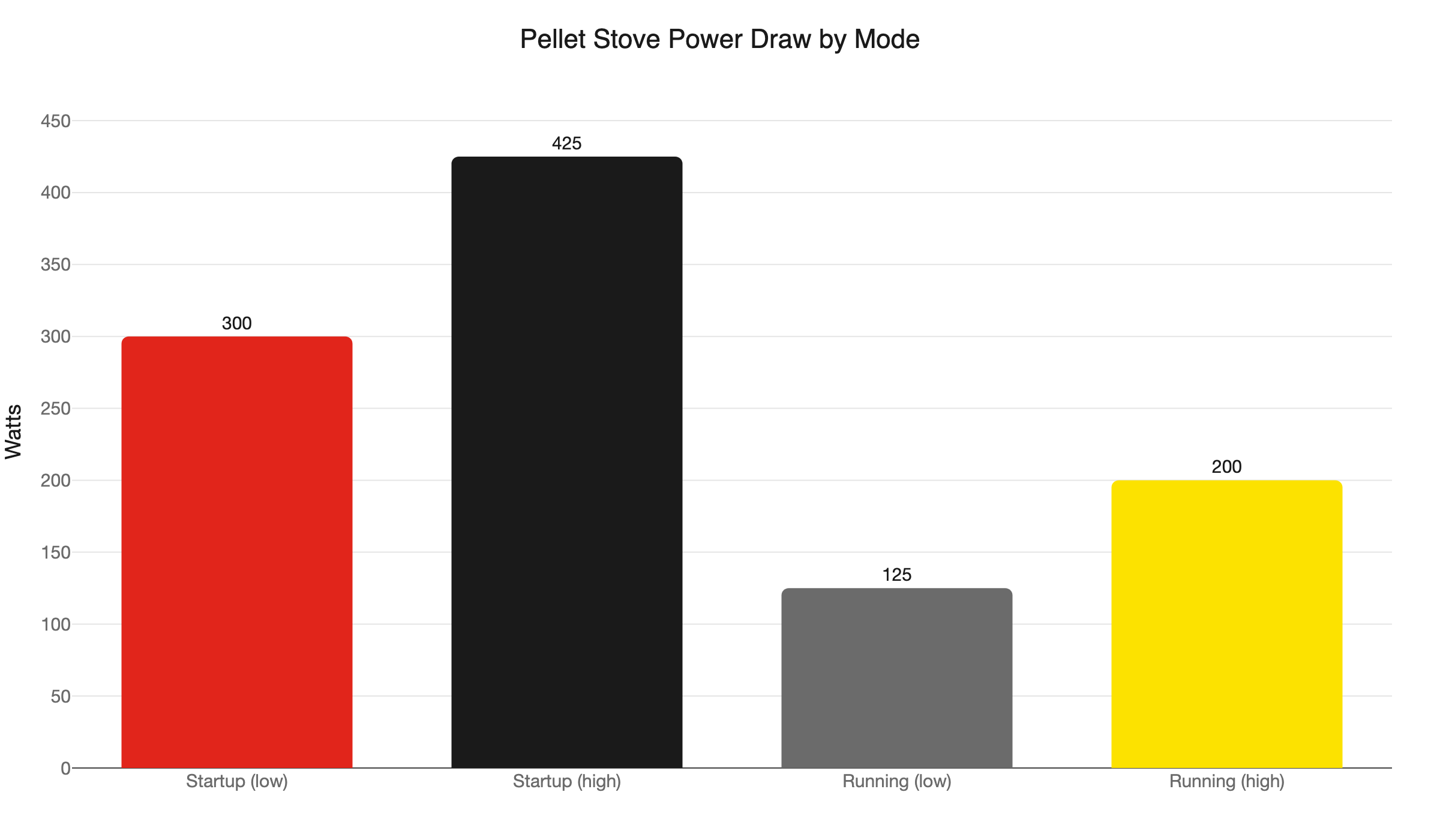
PICKHVAC reports that a pellet stove draws 300 to 425 watts at startup and 125 to 200 watts in steady operation. The listed maximum draw is 2.5 to 3.0 amps. On a 15A circuit, that headroom looks generous. The problem is not the steady-state draw. It is startup surge and what happens when the circuit is shared with other loads.
Why Your Pellet Stove Needs a Dedicated Circuit
A 15A breaker can technically handle far more than a 3A pellet stove. So why does a shared circuit create problems? Three reasons.
Startup surge and nuisance tripping. Motor loads pull more current at startup than during steady operation. A pellet stove’s fans and auger motor spike on ignition. If the circuit also serves a space heater, a microwave, or a hair dryer, a combined load at the wrong moment trips the breaker mid-burn.
Voltage sag. Large motors starting on a shared circuit pull voltage down briefly. For most devices, that blip does nothing. For a pellet stove’s control board, repeated voltage sags accelerate component wear over time.
Fault isolation. If another device on the circuit faults, the stove loses power without warning. A dedicated circuit keeps the stove electrically independent from everything else in the room.
Many pellet stove manufacturers write a dedicated circuit requirement directly into the installation manual. If yours does, that language is binding. Running the stove on a shared circuit voids the warranty regardless of what the code says. Check your manual before the installation conversation, and ask the dealer to confirm the requirement in writing if it is not explicit.
Our post on dedicated circuits for household appliances walks through which appliances code mandates on their own circuit and which ones benefit from one even without a hard code requirement. Pellet stoves fall in the second category by strict code language. Manufacturer requirements often make it binding anyway.
Does Installing a Pellet Stove Circuit Require a Permit in Minnesota?
Yes. Adding any new circuit to a residential electrical system requires an electrical permit filed before work begins. The minimum inspection fee in Minnesota is $55. There are no exceptions for small or simple circuits.
Working without a permit creates three problems. First, the work is unverified. No licensed inspector confirms it meets code. Second, an unpermitted circuit can void your homeowner’s insurance if it contributes to a fire or equipment failure. Third, unpermitted electrical work is a required disclosure item when you sell the house. It follows the property.
Minnesota DLI’s homeowner permit guidance is clear: the permit must be filed and approved before work starts. Not during. Not after the fact.
Here is the jurisdictional detail that catches Twin Cities homeowners off guard. Roughly 66 Minnesota cities have local authority having jurisdiction (AHJ) status. These cities issue their own permits rather than deferring to the state DLI. Minneapolis and St. Paul are both local AHJs. If you live in either city, you file with the city inspections department, not the state.
Bloomington, Brooklyn Park, Woodbury, Blaine, Maple Grove, and Plymouth each have their own process as well. A qualified electrician will know which office to file with. If your contractor is vague about which jurisdiction covers your address, ask directly before signing anything.
Our post on electrical permits in Minnesota covers the full process, including what to expect at the inspection.
Can a Minnesota Homeowner Pull Their Own Electrical Permit?
Yes, under specific conditions. A homeowner can pull their own permit on a single-family home they own and occupy. They must do the work themselves. The permit does not authorize an unlicensed helper, friend, or relative to do the work.
This matters for pellet stove circuits because the work typically involves running a new home run from the main panel. That means installing a new breaker in a live panel and landing wires on breaker terminals. Panel work is where mistakes carry the highest consequences. A loose terminal connection is a fire risk.
The homeowner permit exception also does not apply to rental properties. If you own the home but do not live there, you must hire a licensed electrical contractor regardless of the job scope.
For most homeowners, the math is straightforward. A licensed electrician manages the permit, the installation, and the inspection scheduling. The cost is predictable. The liability stays with the contractor rather than with you.
Does a Pellet Stove Circuit Need AFCI Protection?
Yes, if the stove is in a living room, family room, den, or finished basement. Minnesota’s electrical code requires a combination-type AFCI breaker on all 120V, 15A and 20A circuits serving those spaces.
Minnesota’s code is governed by Chapter 1315 of the State Building Code, which adopts the National Electrical Code directly. The NEC requires AFCI protection on circuits serving living rooms, family rooms, dens, bedrooms, dining rooms, and similar areas. A pellet stove almost always installs in one of those locations. That means the breaker feeding the stove must be a combination-type AFCI breaker, not a standard breaker. An inspector will red-tag a new pellet stove circuit without one.
AFCI breakers detect arc signatures: the electrical patterns that precede a fire. A damaged cord, a loose outlet connection, or a failing motor lead all produce these patterns. A pellet stove running in a living room with a frayed power cord is exactly the scenario AFCI protection is designed to catch before it becomes a fire.
For a complete breakdown of where AFCI protection is required and how to choose the right breaker type, see our post on AFCI breaker requirements.
One practical note: AFCI breakers sometimes trip on pellet stove startup due to motor noise on the line. That is a nuisance trip issue, not a code violation. Our post on AFCI breaker nuisance tripping covers how to diagnose and fix this without removing the protection the code requires.
What Is a Switched Outlet and Why Does It Matter?
A switched outlet is a standard 15A receptacle controlled by a wall switch. It lets you cut power to the pellet stove from across the room without reaching behind the unit or unplugging it.
Under NEC 422.33, a cord-and-plug-connected appliance can use its plug as the disconnecting means, as long as the outlet is accessible and within sight of the appliance. Most pellet stoves install snug against a wall. The outlet behind the unit is technically accessible, but reaching it means moving 200-plus pounds of cast iron.
A switched outlet solves this cleanly. The wall switch is the disconnect. You flip it before servicing the stove, cleaning the burn pot, or leaving the home for a week. Many manufacturers specify a switched outlet in the installation manual. If yours does, that is a code-binding requirement, not a preference.
The wiring is straightforward: a single-pole switch controlling the hot leg of the receptacle, located where it is visible from the stove and clearly labeled. This is typically included as part of the circuit installation and adds minimal cost to the overall job.
Protecting the Control Board: Why Surge Protection Matters
This is the pellet stove electrical detail that most articles skip entirely. It is also the one that generates the most expensive repair calls.
Pellet stove control boards manage auger timing, fan speeds, the combustion cycle, and safety shutoffs. They are built for normal utility power. Voltage spikes from grid fluctuations, lightning events, or generator noise can damage them.
East Coast Hearth documents the failure mode in detail: blown capacitors, fried chips, and failed auger motor circuits. The damage often accumulates over one to three years before the board fails completely. Replacement boards typically cost $200 to $500 or more, plus labor.
The fix is a properly rated surge protector on the outlet. There is one non-negotiable condition: the outlet must be properly grounded. A floating ground or bootleg ground renders the surge protector useless. Without a valid ground reference, it has no path to divert excess voltage.
Before plugging a pellet stove into any outlet, verify the ground is correct. If your home has ungrounded outlets, two-prong receptacles, or aluminum branch wiring, address those issues before the stove goes in.
For homes with multiple sensitive electronics - a pellet stove, home theater equipment, computers - a panel-mounted whole-home surge suppressor is the most comprehensive protection. Our whole-home surge protection guide covers the difference between point-of-use suppressors and panel-mounted whole-home units, and which approach makes more sense depending on your situation.
What Happens to Your Pellet Stove During a Power Outage?
It shuts down completely. Every function of a pellet stove - auger, fans, control board - requires utility power. There is no built-in battery backup, no thermal flywheel. When the grid drops, the stove stops.
This is the central irony of pellet stoves as backup heat in Minnesota. Minneapolis averages 13 nights per year below zero. Winter storms are exactly when backup heat matters most. A pellet stove that cannot run during a grid outage is supplemental heat in normal conditions. It is not backup heat when it actually counts.
ComfortBilt notes that only a pure-sine-wave inverter or pure-sine-wave portable power station can safely run a pellet stove during an outage. A modified-sine-wave generator or inverter - the cheaper and more common type at hardware stores - produces a choppy power wave that damages the stove’s electronics. The money saved on the cheaper generator comes back as a control board replacement.
If you want the pellet stove to work when the grid goes down, plan for backup power during the installation phase. Options include:
- A battery-backed pure-sine-wave power station sized to run the stove for six to eight hours
- A portable inverter generator with pure-sine-wave output, paired with a manual transfer switch
Our posts on portable generator transfer switch installation and whole-house generator installation walk through the options before you call for a quote.
What Changed with Minnesota’s 2026 NEC Adoption?
The 2026 National Electrical Code took effect in Minnesota on August 17, 2026. Permits filed before that date are under the 2023 NEC. Permits filed on or after that date are under the 2026 NEC.
Minnesota DLI maintains the current adoption schedule. The 2026 NEC expands AFCI requirements and closes several gaps in arc-fault coverage that existed under the 2023 code. If someone told you last year that your planned pellet stove circuit would not need an AFCI breaker, verify that against current code before any permit is filed.
This is most relevant for two groups. First, homeowners planning a pellet stove circuit this fall: the permit you pull today is under the 2026 rules. Second, anyone whose earlier estimate was based on 2023 NEC requirements: ask your electrician to confirm compliance under the current code before the work begins.
The circuit specifications themselves do not change. A 15A, 120V dedicated circuit is still correct. What may change is the breaker requirement and which spaces fall under expanded AFCI coverage zones. Your electrician should be current on the 2026 adoption. If they are not, that is a useful question to ask before hiring.
Schedule Your Pellet Stove Circuit Today
Pellet stove electrical requirements are specific. A dedicated circuit, the right breaker type, a proper ground, a switched outlet, and a permit filed before any work starts. Get any one of those wrong and the installation fails inspection, voids the warranty, or creates a long-term safety risk.
We are locally owned and operated in the Twin Cities. Northern Mister Sparky handles pellet stove circuits from permit filing through final inspection. Our team knows which permit office covers your municipality, whether your panel has room for a new breaker, and how to wire the switched outlet and AFCI breaker correctly the first time.
As America’s On-Time Electrician(R), we show up when we say we will. Our UWIN(R) 100% satisfaction guarantee means no malarky: if something is not right, we make it right.
For larger jobs - panel upgrades, generator hookups, or whole-home surge protection - ask about financing options when you call.
Call 763-200-5956 or book online to schedule your pellet stove circuit installation.
Frequently Asked Questions
Do pellet stoves need a dedicated circuit? +
Do I need an electrical permit to install a pellet stove circuit in Minnesota? +
Does a pellet stove circuit need AFCI protection? +
Can a pellet stove run during a power outage? +
Need an electrician now?