
Permanent Outdoor Holiday Lighting Wiring: Minnesota Code
Key Takeaways
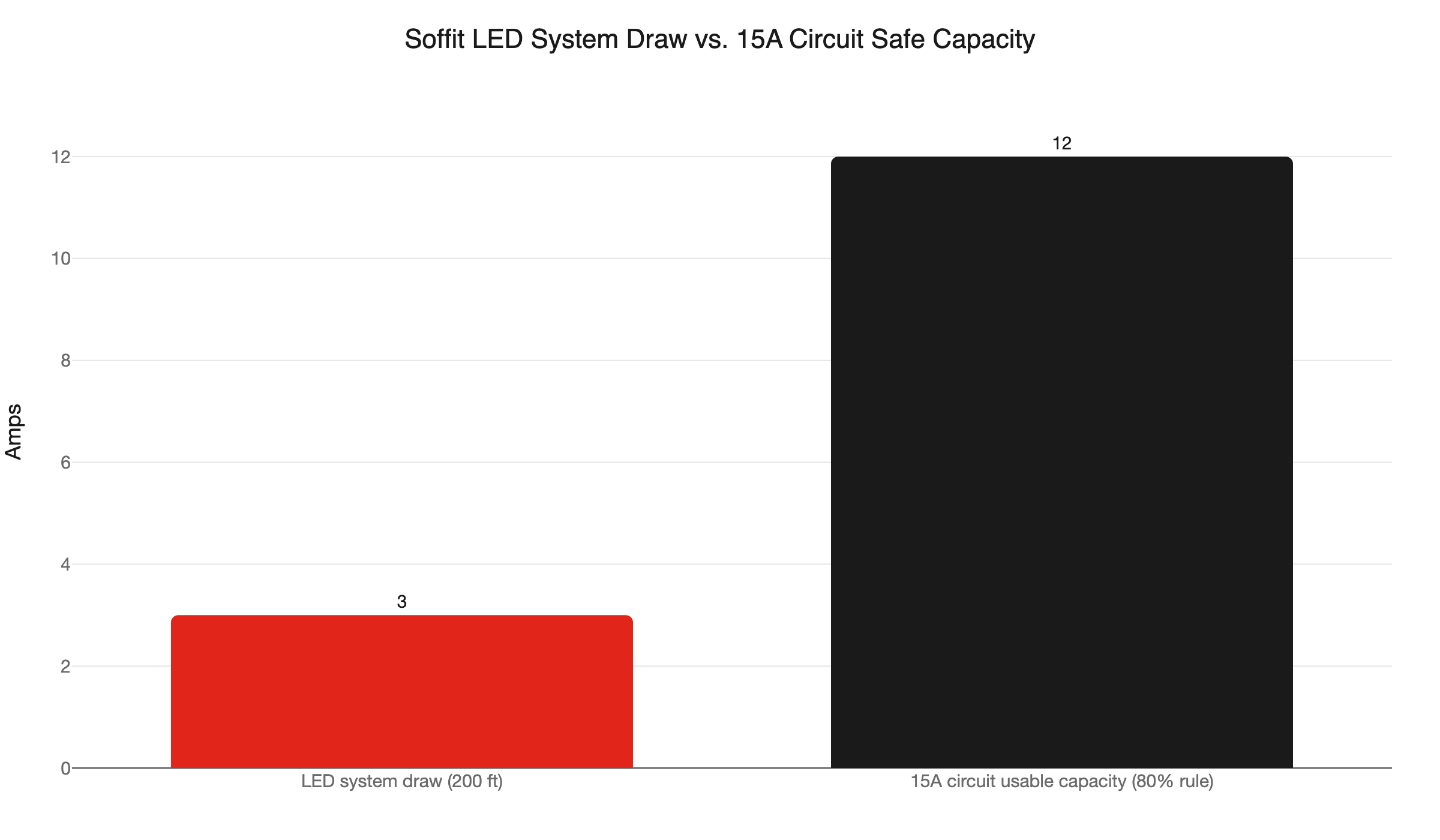
- Permanent soffit LED systems draw fewer than 3 amps on average. One 15-amp circuit handles a full residential installation with headroom to spare.
- Minnesota adopted the 2023 NEC on July 1, 2023. Any new or replaced outdoor outlet now requires a GFCI-protected, weather-resistant (WR) rated receptacle inside an in-use weatherproof cover.
- Adding a new outdoor outlet or circuit requires a permit and a state electrical inspection in Minnesota, even when the homeowner does the work on their own home.
- Most consumer power supplies are rated to 32 degrees F, not -25 degrees F. Mounting location is a real factor in a Minnesota winter.
- Control options beyond the app include smart plugs, hardwired smart switches, and panel-level timers. One option leaves no cord visible outside.
- Skipping a permit on a new outdoor circuit creates problems at resale and can give your homeowner’s insurance carrier grounds to deny claims tied to that circuit.
What These Systems Actually Are
Permanent outdoor LED soffit lights mount in aluminum channels along your roofline, soffits, and fascia. They stay up year-round. You control color and scene from a smartphone app, and one tap swaps holiday display to porch accent lighting.
Govee’s Permanent Outdoor Lights Pro covers a 200-foot run for $599.99 at current pricing. That is enough for most Twin Cities homes. Systems like JellyFish Lighting are UL Listed, which means they passed independent safety testing, not just a factory self-certification.
Both types run on 120V AC from a standard outdoor outlet. The electrical side feels like a plug-in job. It is not complicated, but it carries code requirements that the product install guides skip entirely. That gap is what this article covers.
How Much Power Do Permanent Soffit LEDs Use?
A 200-foot permanent soffit LED system typically draws under 3 amps at 120V, which is fewer than 360 watts. The NEC 80% rule caps continuous loads at 12 amps on a 15-amp circuit. That means a full residential soffit installation leaves more than 9 amps of safe headroom on a single 15-amp circuit.
The load is not the problem. The type of outlet the system connects to is where the code requirements live, and that is the part most install guides skip.
Does Your Existing Outdoor Outlet Meet Current Code?
Whether your outlet qualifies depends on when it was installed and what it is rated for. An older standard outdoor outlet without GFCI protection or a weather-resistant (WR) device rating does not meet the 2023 NEC requirements that Minnesota adopted on July 1, 2023.
Three requirements apply together on any new or replaced outdoor 15-amp or 20-amp outlet at a Minnesota dwelling unit.
GFCI protection. NEC 210.8(A)(3) requires ground-fault protection on all outdoor 15-amp and 20-amp, 125-volt receptacles. A GFCI device, or a GFCI breaker upstream on the circuit, detects current imbalances as small as 4 to 6 milliamps and trips in under 1/40 of a second. For a system that runs through every rainstorm and snowmelt event, that protection is not optional. It is a life-safety requirement.
Weather-resistant (WR) rated device. NEC 406.9(A) requires the physical receptacle to carry a WR listing. The WR designation is molded into or printed on the outlet face. A standard brown or white Decora outlet pulled from a bag at the hardware store does not qualify unless it carries that WR marking. Plenty of outdoor-rated boxes are sold with non-WR devices inside them. Check the outlet itself.
In-use weatherproof cover. NEC 406.9(B)(1) requires a cover that stays sealed around a cord when the outlet is in use. A flush cover, even one marked weatherproof, does not satisfy this requirement. A bubble-style in-use cover is required any time a cord remains plugged in. Permanent lighting is by definition a permanent plug-in load. The in-use cover is not optional for this application.
All three requirements apply together. A GFCI device in a flush cover still fails. A WR-rated receptacle with no GFCI protection upstream still fails. A proper in-use cover on a non-WR device still fails. You need all three at the same time.
Replacing an existing non-compliant outlet with a compliant one generally does not trigger a permit in most Minnesota jurisdictions. That is a like-for-like device swap. Adding a new outlet or running a new circuit is a different category entirely.
For a detailed look at what a GFCI outlet upgrade involves and how to test what you already have, see our guide on outdoor GFCI outlet installation.
Do I Need a Permit to Add an Outlet or Circuit for These Lights?
Yes. In Minnesota, adding a new outdoor outlet or running any new circuit requires a permit from the Minnesota Department of Labor and Industry, plus a state electrical inspection before the outlet can legally serve as permanent wiring.
Minnesota law allows homeowners to self-permit electrical work on their own owner-occupied single-family homes. That right does not eliminate the inspection requirement. You apply for the permit online, complete the work, and schedule a state inspector to sign off before the circuit goes into permanent service.
Rental properties and non-owner-occupied homes require a licensed electrical contractor. The homeowner exemption applies only to the property you live in.
The MN DLI online permit portal handles residential electrical permit applications. The process is online and typically takes a few business days to process. You apply before starting work, not after.
What the inspector checks on a new outdoor outlet: GFCI protection, WR device listing, in-use cover type, correct box mounting and depth, wire gauge appropriate for the circuit rating, and grounding continuity. The 2023 NEC Minnesota residential inspection checklist lists every item the inspector will verify.
Two reasons skipping the permit matters more than most homeowners realize. First, unpermitted electrical work surfaces during pre-sale inspections. Buyers and their attorneys ask for permit records on circuit additions and outlet installations. An unpermitted outdoor circuit can delay or derail a closing. Second, if a fire or water damage event is traced to unpermitted wiring, your homeowner’s insurance carrier can deny the related claim on those grounds.
The cost of pulling the permit is small. The cost of not pulling it compounds over time.
Our full breakdown of Minnesota electrical permit requirements walks through the application process, what triggers a permit versus a simple device replacement, and what to expect from the inspection.
What Are My Switch and Control Options Beyond the App?
Most homeowners assume app-only control is the only choice. It is not. Four options exist, ranging from plug-and-play to a full permit pull. A hardwired option eliminates visible cords and integrates cleanly with whole-home automation systems.
App control only. The default for every system on the market. You set schedules, scenes, and brightness from your phone. This works well when your home network is stable and consistent. The lights hold their last-known state if the power supply loses connection and reboots.
Smart plug. A weather-rated smart plug inside an in-use cover lets you cut power at the outlet from a voice assistant or home automation routine. No electrical work beyond the outlet upgrade is required. The outlet must already meet code. This option adds a hard power-off capability without touching the circuit wiring.
Hardwired smart switch. An electrician installs a switch controlling the source circuit for the outlet. You pair the switch with your home automation hub, such as Lutron Caseta, a Z-Wave controller, or a Zigbee hub. The outlet stays energized; the switch controls the circuit on a schedule. No power cord is visible from outside. No dongle sits in the outlet. This is the cleanest integration for a whole-home automation setup, and it is the right answer for homeowners who want seamless seasonal scene changes without managing a separate app.
Panel-level timer. A time-clock relay at the electrical panel cuts power to the lighting circuit on a fixed schedule. No Wi-Fi required. No app to maintain or update. This is the most reliable option for set-it-and-forget-it seasonal control and the best choice for homeowners who want zero technology dependency in the control chain.
Adding a switch leg for the hardwired option or installing a panel relay typically requires a permit if it involves new wiring. An electrician can assess whether your existing circuit topology supports the modification without a full re-run to the panel.
Where Should the Power Supply Go in a Minnesota Winter?
Do not mount a consumer-grade power supply in an unheated soffit void or on an exposed exterior wall in Minnesota. Most consumer-grade units list 32 degrees F as their minimum operating temperature. Minnesota metro design temperatures regularly reach -25 to -35 degrees F. That gap is not a small variance. It is the difference between a system that runs reliably every January and one that fails before February.
The correct placement follows what professional-tier systems use by default. The controller and power supply go in a protected, semi-conditioned space. The attached garage is the most common and most practical choice in Minnesota homes. Low-voltage DC output wire then routes through the soffit cavity to the LED channels. The 120V power supply stays warm. Only the aluminum channels and LED strips live in the cold.
For a Govee installation using a cord-and-plug power supply, two practical approaches exist.
The first option: run the power supply cord through a short conduit sleeve from an outlet inside the garage to the first soffit channel entry point. The power supply and its cable termination stay inside. Only the low-voltage LED wiring exits through the soffit. This is the cleanest approach and the one that matches how professional systems handle it.
The second option: if exterior mounting is unavoidable, use a UL-listed NEMA 4X rated weatherproof enclosure, and verify the power supply itself is rated below 0 degrees F, not just to the freezing point.
Also check your in-use outlet cover before winter. Standard polycarbonate bubble covers become brittle at sustained sub-zero temperatures and can crack during a hard cold snap. Look for covers specified for cold-weather wet location use and rated for the temperatures your area actually sees. A cracked cover is not a weatherproof cover, and a non-weatherproof outdoor outlet fails the inspection requirement regardless of what the device inside looks like.
What Does a Full, Code-Compliant Installation Include?
The work splits into two distinct phases: the electrical rough work, which may require a permit and a licensed electrician, and the product installation, which is DIY-friendly once the electrical foundation is in place.
Step 1: Electrical assessment. The electrician evaluates your existing outdoor outlet, checks whether it meets current code, confirms available circuit capacity, and determines whether a new circuit is necessary. Most Twin Cities homes with an accessible existing outdoor outlet need only an outlet code upgrade, not a new circuit.
Step 2: Permit application. If a new outlet or circuit is required, the permit is applied for online through MN DLI before any work begins. The permit number is issued and work starts only after it is in hand.
Step 3: Outlet upgrade or new outlet installation. The electrician installs a GFCI-protected, WR-rated receptacle in an in-use cover at the correct location. If a new circuit is required, a breaker is added at the panel and wire is run to the new outdoor box.
Step 4: Power supply routing. The electrician and homeowner agree on the power supply location, typically the garage, and identify the path for wire or conduit from the power supply to the soffit entry point.
Step 5: Smart switch or panel timer (optional). If hardwired automation is part of the plan, the switch or relay is installed during the same permit pull. Combining it with the outlet work avoids a second permit and a second inspection visit.
Step 6: State inspection. MN DLI schedules the inspection. The inspector verifies the outlet device, cover type, GFCI protection, wire gauge, and grounding. A passing inspection closes the permit and creates a clean record for resale.
Step 7: LED channel and product installation. After inspection, the aluminum channels, channel clips, and wire runs through the soffit are installed. App pairing and scene configuration come last. This phase does not require a licensed electrician and is where most homeowners take the reins.
The electrical foundation is the part that gets skipped when homeowners self-install. It is also the part that shows up on an inspection report when you go to sell.
How Much Does the Electrical Work Cost?
The cost depends on what your existing outdoor electrical setup already includes. Most Twin Cities homes have at least one outdoor outlet, but whether it meets current code varies widely based on home age. Here are the common scenarios and what each typically runs in the local market.
Existing compliant outdoor outlet (GFCI, WR rating, in-use cover already in place): No electrical work required. $0 for this phase.
Outlet upgrade on an existing circuit: An electrician replaces a non-compliant outdoor outlet with a GFCI-protected, WR-rated device in an in-use cover. No permit required for a like-for-like device replacement. Cost: $150 to $350 depending on access and whether the circuit already carries GFCI protection upstream.
New outlet from a nearby existing circuit: A short wire run from an existing circuit, a new weatherproof box, and the correct outlet. Permit required in Minnesota for any new outlet. Cost: $300 to $600 in most Twin Cities homes.
New dedicated circuit from the panel: A new breaker, wire run from the panel to the exterior outlet location, and the outlet assembly. Cost: $500 to $1,200 depending on run length and panel access.
No rebate programs currently target outdoor LED lighting circuits in the Twin Cities. Xcel Energy’s residential electrical rebate programs focus on EV charger wiring and panel upgrades. The IRS 25C energy efficiency credit applies only to electrical upgrades that support qualifying energy property such as heat pumps and water heaters. A standalone lighting circuit does not qualify.
For more on what an outlet installation involves and what the scope looks like, visit our outlet installation service page.
Ready to Have the Electrical Side Done Right?
Permanent outdoor LED soffit lights are one of the better curb appeal investments a Twin Cities homeowner can make right now. They run year-round, they survive Minnesota winters when the installation accounts for the climate, and app control makes seasonal scene changes effortless.
The product installation is a DIY job. The electrical foundation is not a guessing game. A code-compliant outlet, a correctly located power supply, and a permit if you are adding a new circuit are what keep the project on the right side of Minnesota law and your insurance coverage intact.
We are locally owned and operated in the Twin Cities. As America’s On-Time Electrician(R), we show up when we say we will and do the work to code. Call us at 763-200-5956 or schedule your outdoor lighting assessment online. We will evaluate your existing outdoor electrical, pull any required permits, and give you a clean foundation for your soffit light install, no malarky.
Frequently Asked Questions
Do I need a permit to add an outdoor outlet for permanent holiday lights in Minnesota? +
What type of outdoor outlet do permanent soffit LED lights require? +
Can one 15-amp circuit power a full permanent soffit LED installation? +
Need an electrician now?