
Range Hood Electrical Wiring Requirements in Minnesota
Key Takeaways
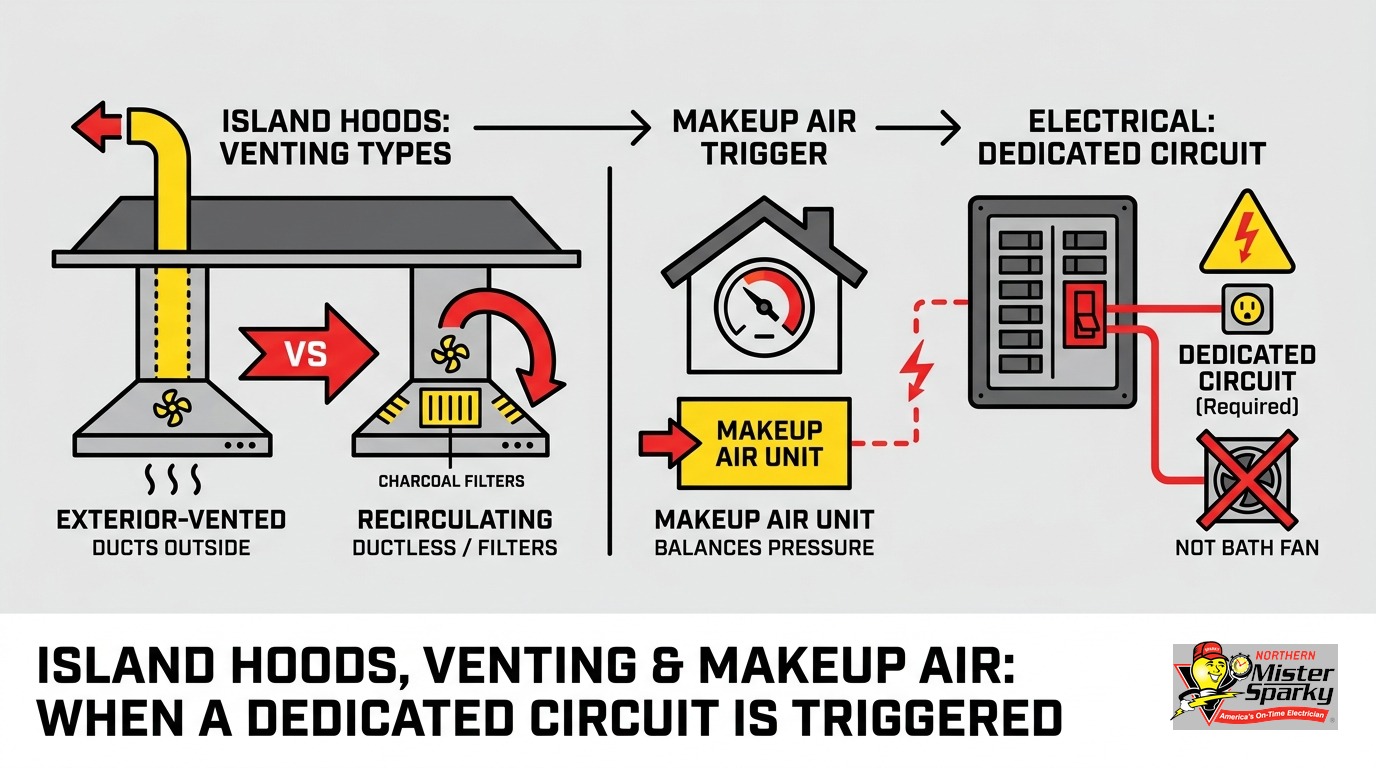
- Cord-and-plug range hoods must be on their own circuit under NEC 422.16(B)(4). Hardwired hoods have no equivalent mandate, but they cannot use the required countertop circuits.
- A range hood cannot tap the two required 20A small-appliance countertop circuits. NEC 210.52(B)(2) prohibits fixed appliances on those circuits.
- Wire sizing follows the breaker: 14/2 cable for 15A, 12/2 for 20A. Most installers run 12/2 to leave headroom for future needs.
- Minnesota adopted the 2020 NEC on November 17, 2020, with no state amendments to kitchen appliance sections.
- Once a ducted hood can exceed 400 CFM, IMC 505.2 requires an electrically interlocked makeup air system. That is a second circuit.
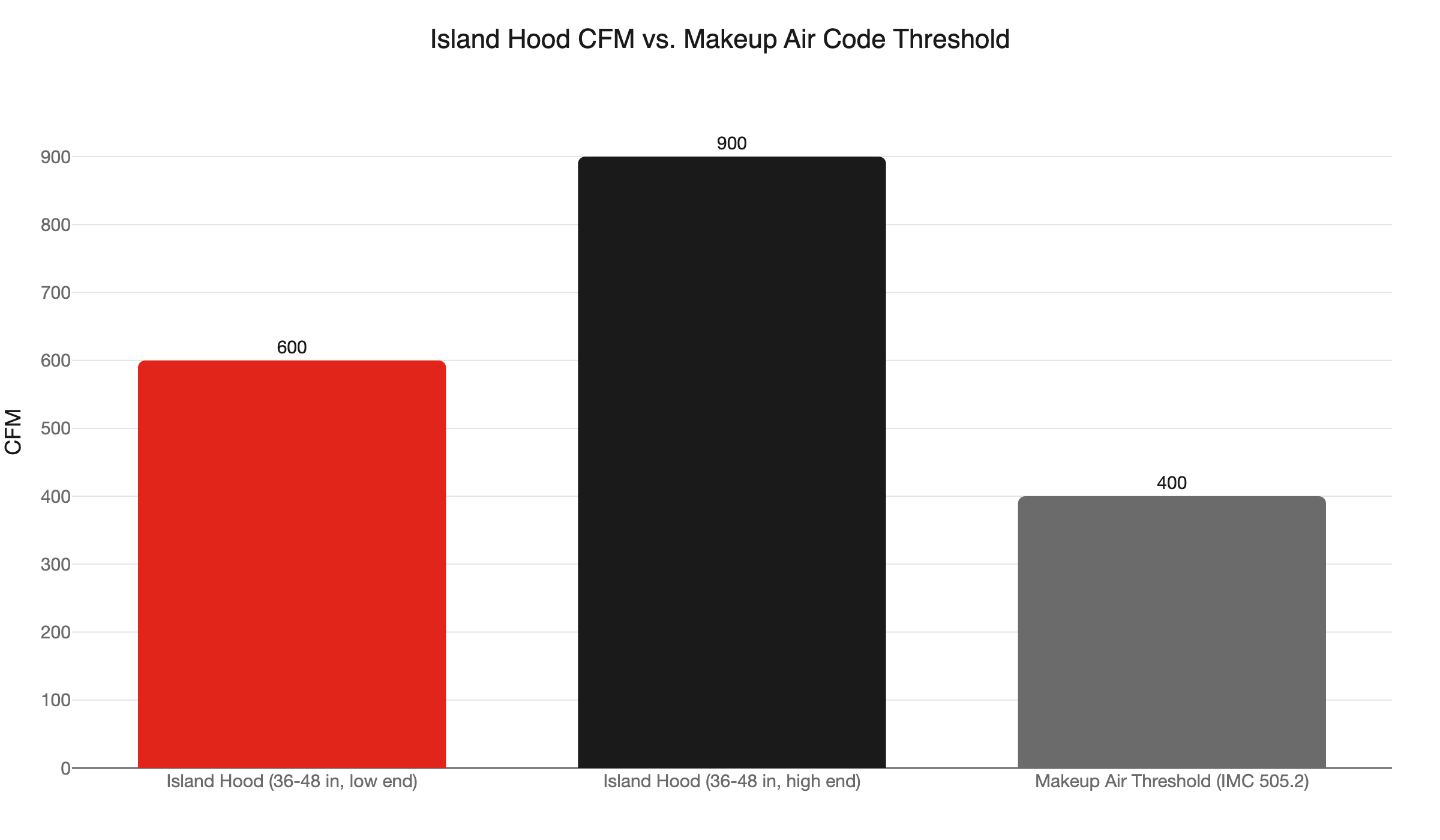
- Island hoods in the 36”-48” range are typically rated 600-900 CFM, well above the 400 CFM trigger.
- In a Minnesota winter, a tempered makeup air unit commonly requires a third dedicated 240V circuit.
- Recirculating (ductless) hoods are fully exempt from makeup air requirements under IRC M1503.6. One circuit, and the job is done.
- New circuits require an electrical permit from the Minnesota DLI or your local AHJ. A makeup air system also requires a separate mechanical permit.
What Are the Range Hood Electrical Wiring Requirements?
The short answer: A cord-and-plug hood needs its own circuit. A hardwired hood should be on its own circuit. Neither can share the two required small-appliance countertop circuits. Wire gauge follows the breaker size: 14/2 for 15A, 12/2 for 20A.
Most homeowners and most online guides treat range hood wiring as a wire-gauge question. It is not the whole picture. The real question is what kind of hood you are installing, how many CFM it moves, and whether it vents outside or recirculates air. Get those wrong, and one circuit becomes two or three.
Three variables determine the full electrical scope: how the hood connects (cord-and-plug vs. hardwired), how much air it moves in CFM, and whether it exhausts outside or filters and returns air to the kitchen. The rest of this guide works through each one.
Hardwired vs. Plug-In: Does Code Treat Them Differently?
The short answer: Yes. NEC 422.16(B)(4) is explicit about cord-and-plug models and silent on hardwired models. In practice, most inspectors treat both the same way, but the code basis differs.
NEC 422.16(B)(4) covers cord-and-plug hoods directly. The requirements are specific: an individual branch circuit, a cord between 18 inches and 4 feet long, and a grounded plug. The hood cannot share that circuit with anything else.
Hardwired hoods are not addressed by an equivalent section. The NEC does not explicitly mandate a dedicated circuit for a hardwired installation. But NEC 210.52(B)(2) closes the easy workaround. It bars the two required 20A small-appliance countertop circuits from supplying luminaires or fixed appliances. A hardwired range hood is a fixed appliance. It cannot use those circuits.
That leaves a hardwired hood with almost nowhere to go except a dedicated circuit. Most inspectors require one. We run a dedicated circuit for every hood we install, whether it is hardwired or cord-and-plug. It is cleaner, it passes inspection the first time, and it leaves the homeowner in a better position if they upgrade the hood later.
For a full picture of which appliances require dedicated circuits under Minnesota code, see our guide to dedicated circuits for home appliances.
What Wire Size Does a Range Hood Need?
The short answer: 14/2 cable on a 15A breaker is the code minimum for most hoods. Electricians commonly run 12/2 on a 20A breaker to leave headroom for future use.
Most residential range hoods draw between 65 and 300 watts. At 120V, that is 0.5 to 2.5 amps. A 15A circuit handles that load easily. But circuit sizing is about the breaker rating, not just the load.
A 15A circuit requires 14-gauge wire at minimum. A 20A circuit requires 12-gauge. Running undersized wire behind an oversized breaker is a fire hazard. Inspectors will find it.
We typically run 12/2 even when the hood nameplate would allow 14/2. The material cost difference on a single circuit is small. The benefit is real: if the homeowner later upgrades to a more powerful hood, the circuit can handle it without a panel visit. Always check the hood’s installation manual before roughing in wire. Manufacturer specs control if they are more restrictive than the NEC minimum.
Can a Range Hood Share a Circuit With Other Kitchen Outlets?
The short answer: No. A cord-and-plug hood is barred from circuit sharing by NEC 422.16(B)(4). A hardwired hood cannot use the required countertop small-appliance circuits under NEC 210.52(B)(2). Most kitchen outlets land on those circuits.
This is where homeowners get into trouble. They see a standard outlet above the range, assume the hood can plug into it, and hire someone who is not a licensed electrician to make it happen. That outlet is almost always on one of the two required 20A small-appliance countertop circuits. Code prohibits fixed appliances on those circuits.
The result: a hood on the wrong circuit, a failed inspection, and a return visit to run a proper dedicated line. Sometimes the homeowner also starts noticing the breaker trips every time the hood and a countertop appliance run together. That is not a coincidence. That is an overloaded circuit.
For a full breakdown of all the circuit rules that govern a kitchen, including the small-appliance circuit requirements, see our kitchen electrical circuits code guide.
What Is the 400 CFM Rule, and When Does It Add a Second Circuit?
The short answer: When a ducted hood system can exhaust more than 400 CFM, Minnesota’s Mechanical Code requires an electrically interlocked makeup air system. That interlock is a separate electrical job. It adds at least one circuit.
IMC 505.2 (Minnesota Mechanical Code) is the controlling rule. It states that exhaust hood systems capable of exceeding 400 CFM shall be provided with makeup air at approximately equal to the exhaust rate, automatically controlled to start and operate simultaneously with the exhaust system.
“Automatically controlled to start and operate simultaneously” is the phrase that creates the electrical work. The makeup air system does not run on its own. It does not run on a timer. It fires when the hood fires and stops when the hood stops. That interlock requires wiring. An electrician connects the hood control to the makeup air unit.
IRC M1503.6 applies the same rule inside homes where any non-direct-vent or non-mechanical-draft combustion appliance sits within the air barrier. If your home has a gas furnace or an atmospheric water heater and your ducted hood exceeds 400 CFM, the makeup air requirement applies regardless of the hood’s position in the kitchen.
The safety rationale is direct. A high-CFM exhaust hood depressurizes the home. Enough depressurization can reverse-draft gas appliances, pulling combustion gases, including carbon monoxide, back into living space. Makeup air prevents that pressure differential. This is a safety requirement with a code basis, not a comfort upgrade.
Recirculating (ductless) hoods are fully exempt. IRC M1503.6 explicitly carves out systems installed exclusively to recirculate air. A ductless hood does not exhaust, so there is no pressure change, no backdraft risk, and no makeup air trigger. The electrical scope stays at one circuit for the hood.
Why Island Hoods Almost Always Cross the 400 CFM Line
A wall-mount hood has a back wall behind it. That wall funnels cooking exhaust toward the intake. An island hood sits in open air on all four sides. Nothing guides smoke toward the intake. The hood has to generate more suction to capture the same volume of cooking exhaust.
The result is a CFM requirement that is roughly 50% higher for island hoods than for wall-mount hoods of the same width. A 36”-48” island hood over a residential range is typically spec’d at 600-900 CFM. The 400 CFM makeup air trigger is crossed before the hood even reaches its working range.
There is no correctly-spec’d ducted island hood installation in Minnesota that avoids the makeup air requirement. If you are selecting an island hood, you are planning for at least two electrical circuits before any design decisions are made. This is what most range hood wiring guides miss. They answer the wire gauge question and skip the part where the island configuration turns a single-circuit job into a multi-circuit coordination project.
What Does a Minnesota Winter Do to Your Makeup Air System?
The short answer: Pulling outdoor air into a kitchen at -20F without treating it first is uncomfortable, strains the heating system, and risks condensation in the ductwork. A tempered makeup air unit solves this by pre-heating the incoming air. It typically requires a dedicated 240V circuit. That is a third circuit on a job many homeowners planned as one.
A passive makeup air opening, a screened duct into the wall, can satisfy code in milder climates. In Minnesota, pulling raw January air into the kitchen at the rate a 700 CFM island hood demands is not practical. The discomfort is immediate. The load on the heating system is significant.
The common Minnesota solution is a tempered makeup air unit. It captures incoming outdoor air, passes it through a heat exchanger or electric resistance coil, and delivers it to the kitchen at a livable temperature. It maintains the volume interlock with the hood, so the makeup air rate tracks the exhaust rate automatically.
That unit needs its own power supply. Typically a dedicated 240V circuit, the same category as a dryer or an electric range outlet. For background on how 240V circuits work in residential settings, see our guide to 240V outlet installation.
The full electrical scope for a typical Twin Cities island hood installation:
- Circuit 1: 120V, 15A or 20A - the range hood motor and lights.
- Circuit 2: 120V or 240V - the makeup air unit interlock and controls.
- Circuit 3: 240V - the tempered makeup air heating element, if the unit uses electric resistance heat.
Homeowners who expect one circuit and one permit often call us back mid-project. We lay this out at the estimate stage so the conversation happens before the cabinets are installed. If the panel lacks room for two or three new circuits, a panel upgrade enters the conversation. That is not the answer every homeowner expects, but it is the accurate one.
Does a Motorized Damper Require Its Own Circuit?
The short answer: Not necessarily its own breaker slot, but it must be electrically interlocked with the exhaust system. If a passive makeup air opening is large enough, code requires the damper to be motorized.
IMC 501.4.2 covers the damper requirement. Passive makeup air openings larger than 8 inches in diameter require a motorized damper electrically interlocked with the largest exhaust system in the home. If your passive makeup air duct qualifies, the damper must open when the hood runs and close when it stops. That interlock requires wiring.
In most installations, the damper wiring ties into the makeup air unit’s control board rather than running to its own breaker. But the connection still requires a licensed electrician. The interlock has to be correct. A damper that stays closed while the hood runs defeats the entire purpose of the makeup air system and leaves the backdraft risk in place.
Do You Need a Permit for Range Hood Wiring in Minnesota?
The short answer: Yes, if you are installing a new circuit. Minnesota requires an electrical permit for new circuit work. A makeup air system requires a separate mechanical permit. Homeowners often pull the electrical permit and miss the mechanical one.
Minnesota DLI oversees electrical licensing and permits statewide. Minneapolis and St. Paul each operate their own building departments with separate permit processes. Either way, a new circuit requires a permit and an inspection before the wall closes.
Skipping the permit is one of the most common mistakes on kitchen remodels involving range hoods. The hood works fine. Years pass. The house goes on the market. An inspector finds unpermitted electrical work in the kitchen, and the closing gets complicated.
We pull permits for every circuit we install. It protects the homeowner and it protects us. For a full overview of when permits are required for residential electrical work in Minnesota, see our electrical permit guide.
The mechanical permit for the makeup air system is separate. Each contractor assumes the other is handling it. Confirm before work starts. The DLI can be reached at dli.electricity@state.mn.us or 651-284-5026.
What About Ductless (Recirculating) Hoods?
The short answer: Ductless hoods are fully exempt from makeup air requirements. One dedicated circuit handles the job. The trade-off is reduced performance for high-output ranges and heavy-cooking households.
Ductless hoods filter air through charcoal or carbon filters and return it to the kitchen. No air is exhausted to the outside. No pressure change occurs in the home, no backdraft risk exists, and the 400 CFM code trigger never fires. The electrical scope is as simple as range hood wiring gets: one circuit, one permit, done.
For homeowners where routing exhaust ductwork to the outside is not practical, a ductless island hood is a legitimate option. It keeps the visual scale of an island canopy without the multi-circuit electrical scope. The trade-off: grease, moisture, and odors are filtered rather than removed, and charcoal filters require regular replacement. For a professional-style range or a household that cooks with high heat frequently, ductless performance often falls short. For the right kitchen and the right cooking style, it is a real choice that significantly simplifies the job.
What to Expect When You Call Northern Mister Sparky
We are locally owned and operated, serving Twin Cities homeowners across Minneapolis, St. Paul, Bloomington, Maple Grove, Plymouth, and the surrounding area. We have wired enough kitchens to know that range hood electrical wiring is rarely just a wire-gauge conversation.
Our process when a homeowner calls about a range hood circuit:
- Confirm the hood type and CFM rating before any planning begins.
- Identify whether it is ducted or recirculating.
- If ducted and rated above 400 CFM, scope the makeup air interlock as part of the same job from the start.
- Check the panel for available capacity before the estimate is final.
- Pull the electrical permit. Confirm the mechanical permit status with the HVAC contractor if a makeup air unit is involved.
No malarky: the electrical and mechanical scopes for a high-CFM island hood need to be coordinated before the kitchen remodel begins. Discovering mid-project that a 240V circuit is needed for a tempered makeup air unit, after the cabinets are in and the walls are closed, is an expensive surprise.
Call 763-200-5956 to talk through what your installation actually requires. Or book online to schedule a visit. We scope it honestly before anyone touches the wall.
Frequently Asked Questions
Does a range hood need its own dedicated circuit? +
What wire size does a range hood need? +
When does a range hood trigger a makeup air requirement in Minnesota? +
Need an electrician now?