
Roof Heat Cable Electrical Requirements: A Twin Cities Guide
Key Takeaways
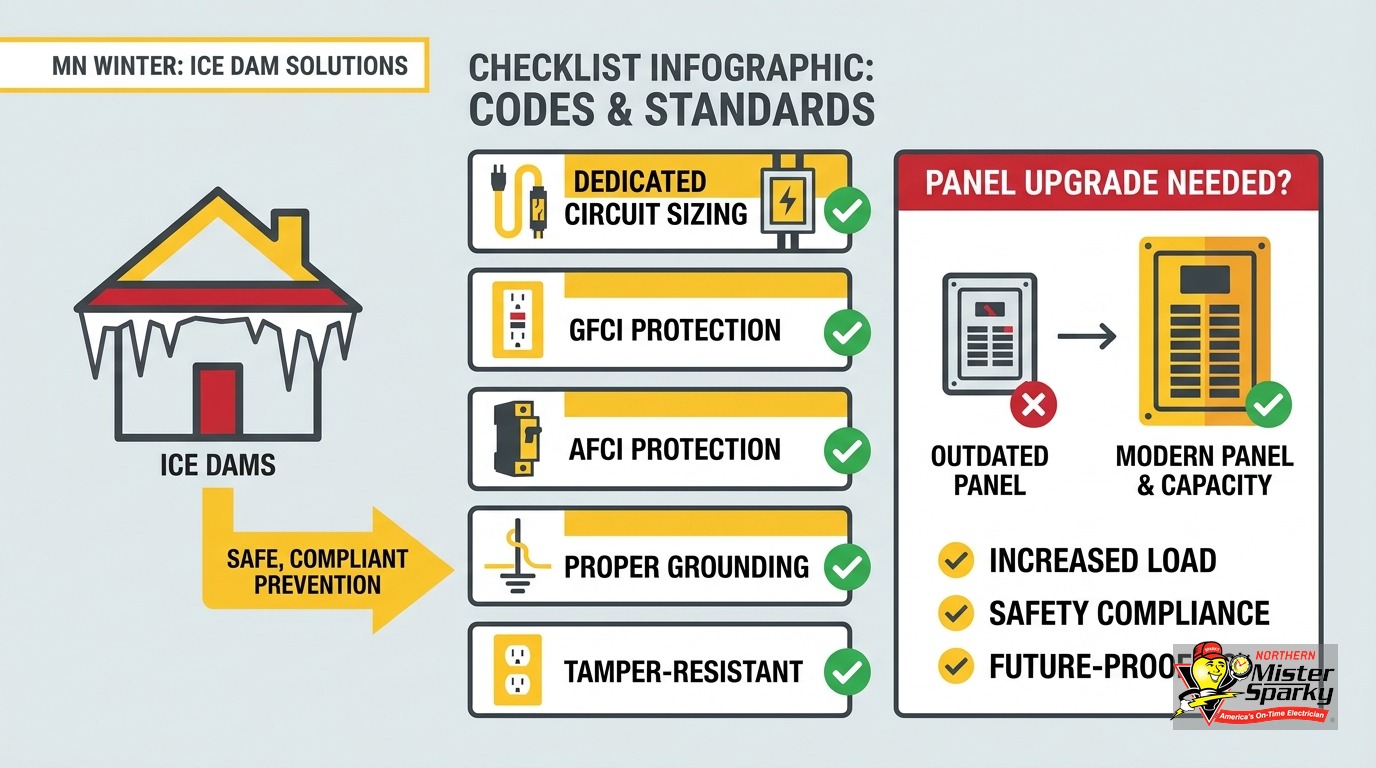
- Heat cable requires GFPE protection (30mA trip) per NEC 426.28, not a standard GFCI outlet (4-6mA trip). A GFCI will nuisance-trip constantly in cold, wet conditions.
- NEC 210.20 requires circuit conductors and breakers to be rated at 125% of the continuous load. At 8W/ft, a 190-foot run requires a 20A circuit - not 15A.
- A typical Twin Cities home needs 250-350 feet of cable. That means two dedicated 20A circuits, minimum.
- Minnesota requires an electrical permit for heat cable. As of August 3, 2026, permits fall under the 2026 NEC.
- A written NEC 220.82 load calculation is the only honest way to determine whether you need a panel upgrade before adding heat cable circuits.
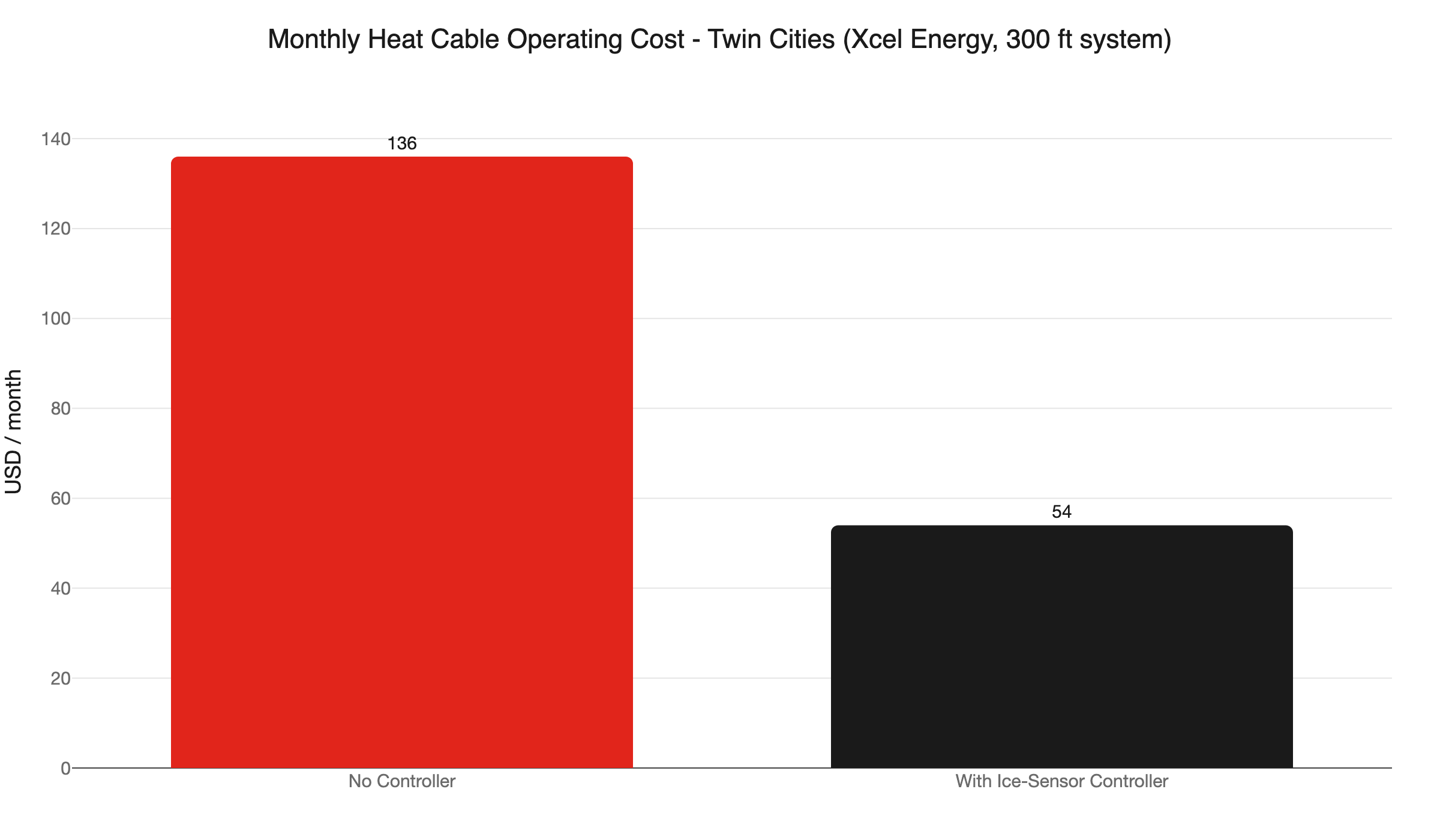
- Monthly operating cost for a 300-foot system runs about $136 without a controller. An ice-sensor timer cuts that roughly 60%, bringing the monthly cost to around $54.
What Are the Roof Heat Cable Electrical Requirements?
The short answer: Heat cable is fixed outdoor electric deicing equipment. It requires a dedicated circuit sized at 125% of the continuous load, protected by a GFPE device - not a standard GFCI outlet. A Minnesota electrical permit is required for the work.
Here is what each requirement means in practice.
Heat cable is a continuous load under the NEC. It runs for three or more hours at a time. That classification triggers NEC 210.20, which requires the circuit and breaker to be rated at 125% of the load - not just the load itself. A circuit sized for exactly the load runs at 100% capacity continuously. That is a code violation and a long-term fire risk.
Most residential heat cable draws between 5W/ft and 12W/ft depending on type and temperature. Eight watts per foot is a common midpoint for self-regulating cable in Minnesota winter conditions.
At 8W/ft on a 120V circuit, the math works out to:
- 100 feet: 800W / 120V = 6.7A x 1.25 = 8.3A required (fits a 15A circuit with room)
- 150 feet: 1,200W / 120V = 10A x 1.25 = 12.5A required (fits a 15A circuit, barely)
- 190 feet: 1,520W / 120V = 12.7A x 1.25 = 15.9A required (needs a 20A circuit)
Run the math before you run the cable.
Why Does My Heat Cable Keep Tripping the Breaker?
The short answer: The cable is almost certainly connected to a standard GFCI outlet or GFCI breaker. Heat cable requires GFPE, which trips at 30mA. A standard GFCI trips at 4-6mA. Cold, wet cable insulation generates enough leakage current to trip a GFCI repeatedly but not enough to be a genuine hazard. The fix is a dedicated circuit with a GFPE breaker - not a better GFCI.
This is the single biggest field error in heat cable installations. No other article online distinguishes these two devices clearly, so let’s do it here.
GFCI (ground-fault circuit interrupter): Trips at 4-6 milliamps. Built to protect people from electrocution at sinks, outdoors, and in wet areas. The threshold is low because even a few milliamps can cause muscle paralysis.
GFPE (ground-fault protection of equipment): Trips at 30 milliamps. Built to protect equipment from faults that could cause fires or damage. NEC 426.28 specifically requires GFPE for all fixed outdoor electric deicing and snow-melting equipment.
When you plug heat cable into a GFCI outlet, the cable’s insulation in freezing conditions leaks a small amount of current to ground. That leakage sits above the 4-6mA GFCI threshold but well below the 30mA GFPE threshold. The GFCI trips. You reset it. It trips again. This plays out every cold snap.
The fix is a dedicated exterior circuit with a GFPE breaker. Dedicated GFPE units that protect up to 60A at 120/208/240V are available and meet both NEC 426.28 and 427.22.
NEC 210.8 also clarifies that a receptacle dedicated to fixed snow-melting equipment is exempt from the standard GFCI requirement - IF it is not readily accessible AND GFPE per 426.28 is provided. A properly wired dedicated circuit does not need a GFCI breaker. It needs a GFPE breaker.
If your heat cable is on a GFCI outlet right now and tripping regularly, that installation is not to code. We can fix it.
How Do You Size a Circuit for Roof Heat Cable?
The short answer: Calculate your total cable length, multiply by watts per foot, divide by 120V for amps, then multiply by 1.25. That final number is your minimum breaker size. A 15A circuit handles roughly 150 feet at 8W/ft; a 20A circuit handles roughly 190 feet. Most Twin Cities homes need more than one circuit.
Here is why the footage adds up quickly in Minnesota.
A typical sizing formula for ice-prone roofs runs:
- Length of heated eave x 1.5 (for the zigzag routing pattern)
- Plus the full length of gutters along that eave
- Plus 20 feet per downspout, down to grade or the drain
A modest story-and-a-half home with 40 feet of problem eave, 60 feet of gutter, and two downspouts can easily reach 250-300 feet. A larger home with dormers or complex roof lines may need 400 feet or more.
At 250 feet and 8W/ft: 2,000W / 120V = 16.7A x 1.25 = 20.8A required. A 20A circuit cannot carry 250 feet to code. You need two circuits, splitting the load between them.
This is why a compliant installation almost always involves new dedicated circuits - not a plug in the garage outlet. If a contractor quotes you a plug-in setup on an existing circuit, ask to see the load calculation before you agree.
For more on how dedicated circuits work for high-draw equipment, see our post on dedicated circuits for appliances.
Self-Regulating vs. Constant-Wattage Cable: Does It Change Your Circuit?
Self-regulating cable adjusts output based on ambient temperature. It draws more watts in the cold, less as it warms. Constant-wattage cable draws the same load regardless of conditions.
From a circuit sizing perspective, this distinction matters for one specific reason: startup inrush current.
Self-regulating cable can draw two to three times its steady-state load for the first few minutes of startup in very cold conditions. If you size the circuit based on the warm-temperature steady-state wattage, the breaker may trip at startup even though the circuit is technically large enough for sustained operation.
The correct approach: size the circuit to the cable’s rated cold-temperature wattage, not the moderate-weather draw. Cable manufacturers list both. Always use the higher figure.
Constant-wattage cable does not have a startup surge problem. But it also never reduces its draw, which means it costs more to operate and is less forgiving of borderline circuit sizing over time.
Do I Need a Permit to Install Roof Heat Cable in Minnesota?
The short answer: Yes. Minnesota requires an electrical permit for heat cable installation. In most cases, a licensed electrical contractor must perform the work. Homeowners can pull their own permit for work on their own homesteaded property - but Minneapolis and St. Paul may limit that exemption. Confirm with your local authority having jurisdiction before starting.
Minnesota law allows homeowners to do their own electrical work on a homestead property with a permit and final inspection. That exemption does not apply everywhere in the metro. Both Minneapolis and St. Paul have adopted ordinances that restrict certain electrical work to licensed contractors. Your local building department is the authoritative answer for your specific address.
What the permit covers: the new circuit, the GFPE protection device, the connection point, and the installation method. An inspector will verify that the circuit is sized correctly, that GFPE is in place rather than GFCI, and that the work meets the current NEC cycle.
For a full breakdown of what a Minnesota electrical permit covers, see our post on electrical permits in Minnesota.
The August 2026 NEC Code Transition
Minnesota adopted the 2026 NEC, effective August 3, 2026. That date is already here. Permits pulled before August 3 follow the 2023 NEC. Permits pulled on or after August 3 follow the 2026 NEC.
For most residential heat cable work, the practical requirements carry forward without major changes. NEC 426.28 (GFPE), 210.20 (125% sizing), and 210.8 (dedicated circuit exemption from GFCI) all remain in force. The transition matters because it changes which code cycle an inspector uses when reviewing your permit.
One wrinkle worth flagging: if you had a heat cable system installed several years ago and are now adding cable runs, the extension may need to comply with the 2026 NEC even if the original installation was under an older cycle. Your electrician can clarify this for your specific situation before any work begins.
When Does Heat Cable Require a Panel Upgrade?
The short answer: Only after a written load calculation under NEC 220.82 shows the existing service cannot absorb the new continuous heating load at 125%. No calculation means no honest answer. Anyone who quotes a definitive upgrade verdict before running that math is guessing.
Here is what the calculation involves.
A licensed electrician totals the nameplate loads of all major circuits on your service: range, dryer, water heater, AC, EV charger if present, and so on. NEC demand factors reduce the total to account for loads that don’t run simultaneously. The electrician compares that adjusted total against your service capacity (typically 100A or 200A), then adds the heat cable load at 125% to see what headroom remains.
A 100A panel with an electric range and dryer may have less room than you expect. A 200A panel with a gas range and gas dryer may absorb two new 20A heat cable circuits without any issue at all. The answer depends on your specific home - not on a general rule.
Two red flags to watch for:
- A contractor who says “you definitely need a panel upgrade” before doing any calculations is guessing - and possibly selling.
- A contractor who adds heat cable circuits without checking available ampacity is creating a code violation.
If your panel is already showing problems - aluminum wiring concerns, breakers running hot, or a brand flagged for reliability issues - a heat cable project is a natural point to address it. But the upgrade decision belongs to the calculation.
For more on how to read the signals your panel sends, see our post on signs you need an electrical panel upgrade.
What Does It Cost to Run Heat Cable in the Twin Cities?
The short answer: A 300-foot system at 8W/ft draws 2.4 kW. Running 12 hours a day during a Minnesota cold snap costs about $4.55 per day at Xcel Energy’s 2026 residential rate of 15.82 cents/kWh - roughly $136 per month. An ice-sensor or thermostat controller cuts that by 60% or more, bringing the monthly cost down to around $54. The chart above shows the difference.
A few other factors affect your actual number:
Xcel Energy time-of-use rates. Xcel offers a voluntary time-of-use rate. Running heat cable off-peak (midnight to 6 a.m. with an ice-sensor timer) can reduce the cost further. If you are on or considering a time-of-use plan, ask your electrician to wire the controller with a timer function.
Cable type. Self-regulating cable draws less in mild conditions - common in early and late winter. On a moderate December day, self-regulating cable costs noticeably less than constant-wattage cable running at full draw. Over a whole season, that adds up.
Controller type. A basic thermostat turns the cable on below a set temperature. An ice sensor also requires detected moisture, which keeps the system off during dry cold snaps. Ice sensors save more energy than thermostats alone.
Attic Insulation Comes First
Heat cable treats the symptom. Inadequate attic insulation is the cause.
Twin Cities falls in IECC Climate Zone 6. Minnesota Energy Code requires a minimum of R-49 attic insulation, with R-60 recommended. When heat escapes through an under-insulated attic, it warms the roof deck, melts snow above, and creates exactly the conditions that produce ice dams - regardless of whether heat cable is installed.
If you haven’t addressed the attic, heat cable is a band-aid. Fix the insulation first, then reassess.
That said, some roofs form ice dams regardless of insulation quality. Complex geometry, low-slope sections, and north-facing dormers can hold ice no matter how tight the envelope is. And some homeowners want the cable in place while they plan longer-term work. We are not here to lecture. We are here to make sure the electrical side is correct when the cable goes in.
Get the Electrical Right Before Winter
The roof heat cable electrical requirements are specific. They are also easy to get wrong, and the GFCI/GFPE confusion alone accounts for a large share of the service calls we see after DIY or underspecified installations.
A compliant installation for a typical Twin Cities home looks like this:
- Two dedicated 20A circuits for 250-350 feet of cable
- GFPE breakers at 30mA trip threshold - not standard GFCI outlets
- Circuit conductors and breakers sized at 125% of the rated continuous load
- A Minnesota electrical permit pulled before work begins
- A written NEC 220.82 load calculation if there is any question about panel capacity
We are Northern Mister Sparky - locally owned and operated here in the Twin Cities, and backed by America’s On-Time Electrician(R) and the UWIN(R) 100% satisfaction guarantee. Whether your heat cable is tripping constantly, you want a new system wired before next winter, or you need a panel check before we add circuits - call us at 763-200-5956 or book online. We will get it right the first time, no malarky.
Frequently Asked Questions
What kind of ground-fault protection does roof heat cable require? +
Do I need a permit to install roof heat cable in Minnesota? +
How many circuits does a typical Twin Cities home need for heat cable? +
Does adding heat cable require a panel upgrade? +
Need an electrician now?