
Smart Home Pre-Wiring: What to Rough In Before Drywall
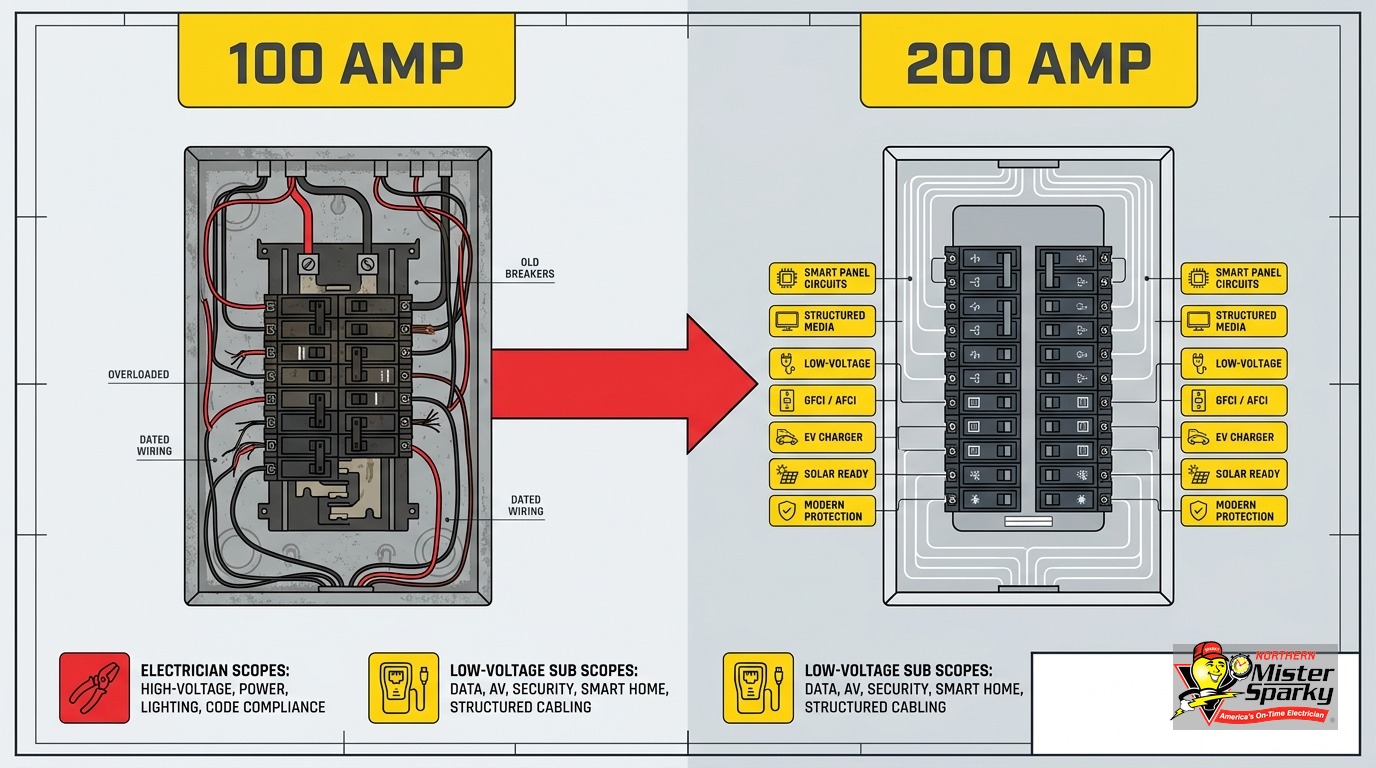
Key Takeaways
- Before drywall goes up is the only affordable time to rough in smart home circuits and cabling.
- Minnesota adopted the 2023 NEC on July 1, 2023; all electrical permits filed now must comply with those rules.
- Your licensed electrician owns every circuit above 100V. All cabling at 100V or below requires a separate Power Limited Technician (PLT) license under Minnesota law.
- A Level 2 EV charger requires a dedicated circuit of at least 50A. Rough in 60A with 6 AWG copper to future-proof without rewiring.
- Smart panels like Span and Lumin are now code-recognized alternatives to a full service upgrade under NEC 625.42.
- Every electrical rough-in in Minnesota requires a permit and a pre-drywall inspection through DLI. No exceptions.
What Is Smart Home Pre-Wiring?
A smart home pre-wiring installation is the process of routing electrical circuits, conduit stubs, and low-voltage cabling inside walls before drywall goes up. Your licensed electrician handles all 120V/240V high-voltage work. Low-voltage cabling - Cat6, coaxial, cameras - requires a separately licensed trade in Minnesota. Both cost far less to install now than to retrofit later.
Every connected device in your home needs either a dedicated circuit, a wired data connection, or both. A smart thermostat wired to a network switch runs more reliably than one on Wi-Fi through a concrete basement. An EV charger needs its own branch circuit, and that circuit is far easier to pull through open framing than through finished walls.
Smart home pre-wiring is not a luxury tier. It is the planning discipline that prevents a $300 Cat6 drop from becoming a $1,200 wall-cutting job three years later. The decisions you make at rough-in stay in your walls for decades.
This guide covers the electrician’s scope, PLT licensing requirements, which specific circuits to rough in, what permits apply in Minnesota, and what the work costs.
Why Does Timing Matter So Much?
Rough-in is the only time every wall cavity is open and accessible without cutting. Once drywall goes up, adding any circuit or cable requires cutting, patching, and refinishing finished surfaces. That labor multiplies the cost of every wire added later.
Open-wall Cat6 drops for a 3,000 sq ft home run roughly $3,000-$7,000. The same scope after drywall is closed costs significantly more per drop because finished-surface labor is far more disruptive than pulling wire through open framing. That cost difference alone justifies planning every fixed device location before insulation goes in.
The rough-in window closes faster than most homeowners expect. Framing inspection, insulation, and drywall can follow each other within two to three weeks on an active build schedule. If you are coordinating with a general contractor, ask for the insulation date. That date is your hard deadline for all rough-in scope.
For remodels, the window opens whenever a room is torn down to studs. Plan your entire smart home scope for every room being opened, not just the one currently in progress. Re-opening walls is expensive every time.
Before framing ends, walk the home and confirm every location where you need:
- A hardwired network connection (home office, TV alcove, gaming room, security camera)
- A dedicated 120V or 240V circuit (EV charger, generator, battery storage, hot tub)
- A conduit stub for future flexibility (panel-to-garage path, attic media runs)
What Does the Electrician Own vs. a Low-Voltage Sub?
Your licensed electrician owns everything above 100V: service entrance, main panel, all branch circuits, outlets, and high-voltage device connections. All cabling at 100V or below - Cat6, coaxial, speaker wire, cameras, doorbells - falls under low-voltage scope and requires different licensing in Minnesota.
This is where homeowners get surprised. The general contractor assumes the electrician is pulling all the wire. The electrician assumes an AV or cabling sub is covering low voltage. Neither talks to the other during scheduling, and the rough-in window closes with no Cat6 in the walls.
Ask your electrician three questions during pre-construction:
- Is your scope high-voltage only, or do you also carry a PLT license?
- Who is coordinating the structured cabling or AV sub on this project?
- Who owns the schedule to make sure both trades rough in before insulation?
If your project has both a licensed electrician and a PLT-licensed low-voltage sub, confirm they have overlapping rough-in windows. If one trade finishes early and the other is delayed, someone works around framing obstructions or asks for walls to be reopened. Confirm the schedule overlap before work starts.
Minnesota’s PLT License: The Rule Most Homeowners Don’t Know
Minnesota is one of the strictest low-voltage licensing states in the country. All systems at 100V or below require a Power Limited Technician (PLT) license under Minn. Stat. §326B.33. This covers data cabling under NEC Article 800, security systems, AV equipment, and all structured cabling.
Businesses doing low-voltage work must hold a Technology Systems Contractor (TSC) license at the company level. Individual technicians must carry the PLT individually. Unlicensed data cabling is a code violation even when the wire never carries dangerous current.
Most licensed electricians in the Twin Cities sub low-voltage scope to a certified TSC firm. That arrangement works fine, but you need to know who that sub is before work starts. Get the TSC firm’s name in writing and confirm they are scheduled for the rough-in window.
“Who holds the PLT on this project?” is the question most homeowners never think to ask. In Minnesota, it is the question that determines whether your Cat6 passes inspection.
What High-Voltage Circuits Should You Pre-Wire?
Pre-wire every 120V or 240V circuit that crosses exterior walls, runs through unfinished spaces, or needs its own dedicated breaker, and that would cost significantly more to add after drywall. The core list: EV charger, panel expansion slots, battery storage, generator transfer switch, and outdoor power runs.
These circuits share common traits. They run long distances, cross exterior walls, and need conduit where they exit the panel. All of that is straightforward during framing. After drywall it means cutting and patching finished surfaces through multiple rooms.
Here is a working list for a Twin Cities new build or major remodel:
- EV charger dedicated circuit: 50A minimum, 60A preferred, in the attached or detached garage.
- Panel expansion slots: Reserve breaker positions for future circuits. A panel at 80% capacity today is maxed out once you add an EV charger and a battery circuit.
- Whole-home battery storage circuit: A 50A or higher dedicated circuit from panel to the battery location, typically a basement utility room. Pull conduit now even if the battery installs two years from now.
- Generator transfer switch connection: Whether you want a portable or automatic standby setup, the circuit and interlock should be roughed in during the same panel work.
- Outdoor circuits: Landscaping power, detached garage subpanel feed, exterior outlet locations, and any planned pool or hot tub supply. Exterior runs are the hardest to retrofit on a finished home.
- Dedicated appliance circuits: Home theater amplifiers, whole-home audio, and workshop equipment all benefit from their own branch circuits.
How Do You Future-Proof an EV Charger Circuit?
NEC 625.40 requires a dedicated branch circuit for EVSE rated above 16A or 120V. For a standard 32A Level 2 charger, the minimum circuit is a 50A breaker with 8 AWG copper. Rough in 60A with 6 AWG copper to support a 48A charger later without rewiring.
Twin Cities homes with attached garages have a specific advantage at rough-in time. The conduit path from the main panel to the garage crosses exterior walls or runs through a basement ceiling before that space is finished. During framing, that run is straightforward. After the basement is drywalled and painted, the same conduit run means cutting finished ceilings through multiple rooms.
The practical approach for most Minnesota homes:
- Minimum: 50A breaker, 8 AWG copper per NEC 625.40. Supports the most common residential Level 2 chargers operating at 32A.
- Future-proof: 60A breaker, 6 AWG copper. Supports a 48A charger with no rewiring. Costs marginally more at rough-in and significantly more to upgrade once walls are closed.
Load calculation matters too. NEC 220.57 requires EV charging load to be calculated at 7,200 VA or the equipment nameplate, whichever is larger, and treated as a continuous load with the 125% rule applied. Your electrician must factor this into the service load calculation when sizing the panel.
NEC 625.54 now requires GFCI protection on all EVSE, including 240V circuits. This was not required under the 2020 NEC. Any contractor skipping GFCI on a 240V charger circuit is setting up a failed inspection in Minnesota.
Xcel Energy offers rebates for residential EV charger installations in Minnesota. The rebate covers the charger hardware, not the electrical installation. Confirm the current rebate amount directly with Xcel before budgeting, because program amounts change.
For a complete walkthrough of the installation itself, see our EV charger installation guide for the Twin Cities.
What About Smart Panels and Service Capacity?
NEC 625.42 now recognizes a smart panel with a certified energy management system as a code-compliant alternative to a service upgrade for managing EV loads. For Twin Cities homes on 100A or 150A service, this can prevent a costly utility service upgrade.
Smart panels like Span and Lumin monitor real-time load across all circuits and throttle the EV charger automatically when other circuits approach capacity. A 100A service can handle daily EV charging without tripping breakers or needing a utility upgrade.
If you are building new or doing a major remodel, the rough-in window is the right time to decide between a traditional panel and a smart panel. The rough-in is identical either way: same service entrance, same branch circuit wiring. The difference is in the panel enclosure itself, which you specify before trim-out.
One requirement applies regardless of panel type: NEC 230.67 now mandates surge protection devices (SPDs) on all dwelling unit services. This is a 2023 NEC requirement and a permit inspection item in Minnesota. Your electrician installs the SPD during rough-in or trim-out, and the inspector verifies it before the permit closes. Our whole-home surge protection guide covers what SPD installation protects and what to expect during that inspection.
Should You Pre-Wire for Battery Storage?
Yes, if you expect to add whole-home backup power or solar-plus-storage within the next decade. Battery systems require a high-amperage dedicated circuit and often a critical-load subpanel. Pull conduit now. Retrofitting it through a finished basement is expensive and disruptive.
The key pre-wire for battery storage is a conduit stub from the main panel to the intended battery location, typically a basement utility room or garage wall. Even if the battery installs two or three years later, the conduit run at rough-in costs a fraction of what it costs after the basement ceiling is closed.
Size the conduit for at least 50A and install a pull string at rough-in. Confirm the exact circuit requirement against the specific system you intend to install, because amperage requirements vary by manufacturer and system size.
If you want a whole-home generator now and plan to add battery storage later, the generator transfer switch circuit and the battery storage conduit can both be roughed in during the same visit. Two tasks, one mobilization.
What Structured Wiring Goes In During Rough-In?
Structured wiring means the Cat6 and coaxial cables pulled to every outlet location before drywall. TIA-570-D Grade 2 calls for two Cat6 cables and two RG-6 coaxial cables per outlet location as the baseline for streaming, gaming, and remote-work reliability.
This scope belongs to the PLT-licensed sub, not the electrician, unless the electrician also holds a PLT. But the planning conversation happens in the same pre-drywall window, and the two trades need to coordinate on cable separation and the distribution hub location.
Locations that should receive Cat6 drops in most Twin Cities homes:
- Every TV wall location - streaming devices outperform on wired Ethernet versus Wi-Fi
- Home office desks - plan two drops minimum per workspace
- Kitchen counter or island (smart displays, tablets, or monitoring screens)
- Outdoor security camera mounting points (corner eaves, front door, garage entry)
- Network distribution hub where all runs terminate (closet or dedicated media room)
- Basement entertainment area, bonus room, or any space that may become a gaming room
Cat6 runs must stay at least 12 inches away from 120V/240V electrical runs to prevent voltage induction and signal degradation. This separation is the main reason electrical and low-voltage rough-in phases are scheduled separately rather than run simultaneously.
The media distribution hub - where all Cat6 runs terminate at patch panels - needs a dedicated 120V outlet nearby. Your electrician needs to know the hub location to rough in that outlet. The PLT sub terminates their cables at the same point.
Do You Need a Permit for Rough-In Work in Minnesota?
Yes. Every electrical rough-in in Minnesota requires a permit and a pre-drywall inspection. Permits are filed through DLI’s online system. Work cannot be enclosed until inspection passes. Skipping the inspection creates a code violation that surfaces when you sell.
Minnesota adopted the 2023 NEC effective July 1, 2023. All permits filed now comply with 2023 NEC requirements. DLI published a 2026 NEC FAQ on July 6, 2026, indicating the next adoption cycle is being staged - but the 2023 NEC governs every permit filed today.
The licensed electrical contractor pulls the permit for high-voltage work. Homeowners may self-permit at their own primary residence under Minnesota rules, but the work must still pass inspection. For low-voltage work requiring a PLT, the TSC firm pulls their own separate permit.
The pre-drywall inspection is where errors are caught while correction is still inexpensive. An inspector verifies circuit routing, grounding, protection devices, and the SPD requirement under NEC 230.67. Nothing gets enclosed until the inspection passes.
Our electrical permit Minnesota guide walks through the DLI permit system step by step.
What Does Smart Home Pre-Wiring Cost?
Total cost depends on scope and timing. Open-wall structured cabling for a 3,000 sq ft home runs roughly $3,000-$7,000 at rough-in. High-voltage circuit costs are separate and vary by circuit count, run distance, and panel capacity. Doing it during rough-in is always the lowest-cost point.
What drives cost on the electrical side:
- Service capacity: If your panel is near capacity, adding EV and storage circuits may require a panel upgrade or smart panel before those circuits can land. Ask for a load calculation before finalizing scope.
- Run distance: The farther the panel from the garage or battery location, the more conduit and wire needed. Twin Cities homes with detached garages or larger lots face longer runs than attached-garage builds.
- Circuit count: Each dedicated circuit adds material and labor. Bundling multiple circuits in one rough-in visit is always more cost-effective than separate service calls for each.
- Panel type: A traditional panel costs less upfront than a smart panel. But a traditional panel may require a utility service upgrade later when EV and storage loads arrive - and that upgrade adds significant cost on its own.
Financing is available for larger scopes. Panel upgrades, EV charger circuits, and smart panel installations all qualify. Ask about it when you call. No malarky: we give you a straight answer on scope and cost before any work starts.
Call Us Before the Drywall Goes Up
The rough-in window closes fast. Once insulation is in, your options narrow and your costs climb.
Our team at Northern Mister Sparky handles the licensed electrical rough-in: high-voltage circuits, panel specification, EV conduit stubs, and SPD installation. We coordinate with your PLT-licensed low-voltage sub, pull our own permits, and schedule inspections so your project does not stall at pre-drywall.
We are locally owned and operated, serving Minneapolis, St. Paul, Bloomington, Brooklyn Park, Woodbury, Blaine, Maple Grove, Plymouth, and the surrounding Twin Cities area. As America’s On-Time Electrician(R), we show up when we say we will. We give you a straight answer on scope before work begins.
Call 763-200-5956 or schedule your rough-in consultation online.
Frequently Asked Questions
Do I need a permit for smart home pre-wiring in Minnesota? +
Can my electrician pull the Cat6 and camera wire? +
What circuit size should I rough in for an EV charger? +
What is smart home pre-wiring? +
Need an electrician now?