
Smart Thermostat Wiring: Fix the C-Wire Problem
Key Takeaways
- The C-wire is the common wire in a thermostat cable. It gives a smart thermostat steady 24V power between heating and cooling cycles so the Wi-Fi radio, touchscreen, and sensors can run around the clock.
- Twin Cities homes built before 1980 commonly have only four thermostat wires, not five. The C-wire was never pulled because old mercury-switch thermostats did not need continuous power.
- Without a C-wire, some smart thermostats steal power from signal wires. That can trigger rapid short cycling of your furnace control board, and it is most likely during Minnesota’s long, mild shoulder seasons when the system sits idle for days.
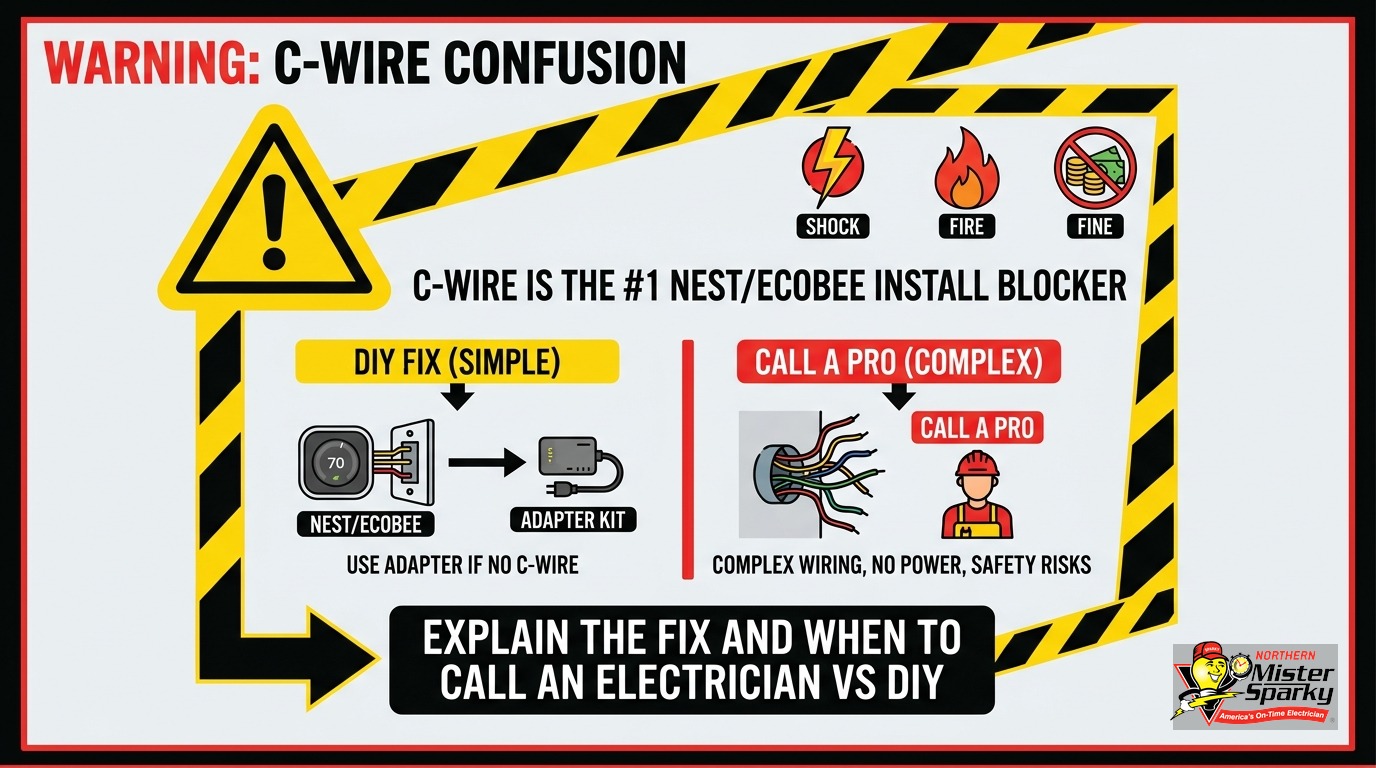
- A thermostat swap with an existing C-wire, or an Ecobee Power Extender Kit install, is within most homeowners’ DIY range. Running new cable through finished walls is a job for a licensed electrician.
- Xcel Energy offers a $50 ENERGY STAR smart thermostat rebate on qualifying models, plus a free ecobee through the AC Rewards program for homes with central air.
- Replacing a damaged furnace control board costs far more than a C-wire install. If your situation is complex, call a pro first.
What Is the C-Wire, and Why Does Smart Thermostat Wiring Depend on It?
The C-wire is the common return leg of your HVAC system’s 24V transformer circuit. Smart thermostats need it for continuous power so their Wi-Fi radio, touchscreen, and sensors can run around the clock, even when heating and cooling are completely off.
Old mercury-switch thermostats were passive devices. They drew a tiny pulse of electricity only when opening or closing a circuit to call for heat or cooling. They did not need to stay powered between cycles. You could run them on a single wire pair and everything worked fine.
Smart thermostats work differently. They run a small computer 24 hours a day. That computer manages scheduling, remote access, occupancy sensing, and a Wi-Fi connection that never sleeps. All of that requires a steady power source, not just a brief pulse every few hours.
A standard five-wire thermostat cable carries five conductors:
- R: 24V power from the transformer
- G: fan signal
- Y: cooling signal
- W: heating signal
- C: common (the return path that completes the 24V circuit)
The R wire delivers power. The C wire completes the circuit back to the transformer. Together they give the smart thermostat a reliable, continuous 24V supply to draw from.
If your thermostat cable only has four wires, the C conductor was simply never installed. Installers in the 1950s, 1960s, and 1970s pulled only what they needed, and older thermostats needed four wires, not five. This is the most common smart thermostat wiring problem we encounter in the Twin Cities, and it is the first thing worth checking before you buy a new thermostat.
The Minnesota Shoulder-Season Problem
Minnesota gives you two long stretches of mild weather every year. Spring runs roughly from mid-April through mid-May. Fall runs from mid-September through October. During those weeks, your furnace and air conditioner may sit completely idle for three, five, or even ten days in a row.
That idleness is exactly when smart thermostats without a C-wire cause the most damage.
Here is how it works. A smart thermostat without a C-wire needs to draw power from somewhere when the system is off. Most use a technique called power stealing, pulling a small electrical pulse from the W or Y signal wire during idle periods. That pulse keeps the thermostat’s electronics alive between heating and cooling calls.
The problem is what happens at your furnace. Sensitive HVAC control boards read that stolen pulse as a real call for heat or cooling. The system turns on. As soon as it does, the thermostat gains access to full circuit power and stops stealing. The system turns off because the call was never genuine. The thermostat starts stealing again. The cycle repeats rapidly. This is called short cycling, and it puts significant stress on the control board and other mechanical components.
HowToGeek notes that power stealing could result in a short circuit or damage components over the long term. The damage is gradual, which is what makes it so difficult to diagnose.
Consider the typical fall install scenario. You put in a Nest in early October. October evenings are cold, so the furnace runs frequently. When the system runs often, the thermostat gets real power most of the time and barely needs to steal anything. November and December are even colder. Everything works fine for months.
The following April, a warm week arrives. The furnace goes five days without a call. Power stealing runs nonstop. Short cycling starts. By the time a service tech arrives, nobody connects it to the thermostat installed six months earlier.
Homeowners in Minneapolis, St. Paul, Edina, Bloomington, Richfield, Columbia Heights, and every first-ring suburb face this exact timing every spring and fall. Knowing it in advance is what lets you plan around it.
Does Your Twin Cities Home Have a C-Wire?
If your home was built before 1980, the odds are against it. Pre-1980 Twin Cities homes commonly have 4-wire thermostat cable because old mercury-switch thermostats never needed a fifth wire. Check behind your existing wallplate before buying anything - a five-minute look now saves hours of troubleshooting later.
Here is how to check. Turn off power to your HVAC system at the breaker. Remove your existing thermostat from the wall. Look at the wires connected to the terminal block. Each wire connects to a labeled terminal.
If a wire connects to the terminal labeled C, you have what you need. A standard smart thermostat install will work without any additional wiring.
If the C terminal is empty, look carefully for a fifth wire coiled or folded behind the wallplate. Older homes sometimes include a spare conductor in the thermostat cable that was never terminated. The installer pulled a full 5-conductor cable but only connected four wires because the thermostat at the time did not need the fifth. That dormant wire, if present, can be connected at both ends without running any new cable through your walls.
If you find a coiled fifth wire, this is low-voltage work that most capable homeowners can handle: connect it to the C terminal at the thermostat location, trace it to the furnace, and connect the other end to the C terminal on the control board.
If there are only four wires and nothing spare, your options are an adapter kit or new cable. The next two sections cover both.
What Happens When a Thermostat Steals Power?
The thermostat pulls a small electrical pulse from the W or Y wire when the system is off. Sensitive control boards read that pulse as a real heating or cooling call. The system turns on and off rapidly in a loop called short cycling. This stresses the control board and can cause lasting damage over months or years.
The risk is real and documented. The smart thermostat install risk guide at SmartThermostatGuide.com notes that the problem can surface in under a day or take more than a year to appear, depending on your control board’s sensitivity and how often the system runs.
Some older, simpler control boards tolerate power stealing without issue for years. Newer high-efficiency furnaces with digital control boards are far more sensitive. There is no reliable way to know which category your furnace falls into without running it on a power-stealing thermostat and waiting, which means risking the board.
When a control board fails from short cycling stress, the repair includes the cost of the part plus a service call. That combined cost routinely exceeds what a licensed electrician would have charged to add a C-wire before the install. The no-C-wire path is not free. It trades a known upfront wiring cost for an uncertain but real equipment risk down the road.
If you have noticed your furnace running in short bursts more than usual, it is worth investigating the thermostat connection before assuming the cause is mechanical.
DIY or Call an Electrician: Which Path Fits Your Situation?
A straight thermostat swap or Ecobee PEK install is within reach for most capable DIYers. If you need to run new wire through finished walls, or if you have a heat pump, a dual-transformer system, or radiant/boiler heat, call a licensed electrician. Compatibility issues on complex systems can cause immediate control board damage.
Use this breakdown to decide your path:
DIY is reasonable when:
- Your existing wiring already includes a connected C-wire at both the thermostat and the furnace control board.
- A spare fifth conductor is coiled behind the wallplate and just needs connecting at both ends. This is low-voltage work and generally does not require a permit.
- You are installing an Ecobee with its included Power Extender Kit. The PEK mounts at the furnace control board and repurposes the G wire, combining the fan and cooling signals into one terminal. It works on most standard 4-wire gas furnace setups, though it is not compatible with dual-transformer or heat-only systems.
Call a licensed electrician when:
- You have no C-wire and no spare conductor. Running new 18/5 cable from the furnace to the thermostat location through finished walls requires drilling, wire fishing, and often drywall repair. It also sits in a permit gray zone under Minnesota DLI rules, and requirements vary by city. Minneapolis and Saint Paul each have local inspection authority that layers on top of the state baseline.
- Your system is a heat pump, dual-transformer, or radiant/boiler setup. These systems carry real compatibility risks, and a wiring mistake can damage the control board immediately.
- The property is a rental, a multi-unit building, or any structure that is not your homesteaded residence. Minnesota’s homeowner electrical exemption applies only to owner-occupied residential property. A licensed contractor is required by law for any other situation.
- You are not fully confident in tracing wires to the correct terminals. An incorrect connection at the control board can destroy it in seconds.
Our post on DIY electrical dangers walks through the scenarios where skipping a professional costs more in the end. Smart thermostat wiring is low-voltage, but the control board it connects to is not something you want to damage.
For questions about whether your specific project crosses the permit line, our Minnesota electrical permit guide explains what the state DLI requires and when your city adds its own layer of rules.
Can Minnesota Rebates Cut Your Upgrade Cost?
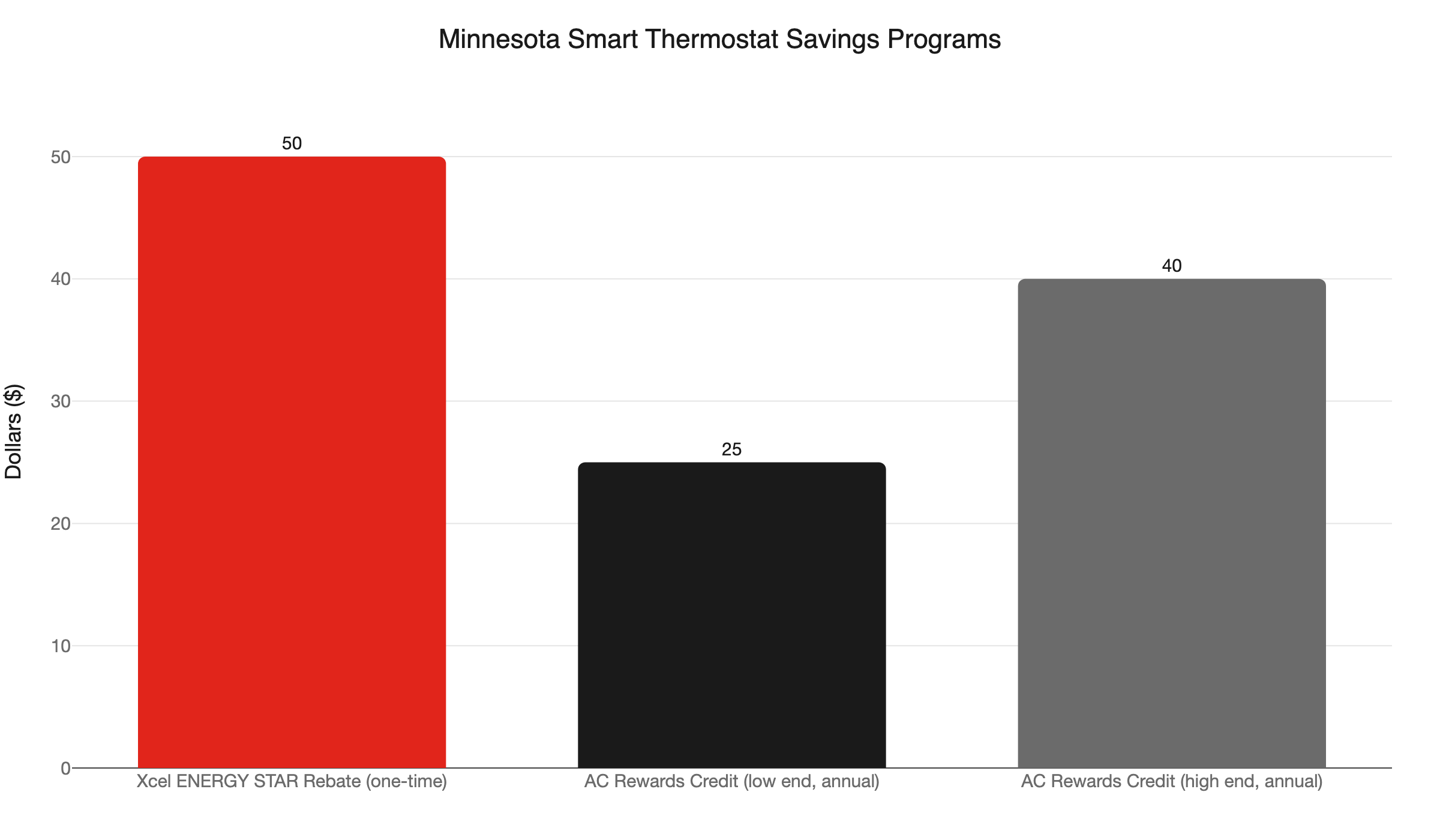
Yes. Xcel Energy customers can claim a $50 ENERGY STAR rebate on qualifying smart thermostats. The separate AC Rewards program provides a free ecobee3 lite plus a $25-40 annual bill credit for homes with central air, in exchange for limited demand-management cycling during peak events each season.
Here is how each program works in practice:
Xcel ENERGY STAR Smart Thermostat Rebate Xcel pays $50 back on qualifying smart thermostat purchases by residential customers. Buy the thermostat, submit the receipt through Xcel’s rebate portal, and the money comes back. This rebate applies to most major brands carrying the ENERGY STAR certification. It can be used with a standard purchase or alongside the C-wire install cost.
Xcel AC Rewards Program Xcel provides an ecobee3 lite at no cost and pays a $25-40 annual bill credit. In exchange, Xcel can cycle your central air conditioner during up to 10 peak-demand events per season. Customers can opt out of up to 5 events per year. The program requires central AC, a working Wi-Fi connection, and a residential Xcel electric account. It cannot be combined with the Saver’s Switch program.
There is one gap worth planning for. The AC Rewards program supplies the thermostat at no cost, but it does not wire your house. If your home lacks a C-wire, you still need that work done before the ecobee operates correctly. That wiring job is exactly what our team handles.
If you heat with natural gas through CenterPoint Energy (Minnesota Energy Resources), check the current thermostat rebate amounts directly on their site. Rebate programs and dollar amounts change annually, so verify before you purchase the equipment.
The rebates offset the hardware cost. Adding the C-wire is a separate electrical job, and it is one worth doing right.
What Does an Electrician Do to Add a C-Wire?
An electrician checks the existing cable for a spare conductor and connects it at both ends if one is present. If not, they run new 18/5 cable, verify control board compatibility, and test the full system through both heating and cooling cycles before leaving.
Here is what that process looks like in a typical Twin Cities home:
Step 1: Inspect the existing cable. The electrician removes the thermostat wallplate and looks at the cable. A spare fifth conductor coiled behind the plate means the hard part is already done. The job becomes: terminate the wire at the C terminal at the thermostat, trace the cable to the furnace, and land the other end at the C terminal on the control board. In a straightforward case, this can take less than an hour.
Step 2: Run new cable if needed. No spare wire means new 18/5 thermostat cable from the furnace to the thermostat location. In a home with an unfinished basement and open joists, this is a relatively quick run. Through finished walls in a 1960s rambler or split-level, it requires drilling through top plates and may involve patching drywall. Time and cost increase with the difficulty of the route.
Step 3: Verify control board compatibility. A qualified electrician reviews the control board before making any connections. Some older boards use non-standard terminal labeling. Some systems have multiple transformers. Checking first prevents a wiring mistake from becoming a board replacement.
Step 4: Test the complete system. After wiring, the electrician confirms the smart thermostat powers up, connects to Wi-Fi, and cycles the system through both heat and cool modes correctly. A proper end-to-end test confirms no short cycling is occurring and the control board is responding as expected.
If your home has an aging electrical panel or older wiring throughout, a C-wire visit is a natural opportunity to ask for a quick visual inspection of the system while someone is already on-site. Catching a panel problem early costs far less than an emergency call later.
For homeowners planning a larger project, a C-wire addition pairs efficiently with smart home pre-wiring work, whether that means structured cabling, in-wall audio runs, or low-voltage planning throughout the house. Combining those scopes in a single visit is more efficient than scheduling separate trips.
Ready to Schedule?
Our team is locally owned and operated in the Twin Cities. As America’s On-Time Electrician(R), we show up when we say we will. The UWIN(R) 100% satisfaction guarantee backs every job we complete.
No malarky: if we look at your setup and find a spare fifth wire already in the wall that just needs connecting, we will tell you that rather than suggest unnecessary work.
Call 763-200-5956 or book online to schedule a visit. We serve Minneapolis, St. Paul, Bloomington, Brooklyn Park, Woodbury, Blaine, Maple Grove, Plymouth, and the surrounding Twin Cities metro.
Frequently Asked Questions
Do I need a permit to add a C-wire in Minnesota? +
Will a smart thermostat work without a C-wire? +
How much does it cost to have an electrician add a C-wire? +
Does Xcel Energy offer rebates for smart thermostats? +
Need an electrician now?