
Solar Panel Electrical Requirements in Minnesota
Key Takeaways
- Minnesota law requires a licensed electrical contractor for all solar PV wiring. A Master Electrician must pull the permit.
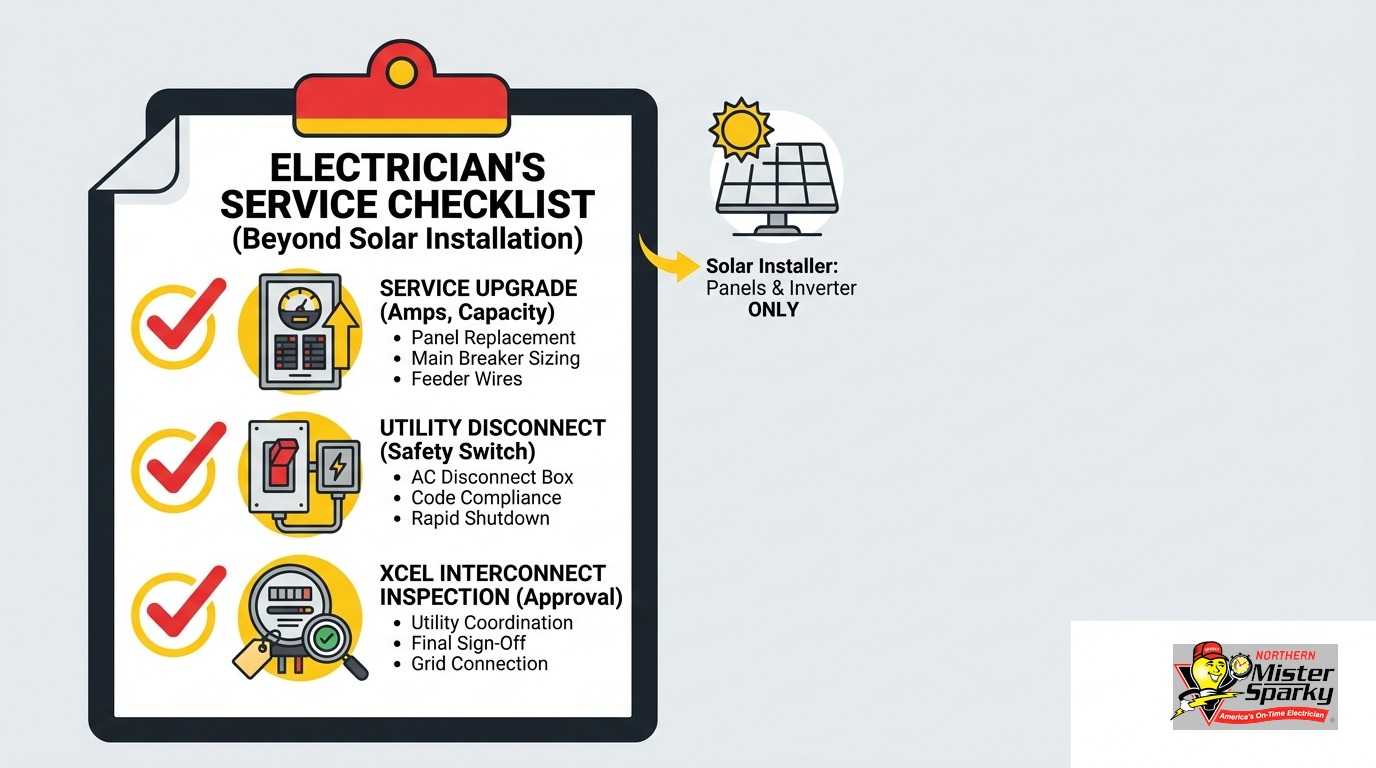
- The solar installer handles panels, racking, and DC wiring from panels to inverter. The electrician handles the AC disconnect, service entrance work, interconnection wiring, rapid shutdown design, and the permit.
- NEC 705.12’s 120% rule limits how much solar can backfeed into your panel. Systems larger than roughly 8 kW on a 200A service often require a panel upgrade or a supply-side connection.
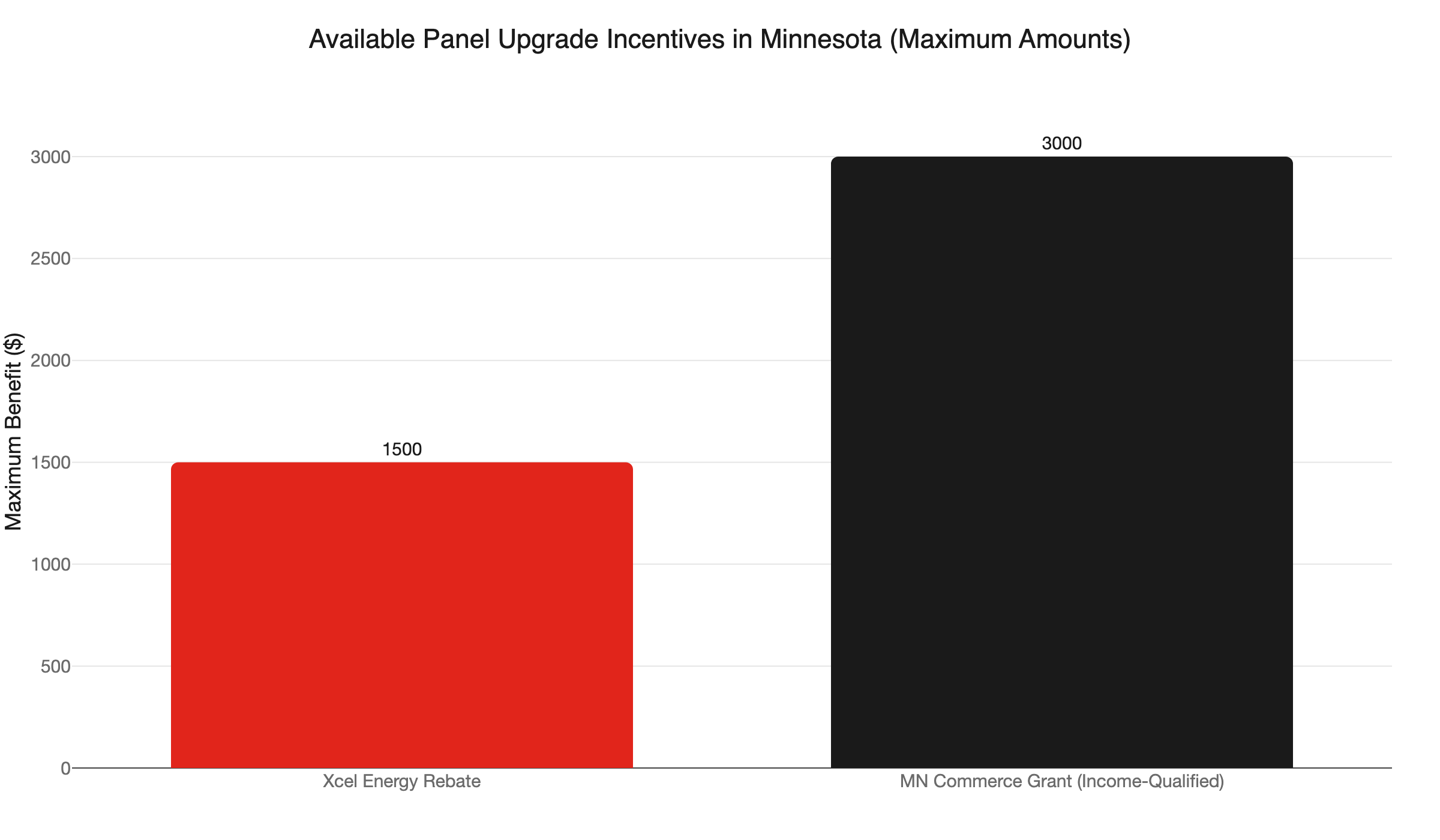
- Panel upgrades in Minnesota run $1,800 to $4,500 or more. Stack the Xcel Energy rebate (up to $1,500) with the Minnesota Commerce grant (up to $3,000, income-qualified) to cut out-of-pocket costs.
- The municipal electrical inspection must pass before Xcel schedules your net meter. You receive Permission to Operate when a red door hanger appears at your property.
- Call 763-200-5956 or book online before you sign a solar contract. The panel evaluation shapes every decision that follows.
Solar Panel Electrical Requirements in Minnesota: Two Crews, One Project
Most Twin Cities homeowners sign a solar contract and assume the solar company handles everything. That assumption is expensive. Understanding the solar panel electrical requirements in Minnesota means knowing exactly where the solar installer’s job ends and where the licensed electrician’s job begins. Those are two different scopes of work, and only one requires an electrical license.
Who Is Legally Required to Do the Electrical Work on a Solar Job?
Minnesota law requires all solar PV electrical work to be performed by a licensed electrical contractor. The solar company’s crew cannot do this work unless each member is also a licensed electrician. A Master Electrician must pull the permit under the authority having jurisdiction (AHJ) for your municipality. That is not a technicality. It is state law with enforcement behind it.
DLI confirmed this requirement and added a second layer effective July 1, 2023: the solar company contracting with you must also hold a licensed residential building contractor or remodeler license. Two licenses, two distinct scopes of work.
This split matters across the Twin Cities. Permit requirements vary by municipality. What Minneapolis requires differs from Minnetonka, Andover, or Blaine. The electrician must pull the permit under the correct local AHJ. They are responsible if the installation does not pass inspection.
Look at your solar contract before you sign. It should name the electrical subcontractor, their license number, and the AHJ where the permit will be pulled. If those three items are not in the paperwork, push for them. This protects you if the inspection fails or the job gets delayed.
If your solar quote does not name a specific licensed electrical subcontractor, ask who is pulling the permit. That question should have a clear, immediate answer.
What Does the Electrician Actually Handle on a Solar Project?
The electrician owns every piece of the system that connects to your home’s utility service. That includes the AC disconnect, interconnection wiring from the inverter to the service entrance, any service upgrade or supply-side connection work, rapid shutdown compliance design, the electrical permit, and all inspection coordination. The solar installer handles panels, racking, and DC wiring only.
Here is the full breakdown of what falls in the electrician’s lane:
- Evaluating your existing panel under NEC 705.12’s 120% rule
- Deciding whether a service upgrade or a supply-side connection is the right path
- Installing the AC disconnect per NEC 690.13 in a utility-accessible location
- Wiring the inverter’s AC output to your load-center or utility meter
- Designing the rapid shutdown solution required by NEC 690.12
- Pulling the electrical permit with the correct local AHJ
- Coordinating the state or municipal electrical inspection
- Submitting inspection results to Xcel or your co-op for interconnection review
From the inverter forward, the work belongs to the electrician. Understanding that line is how you ask the right questions before signing anything.
See our guide to electrical permits for Minnesota homeowners to understand what the permit and inspection process looks like from your side of the project.
Does Your Panel Need an Upgrade Before Solar Can Go In?
Maybe. NEC 705.12 limits solar backfeed to your panel based on busbar rating and main breaker size. On a standard 200A service with a 200A busbar, a solar system larger than about 8 kW will often push past that limit and require either a panel upgrade or a supply-side connection upstream of the main breaker. An electrician makes this call, not a solar sales estimate.
Here is the math. NEC 705.12 states that 125% of the inverter’s continuous output current, added to the main breaker rating, cannot exceed 120% of the busbar rating. On a 200A panel with a 200A busbar, the maximum solar backfeed breaker is 40A, which equals roughly 32A continuous. A system at or above 8 kW often exceeds that ceiling on a standard residential service.
When the math exceeds the limit, the electrician chooses between two options.
Option 1: Service upgrade. Upgrade the panel to a higher busbar rating so the numbers comply with code. This is the most common path. It also future-proofs the home for an EV charger, heat pump, or other large loads added later.
Option 2: Supply-side connection. NEC 230.40 exception allows a connection upstream of the main breaker, bypassing the 120% rule entirely. This is a technically valid alternative. It requires a licensed electrician to evaluate the service entrance and execute the work. Not every panel location or utility will accommodate it.
Both options involve work only a licensed electrician can perform. The right choice depends on your current panel condition, your system size, and what the local utility will accept.
Panel upgrades in Minnesota run $1,800 to $4,500 or more, depending on amperage, panel brand, and utility requirements. That is a real number to budget, but incentives exist to offset it. See the rebate section below.
If you are not sure whether your panel is ready for solar, read our post on signs you need an electrical panel upgrade. Many of those symptoms show up before solar ever enters the conversation.
What Is the AC Disconnect, and Why Does the Electrician Install It?
The AC disconnect is a dedicated switch that lets your utility and first responders cut power to your solar system from outside the home. NEC 690.13 requires it on every PV system. Xcel Energy’s installation standard adds a placement rule: the utility AC disconnect and production meter must be co-located, readily accessible, and within 10 feet of the main service meter. Only a licensed electrician can install it.
The disconnect is a safety device first. If a firefighter needs to access your roof while your system is generating power, the disconnect gives them a way to kill that power from outside the structure. Xcel will not schedule net meter installation until the AC disconnect is in place and the electrical inspection has passed. There is no workaround for this step.
The electrician selects the correct disconnect for your system’s amperage, mounts it in the required location, wires it to the inverter output, and labels it to code. Incorrect labeling or placement will fail the inspection. The inspection must pass before Xcel moves on interconnection.
How Does the Rapid Shutdown Requirement Work?
NEC 690.12 requires rooftop solar conductors to de-energize to under 30 volts within 30 seconds of the AC disconnect opening. This protects firefighters who may need to work on a roof while the system is generating power. Minnesota adopted the 2023 NEC on July 1, 2023, so every residential solar system permitted in the Twin Cities must comply.
There are three common ways to meet the requirement. The electrician selects the method at permit time based on system design, product availability, and budget.
- Microinverters. Each panel gets its own small inverter. DC-to-AC conversion happens at the module, so no high-voltage DC ever runs across the roof. The system meets rapid shutdown automatically.
- DC power optimizers. Optimizers attached to each panel receive a shutdown command from the string inverter. Module voltage drops to safe levels within the 30-second window.
- PV Hazard Control System (PVHCS). Dedicated module-level shutdown devices that activate when the AC disconnect opens.
Each method carries different hardware costs and ongoing maintenance considerations. This is a real engineering decision with safety implications. The approved design appears in the permit drawings before installation starts. If your solar quote does not specify a rapid shutdown method, ask for it in writing before you sign.
How Does the Xcel Energy Interconnection Process Work?
Xcel Energy serves roughly 60% of Minnesota households and covers the full Twin Cities metro. Every solar project on the Xcel grid must follow a specific sequence before Permission to Operate is granted. The solar panel electrical requirements in Minnesota are not considered complete until this process finishes and the red door hanger appears at your property.
Here is the sequence from permit to PTO:
- Electrical permit issued. The electrician pulls the permit with the local AHJ before any work starts.
- Installation complete. The electrician finishes all AC work: disconnect, interconnect wiring from the inverter to the service entrance, and rapid shutdown compliance.
- Municipal or state electrical inspection. A state or local inspector verifies the installation before the system can be energized. DLI requires this step for every residential solar project in Minnesota.
- Interconnection application submitted. The application goes to Xcel with the final inspection report. For Level 1 systems under 10 kW, the application fee is $100. Solar*Rewards participants also submit a NABCEP certification form.
- Xcel document review. Xcel targets 3 business days once the final inspection report is uploaded.
- Bi-directional net meter installed. Xcel orders the meter and schedules a technician appointment at your property.
- Permission to Operate (PTO). You have PTO when a red door hanger appears at your door. Do not energize the system before that hanger arrives.
For systems requiring it, Xcel conducts an acceptance and witness test. The test confirms all inverters are operational, anti-islanding protection is active (the system must stop delivering power within 2 seconds of a simulated utility outage), and inverters restart with the required 5-minute staggered delay. The electrician’s interconnect wiring and labeling is what gets verified at that test. A labeling error or a loose connection means a failed test and a delayed Permission to Operate.
The DLI Solar PV resources page is the authoritative source for code factsheets, permit instructions, and inspector contacts across Minnesota.
What If You Are a Connexus Energy Customer?
Homeowners in Anoka County and parts of the northern metro may be on Connexus Energy rather than Xcel. Connexus requires a state electrical inspection first, then a Connexus final inspection and witness test before Permission to Operate is issued. The steps parallel the Xcel process. The contacts, forms, and timeline are different.
The northern metro has mixed utility territories. Anoka County is largely Connexus territory, but individual addresses can fall on different service boundaries. Check your utility bill if you are not certain who serves your home. Your electrician should confirm the serving utility before pulling any permit.
Your electrician must know which utility serves your address and pull the permit under that utility’s specific interconnection requirements. If your solar quote does not name your specific utility anywhere in the paperwork, ask before signing. “We handle interconnection” is not the same as “we know Connexus’s process and forms.”
How to Stack Rebates on a Panel Upgrade
A panel upgrade required by your solar project is not a pure cost. Real incentives exist to offset it, and stacking them requires the electrician’s work to be correctly documented and completed to code.
Xcel Energy panel upgrade rebate: Up to $1,500 for qualifying electrical panel upgrades that support home electrification. Available to Xcel residential customers. The rebate application requires documentation of the completed upgrade.
Minnesota Commerce residential panel upgrade grant: Up to $3,000 for income-qualified homeowners below 150% of the area median income. The program was established through the state legislature. Check the Minnesota Commerce Energy page for current launch status and application details.
Federal Investment Tax Credit (ITC): A portion of electrical upgrade costs directly tied to your solar project may qualify for the federal solar ITC. Talk to your tax advisor for current guidance and income thresholds.
These stack. A qualifying homeowner could offset $4,500 of panel upgrade cost through the Xcel rebate and the Commerce grant alone, before counting any federal credit. The electrician’s work, completed to code and documented at each step, is the foundation that makes each incentive claim possible.
If your project also involves adding an EV charger, see our post on EV charger installation in the Twin Cities. A panel upgrade for solar and a charger rough-in can often share a single service upgrade cost when planned at the same time.
Northern Mister Sparky offers financing options for panel and solar-prep electrical work. Ask when you book.
Ready to Add Solar? Start Here.
Call an electrician before you call a solar company. The panel evaluation determines your system size ceiling, whether a service upgrade is needed, and which interconnection path your home can support. Those decisions shape the solar contract, not the other way around. Signing before the electrical evaluation is done can lock you into a system size or cost that does not fit your actual service entrance.
We are locally owned and operated in the Twin Cities. Our team pulls permits across every metro AHJ, handles the AC disconnect and interconnect wiring, and stays in contact through every inspection step. As America’s On-Time Electrician(R), we show up when we say we will. No malarky. UWIN(R) is our guarantee.
For more on what a panel upgrade involves from start to finish, see our electrical panel upgrade service page.
Call 763-200-5956 or book online today. The electrical evaluation before your solar quote is the step most Twin Cities homeowners skip. It is also the step that determines whether the rest of the project goes smoothly.
Frequently Asked Questions
Do I need a separate electrician for my solar installation in Minnesota? +
What is the 120% rule for solar panels? +
How long does the Xcel Energy solar interconnection process take? +
What incentives are available for a panel upgrade tied to solar in Minnesota? +
Need an electrician now?