
Stair Lift Electrical Installation: A Twin Cities Guide
Key Takeaways
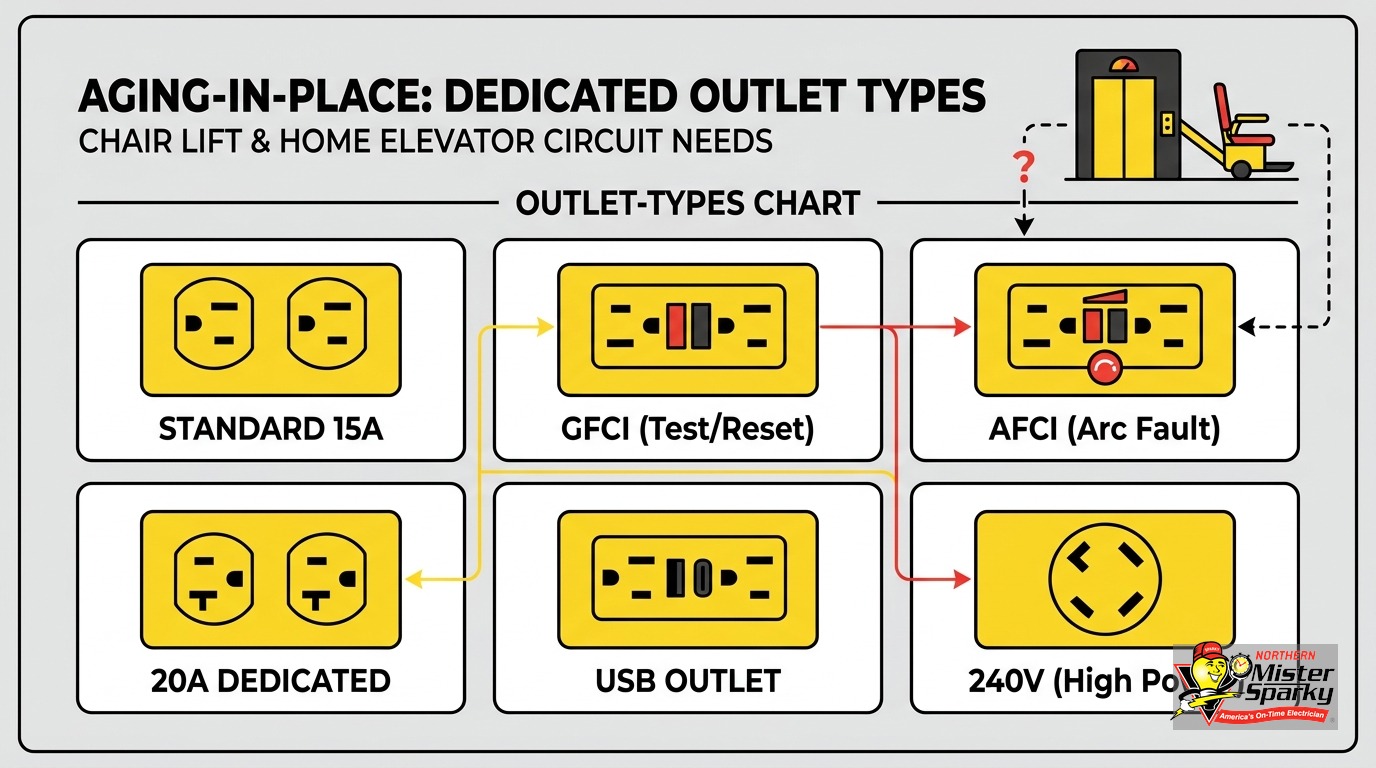
- Most indoor stairlifts run on a standard 120V/15A outlet. No dedicated circuit or panel work is required.
- The outlet must be within 6 feet of the charger station. If no qualifying outlet is nearby, you need one added.
- Outdoor stairlifts require a GFCI-protected outlet with a weatherproof in-use cover. A new outdoor GFCI outlet runs $250 to $500 installed.
- Home elevators are a completely separate job. NEC Article 620 requires dedicated branch circuits, GFCI receptacles in the pit and hoistway, and a lockable disconnect.
- Minnesota requires an electrical permit any time you add or extend a circuit. Starting without one triggers investigation fees.
- Older Twin Cities homes often carry a 100A panel. A licensed electrician should evaluate headroom before adding any new circuit.
- Stairlift costs may be fully deductible as a medical expense under IRS Publication 502. Home elevator costs require subtracting any appraised home value increase first.
- A pending Minnesota grant program may offer up to $3,000 toward a 200A panel upgrade for income-qualified homeowners, though it had not yet launched as of early 2026.
Stair Lift Electrical Installation: The Question Most Dealers Skip
Aging in place is the goal for many Twin Cities homeowners and their families. A stairlift or home elevator can make staying in a home you love possible, even when stairs become a daily obstacle.
When families start shopping for either product, one question comes up fast: do we need an electrician?
The answer depends entirely on which product you choose. Most stairlifts plug into an ordinary outlet. Home elevators do not. The two products fall into completely different regulatory categories. Treating them as similar leads to surprises in scope, cost, and permits.
This guide covers what stair lift electrical installation actually involves. It starts with the standard indoor scenario and works through the full NEC Article 620 requirements that govern residential elevators. It also covers permits, older Twin Cities panels, and a tax deduction angle that most stairlift dealers never bring up.
Does a Stair Lift Actually Need Special Wiring?
For most indoor stairlifts: no. The unit runs on a standard 120V/15A outlet - the same type that powers a lamp or a small appliance. If an outlet sits within 6 feet of the planned charger station location, no new wiring is required.
According to published stairlift electrical requirements, a stairlift draws between 300 and 600 watts while moving. On the charger at rest, the draw drops to 5 to 15 watts. That load fits comfortably on a standard 15A household circuit with room to spare.
Manufacturers design stairlifts to run on ordinary household power. No dedicated circuit, no 240V supply, and no panel work is required for a typical indoor install. In most cases, the electrician confirms the outlet is within range and the circuit has enough capacity - and that is the full scope of the job.
There is one firm location rule. Charger cords run 6 to 8 feet long. The outlet must be within 6 feet of where the charger station will mount on the rail. Measure before you assume the existing outlet qualifies. If the distance works, you are done. If it does not, you need an outlet added before the installer arrives.
What If There Is No Outlet Near the Staircase?
Adding a single outlet is a straightforward job. A licensed electrician runs wire from a nearby circuit with available capacity, installs a properly rated receptacle at the right location, and the stairlift dealer can proceed. In older homes, we verify circuit capacity before tapping in.
In older Twin Cities homes - a 1958 St. Paul colonial or a 1963 Plymouth split-level - we check the target circuit first. Original wiring from that era may run a smaller gauge than modern installations, or the circuit may be near its capacity already. We confirm the numbers before tapping into it.
If the existing circuits cannot safely absorb one more device, we either run a short new circuit from the panel or we have a larger conversation about the panel itself. Our outlet installation service covers what that work typically involves and how to schedule a visit.
Does an Outdoor Stair Lift Have Different Electrical Requirements?
Yes, and this is where stair lift electrical installation gets meaningfully more involved. An outdoor stairlift cannot use a standard indoor outlet. It requires a GFCI-protected outlet with a weatherproof in-use cover. Installing an indoor outlet on an exterior wall is a code violation.
Per outdoor stairlift electrical guidelines, the wiring must use conduit - EMT or PVC - or UF-rated cable, depending on your local jurisdiction. A new weatherproof GFCI outlet installed to exterior costs $250 to $500 installed. Adding a dedicated branch circuit to that location adds another $300 to $500.
Our outdoor GFCI outlet installation guide covers what a proper outdoor outlet job involves, including the conduit and cover requirements that apply in Minnesota. That work requires a permit and an inspection. We handle both as standard parts of the job.
Twin Cities winters add a practical dimension to outdoor electrical work. The outlet location must stay protected from snow, ice melt runoff, and freeze-thaw moisture intrusion. Weatherproofing here is a functional requirement, not just a code checkbox.
Stair Lift vs. Home Elevator: Two Completely Different Jobs
A stairlift is a plug-in appliance. A residential elevator is a permanent mechanical structure. That single distinction creates two separate permit tracks, two separate inspection processes, and two very different scopes of electrical work.
A stairlift occupies one outlet on an existing household circuit. No structural or mechanical permits apply on the electrical side. The stairlift dealer handles the rail and drive system. The electrician adds an outlet if one is needed nearby.
A home elevator is a different matter. It requires its own dedicated branch circuits, GFCI protection at several specified locations, and a lockable safety disconnect. The mechanical installer and the licensed electrician coordinate timing. The electrical rough-in must happen while the hoistway is still open. Once the cab is installed, revisiting certain electrical runs becomes expensive. In Minnesota, only a licensed elevator contractor can install the lift mechanism. The electrical rough-in must still be pulled by a licensed electrician, regardless of who installs the cab.
If a contractor quotes you identical electrical work for a stairlift and a home elevator, push back. The two scopes are not remotely close.
What Does NEC Article 620 Require for a Residential Elevator?
A home elevator triggers NEC Article 620, which requires dedicated branch circuits, GFCI receptacles at multiple specific locations, and a lockable disconnect in the machine room. This is a multi-circuit job with placement rules that go well beyond a stairlift outlet.
According to NEC requirements for elevators and escalators:
- Section 620.22 requires a separate dedicated branch circuit for the car lights, receptacles, auxiliary lighting, and ventilation. Each of those is its own circuit. They cannot share.
- Section 620.6 requires that all 15A and 20A 125V receptacles in the pit, hoistway, and on the car be GFCI-protected.
- Pit lighting is the exception. Pit lights must NOT be on a GFCI circuit. A tripped GFCI should never leave someone stranded in the dark. Pit lighting runs on its own separate circuit, no GFCI protection.
- The lockable disconnect must be located in the machine or control room, accessible only to qualified personnel.
In Minnesota, the DLI elevator permits and inspections page describes how stairway chairlifts and residential vertical platform lifts go through a separate, lighter inspection process using VuSpex Go offline field reports. A full residential elevator requires a more extensive permit and inspection track. The licensed elevator contractor handles the mechanical scope. The licensed electrician handles the rough-in permit.
Coordination between trades matters more here than on most residential jobs. Rough-in wiring goes in while the hoistway is accessible. Once the elevator cab is set, certain work becomes a costly tear-out to revisit.
Do You Need an Electrical Permit in Minnesota?
Yes, if any new wiring is involved. Minnesota requires an electrical permit any time you add or extend a circuit. No permit is needed if a qualifying outlet already exists and no wiring changes are made. The moment you run new wire or install a new outlet, the permit is mandatory.
The Minnesota Department of Labor and Industry is the electrical inspection authority for most of the state. About 66 cities in Minnesota - including Minneapolis, St. Paul, and several Twin Cities suburbs - have local electrical inspection authority and run their own permit forms and fee schedules. The work requirements are the same. The paperwork goes to the city, not the state.
Starting work before filing a permit triggers investigation fees on top of the standard permit cost. We pull the permit before work begins. No surprises, no malarky.
Minnesota adopted the 2026 NEC effective August 17, 2026. Permits filed before that date must comply with the 2023 NEC. Permits filed on or after that date must comply with the 2026 NEC. If you are in the planning stage now, the applicable code depends on when the permit is filed.
Our Minnesota electrical permit guide walks through what a homeowner should expect from permit filing through inspection sign-off.
What About Older Twin Cities Panels?
Homes built before 1970 in Minneapolis or St. Paul often carry a 100A service panel. Before we add any new circuit, a licensed electrician checks panel headroom. If the panel is near capacity, adding even a modest circuit is not safe without addressing the panel first.
Minneapolis and St. Paul have a large stock of homes built between 1945 and 1970. Many still carry original 100A service. That capacity was sized for a different era of home appliances. Today’s households run central air, an electric range, a home office setup, and increasingly an EV charger or electric heating system. A stairlift outlet draws very little on its own - but if the panel is already near its limit, a small addition is still an addition.
Before we add any circuit, we assess panel headroom. If the panel can absorb the new load, the work is quick. If it cannot, we have an honest conversation about upgrading. A panel upgrade is often the right call anyway if the household is also planning an EV charger, an induction range, or a mini-split system.
Our 100A vs. 200A electrical service guide explains what panel headroom means in practical terms and when an upgrade pays off.
A Minnesota program offers up to $3,000 toward a 200A panel upgrade for income-qualified homeowners at or below 150% AMI. The Residential Electrical Panel Upgrade Grant was awaiting U.S. DOE approval as of early 2026 and had not yet launched. Grants are not retroactive. If you may qualify, track the program timeline before scheduling your panel work.
Can You Deduct Stair Lift Electrical Installation on Your Taxes?
Possibly - and the rules differ sharply between stairlifts and home elevators. Both can qualify as a medical expense under IRS Publication 502, but the calculation is different, and the difference can be worth thousands of dollars.
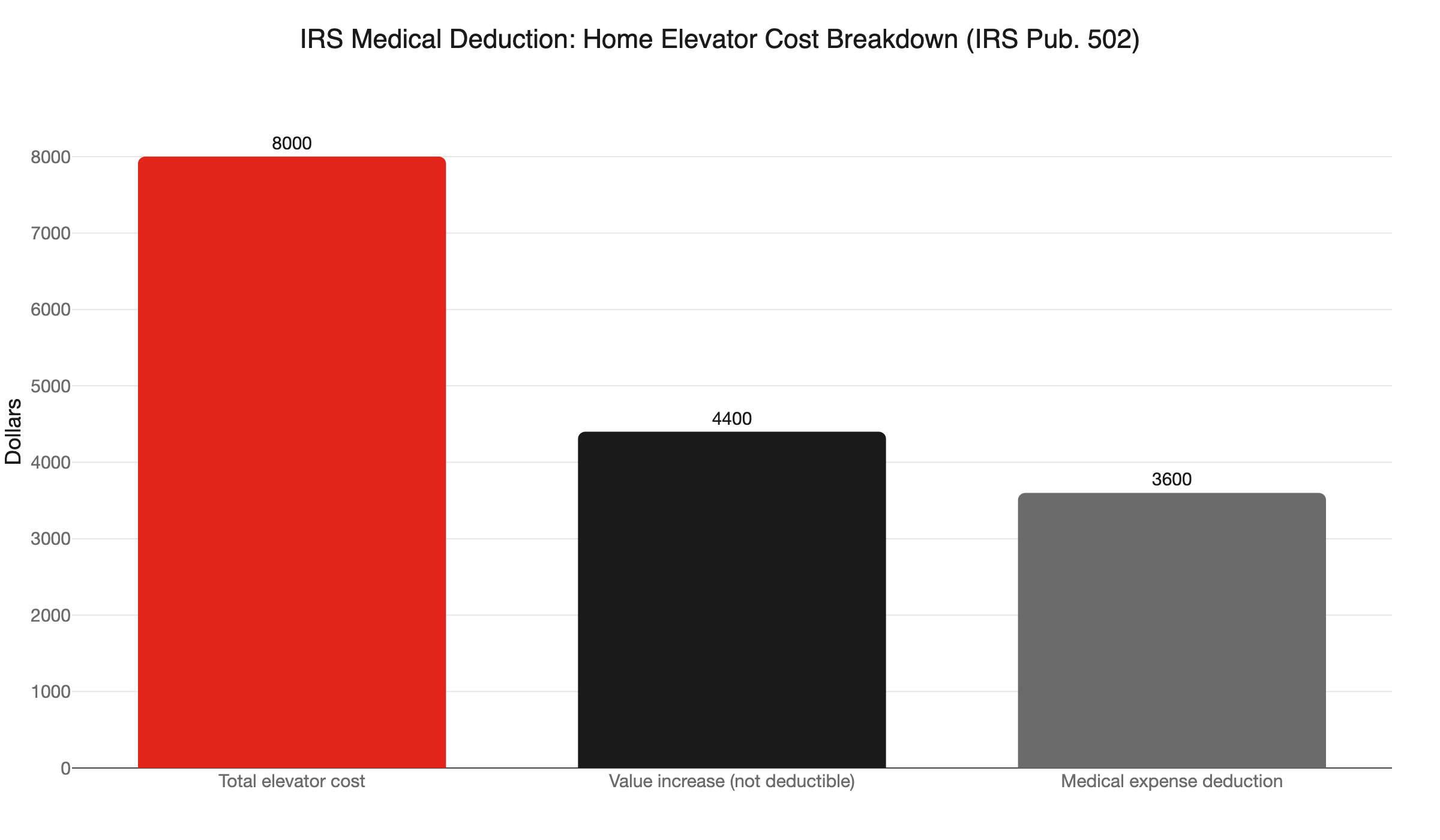
Per IRS Publication 502, home improvements made for medical reasons are potentially deductible as medical expenses above the 7.5% adjusted gross income floor, with a doctor’s written recommendation. The deductible amount depends on whether the improvement increases home value.
Stairlifts generally do not add home value. The IRS recognizes this. The full cost of a stairlift project - including the electrician’s outlet work - is potentially deductible in full as a medical expense.
Home elevators are treated differently. They do add value to a home. The deductible amount is the total project cost minus the appraised value increase. If an $8,000 home elevator project results in a $4,400 increase in appraised home value, the deductible medical expense is $3,600. See the chart above for a visual breakdown of how that math works.
Get a qualified appraisal before filing. Confirm the numbers with a CPA. We can provide an itemized invoice that separates the electrical rough-in cost from the rest of the project. That separation may help your tax preparer document the deduction accurately.
We are electricians, not tax advisors. The CPA handles the return. We make the invoice clear.
Are There Grants or Rebates to Help Cover the Cost?
No Xcel Energy rebate covers stairlift or elevator outlet work. Two other resources exist for Minnesota homeowners: the Live Well at Home program through Minnesota DHS, and a pending $3,000 panel upgrade grant for income-qualified homeowners that had not yet launched as of early 2026.
Xcel’s current Minnesota residential rebate program covers heat pumps, central AC, smart thermostats, insulation, and water heaters. Accessibility modifications are not on the list.
Live Well at Home (Minnesota DHS): The Live Well at Home program funds home modifications that support aging in place, including structural and accessibility work. The funds do not go directly to homeowners. They flow to local grantee organizations through Area Agencies on Aging. Contact your local Area Agency on Aging to ask about active grant cycles and whether your project qualifies.
Minnesota Residential Electrical Panel Upgrade Grant: Income-qualified homeowners at or below 150% AMI may receive up to $3,000 toward a 200A panel upgrade through the state’s $5.8 million program. As of early 2026, the program was still awaiting U.S. DOE approval and had not launched. Grants are not retroactive.
If your accessibility project will also require a panel upgrade, the timing of the grant launch is worth factoring into your schedule before committing to a project start date.
What Northern Mister Sparky Handles
We are locally owned and operated in the Twin Cities. When you call us about a stairlift or home elevator project, here is what we scope:
Stairlift, indoor: We confirm the existing outlet qualifies based on location and circuit capacity. If it does not, we add one. We pull a permit if new wiring is involved.
Stairlift, outdoor: We install a weatherproof GFCI outlet with proper conduit on a qualifying circuit. We pull the permit and coordinate the inspection.
Residential elevator rough-in: We scope and install the full branch circuits, GFCI receptacles, and lockable disconnect to NEC Article 620 standards. We coordinate rough-in timing with the elevator contractor and handle all electrical permits and inspections.
Panel assessment: We evaluate capacity before adding any circuit. If the existing panel cannot safely carry the new load, we tell you before work starts - not after.
Financing is available for larger jobs, including panel upgrades and elevator rough-ins. Ask when you call.
We are America’s On-Time Electrician(R). We show up when we say we will, and the UWIN(R) guarantee backs every job we do.
Ready to Schedule Your Stair Lift Electrical Installation?
Whether you need a simple stairlift outlet in Maple Grove or a full elevator rough-in in Edina, call us before anything else. We will tell you exactly what the electrical scope looks like - and what it will cost - before any work starts.
Call 763-200-5956 or book online.
We serve Minneapolis, St. Paul, Bloomington, Brooklyn Park, Woodbury, Blaine, Maple Grove, Plymouth, and the surrounding Twin Cities metro.
Frequently Asked Questions
Does a stair lift need a dedicated circuit? +
What electrical work does a home elevator require? +
Do I need an electrical permit for stair lift electrical work in Minnesota? +
Is stair lift electrical installation tax-deductible? +
Need an electrician now?