
Steam Shower Generator Electrical Requirements Explained
Key Takeaways
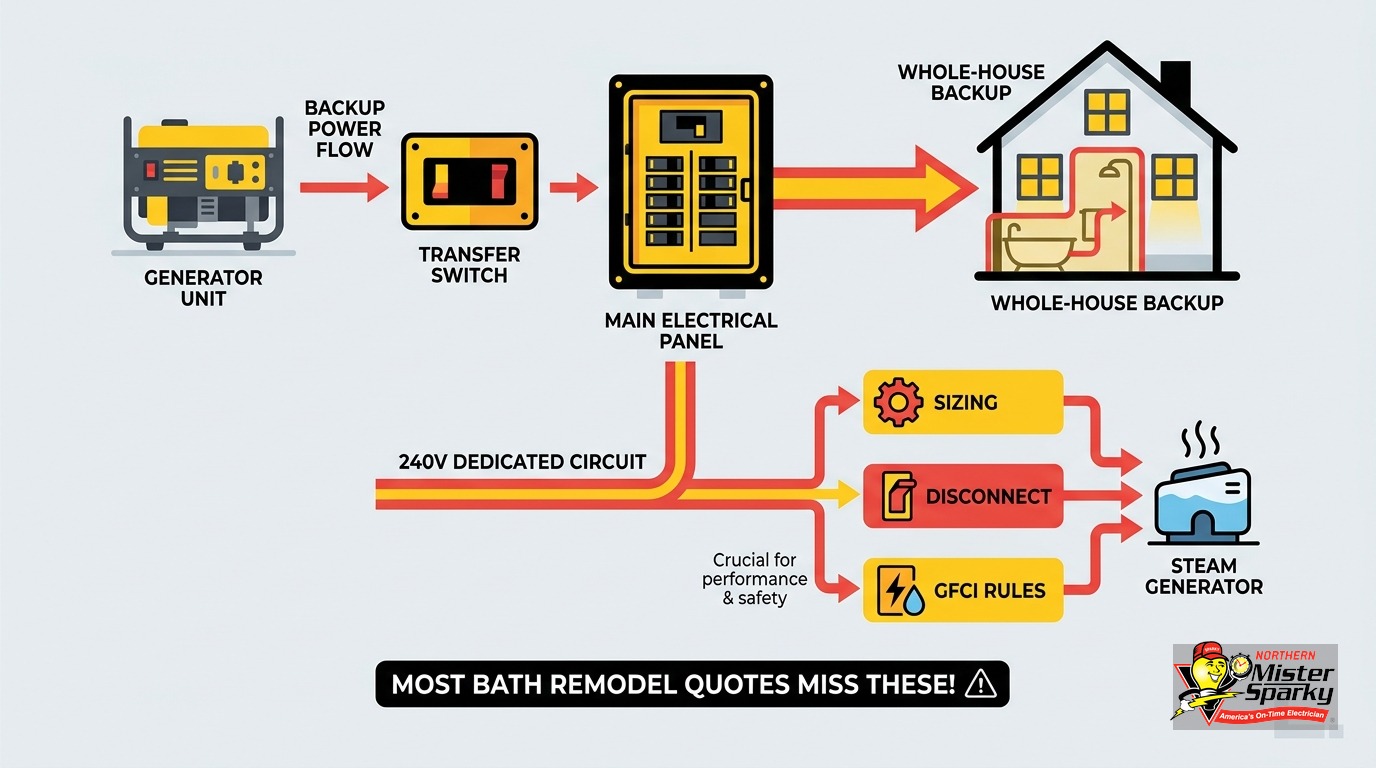
- Every steam generator needs its own dedicated 240V circuit. No appliance sharing - that is both an NEC requirement and a manufacturer requirement.
- Breaker and wire size are set by the 125% continuous-load rule, per NEC Sections 210.19 and 215.2. A 10 kW unit requires a 60A breaker and #6 AWG copper wire.
- A hardwired 240V steam generator in a bathroom requires GFCI protection under current NEC rules. Most bath remodel scopes skip this item entirely.
- If the electrical panel is not within sight of the generator, NEC 422.31(B) requires a separate disconnect switch near the unit.
- In Minnesota, the electrical permit for the steam circuit is separate from the GC’s remodel permit. A licensed electrical contractor must pull it.
- Older Twin Cities homes on 100A or 150A service may need a panel upgrade before the steam circuit can be added.
What Are the Steam Shower Generator Electrical Requirements?
Short answer: A steam generator needs a dedicated 240V circuit sized at 125% of the unit’s running amperage. It also needs GFCI protection on the hardwired feed, likely a nearby disconnect switch, and a separate electrical permit pulled by a licensed Minnesota electrician - not your GC.
Steam generators are hardwired, permanently installed appliances. They run on 240 volts and are not plug-in devices. That classification puts them under a different set of NEC rules than a standard bathroom receptacle.
Three code layers apply to every steam generator installation:
- Circuit sizing. The generator’s kW rating determines the breaker size and wire gauge. The 125% continuous-load rule sets the minimum.
- GFCI protection. Hardwired 240V equipment in a bathroom requires GFCI protection. Most GC-written specs miss this entirely.
- Disconnect switch. If the panel breaker is not within sight of the generator, a separate disconnect is required near the unit.
Getting all three right is the difference between a first-time pass on inspection and rework after the tile is already on the wall.
How Do You Size the Circuit for a Steam Generator?
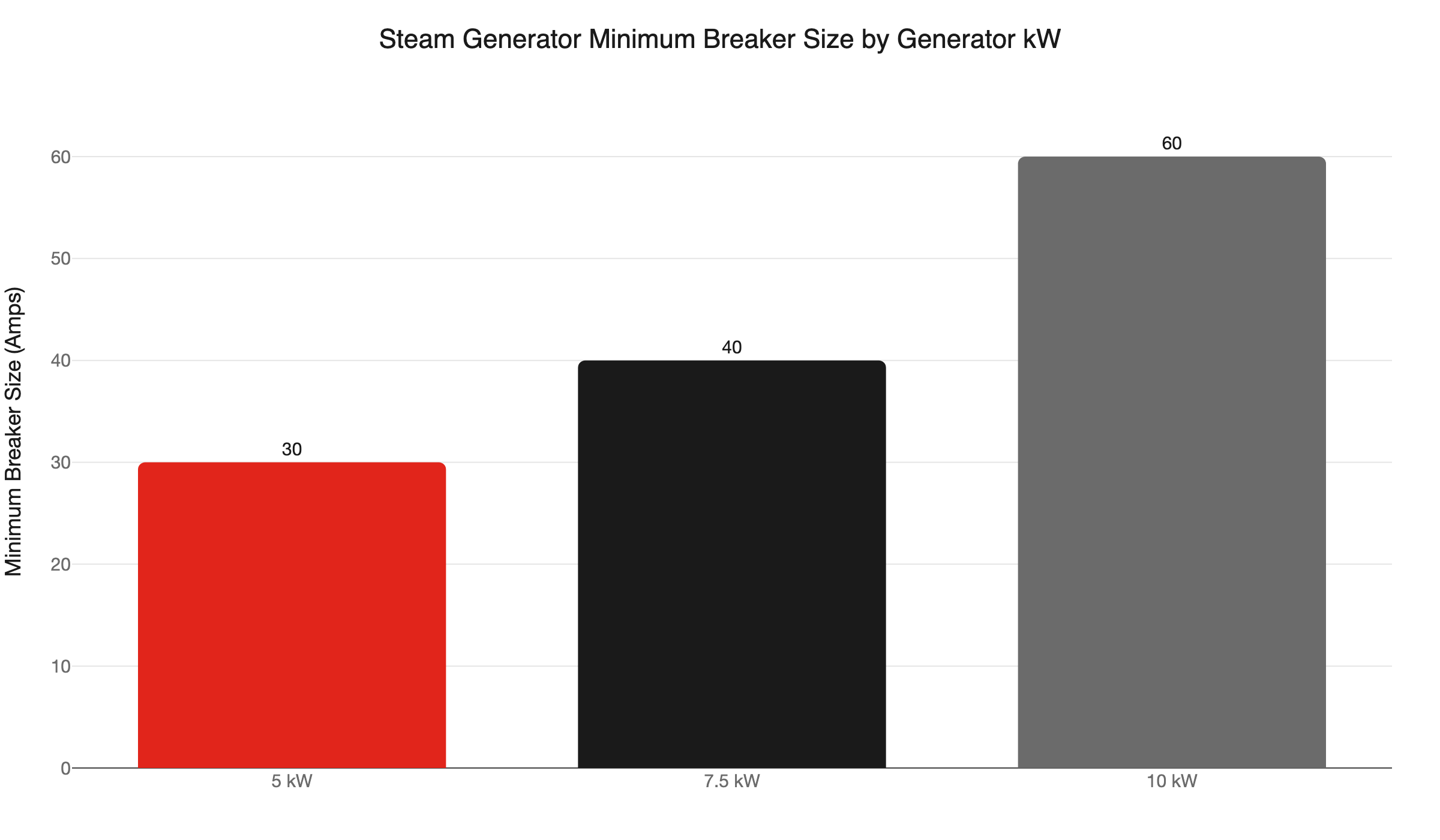
Short answer: Divide the generator’s wattage by 240V to get the running draw, then multiply by 1.25. A 10 kW unit draws 41.7A and requires a 60A breaker - not the 40A circuit a generic “add 240V circuit” spec often provides.
Steam generators qualify as continuous loads under the NEC. They operate for three or more hours at a stretch. NEC Sections 210.19 and 215.2 require that circuits serving continuous loads be sized at 125% of the load’s running amperage.
The sizing formula has three steps:
- Divide the generator’s wattage by 240V. That gives you the running amperage.
- Multiply the running amperage by 1.25. That gives you the minimum breaker rating.
- Match wire gauge to that breaker size.
Here is how the math works out across common generator sizes:
- 5 kW: 20.8A running draw. Minimum 30A breaker. #10 AWG copper wire.
- 7.5 kW: 31.3A running draw. Minimum 40A breaker. #8 AWG copper wire.
- 10 kW: 41.7A running draw. Minimum 60A breaker. #6 AWG copper wire.
- 12 kW+: 50A+ running draw. 60A+ breaker. #4 AWG copper wire.
These figures align with published installation manuals from major steam generator manufacturers. Always verify the exact specs against the install manual for the specific unit you purchase. Specs can vary between models and product generations.
Most bath remodel quotes that mention a steam generator do not specify a kW size for the unit. That is a problem. A 40A circuit is adequate for a 7.5 kW generator and undersized for a 10 kW one. Confirm the generator model with the homeowner before the electrician quotes the scope. The circuit size follows the unit size.
One more manufacturer-side rule: most brands require the generator to be within 25 feet of the steam enclosure, measured as the actual wire run, not a straight line. Beyond that limit, voltage drop and steam output pressure can suffer. That constraint shapes where the unit gets installed, which in turn affects the disconnect switch requirement.
For more on dedicated circuit requirements for other high-draw appliances, see dedicated circuits for appliances.
Does a Hardwired 240V Steam Generator Need GFCI Protection?
Short answer: Yes. Under 2020 and later NEC rules, “outlet” includes hardwired equipment, not just receptacles. A hardwired 240V steam generator in a bathroom requires GFCI protection. Nearly every GC-written remodel spec misses this requirement.
This is the requirement that trips up the most projects.
NEC Section 210.8(A)(1) requires GFCI protection for all bathroom outlets in dwelling units. The 2020 NEC updated the Article 100 definition of “outlet” to include permanently installed hardwired equipment, not just cord-and-plug devices or standard receptacles. That change brought hardwired 240V appliances in bathrooms under the GFCI rule.
Many general contractors still work from the pre-2020 interpretation. Under that older reading, GFCI applied only to 15A and 20A 125V receptacles. That interpretation is outdated. Both the 2023 and 2026 NEC include the GFCI requirement for hardwired bathroom equipment.
What happens at inspection if the GFCI is missing? The inspector fails the rough-in. You cannot get final approval on the electrical permit, and that holds up final approval on the remodel permit as well. The generator cannot be connected until the correct breaker is installed. If the wall is already drywalled at that point, swapping the breaker is the easy part. Explaining to the homeowner why the inspection failed on a code requirement that has been in the NEC since 2020 is the harder conversation.
In practical terms: the steam circuit needs a 2-pole GFCI breaker, not a standard 2-pole breaker. A 2-pole GFCI breaker costs more than a standard breaker - typically $80 to $150 more, depending on panel brand and amperage. If your remodel quote does not specify a GFCI breaker on the steam circuit, that line item is missing from both the scope and the budget.
Minnesota adopted the 2026 NEC effective August 17, 2026. Permits filed on or after that date require 2026 NEC compliance. Permits filed before that date require 2023 NEC compliance. The GFCI obligation applies under both code cycles.
What Is the Disconnect Switch Rule for Steam Generators?
Short answer: NEC 422.31(B) requires a readily accessible disconnect near any permanently connected appliance over 300VA when the panel is not within sight of the equipment. Steam generators almost always trigger this because the unit lives in a vanity cavity, closet, or adjacent room - out of sight from the panel.
“Within sight” has a specific NEC definition: visible from the equipment location and within 50 feet. A panel in the basement, on the opposite side of the house, or around a corner does not meet that standard.
The disconnect is typically a small fused safety disconnect box mounted within a few feet of the generator. Its purpose is straightforward: it lets an electrician or first responder de-energize the unit without walking to the main panel. It is a modest addition to the scope. It is also a code requirement whenever the generator is out of sight from the panel, which is almost every installation.
When evaluating electricians for the job, ask directly whether the planned generator location triggers the NEC 422.31 disconnect requirement. A clear, confident answer is one signal of solid code knowledge. Hesitation or confusion about the question is another kind of signal.
What Does Minnesota Law Require for the Electrical Permit?
Short answer: The electrical permit is separate from the GC’s remodel permit. Minnesota Statute 326B.35 requires all wiring to comply with the NEC as prima facie evidence of accepted construction standards. In most cases, a licensed electrical contractor must pull the permit - not the homeowner and not the GC.
Minnesota’s Department of Labor and Industry oversees electrical contractor licensing and permitting. You can verify a contractor’s license and confirm current requirements at dli.mn.gov.
Several specifics to know before the project starts:
- Two permits, not one. The GC pulls a building permit for the remodel. The electrician pulls a separate electrical permit for the new circuit. These are different permits, different inspectors, and different timelines.
- Homeowner permit limitations. Minnesota homeowners can pull permits for work on their own primary residence under specific, narrow conditions. A steam generator installation in a bath remodel almost certainly falls outside that scope. Confirm current eligibility directly with DLI before assuming you can permit the work yourself.
- Code transition. Permits filed before August 17, 2026 require 2023 NEC compliance. Permits filed on or after that date require 2026 NEC compliance. If your remodel spans that date, confirm which code cycle applies with your electrician before rough-in starts.
- Two inspections. Rough-in inspection happens before walls close. Final inspection happens after the generator is connected and operational. Build both into your project schedule.
Skipping the electrical permit is not a cost savings. Uninspected work can affect your homeowner’s insurance coverage, surface problems at closing, and leave genuine code violations behind finished walls. For more on the permit process in Minnesota, see electrical permits in Minnesota.
Will a Steam Generator Fit in Your Current Electrical Panel?
Short answer: Maybe. A 10 kW generator needs a double-pole 60A breaker - a significant load on any panel. Many older Twin Cities homes run on 100A or 150A service. Before committing to the upgrade, have a licensed electrician calculate total connected load and confirm available panel capacity and slots.
Panel capacity is the question nobody asks until the electrician opens the box.
A 200A service with available slots and a manageable total load can typically absorb a 60A steam circuit. The issue is that a significant share of Twin Cities housing stock runs on 100A or 150A service. Pre-1980 Craftsman bungalows, postwar ramblers, and early split-levels are common in Minneapolis, St. Paul, Bloomington, and the inner-ring suburbs. A 150A panel supporting an HVAC system, an electric range, an electric dryer, and a full circuit load may not have 60A of headroom. A service upgrade may be part of the job.
If a panel upgrade is needed, plan it alongside the bath remodel. One mobilization, one permit timeline, one inspection sequence. Adding the panel upgrade as a separate project after the bathroom is finished costs more and disrupts more.
Read more about the signs that point to a panel upgrade in signs you need an electrical panel upgrade.
The Electrical Scope a Complete Steam Shower Quote Includes
Bath remodelers know tile and fixtures. Most know the generator needs a 240V circuit. Very few know the GFCI obligation on that hardwired feed, the disconnect rule under NEC 422.31, or how to apply the 125% continuous-load formula to wire and breaker sizing.
That is not a knock on GCs. Code-compliant electrical work is a licensed electrician’s domain, not a remodeler’s. The gap is a scope gap, not a competence gap. The problem is that homeowners do not always know to ask for the full electrical scope as a separate line item.
A properly scoped steam generator installation includes all of the following:
- A dedicated 240V circuit with breaker and wire sized correctly using the 125% continuous-load rule
- A 2-pole GFCI breaker on that circuit
- A disconnect switch near the generator when the panel is not within sight
- An electrical permit pulled by a licensed electrical contractor
- A rough-in inspection before walls close
- A final inspection after the generator is connected and running
If your bath remodel quote says “add 240V circuit for steam generator” and nothing else, at minimum the GFCI breaker, the disconnect switch, and the permit are missing from the scope. Those are real costs and real code requirements.
The right time to scope the electrical correctly is before the remodel starts. The rough-in window - before drywall closes the walls - is the lowest-cost point to get everything in. Adding a GFCI breaker after the fact is panel work. Adding a disconnect switch after tile is set means opening finished walls. Neither conversation goes well with a homeowner who thought they were done.
Common Questions About Steam Generator Electrical Work
Can I use an existing 240V circuit for the generator?
No. Steam generators require a dedicated circuit. Sharing with another appliance violates NEC requirements and most manufacturer warranties. Any existing 240V circuit in the bathroom is already committed to its current load.
What if the generator needs to go in an adjacent closet or utility space?
That is a common and acceptable location. The generator must be outside the shower enclosure - most manufacturers require it. An adjacent closet or vanity cavity works well, provided the wire run stays within 25 feet of the enclosure and the space is accessible for service. All GFCI and disconnect requirements still apply regardless of where the unit is installed.
Does a smaller 5 kW generator have lighter code requirements?
No. The GFCI obligation, the disconnect rule, and the permit requirement apply regardless of generator size. The circuit is smaller - a 5 kW unit needs a 30A breaker and #10 AWG wire - but the code framework is identical. There is no small-generator exemption.
How long does the rough-in take?
For a straightforward panel-to-bathroom run on the same floor of a 200A house, plan on roughly half a day for rough-in. A longer run, a disconnect switch, or a panel upgrade adds time. An electrician can give a realistic timeline after a site visit. Most do free estimates.
Get the Electrical Scope Right Before the Tile Goes In
We are locally owned and operated in the Twin Cities, and we are America’s On-Time Electrician(R). Our team handles the full electrical scope for steam shower installations: continuous-load circuit sizing, 2-pole GFCI breakers, disconnect switches, permits, and inspections. Our UWIN(R) 100% satisfaction guarantee backs every job.
If your bath remodel is already underway and the GC scoped only “a 240V circuit,” call us before the walls close. Adding the GFCI breaker and disconnect switch during rough-in costs far less than cutting open finished walls after the tile is grouted and the vanity is set.
Call 763-200-5956 or book online to schedule a site visit. We will pull the permit, size the circuit correctly, and make sure the inspection passes the first time - no malarky.
Frequently Asked Questions
Do I need a dedicated circuit for a steam generator? +
Does a hardwired 240V steam generator need GFCI protection? +
What size breaker does a 10 kW steam generator need? +
Need an electrician now?