
Switch Controlled Outlet Wiring in Twin Cities Homes
Key Takeaways
- Switch controlled outlet wiring was standard practice in 1950s-1970s Twin Cities construction. It was code-compliant then, and the code still permits it today.
- NEC 210.70(A)(1) allows a switch-controlled receptacle to substitute for an overhead lighting fixture in most habitable rooms except kitchens and bathrooms.
- Any new wire run or new device location in Minnesota requires a permit and two inspections: one rough-in and one final.
- Minnesota adopted the 2026 NEC on August 3, 2026. All permits filed after that date must comply with that version.
- Pre-1960 Twin Cities homes almost certainly have ungrounded two-wire circuits. Adding a three-prong switched outlet on an ungrounded circuit requires a grounding solution.
- Minneapolis and Saint Paul have their own permit offices, separate from the state DLI portal at ims.dli.mn.gov.
- Three situations cover most homeowners: a dead switched outlet, adding a new switched outlet where none exists, and converting to a half-hot split outlet. Each has different permit and grounding implications.
Why Was My Home Wired This Way?
Your 1950s-1970s Twin Cities home was wired with switch-controlled outlets because the NEC allowed it. NEC 210.70(A)(1) Exception No. 1 permits a switch-controlled receptacle in place of an overhead lighting fixture in most habitable rooms. Builders used this provision widely because it was cheaper than running a ceiling fixture circuit. It was standard practice, not a workaround.
If you flip a wall switch and a floor lamp comes on, you have switch controlled outlet wiring. This is not a shortcut or a contractor’s mistake. For most of the twentieth century, builders across the Twin Cities used a wall switch controlling an outlet as a code-compliant substitute for ceiling lighting in bedrooms, living rooms, and dens.
Here is the exact code language: “In other than kitchens and bathrooms, one or more receptacles controlled by a listed wall-mounted control device shall be permitted in lieu of lighting outlets.” That language has been in the NEC for decades, and it still applies under the 2026 NEC that Minnesota adopted this past August.
The practical result was a generation of homes where a floor lamp or table lamp plugged into a specific outlet served as the room’s primary light source. The wall switch by the door controlled it. Homeowners replaced lamps and grew accustomed to the setup. Many never knew their homes were wired differently from newer construction.
The Twin Cities neighborhoods most affected include the bungalow belt in South Minneapolis, Mac-Groveland and Highland Park in Saint Paul, and postwar subdivisions across the inner ring suburbs. If your home was built between 1945 and 1975, this kind of switch controlled outlet wiring is the rule, not the exception.
Understanding this history matters when you are troubleshooting a dead outlet, planning an upgrade, or explaining your home’s wiring to a contractor.
How Does Switch Controlled Outlet Wiring Actually Work?
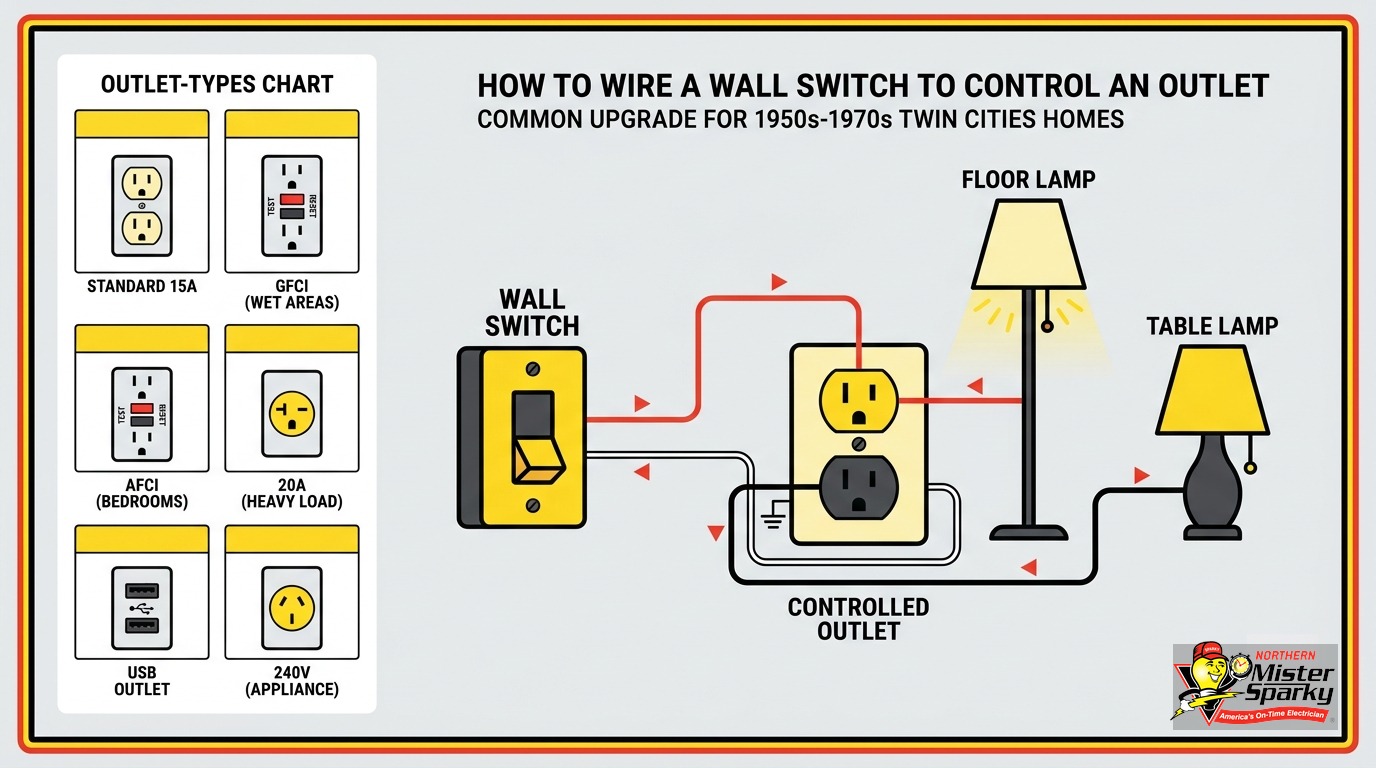
Power runs from the panel to the switch, then from the switch to the outlet. When the switch is off, the outlet has no power. When the switch is on, the outlet is live. The switch interrupts the hot conductor that feeds the outlet. The neutral returns to the panel without passing through the switch at all.
In most older Twin Cities homes, this circuit runs on a 15-amp branch circuit using 14-gauge wire. Power arrives at the switch box. It travels from the switch to the outlet, and the neutral returns directly to the panel. This configuration is called a switch loop.
A switch loop has no neutral wire at the switch box. Only the hot conductor passes through the switch. That detail becomes important when you consider smart switch upgrades, which we cover below.
There is a more advanced variation: the split-tab, or half-hot, outlet. A standard duplex receptacle has a small break-off tab connecting both hot terminals on the brass side. Remove that tab and the two outlets become independent of each other. One stays live all the time. The other connects to the switch. This configuration requires 14/3 or 12/3 cable with a red conductor, so each terminal has its own wire.
Wire sizing follows the circuit amperage. Most bedroom and living room circuits in older Twin Cities homes are 15-amp circuits wired with 14-gauge wire. A 20-amp circuit requires 12-gauge wire. Never mix gauges on the same circuit. Undersized wire carrying more current than it is rated for is a fire hazard.
Do I Need a Permit for Switch Controlled Outlet Wiring in Minnesota?
Yes, if you are running new wire or placing a device in a new location. A like-for-like swap in the same existing box does not require a permit. New wire runs, new outlet positions, and new switch positions always require a permit and two inspections in Minnesota.
Minnesota’s electrical permit rules draw the line at new wire and new locations. A new circuit, a new device location, or a new wire run triggers the permit process. The requirement covers two inspections: a rough-in inspection before you close the walls, and a final inspection after the work is complete.
Replacing a bad outlet with an identical outlet in the same box is a like-for-like swap. No permit needed. Running new cable from a switch box to an outlet location that never had one? Permit required, every time.
Minnesota adopted the 2026 NEC on August 3, 2026. Permits filed on or after that date must comply with the current code version. Your inspector will check the work against that code. For a full walkthrough of what the permit process looks like for a typical homeowner, our post on electrical permit requirements in Minnesota covers the key steps.
Minneapolis and Saint Paul Have Separate Permit Offices
Most Twin Cities suburbs use the state DLI portal at ims.dli.mn.gov to apply for permits. Minneapolis and Saint Paul do not. Each city runs its own building inspection department. If you live inside either city, contact that city’s inspections office directly. Do not use the state portal.
Can You Self-Permit This Work?
Minnesota allows homeowners to pull their own electrical permit on a single-family home they own and occupy. You must personally perform all the work. Rental properties, condos, and duplexes require a licensed electrical contractor to pull the permit and do the work.
Self-permitting still means scheduling two inspections and passing both. The liability for the quality of the work falls on you. For most homeowners, the permit and inspection process alone is reason enough to hire a licensed electrician from the start.
What Is the Two-Wire Problem in Older Twin Cities Homes?
Homes built before approximately 1970 typically have ungrounded two-wire circuits. There is no ground conductor in the cable. Install a three-prong outlet on an ungrounded circuit and the ground slot has no connection. That is a safety gap and a code violation. Almost every DIY switch-outlet wiring guide skips this entirely, and it matters a great deal in the Twin Cities.
PVC-sheathed cable with a ground conductor did not become standard practice until around 1970. Homes built in South Minneapolis, Mac-Groveland, and Highland Park before that era almost certainly have two-conductor cable: one hot, one neutral, no ground. Pull an outlet from the wall in a 1958 bungalow and you will likely find exactly that.
The problem surfaces whenever you want to add or upgrade a switched outlet on one of these circuits. A three-prong outlet on an ungrounded circuit would have an unconnected ground slot. Sensitive electronics depend on a proper equipment ground. The NEC requires the ground slot to be connected.
You have three code-compliant paths forward:
Run new three-wire cable. Pull new 14/3 or 12/3 NM-B cable from the panel to the outlet and switch location. You get a ground conductor and modern wiring at the same time. This requires opening walls, pulling a permit, and scheduling two inspections. It is the right choice when you are already doing significant work in the room.
Install a GFCI-protected outlet. The NEC allows an ungrounded outlet to be made code-compliant with GFCI protection. The outlet must be permanently labeled “No Equipment Ground and GFCI Protected.” This is the least invasive path when rewiring the circuit is not practical. Our guide on ungrounded outlets in older Twin Cities homes explains when this option is appropriate and what the label requirement means in practice.
Keep a two-prong outlet. If the original device was two-prong and you are replacing a failed one in the same box, you can install another two-prong outlet. No grounding upgrade is required. No permit is required. This is the simplest option when you need a working outlet and do not need a ground slot.
The right choice depends on what you are plugging in, what is inside your walls, and your budget. Our team can assess the circuit before any work starts and give you a straight answer on which path makes sense.
Three Scenarios: Which One Is Yours?
Most Twin Cities homeowners asking about switch controlled outlet wiring fall into one of three situations. The permit and grounding rules play out differently in each. Knowing your scenario changes what work you actually need.
Scenario 1: Your Existing Switched Outlet Stopped Working
The lamp worked fine last week. You flip the switch and now nothing happens. Before assuming a wiring problem, work through this checklist:
- Confirm the switch controls that specific outlet. Plug in a lamp and flip every switch in the room, one at a time.
- Check for a GFCI outlet. If the outlet face has two small buttons, press the reset button.
- Check your main panel for a tripped breaker.
- Look for a GFCI outlet elsewhere on the same circuit. Older homes sometimes have a single GFCI in the bathroom or kitchen that protects downstream outlets in other rooms.
If none of those steps restore power, the problem is likely a loose connection at the switch, at the outlet, or at a junction box between them. Connections in older wiring loosen over time due to thermal cycling. A loose connection that arcs is a fire hazard, not a minor inconvenience.
This is a good situation to call a licensed electrician. Because you are working in existing boxes with existing wire, a repair in this scenario does not require a permit.
Scenario 2: You Want to Add a New Switched Outlet Where None Exists
You want a wall switch to control a floor lamp, and right now there is no switched outlet in the room. This project always requires a permit in Minnesota.
The work involves running new cable from an existing circuit to the new outlet location, and from there to a new switch position near the door. That means opening walls or fishing wire through finished surfaces, making connections at each end, and scheduling two inspections with your permit office.
The grounding question applies here. If you are tapping an older ungrounded circuit, decide how to handle the ground before work begins. Running new three-wire cable solves the grounding issue at the same time as the new run.
For a look at what this kind of project involves in a finished room, our guide on adding an outlet to a finished wall walks through the key steps and the options for running wire without cutting large sections of drywall.
Scenario 3: You Want a Half-Hot, Half-Always-On Outlet
You want one outlet to turn on with the switch and one outlet to stay live all the time. This is useful when you want to control a floor lamp with the switch but also need a live outlet for a phone charger or a clock that should never lose power.
This requires a split-tab receptacle and 14/3 or 12/3 cable with a red conductor. The red wire feeds the switched terminal after the tab is removed. The black wire feeds the always-on terminal. Without the red conductor, you cannot split the outlets independently.
If your existing circuit uses 14/2 or 12/2 cable, there is no red wire. Converting to a half-hot outlet requires running new cable, which requires a permit.
If the circuit already has 14/3 cable because it was set up for a split-tab at some earlier point, you may be able to do the conversion in the existing box. Have an electrician verify what is in the wall before you commit to the project. Guessing at cable type from the outside is a reliable way to create a larger problem.
What About Smart Switches and Battery-Powered Controls?
Most smart switches need a neutral wire at the switch box. Older switch-loop circuits have no neutral at the switch. Verify the wiring configuration at your switch box before buying any smart switch for a 1950s-1970s Twin Cities home. Battery-only wireless switches also have specific NEC limitations when used on required lighting outlets.
Smart home upgrades are popular in older Twin Cities homes right now, and switched outlets are a common target. Two wiring facts will prevent you from buying the wrong device.
The neutral wire problem. Most smart switches need a neutral conductor at the switch box to power their internal electronics. In an older switch-loop circuit, the neutral stays at the outlet and never runs to the switch. Pull the switch cover plate and find only two conductors, and the circuit almost certainly has no neutral there. Some smart switches are designed to work without a neutral, but they are a smaller category and can cause flickering or ghost switching in certain configurations. Confirm the wiring at your switch box before purchasing.
Battery-powered switch limitations. The 2023 NEC addressed battery-powered wall controls directly: a wall switch controlling a required lighting outlet cannot rely exclusively on battery power unless the outlet automatically energizes when the battery fails. If the switched outlet in a given room is that room’s required lighting source under NEC 210.70, a battery-only wireless switch has specific compliance requirements. Check with a licensed electrician before installing a battery-powered wireless switch in that application.
The short version: smart switch upgrades in older homes need a wiring assessment before you buy anything.
When Should You Call a Licensed Electrician?
Call before you start if you are running new wire, adding a device in a new location, unsure of the grounding situation, or dealing with anything near the panel. Repairs in existing boxes at the same location are sometimes reasonable for an experienced homeowner. New wire runs are not.
Here is the clear line. Replacing a failed outlet or switch in an existing box, with the breaker off and verified dead before you touch anything, is a manageable task for a careful homeowner with basic tool skills. That is a like-for-like swap. Minnesota allows homeowners to do this work in a single-family home they own and occupy.
Running new cable through walls, diagnosing intermittent faults in 60-year-old wiring, or working anywhere near the main panel is a different matter. Old wiring hides surprises. We find double-tapped breakers, reversed polarity, knob-and-tube splices hidden behind outlet boxes, and breakers undersized for the load they have been running for decades. These are not problems you want to discover mid-project on a Saturday afternoon.
If you are in the Twin Cities and something does not look right, call us before you pull wire. We are locally owned and operated. We will give you a straight assessment, no malarky, before any work starts.
As America’s On-Time Electrician(R), we back every job with the UWIN(R) 100% satisfaction guarantee.
Call 763-200-5956 or book an appointment online. We serve Minneapolis, Saint Paul, Bloomington, Brooklyn Park, Woodbury, Blaine, Maple Grove, Plymouth, and the rest of the Twin Cities metro.
Frequently Asked Questions
Does switch controlled outlet wiring require a permit in Minnesota? +
Why does my wall switch control an outlet instead of a ceiling light? +
Can I install a grounded outlet on an ungrounded two-wire circuit in an older home? +
Need an electrician now?