
Tamper Resistant Outlets: The Twin Cities Safety Upgrade
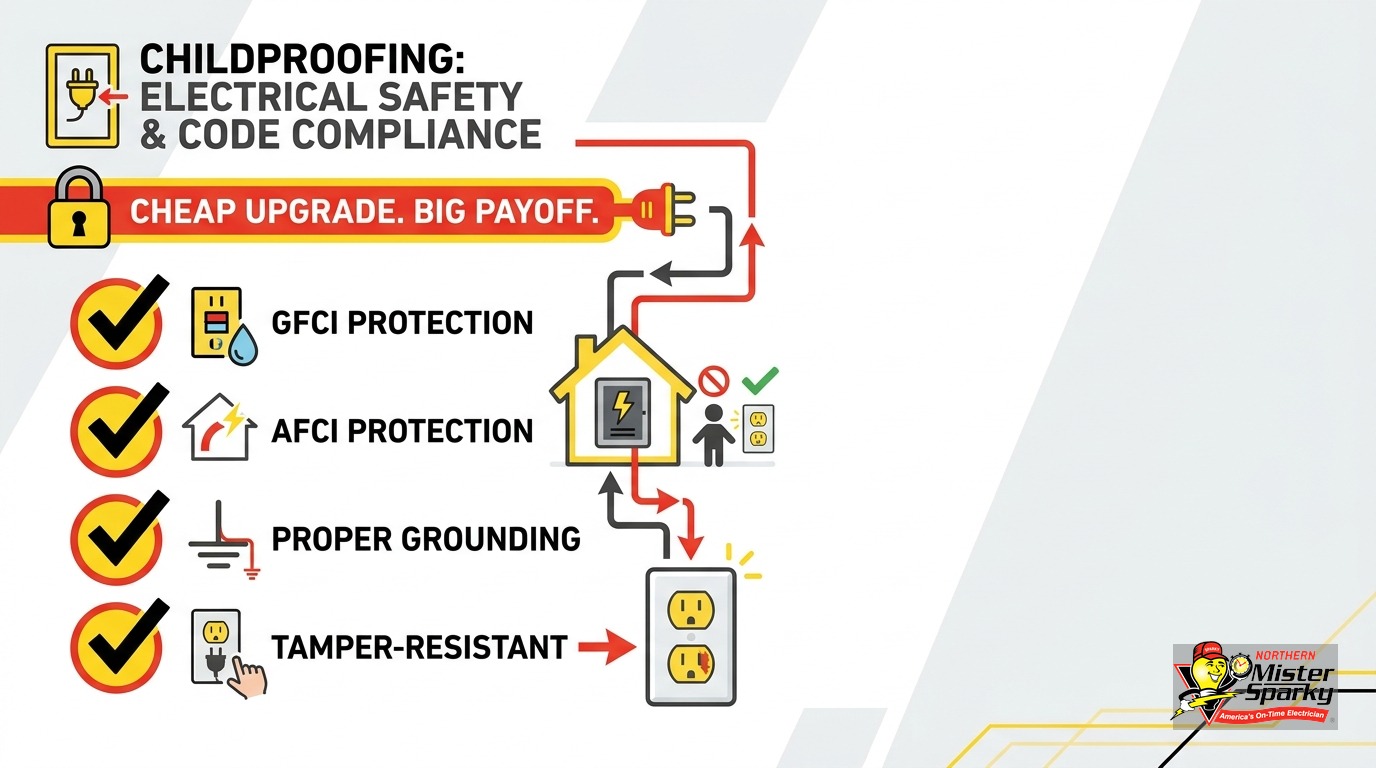
Key Takeaways
- Tamper resistant outlets (TRRs) use spring-loaded shutters that open only when both slots receive equal, simultaneous pressure. One object in one slot cannot complete a circuit.
- Minnesota adopted the 2023 NEC on July 1, 2023. NEC 406.12 requires TRRs in virtually all 15A and 20A, 125V/250V residential outlets.
- Plastic outlet caps are unreliable. A Temple University lab study found 100% of 2- and 4-year-olds removed one tested cap brand, many in under 10 seconds.
- The NEC replacement rule has no grandfather clause. Replace any outlet in a covered location and the new outlet must be TR-type, regardless of how old the home is.
- Pre-2008 Twin Cities homes almost certainly have zero TRRs. Most of Minneapolis, St. Paul, and the inner-ring suburbs fall in that window.
- The hardware is cheap. TRR receptacles run $2-6 each. A whole-home upgrade in a typical Twin Cities house fits in a half-day service call.
Tamper resistant outlets might be the cheapest code-required safety upgrade your Twin Cities home will ever need. Yet most homes built before 2008 have none.
Each year, roughly 2,400 children in the United States suffer severe shock and burns from outlet tampering. About half of those ER visits involve children ages 2 and 3. If your home predates 2008, you almost certainly have zero tamper resistant outlets. That covers much of Minneapolis, St. Paul, Bloomington, Richfield, and the inner-ring suburbs.
This guide explains what Minnesota code now requires, why the plastic cap in your junk drawer does not meet that standard, and what a licensed electrician can do to upgrade your entire home in one visit.
What Are Tamper Resistant Outlets?
Tamper resistant outlets look like standard outlets but contain two spring-loaded shutters behind the slots. The shutters open only when both receive equal, simultaneous pressure - like inserting a plug. A child pressing a single object into one slot cannot open the shutter on that side alone.
Tamper resistant receptacles - also called TRRs or TR outlets - are visually nearly identical to standard outlets. Most carry a small “TR” stamp embossed on the face between the two slots. If you are unsure whether an outlet is TR-type, look for that mark.
The protection is mechanical, not electronic. Two spring-loaded plastic shutters sit behind the slot openings. When a standard plug goes in, both prongs apply equal pressure at the same time. Both shutters retract. When a child inserts a key, a coin, or a finger into one slot, only that side receives pressure. The mechanism is asymmetric by design. The shutter stays closed.
This is why the Consumer Product Safety Commission specifically recommends tamper resistant receptacles for permanent residential outlet protection. The protection is built into the receptacle itself. There is nothing removable, nothing to lose, and nothing for a curious child to figure out.
Why Plastic Outlet Covers Are Not Enough
Plastic outlet caps are sold everywhere and cost almost nothing. They are also not reliable child protection.
A Temple University Biokinetics Lab study tested two popular brands of plastic outlet caps with children ages 2 and 4. With the first brand, 47% of 4-year-olds removed the cap successfully. With the second brand, 100% of 2- and 4-year-olds removed it. Many did so in under 10 seconds.
Lab conditions give a child one structured attempt. In a real home, a toddler has all day. The cap they crack once is on the same outlet tomorrow morning.
There is a second hazard. Once removed, a small plastic cap becomes a choking risk. The safety product creates a different danger.
The numbers behind this risk are worth sitting with. Between 1991 and 2001, more than 24,000 children under age 10 were treated in emergency rooms for receptacle-related injuries. That is roughly 7 per day over a decade. An eight-year hospital study from 1996 to 2003 found 69% of child outlet injuries occurred when an object was placed directly in a slot. 79% occurred at home.
This is not a problem that happens elsewhere. It happens in living rooms, bedrooms, and hallways. Plastic caps get lost behind furniture in those same rooms.
Tamper resistant outlets are the permanent fix. The protection is inside the receptacle. It cannot be removed, misplaced, or defeated.
Are Tamper Resistant Outlets Required by Minnesota Code?
Yes. Minnesota adopted the 2023 NEC effective July 1, 2023. NEC Section 406.12 requires tamper resistant receptacles in all 15A and 20A, 125V/250V non-locking outlets in residential dwelling units. Any permitted electrical work filed after that date must comply.
The 2023 NEC is Minnesota’s active electrical code. The key provision is NEC Section 406.12. It covers all 15-ampere and 20-ampere, 125-volt and 250-volt non-locking outlets installed in dwelling units.
In practical terms: virtually every standard outlet in your home is covered. Bedrooms, living rooms, hallways, kitchens, dining rooms. Earlier NEC cycles expanded scope to garages, detached accessory buildings, and multifamily common areas. The 2023 cycle did not narrow any of that.
Exceptions are intentionally narrow. Outlets installed more than 5.5 feet above the floor are exempt - a toddler cannot reach them. Receptacles that are part of a luminaire or appliance are exempt. A single dedicated outlet serving a fixed, non-movable appliance is exempt. Your floor-level and counter-level outlets do not qualify for any of those.
One more signal worth noting: Minnesota’s DLI is already publishing 2026 NEC inspection checklists and FAQ documents. The next adoption cycle is in review. Requirements will expand, not contract. Installing TRRs now keeps your home ahead of both the current code and the next one.
What Is the NEC Outlet Replacement Rule?
NEC 406.4(D) requires that any outlet replaced in a location where tamper resistant outlets are required must itself be a TR-type outlet. No grandfather clause exists. Replace any outlet in a covered location - for any reason - and the new outlet must meet current code.
Most homeowners learn about this rule mid-service call, when a licensed electrician is already holding a dead outlet.
NEC 406.4(D) applies to all replacements in code-covered locations. It does not matter that the original outlet was installed in 1968 or that TRRs did not exist when the home was wired. The trigger is the replacement itself. The new outlet must comply.
The practical implication: if you have an outlet that has stopped working, that repair visit already obligates you to TRR compliance at that location. Once you are there for one outlet, a coordinated whole-home upgrade during the same visit is almost always the smarter move. Separate service calls for piecemeal replacements cost more per outlet than one organized job.
The rule also applies to renovations. A contractor pulling a permit for a kitchen remodel whose electrical scope touches any outlets in those rooms must install TR-type receptacles. This is not a technicality that gets worked around. It is code, and any licensed electrician on a permitted job must comply. If you have a renovation coming up, build the TRR upgrade into the project scope from the start.
Does My Twin Cities Home Have Tamper Resistant Outlets?
Almost certainly not, if it predates 2008. The 2008 NEC was the first edition to require TRRs in new residential construction. Any home built or last fully wired before that code cycle has standard receptacles throughout, regardless of any updates made since.
The 2008 mandate applied to new construction going forward. It did not require existing homes to retrofit. That means millions of homes occupied by families with young children today may have never had a TRR installed.
In the Twin Cities, the gap is large. Minneapolis has a high concentration of pre-1940 housing. St. Paul, Bloomington, Richfield, and Edina carry similar vintage stock. Inner-ring suburbs like Roseville, St. Louis Park, and Columbia Heights are similar. These homes were wired decades before TRRs existed as a code concept.
A home built between 2008 and 2022 may have TRRs in some locations - specifically wherever a permit was pulled and TR outlets were required at the time. But partial coverage from one remodel project does not make the whole home compliant. Rooms outside that permit’s scope still have standard outlets.
The easiest check is visual. Look for the “TR” stamp embossed between the two slots on a faceplate. No stamp means standard. For a definitive picture of the whole home, a licensed electrician can walk every room and map it out. We do this as part of a routine electrical safety inspection.
How Do Tamper Resistant Outlets Differ from GFCI Outlets?
Tamper resistant outlets physically block foreign objects from entering outlet slots. GFCI outlets detect dangerous current leaks and cut the circuit within milliseconds. They protect against different hazards. Both protections can exist in one receptacle, and often should in kitchens, bathrooms, and outdoor locations.
A GFCI outlet detects a ground fault - current leaking through a person or wet surface to ground. It trips in milliseconds to prevent electrocution. Minnesota code requires GFCI protection in bathrooms, kitchens, garages, unfinished basements, and outdoor receptacles.
A tamper resistant outlet does something entirely different. It physically prevents a single foreign object from opening a slot. It has no fault-detection function. It does not trip. It simply will not open unless both prongs apply equal, simultaneous pressure.
Both protections can be combined in one outlet. TR/GFCI combination receptacles are widely available. They are the right choice where both requirements overlap - a kitchen counter outlet or a bathroom outlet within 6 feet of a sink, for example. In a child’s bedroom, a standard TR outlet satisfies code without GFCI protection.
Knowing which outlet types are already in your home clarifies where you have coverage and where you have gaps. A licensed electrician can map that out in one walk-through.
What Does a Tamper Resistant Outlet Upgrade Cost?
TRR receptacles cost $2 to $6 each at hardware stores. Professional installation varies by outlet count, home age, and whether the job is bundled with other work. A whole-home upgrade in a typical Twin Cities house usually wraps up in a half day.
The hardware is genuinely inexpensive. A tamper resistant receptacle from a name-brand manufacturer runs $2-6. The cost is not in the parts.
Labor is the primary driver. Minnesota requires a licensed electrician for permitted outlet work. Most outlet replacements in a primary residence require a permit and inspection. Per-outlet cost depends on several factors:
- Volume. More outlets on one job typically lower the per-outlet labor rate.
- Home age and wiring condition. Older homes sometimes present complications at each location: two-prong ungrounded receptacles, deteriorated insulation, or aluminum branch circuit wiring that needs pigtailing before a new outlet can go in. Each of those adds time to the job.
- Panel access. Well-labeled circuits and easy-to-reach panels mean faster work.
- Bundled vs. standalone. If you are already scheduling a panel upgrade, generator install, or other electrical project, adding TRRs to that same visit compresses total labor cost significantly.
The lowest-cost path is almost always one coordinated upgrade - not multiple service calls as outlets fail one by one. A single visit to handle the whole home is faster, cleaner, and more cost-effective per outlet than catching problems piecemeal.
For a specific estimate on your Twin Cities home, call 763-200-5956 or book online. We will assess the home, give you a flat price before we start, and finish on schedule.
What Are the Exceptions to the Tamper Resistant Outlet Requirement?
NEC 406.12 exempts outlets more than 5.5 feet above the floor, receptacles that are part of a luminaire or appliance, and single dedicated receptacles for fixed, non-movable appliances. All other outlets in a dwelling unit at floor and counter level are covered.
The exceptions reflect practical risk. An outlet 5.5 feet off the floor is above a toddler’s reach. An outlet integrated into a range hood is governed by the appliance design. An outlet directly behind a built-in refrigerator that never moves is not accessible to curious hands.
What those exceptions do not cover: the outlets you see every day. Living room outlets at baseboard height. Bedroom outlets near the nightstand. Hallway outlets used for nightlights and vacuums. Kitchen counter outlets. These are all in scope, and they are the locations where outlet injuries actually happen.
If you want a clear picture of which outlets in your home are covered and which fall under an exception, a licensed electrician can walk through and sort it out quickly. The assessment is straightforward, and it gives you a clean action list for the upgrade.
Schedule Your Upgrade with Northern Mister Sparky
Northern Mister Sparky is locally owned and operated in the Twin Cities. We are licensed and insured in Minnesota. As America’s On-Time Electrician(R), we show up in the window we quote - no waiting, no scrambling to reschedule.
A whole-home tamper resistant outlet upgrade is a well-defined job. We assess which outlets need replacement, pull the required permit, do the swap, coordinate the inspection, and leave you with a clean documentation file. For a typical three-bedroom Twin Cities home, most upgrades wrap up in a single morning.
If you have young children at home - or grandchildren who visit regularly - the calculation here is not complicated. TRR outlets cost a few dollars each. Installation is a half day. The protection is permanent and built into the outlet itself. No cap to lose, no 10-second test for a two-year-old to crack, no malarky.
Call 763-200-5956 or book online today. We serve Minneapolis, St. Paul, Bloomington, Brooklyn Park, Woodbury, Blaine, Maple Grove, Plymouth, and the surrounding metro. We will give you a straight answer and a straight price before we start.
Frequently Asked Questions
Are tamper resistant outlets required in Minnesota? +
Do tamper resistant outlets replace plastic outlet covers? +
How much do tamper resistant outlets cost to install in the Twin Cities? +
Need an electrician now?