
Tankless Gas Water Heater Electrical Requirements
Key Takeaways
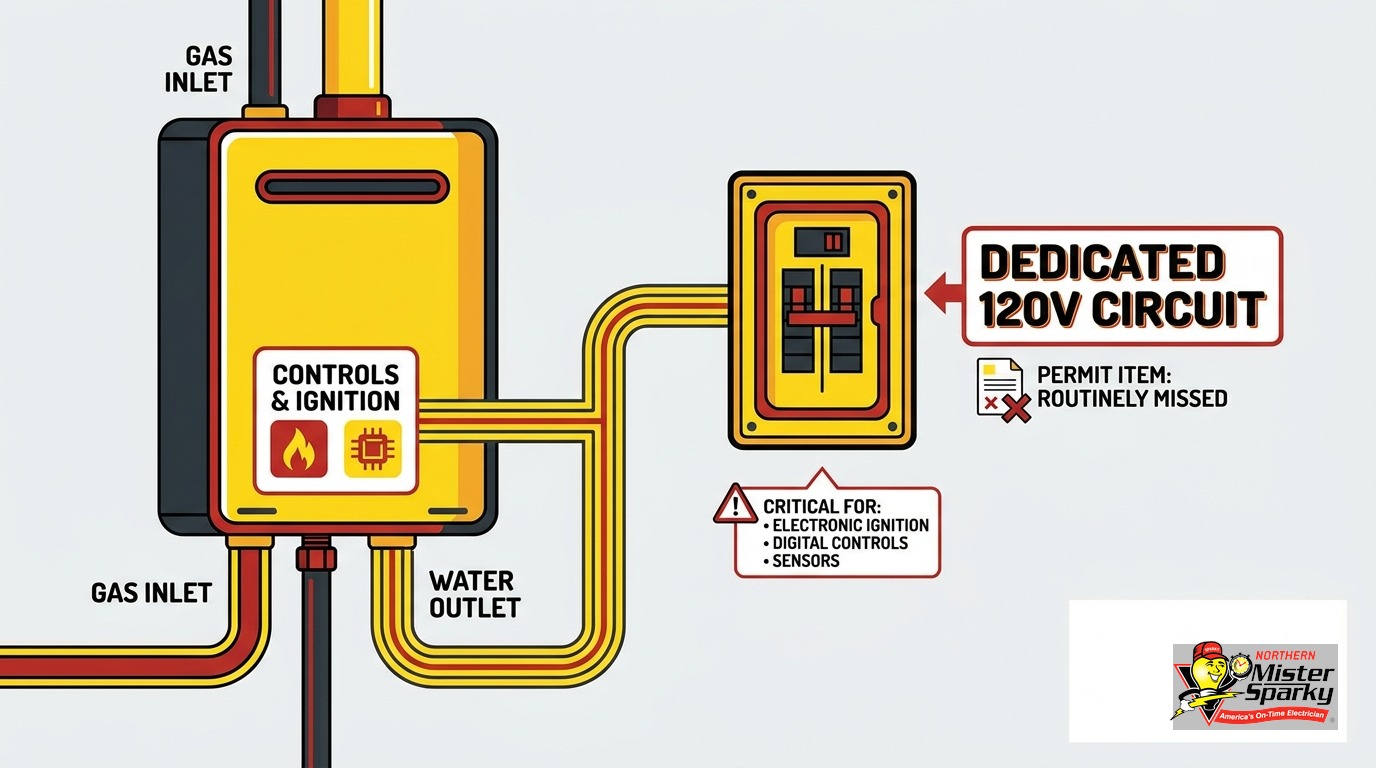
- Gas tankless water heaters require a dedicated 120VAC, 60Hz grounded outlet for ignition, the control board, and the modulating gas valve. Without it, the unit will not light.
- The circuit must be dedicated. Manufacturer installation instructions require it, and NEC 110.3(B) makes those instructions code-enforceable. A shared circuit causes ignition failures and fault lockouts.
- Most Twin Cities tankless installations go in basements, garages, or utility rooms. All three locations require GFCI protection on 120V outlets under NEC 210.8(A).
- Minnesota adopted the 2026 NEC effective August 17, 2026. Any electrical permit filed now must comply with current code.
- The plumbing permit your plumber pulls does not cover the 120V circuit. A licensed electrician must pull a separate electrical permit under Minnesota Statute 326B.
- On condensing units like the Navien NPE-A2 and Rinnai RX and RU series, the 120V circuit also powers built-in freeze protection. In Minnesota winters, a failed circuit means a vulnerable unit.
What Does a Gas Tankless Water Heater Actually Need Electrically?
Short answer: A dedicated, grounded 120VAC, 60Hz outlet - typically on a 15-amp circuit - for the ignition system, the control board, and the electronically controlled gas valve. The draw is small (1 to 2 amps for most residential units), but the requirement is firm. Without a reliable power supply, the unit does not fire.
Gas tankless units are not the same as electric tankless heaters. Electric tankless units require a massive 240V circuit upgrade - often 50 to 100 amps - and are the reason so many competitors focus on panel capacity. Gas tankless units skip that. They heat water by burning gas. That part does not need a high-amperage circuit.
But every gas tankless unit manufactured today uses electricity for three critical functions. First, electronic ignition: the spark that lights the burner every time a hot water demand triggers. Older standing-pilot systems kept a small flame burning continuously. Modern units spark on demand, which requires a control signal and a reliable voltage supply. Second, the control board: the unit’s brain, which senses water flow at the inlet, modulates the gas valve to match the BTU load to demand, monitors exhaust temperatures, and generates fault codes when something is wrong. Third, the modulating gas valve itself: an electromechanical valve that opens, closes, and throttles based on signals from the control board. Pull the power, and all three functions stop.
Rinnai’s V-Series installation manual specifies 120VAC, 60Hz, minimum 1.0A on a grounded three-prong outlet within reach of the unit. Navien’s NPE-A2 condensing unit calls for 120VAC, 60Hz, 2.0A maximum on a dedicated grounded outlet. Both are explicit: the outlet must be grounded, must be accessible, and must be the unit’s dedicated supply.
This is where the gap opens. The plumber shows up to swap the water heater. The old tank may have had no outlet nearby at all - older storage heaters are often just gas and water, no electrical connection. Or there is an outlet on the wall that looks fine. Neither observation tells you whether that outlet is on a dedicated circuit, whether it is GFCI-protected for a basement location, or whether anyone pulled an electrical permit when it was installed. The Department of Energy estimates that gas condensing tankless heaters are 8 to 14 percent more efficient than standard gas storage heaters for households using 41 or more gallons per day. That efficiency gain is drawing a lot of swaps right now. The electrical work needs to be part of the plan from the start.
Does the Circuit Need to Be Dedicated?
Short answer: Yes. Manufacturer installation instructions require a dedicated outlet. NEC 110.3(B) requires that appliances be installed in accordance with their listed instructions, which makes the manufacturer’s dedicated-circuit requirement code-enforceable. A shared circuit that drops voltage during other loads causes ignition failures, fault codes, and nuisance lockouts.
“Dedicated” has a specific meaning here. It means one circuit breaker in your panel feeds one circuit. That circuit feeds one outlet. That outlet feeds only the water heater. Nothing else is on that breaker - no other outlets, no lights, no other appliances.
Here is why a shared circuit fails in practice. When a basement dehumidifier, a chest freezer, a sump pump, or a battery charger on the same circuit cycles on, it draws current and briefly pulls the voltage down. The voltage dip lasts a fraction of a second. For most household loads, it is invisible. For a gas tankless unit’s control board - which is monitoring sensor inputs and managing a gas valve while a burner is trying to fire - that dip at the wrong moment is an ignition failure. The unit throws a fault code. It may go into a lockout state that requires a manual reset before it will try again. You get a shower that starts warm and then goes cold. The service call finds no part failure, just an undersupported circuit.
There is also the inspection angle. When an inspector reviews the electrical work - either during the original permit inspection or during a future project - they check that the outlet serving the fixed appliance is on a dedicated circuit. If it is not, the installation does not pass. Any time an electrical permit is open on your home, everything in scope is subject to current-code review.
A 15-amp, 120V dedicated circuit on 14 AWG wire is standard for this application. Some electricians prefer 20 amps on 12 AWG for additional headroom. Either sizing works for the load; the key is that the circuit is dedicated and properly sized. See our guide on dedicated circuits for appliances for more detail on how this requirement applies across the other major appliances in your home.
Does a Gas Tankless Water Heater Need GFCI Protection in Minnesota?
Short answer: In most Twin Cities installations, yes. NEC 210.8(A) requires GFCI protection on 120V outlets in garages, basements, and crawl spaces. Most Minnesota tankless swaps go into basements or utility rooms - squarely within that requirement. Minnesota adopted the 2026 NEC on August 17, 2026, so this is current code for any permit filed now.
GFCI protection trips the circuit in milliseconds if current leaks to ground through a person or a wet surface. A basement utility area is exactly the environment the code had in mind: concrete floors that stay damp, floor drains, condensate lines from the furnace and now the condensing tankless unit, and the inevitable water heater connections that occasionally drip. The risk of water contact with a 120V outlet in that space is real.
NEC 210.8(A)(5) covers unfinished basements. NEC 210.8(A)(2) covers garages. NEC 210.8(A)(4) covers crawl spaces. If your gas tankless installation lands in any of those locations - and in the Twin Cities, the vast majority do - the outlet needs GFCI protection. That protection can come from a GFCI outlet device at the receptacle, or from a GFCI breaker protecting the circuit upstream. Both satisfy the code requirement. A standard non-GFCI outlet in any of those locations does not, regardless of how long it has been there.
The failure scenario that causes problems at resale: the plumber installs the tankless unit, plugs it into the old water heater outlet, and nobody verifies the GFCI status. The unit works. Years pass. A home inspector during a sale checks the basement outlet, confirms it is in a required-GFCI location, confirms it is not GFCI-protected, and writes it up as a deficiency. Now you are negotiating an electrical repair under closing-date pressure. Catching it before the swap - not after - is straightforward. Our post on GFCI outlet requirements explained covers all the required locations and what a compliant installation looks like.
The Two-Permit Problem Most Homeowners Never Hear About
Here is how a standard gas tankless swap typically gets scheduled in Minnesota. The plumber books the job, pulls a plumbing permit from the Minnesota Department of Labor and Industry (DLI) or the local authority having jurisdiction (AHJ), installs the unit, and calls for inspection. The inspector verifies the gas connections, the water connections, and the venting. Sign-off. Done.
Except the electrical circuit is not in that permit at all. Not one wire, not one outlet, not the GFCI retrofit if one is needed, not a new circuit if the existing one is shared or absent. Electrical work in Minnesota requires a separate electrical permit.
The Minnesota DLI electrical permit process is an entirely separate filing from the plumbing permit. It is reviewed by a separate inspection program. It results in a separate documented sign-off. Two permits, two inspections, two records in the permit history for your home.
Why does this matter beyond compliance? Three reasons. First, permit documentation protects you at resale. A buyer’s inspector or attorney who pulls permit history and finds no electrical permit for a known circuit installation has grounds for negotiation, or for requiring repairs before closing. Second, your homeowner’s insurance coverage can be affected by unpermitted electrical work. If a claim arises - a fire, a flood, damage involving the circuit - the insurer’s investigation looks at permit history. Third, when a future project opens an electrical permit on your home (a panel upgrade, a finished basement, an EV charger), the inspector can require that any unpermitted electrical work in scope be brought up to current code before the new permit closes.
The practical fix is simple: loop in a licensed electrician before the swap, not after. We coordinate with your plumber to sequence the permits correctly. Call 763-200-5956 and describe what the plumber has quoted. We will tell you whether a separate electrical permit is needed and what the job looks like.
What Changed When Minnesota Adopted the 2026 NEC?
Short answer: Minnesota’s DLI adopted the 2026 NEC effective August 17, 2026. Electrical permits filed on or after that date must comply with 2026 code. For the 120V circuit serving a gas tankless water heater, the practical requirements - dedicated circuit, GFCI in basements and garages - were already present in the 2023 NEC. The change is that any permit filed today is under the current cycle, and contractors citing old practices without pulling permits are not keeping you compliant.
The 2026 NEC cycle’s most significant changes affect energy storage systems, EV charging infrastructure, and solar installations. For a straightforward 120V dedicated appliance circuit, the requirements are consistent across the 2023 and 2026 cycles. What shifts is which code an inspector applies to any permit filed after August 17, 2026.
For homeowners, there is one scenario where the code-cycle date matters directly. If your water heater project involved electrical work before August 17, 2026, and a permit was pulled at that time, that work was inspected under the 2023 NEC. That is valid for that permit. What you should not accept is a contractor who claims no permit was needed, or that the work was “grandfathered,” when a new circuit or outlet was installed after the swap.
Minnesota adopts updated NEC cycles on a regular basis. Working with a licensed Minnesota electrical contractor means you are automatically on the right code cycle for the permit filing date. There is no guesswork about which version applies.
Why a Plumber Cannot Legally Wire That Circuit
Minnesota Statute 326B governs electrical licensing in the state. Installing or modifying a 120V circuit and outlet - including adding GFCI protection to an existing outlet - requires either a licensed electrical contractor’s permit or a homeowner-occupant permit on a home the owner occupies and lives in. A plumbing license does not authorize electrical work.
This is not a technicality buried in obscure code. It reflects a real safety distinction. Electricians in Minnesota are licensed, continuing-educated, and inspected specifically because electrical wiring done incorrectly causes fires and electrocution. The licensing system, the permit process, and the inspection requirement are how the state verifies that the work meets a minimum safety standard. Plumbers are licensed for a separate scope.
When a plumber installs or moves an outlet as part of a water heater swap - with good intentions, often at no extra charge - that work is unlicensed, unpermitted electrical work. There is no electrical inspection. There is no documentation in your permit history. There is nothing to show a buyer, an insurer, or a future inspector that the circuit was installed correctly by a licensed professional.
The permit also creates accountability. If a licensed electrician pulls a permit and the work later has a deficiency, there is a documented record of who did the work and when. That accountability is part of what you are paying for when you hire licensed trades.
If you want to confirm that any electrician you hire holds a valid Minnesota contractor license, the DLI maintains a lookup at dli.mn.gov/business/electrical-contractors. We are licensed, insured, and locally owned in the Twin Cities. Call us and we will tell you straight what your project needs.
What Happens to Your Tankless Unit If the 120V Circuit Fails in Winter?
Short answer: You lose hot water immediately. But for condensing units with built-in freeze protection - including the Navien NPE-A2 and Rinnai’s RX and RU series - a failed 120V circuit also kills the frost-prevention system. In Minnesota winters, that is not a hypothetical. It is a unit-destroying failure that happens when temperatures drop below zero overnight.
Most homeowners think of the 120V circuit as the “controls” circuit: it runs the ignition and the board, but the heater itself is gas. That framing misses something important.
Condensing gas tankless units are efficient because they extract heat from exhaust gases down to very low temperatures, producing condensate as a byproduct. The internal components that make this possible - narrow heat exchanger passages, condensate collection chambers - are vulnerable to freezing. Manufacturers address this with built-in freeze protection: a small electric heater element inside the unit that activates when ambient temperatures approach freezing. This system draws power from the same 120V supply circuit as the rest of the unit. It is designed to be always available when temperatures drop, without any user action required.
If the dedicated circuit is tripped, if the outlet loses continuity, or if an improperly wired circuit fails in cold weather, the freeze-protection system goes offline at exactly the wrong moment. At minus 10 or minus 15 degrees Fahrenheit - a routine January temperature in the Twin Cities - a heat exchanger that loses frost protection overnight can crack. Repair costs for a cracked heat exchanger range into the thousands. A full unit replacement costs more.
This is a specific reason - beyond code compliance and permit documentation - to care about the quality of the dedicated 120V circuit. An outlet added without a permit, on a shared circuit with loads that trip the breaker, or without proper GFCI protection in a location where water contact is possible, introduces failure risk at exactly the conditions where you most need the unit to function.
For older homes in the Twin Cities where basement wiring is uncertain, it is worth having the circuit evaluated before the tankless unit goes in. Our post on the electrical permit process in Minnesota walks through what is required and how the inspection process works from start to finish.
Ready to Get This Right?
The short checklist before any gas tankless water heater swap:
- Confirm the outlet serving the unit is on a dedicated 15- or 20-amp, 120V circuit.
- Confirm GFCI protection is present if the installation location is a basement, garage, crawl space, or utility room.
- Determine whether a new circuit is needed - and if so, budget for a licensed electrician to pull the electrical permit separately from the plumbing permit.
- Coordinate the electrician and the plumber before the swap date, not after. Getting the circuit permitted and inspected before the unit goes in is cleaner than retrofitting wiring around a live appliance.
This is a straightforward job for a licensed electrician. We assess the existing outlet, verify GFCI compliance for the installation location, pull the electrical permit, run the dedicated circuit if needed, and schedule our inspection before the plumber’s install date. You get documented, code-compliant electrical work with a permit in the history for your home.
We are locally owned and operated in the Twin Cities. We are “America’s On-Time Electrician(R)” - we show up when we say we will - and our UWIN(R) 100% satisfaction guarantee means if something is not right, we fix it.
If your water heater project is part of a larger scope - adding an EV charger, finishing a basement, upgrading the panel to handle new loads - ask about financing options when you call. Combining the work often makes the overall project more manageable, and it means one permit window instead of two.
Call 763-200-5956 or book online to get the electrical side of your water heater project scheduled.
Frequently Asked Questions
Does a gas tankless water heater need electricity? +
Do I need a separate electrical permit for a gas tankless water heater in Minnesota? +
Does a gas tankless water heater need GFCI protection? +
Need an electrician now?