
Undercounter Ice Maker Electrical Requirements in Minnesota
Key Takeaways
- Most undercounter ice makers need a dedicated 115V, 15A circuit on solid #14 AWG copper wire. Some models specify 20A - check the spec label before work begins.
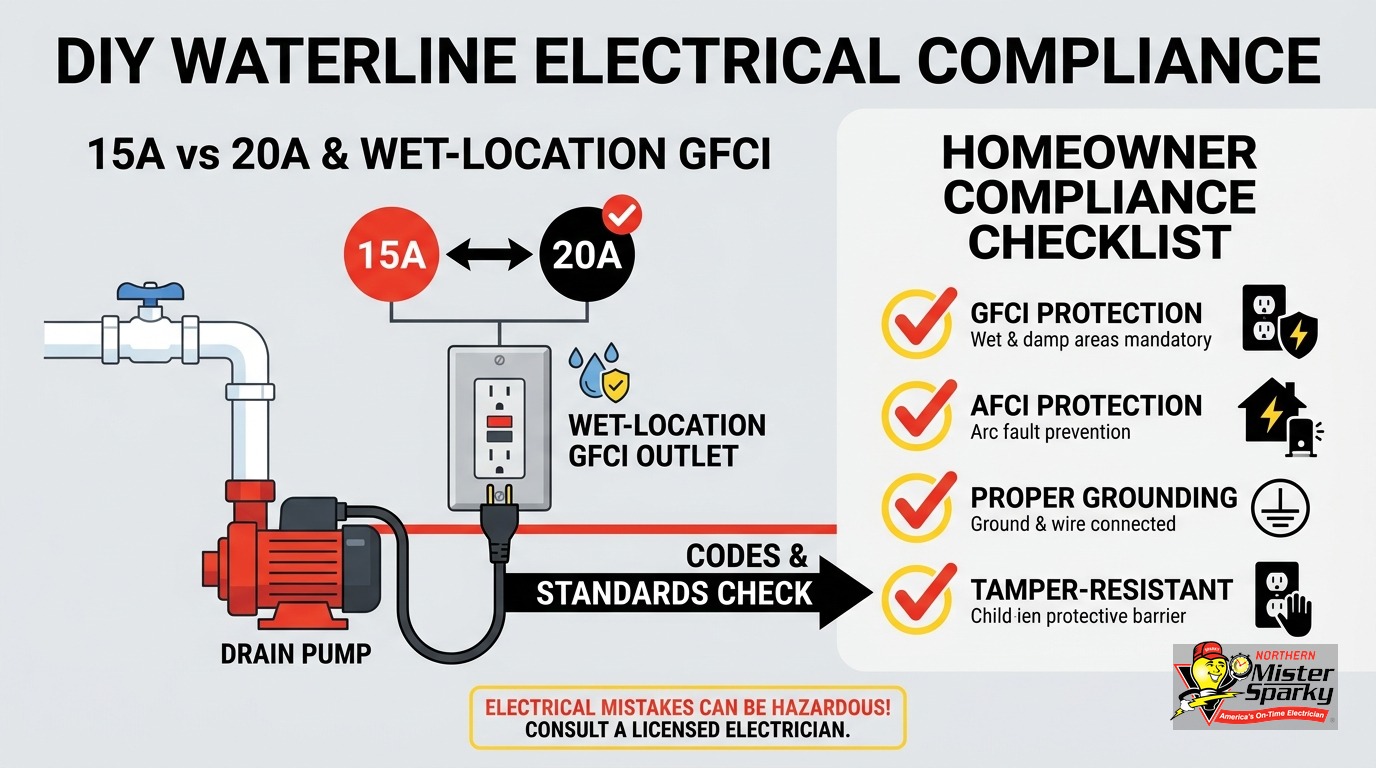
- When gravity drainage is not possible, a drain pump is required. That pump is a separate corded appliance with its own outlet, and its GFCI requirements depend on its physical location - not the ice maker’s location.
- Manufacturer manuals often say not to use a GFCI outlet indoors because of nuisance tripping. The NEC requires GFCI on kitchen receptacles. The fix is a GFCI breaker at the panel, not a plain outlet at the wall.
- Minnesota adopted the 2026 NEC effective August 17, 2026. AFCI protection now applies to all new 120V branch circuits in a dwelling. A new ice maker circuit filed under a Minnesota permit today likely needs a combination AFCI/GFCI breaker.
- Any new outlet or circuit in Minnesota requires a permit. Homeowners may pull their own, but the inspection is not optional.
- Older Twin Cities homes with 100A service may need a panel evaluation before this circuit can land.
What Are the Undercounter Ice Maker Electrical Requirements?
Quick answer: Most residential models need a dedicated 115V, 60 Hz, 15A circuit with a grounded 3-prong receptacle on solid copper wire. Some specify 20A. A drain pump - needed when gravity drainage is unavailable - adds a second outlet to the plan. Minnesota’s 2026 NEC requires a combination AFCI/GFCI breaker for any new circuit permit filed today.
Every appliance retailer FAQ and installation guide will give you the circuit spec off the appliance nameplate. That is the part they get right. What they skip is the fact that a typical Twin Cities ice maker installation involves three questions none of them answer.
The first is the drain pump outlet. Bar areas, finished basements, and kitchen islands almost never have floor drains nearby. No floor drain means no gravity drainage, and no gravity drainage means a drain pump is required. That pump is a second corded appliance with its own outlet - and its own code requirements based on where it lands.
The second is the GFCI conflict. Your owner’s manual may tell you explicitly not to use a GFCI outlet. The National Electrical Code tells you otherwise. Those two requirements do not cancel each other out, and the NEC is the one with legal standing.
The third is Minnesota’s 2026 NEC adoption. Any permit filed on or after August 17, 2026 falls under expanded AFCI requirements that apply to virtually every new 120V circuit in a home - including appliance circuits that were previously excluded.
Know all three before the first wire is run.
Does an Undercounter Ice Maker Need a Dedicated Circuit?
Quick answer: Yes, always. A dedicated circuit means no other appliances share that breaker. Undercounter ice makers cycle their compressors automatically in short bursts. On a shared circuit, those startup surges can trip the breaker, interrupt the compressor mid-cycle, and degrade the unit over time.
Here is what a nuisance trip looks like from the homeowner’s side. You open the ice maker and find it empty. The unit is not running. You reset the breaker and it restarts fine. Two days later, same problem. The breaker is not failing - it is doing its job on a circuit that is drawing more than it was designed to supply. But every abrupt compressor interruption puts mechanical stress on a component that was not designed to be power-cycled that way.
The Sub-Zero UC-15I installation specification is direct: 115 VAC, 60 Hz, 15A on a dedicated circuit with a 3-prong grounding receptacle. The outlet must be within reach of the power cord and placed in the adjacent cabinet, not inside the unit’s own opening unless the manufacturer designates a specific area for it.
That placement detail has a practical implication. The receptacle needs to stay accessible after installation. It should not be buried behind the appliance in a location that requires pulling the entire unit out to reach. It should not be in the direct path of condensation, and the power cord cannot be bent tightly against the cabinet frame.
If no spare circuit exists near the installation location, adding one means running new wire back to the panel. That is a standard job, and it is the right time to confirm panel capacity while the work is open.
15A or 20A: Which Circuit Does Your Ice Maker Need?
Quick answer: Check the nameplate before anyone schedules the job. Most residential models specify 15A. Some commercial-adjacent units require 20A. A 15A circuit on a 20A appliance is a code violation. The plug shapes also differ - a 20A receptacle accepts NEMA 5-15 and 5-20 cords, but a 15A outlet will not accept a 20A plug.
The Scotsman CS0415 - one of the more widely installed residential undercounter models - specifies 115V, 60 Hz, 15A on a dedicated circuit. The Sub-Zero UC-15I matches that spec. But if you are evaluating a unit marketed for high daily output or positioned as a professional-grade model, the spec sheet may call for 20A. Confirm before the panel work is scheduled, not after the circuit is already roughed in.
Wire gauge is the second variable most homeowners overlook. Breaker size sets the minimum wire gauge, but run length can require stepping up:
- Runs under 100 feet: #14 AWG solid copper is the minimum for a 15A circuit.
- Runs between 100 and 200 feet: use #12 AWG to hold voltage drop within acceptable limits.
Running undersized wire on a longer circuit creates resistance, and resistance turns into heat. That heat concentrates at the points of highest resistance - typically inside a junction box or at the back of the receptacle. The circuit can pass a visual inspection and fail years later when a connection overheats and begins charring the surrounding insulation.
For a detailed look at how 15A and 20A circuits differ and when each is the right choice, see our post on 15A vs. 20A outlet and circuit differences.
The Second Outlet Nobody Plans For: The Drain Pump
This is the gap that separates a complete electrical plan from an incomplete one.
When an undercounter ice maker cannot drain by gravity - because the installation is in a bar area, a finished basement, or a kitchen island without a nearby floor drain - the unit requires a drain pump. The pump lifts meltwater and routes it to a standpipe, sink drain, or drain line.
A drain pump is a separate powered device, not a built-in feature of the ice maker. It ships with its own power cord and plugs into its own outlet. It operates independently of the ice maker’s main circuit.
That means the electrical plan for a typical undercounter ice maker installation needs two outlets, not one.
Those two outlets are not interchangeable. Each outlet’s GFCI requirements are determined by its specific physical location, independent of where the ice maker itself sits. The ice maker outlet in a kitchen cabinet is subject to kitchen receptacle rules under NEC 210.8. The drain pump outlet may land somewhere different - an adjacent utility space, an unfinished basement corner, or a cabinet zone that sits at the boundary between kitchen and utility room classifications.
If the drain pump outlet ends up in an unfinished basement area, basement receptacle rules apply. The NEC removed the exception that once allowed a single dedicated receptacle for a sump pump or freezer to skip GFCI protection. That exception was removed in the 2008 NEC. Under any code edition since then, unfinished basement receptacles require GFCI - and there is no dedicated-appliance carve-out remaining.
The lesson: plan for two outlets from the start, and determine each outlet’s GFCI requirement based on where it physically lands.
Does Your Ice Maker Manual Say “No GFCI”? Here Is the Code Conflict.
Quick answer: Many manufacturer manuals say not to use a GFCI outlet indoors - nuisance tripping interrupts the compressor. But NEC 210.8 requires GFCI on kitchen receptacles, and code wins. The fix is a GFCI breaker at the panel. It satisfies code without putting a GFCI device at the wall where the appliance is sensitive to nuisance trips.
The Scotsman CS0415 Use and Care Guide puts it plainly: “A GFCI is not recommended for indoor installations as it may cause interruption of operation.” Multiple other manufacturers carry the same language. The concern is legitimate. Ice maker compressors and refrigeration systems produce small leakage currents during normal operation - not a safety hazard, but enough to register on a sensitive GFCI outlet’s trip mechanism. Each nuisance trip cuts power abruptly. The compressor stops mid-cycle. The drain pump loses power. Ice production halts, and when service resumes, the compressor must restart cold.
From the homeowner’s side, this looks like an ice maker that keeps shutting off for no apparent reason. You reset the GFCI outlet. It runs fine for a few days, then trips again. The appliance is not malfunctioning - the outlet is responding exactly as designed to a signal the ice maker generates during normal operation.
But NEC 210.8(A)(6) requires GFCI protection on 15A and 20A, 125V receptacles in kitchen areas of dwelling units. The code does not provide a carve-out for ice makers or refrigeration appliances in a kitchen location. The field position is consistent: a manufacturer instruction cannot delete a code requirement. If the location triggers NEC 210.8, a plain outlet at the wall fails inspection.
The solution is a GFCI breaker installed at the panel. The breaker provides the code-required ground fault protection for the entire circuit, upstream of the appliance. The outlet at the wall is a standard receptacle with no GFCI sensor at the face. The compressor sees clean, uninterrupted power. The inspector sees a GFCI-protected circuit. Both requirements are satisfied with one device.
For more on when a GFCI breaker makes more sense than a GFCI outlet, see our GFCI breaker vs. GFCI outlet comparison.
What Does Minnesota’s 2026 NEC Mean for Your Ice Maker Circuit?
Quick answer: Minnesota adopted the 2026 NEC effective August 17, 2026. Under the 2026 NEC, AFCI protection applies to all 120V branch circuits in a dwelling - not just bedrooms and living areas. A permit for a new ice maker circuit filed after that date likely requires a combination AFCI/GFCI breaker at the panel.
Previous NEC editions required AFCI primarily on bedroom circuits and a limited set of living-space circuits. Appliance circuits in kitchens and bar areas were often outside that scope. The 2026 edition extended AFCI coverage to all 120V dwelling unit branch circuits, removing that distinction.
The DLI 2026 NEC electrical inspection checklist reflects the updated requirements. Minnesota inspectors reviewing permits filed after August 17, 2026 are applying the expanded AFCI rules. A circuit that would have passed with only a GFCI breaker under a prior code edition now also requires arc-fault protection.
A dual-function AFCI/GFCI breaker handles both in a single panel device. AFCI detects the high-frequency electrical sparking that occurs when wire insulation is damaged, connections are loose, or a cord is pinched under a cabinet - catching a potential fire cause before it ignites. GFCI detects current leakage to ground. Together in one breaker, they cover both protection categories required for this circuit type under Minnesota’s current code.
Older panels with limited open breaker slots may not accommodate a dual-function breaker without some consolidation first. If the available positions in the panel only support tandem breakers or standard single-function devices, that becomes a step to resolve before the ice maker circuit can land. Another reason to have a licensed electrician assess panel capacity at the start of the job, not partway through.
For a full breakdown of how AFCI and GFCI work together in a combination device, see our post on combination AFCI/GFCI breakers explained.
Do You Need a Permit for an Ice Maker Outlet in Minnesota?
Quick answer: Yes. Any new outlet or circuit in Minnesota requires an electrical permit. Homeowners in a single-family primary residence may pull their own permit, but they must personally perform all the work and pass a state inspection. The baseline is a $25 permit fee plus a $55 minimum inspection fee.
According to Minnesota permit and DIY rules, homeowners who pull their own permit cannot direct unlicensed helpers or friends to assist with the work. The permit holder must personally perform the electrical installation. The completed circuit must pass a state inspection before being put into service.
Skipping the permit creates problems that compound over time:
- Unpermitted electrical work surfaces during a home sale inspection. The buyer’s inspector flags the non-permitted circuit. The seller is typically required to correct it to current code before closing - at their cost, under the code edition in force when the correction is made, not when the original work was done.
- A homeowner’s insurance claim that traces back to unpermitted work can be denied. Policies may exclude losses caused by work that was not inspected and approved.
- The homeowner remains liable for bringing the work to current code standards at their own expense. If the original installation cannot be salvaged, that may mean re-pulling wire.
The permit process also functions as a code check on everything this post covers. A Minnesota electrical inspector reviewing a new ice maker circuit is looking at breaker type, wire gauge, outlet placement, and GFCI/AFCI compliance. Catching a code conflict at inspection is a minor inconvenience. Catching it after a related insurance claim or during a home sale negotiation is not.
For a complete walkthrough of the Minnesota permit process, see our guide to electrical permits in Minnesota.
Could Your Twin Cities Home Need a Panel Upgrade Before Adding This Circuit?
Quick answer: Possibly. Twin Cities homes built between 1970 and 1990 commonly have 100A electrical service. Adding an ice maker circuit and a drain pump outlet is a modest added load, but it requires at least one open breaker slot. If the panel is near capacity or fully occupied, the circuit cannot land without solving a space or load problem first.
Minnesota homes from that era were built when a 100A service was adequate. The loads in a 1978 Twin Cities house - a gas range, a refrigerator, lighting circuits, and a clothes dryer - fit comfortably. A home that now carries an electric range, an EV charger, a home office, a chest freezer in the garage, and a finished basement bar is a different load picture entirely.
An electrician evaluating panel capacity for an ice maker circuit looks at several things. Available breaker slots is the first question - a panel with no open positions needs a path forward before any new circuit can land. Options include consolidating double-tapped breakers to free a slot, adding a subpanel for the kitchen or bar area, or upgrading to 200A service if capacity is the broader constraint.
Panel age and brand is the second question. Federal Pacific, Zinsco, and split-bus panels from the same era carry documented reliability issues. If the ice maker installation is the first reason to open the panel in 30 years, that service call is a natural time to assess the overall panel condition - not just the available slot count.
An electrician can evaluate panel capacity, breaker slot availability, and panel condition at the same visit. If the panel is fine, you get confirmation and move forward. If it is not, you learn that before the permit is filed and the walls are opened.
The Complete Picture for a Minnesota Ice Maker Circuit
A code-compliant undercounter ice maker installation in the Twin Cities under Minnesota’s current code involves more than running one outlet. Here is what the complete job requires:
- Confirm the appliance spec from the nameplate: 15A or 20A, before anything is scheduled.
- Plan for two outlet locations when gravity drainage is not available - one for the ice maker, one for the drain pump.
- Determine the GFCI requirement for each outlet independently based on physical location and NEC 210.8.
- Install a combination AFCI/GFCI breaker to satisfy Minnesota’s 2026 NEC for any circuit permit filed after August 17, 2026.
- Use the correct wire gauge: #14 AWG solid copper for runs under 100 feet, #12 AWG for longer runs.
- Pull the permit before work begins.
- Schedule the state inspection and receive approval before the appliances go into service.
Most online installation guides devote most of their length to the waterline and the cabinet cutout. The electrical section typically amounts to “run a dedicated 15A outlet.” That misses the drain pump outlet, the GFCI conflict built into the manufacturer’s own instructions, the 2026 AFCI requirement, and the permit. Those are the parts that determine whether the job passes inspection and stays safe over the life of the appliance.
Schedule Your Ice Maker Circuit Installation
Northern Mister Sparky is locally owned and operated in the Twin Cities. Our team handles dedicated circuit installations for kitchens, bar areas, and finished basement build-outs every week. When we run your ice maker circuit, we pull the permit, plan for both outlets, install the correct AFCI/GFCI breaker for Minnesota’s current code, and schedule the inspection.
As America’s On-Time Electrician(R), we show up when we say we will. Every job is backed by the UWIN(R) 100% satisfaction guarantee.
Call 763-200-5956 or book your installation online. If the job may touch your panel, we include a capacity evaluation at the same visit.
Frequently Asked Questions
Do I need a GFCI outlet for an undercounter ice maker? +
Does an undercounter ice maker need a dedicated circuit? +
Do I need a permit for an ice maker outlet in Minnesota? +
What breaker does a new ice maker circuit need in Minnesota? +
Need an electrician now?