
Water Softener Electrical Outlet Requirements Guide
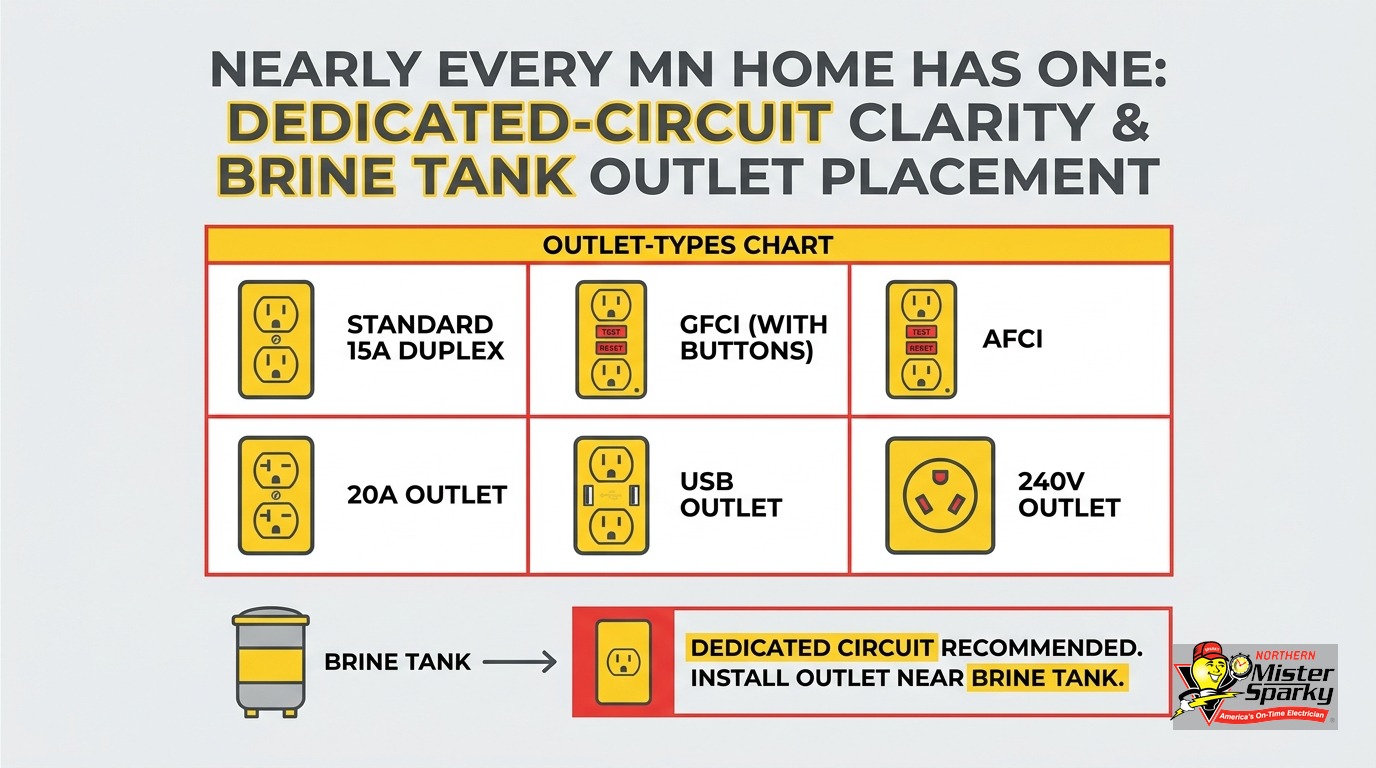
Key Takeaways
- Water softener electrical outlet requirements in Minnesota now fall under the 2026 NEC, which took effect August 17, 2026. Any permit filed on or after that date uses the new standard.
- Standard specs are 120V/60Hz, a 15-amp circuit, and 14-gauge wire minimum. Peak draw during regeneration is 0.8 to 3 amps.
- A dedicated circuit is required by nearly every manufacturer manual. The NEC does not list it explicitly, but inspectors enforce manufacturer installation specs as code.
- GFCI protection is required under two overlapping rules: NEC 210.8(A)(5) for all basement receptacles, and the 2026 NEC’s new rule within 6 feet of any indoor sink.
- The outlet should be mounted above the brine tank, within 6 to 10 feet of the unit, using a single-gang receptacle.
- A new outlet or circuit requires a permit. Minneapolis and St. Paul run their own permit departments, separate from state DLI. Your licensed electrician handles permit coordination.

What Are the Standard Water Softener Electrical Outlet Requirements?
Quick answer: A water softener needs a 120V/60Hz outlet on a 15-amp circuit with 14-gauge wire minimum. The unit draws 0.8 to 3 amps during its regeneration cycle. Annual energy use is roughly 70 kWh - about the same as a clock radio left running year-round.
The low draw is why many homeowners assume any open outlet nearby will do. The softener will run. But “runs it” and “meets code” are two different things.
Per manufacturer spec analysis, the softener’s internal transformer steps 120V down to roughly 24V for the control valve. The electronics are simple. The concern is not the softener overloading the circuit on its own. The concern is what else is sharing the circuit when regeneration kicks in at 2 a.m.
Water softeners typically regenerate on an overnight timer. If the circuit trips during that cycle, the softener skips regeneration. Your water goes hard again and you may not notice for days. Scale accumulates in the water heater, the dishwasher, and the pipes in the meantime.
The 14-gauge wire minimum matters for wire sizing under load. Some older basement circuits use 12-gauge wire on a 20-amp breaker. That configuration can power a softener, but the outlet itself still needs to be installed correctly and the circuit still needs GFCI protection under current code.
Does a Water Softener Need a Dedicated Circuit?
Quick answer: Manufacturer manuals almost universally require a dedicated circuit. The NEC does not list water softeners among appliances that must have one by code reference. But Minnesota inspectors enforce manufacturer installation instructions as code compliance. No dedicated circuit when the manual requires one is a likely inspection flag.
This distinction matters for how you scope the job. Some appliances carry an explicit NEC mandate for a dedicated circuit - dishwashers, garbage disposals, and microwave ovens among them. Water softeners are not on that list. The NEC does not mandate a dedicated circuit for water softeners by code section alone. The requirement flows from the manufacturer’s installation instructions, which carry the weight of code under the NEC’s installation-compliance standard.
When an inspector asks to see the installation manual and it says “dedicated circuit required,” sharing a circuit is a violation. That is the practical outcome in virtually every installation.
The cost argument for running a dedicated circuit is simple. A callback visit costs more than the extra circuit. And a shared circuit means the softener is competing with the sump pump, the utility room lights, or whatever the builder wired through that corner of the basement. Regeneration is not the only load scenario. A sump pump and a softener running simultaneously on the same 15-amp circuit can trip a breaker.
For a full breakdown of which appliances legally require dedicated circuits and which are manufacturer-requirement only, see our post on dedicated circuits for appliances.
What GFCI Requirements Apply to a Water Softener Outlet?
Quick answer: Two overlapping rules now apply in Minnesota. NEC 210.8(A)(5) requires GFCI protection on all basement receptacles, finished or unfinished - a rule in place since the 2020 code. The 2026 NEC adds a new requirement: GFCI within 6 feet of any indoor sink. Most water softener outlets fall under one or both rules.
This is the part of the water softener electrical outlet requirements conversation that no national electrical site is covering accurately right now.
The existing rule: NEC 210.8(A)(5) has required GFCI protection on all 120V receptacles in basements, finished or unfinished, since the 2020 NEC. That rule did not change. It is still in force. Any softener outlet in a basement needs GFCI. A significant number of existing installations skip it anyway. That gap surfaces during permit inspections on new work in the same space.
The new 2026 NEC rule: GFCI is now required for any receptacle within 6 feet of the edge of an indoor sink. This includes laundry sinks and utility sinks - types of fixtures that were previously excluded from the proximity rule. The 2026 NEC expansion of Section 210.8 extends GFCI coverage to these interior sink locations. Water softener brine tanks almost always drain to a utility sink or a nearby floor drain. The outlet for the unit commonly sits within 6 feet of that drain point. Under the new code, that outlet must be GFCI-protected regardless of whether it is on a dedicated circuit.
What this means for a new installation: even if you run a dedicated 15-amp circuit correctly, a missing GFCI device will fail inspection if the outlet is within 6 feet of the utility sink. The GFCI protection can come from a GFCI receptacle at the outlet or from a GFCI breaker protecting the entire circuit at the panel. Either satisfies the code requirement.
What this means for older installations: you are not required to immediately upgrade compliant existing work just because the code changed. Permits are the trigger. When a licensed electrician pulls a permit for new work in that utility space, everything in scope gets reviewed against current code. That is when older GFCI gaps come up.
For a full primer on where GFCI protection applies across the home, see our guide on GFCI outlet requirements explained.
Water Softener Electrical Outlet Requirements Under the 2026 NEC
Minnesota adopted the 2026 NEC with an effective date of August 17, 2026, per the Department of Labor and Industry. Permits pulled before that date fall under the 2023 NEC. Permits pulled on or after that date fall under the 2026 NEC.
That date is essentially brand new. Contractors are updating their checklists. Homeowners who had outlet work quoted before August 17 may have received a quote under the old standard. The expanded 6-foot indoor sink GFCI rule was not in scope under the 2023 NEC for utility sinks. It is now.
The practical consequence: if a plumber is installing a new softener this week and an electrician is pulling a permit for the outlet, the 2026 NEC governs. The electrician needs to know the new standard applies. A good contractor already knows. But it is a fair question to ask when you schedule the work.
No malarky: if your quote was written before August 17, ask your electrician whether the GFCI scope needs updating under the new code.
The MN 2026 NEC Residential Inspection Checklist is publicly available. It is the document your inspector uses on-site. Reading it before the inspection lets you know exactly what is being checked.
Where Should the Outlet Be Located Near the Brine Tank?
Quick answer: Place the outlet within 6 to 10 feet of the softener to avoid extension cords. Mount it above the brine tank, clear of water splash. Use a single-gang receptacle rather than a duplex. Single-gang reinforces that this circuit has one dedicated purpose.
Extension cords are not a code-compliant permanent solution for a water softener. Most manufacturer manuals prohibit them explicitly. A cord trailing across a utility room floor is both a trip hazard and a moisture risk.
Height matters for splash protection. The brine tank can overflow or release water during regeneration. An outlet mounted low behind the tank sits in the splash zone. Standard practice is to mount the receptacle at 48 to 54 inches above the floor, above the unit’s control head. Higher is acceptable if the room allows.
The single-gang convention (one outlet, not two) is standard practice for dedicated circuits. It does not prevent someone from using a plug adapter later, but it signals to any future electrician or inspector that this outlet serves one circuit and one appliance. That clarity matters when the utility room fills up with equipment over the years.
Route the cord cleanly. Position the outlet on the same wall as the softener’s control head. This keeps the cord from crossing in front of the unit or stretching around a corner toward the drain.
Do You Need a Permit to Add a Water Softener Outlet in Minnesota?
Quick answer: Yes. Any new outlet or circuit addition requires a permit in Minnesota. Minneapolis and St. Paul operate their own electrical permit departments, separate from state DLI. Roughly 66 Minnesota cities have adopted local electrical inspection authority. Your licensed electrician handles permit coordination as part of the job.
This surprises many homeowners in the Twin Cities. The assumption is that permits run through a single statewide process. Electrical permits in Minnesota do not work that way.
Minnesota’s Department of Labor and Industry oversees statewide electrical licensing and permits for most jurisdictions. But Minneapolis routes permits through the city’s Department of Regulatory Services. St. Paul uses DSI, the Department of Safety and Inspections. Each city has its own application process, fee schedule, and inspection scheduling system.
When you hire a licensed electrical contractor, they know which authority has jurisdiction for your address. The permit is pulled as part of the scope. The permit fee is typically passed through as a line item on your invoice.
The homeowner self-permit path exists but comes with strict conditions. You can pull your own permit and perform electrical work only if you personally own the property, personally occupy it as your primary residence, and personally perform all of the work. Homeowners who hire a plumber for the softener install and a separate electrician for the outlet do not qualify under this exemption.
A permitted and inspected outlet also has resale value. It is documentation that the work was done to code. That documentation helps when a buyer’s inspector reviews the utility room before closing.
For more on how Minnesota electrical permits work and when they are required, see our post on electrical permits in Minnesota.
Why Twin Cities Water Hardness Drives So Many of These Jobs
Minnesota’s water is genuinely hard. The state average is 192 ppm, and 30 of 49 measured Minnesota cities fall in the hard or very hard band, above 120 mg/L. That drives a lot of softener installations, which in turn drives steady demand for dedicated outlet work.
But hardness varies meaningfully across the Twin Cities metro. Where you live affects how urgently the softener matters.
Bloomington draws primarily from groundwater and measures around 18 grains per gallon (GPG). That is in the very hard range. Scale accumulates fast on fixtures, appliances work harder, and soap barely lathers. St. Paul measures roughly 12 GPG. Minneapolis proper comes in at approximately 5.4 to 5.5 GPG, according to regional water quality data. Minneapolis sources water from the Mississippi River, treated centrally before distribution. It is moderately hard - still worth treating, but the urgency differs from a groundwater suburb.
For suburban Twin Cities homeowners in Bloomington, Brooklyn Park, Woodbury, Maple Grove, or Blaine, a softener is not a luxury item. It is protecting the water heater, the dishwasher, and the pipe connections throughout the home. The outlet to run it needs to meet the 2026 NEC standard, and that now includes GFCI protection near the utility sink.
What Does a Licensed Electrician Check on This Job?
Quick answer: The electrician confirms circuit specs, GFCI compliance under the 2026 NEC, outlet placement and height, panel capacity, and which permit authority has jurisdiction. Each checkpoint has a direct code implication for the inspection outcome.
This is not a complex job, but it has several layers.
Circuit load and labeling. The electrician confirms the panel can accommodate a new 15-amp dedicated circuit and that the breaker slot is available and correctly labeled. Clear panel labeling matters for any future service work in that space.
GFCI compliance. The electrician measures the distance from the outlet to the utility sink, confirms GFCI protection is specified, and selects the right method - GFCI receptacle at the outlet, or a GFCI breaker protecting the circuit from the panel. Either satisfies the 2026 NEC requirement.
Outlet placement and mounting. Height, distance from the unit, single-gang specification, and clearance from the brine tank and drain connections are reviewed before rough-in.
Panel capacity. If the panel is near its limit, adding a dedicated circuit may require a slot review first. A panel with no available space is an upstream problem that needs resolution before the softener circuit can be added cleanly.
Permit and inspection coordination. The electrician pulls the permit from the correct authority - DLI, Minneapolis, St. Paul, or the relevant local jurisdiction - schedules the inspection, and gets the work signed off. The job is not code-complete until it passes inspection.
Schedule Before the Softener Goes In
The cleanest sequence: have the outlet work permitted and inspected before the softener installer arrives. Your plumber or softener installer wants the outlet ready when the unit goes in. Scheduling the electrician after the fact means the softener sits unplugged or on an extension cord while a permit slot opens up.
Northern Mister Sparky is locally owned and operated in the Twin Cities, backed by the “America’s On-Time Electrician(R)” standard. Our team handles dedicated circuit installs, GFCI upgrades, and permit coordination across Minneapolis, St. Paul, Bloomington, Brooklyn Park, Woodbury, Blaine, Maple Grove, Plymouth, and the surrounding area. Every job comes with the UWIN(R) 100% satisfaction guarantee.
Call us at 763-200-5956 or book online to schedule. We can coordinate timing with your softener installer so the outlet is ready when the unit arrives.
Frequently Asked Questions
Does a water softener need a dedicated circuit in Minnesota? +
What GFCI protection does a water softener outlet need in Minnesota? +
Do I need a permit to add a water softener outlet in Minnesota? +
Where should a water softener outlet be placed? +
Need an electrician now?