
Bathroom Heat Lamp Installation Wiring: Minnesota Code Guide
Key Takeaways
- Minnesota adopted the 2026 NEC on August 17, 2026. Permits filed today must comply with the new code.
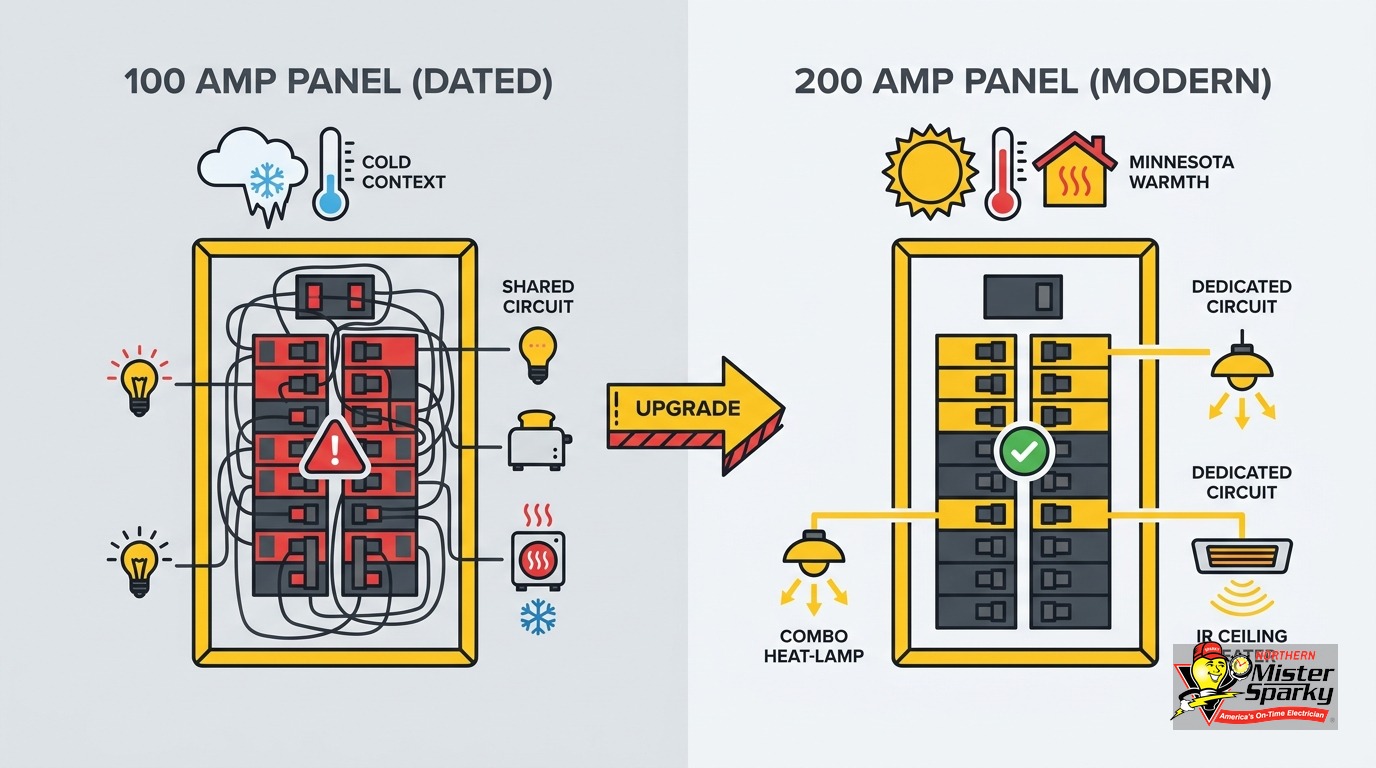
- Hardwired IR ceiling heaters fall under NEC Article 424. That article requires an individual branch circuit for fixed electric space heating equipment.
- Manufacturer installation instructions carry the weight of code. A spec sheet that says “dedicated circuit required” makes that instruction legally binding under NEC 110.3(B).
- A permit is required for new circuit work in Minnesota. Homeowners can apply online, but the work must pass a licensed inspection.
- GFCI protection is mandatory on all bathroom circuits. That includes dedicated circuits feeding heat lamps and hardwired IR heaters.
- Real-world load math is tight. A hair dryer (12A), a curling iron (5A), and a 4-bulb combo unit (4.2A) together pull 21.3 amps on a 20A breaker.
- Radiant infrared warms the body directly, not the air. In a Minnesota bathroom at -20F outside, that is an engineering advantage, not a comfort upgrade.
Why Do Minnesota Bathrooms Need a Heat Lamp?
In Minnesota, a bathroom heat lamp is practical, not a luxury. Radiant IR heats the body directly, bypassing the building envelope. At -20F outside, that matters. A forced-air or convection heater warms the air, but the air keeps escaping. IR delivers warmth to the person even when the room is still cold.
Most bathroom heat lamp guides treat these fixtures as spa accessories. They are written for moderate climates where a bathroom warms up in minutes. In the Twin Cities, that framing misses the point.
Consider a bathroom with an exterior wall in February. That wall is shedding heat at -20F outside. A forced-air system pumps warm air into the space, but the warm air mixes with the cold zone near the wall and cools quickly. You feel it the moment you step out of the shower.
Radiant infrared works differently. It heats the objects and people it contacts, not the surrounding air. It travels in straight lines, like sunlight. The moment you step out of the shower, the heat lamp warms you directly. The air temperature in the room matters less.
This is not a marketing claim. It is how radiant infrared physics works. And it explains why these fixtures perform better in cold climates than forced-air alternatives.
For Twin Cities homeowners, these fixtures run harder and longer than they do in warmer parts of the country. That makes getting the bathroom heat lamp installation wiring right more important, not less.
What Does “Bathroom Heat Lamp Installation Wiring” Actually Cover?
The scope ranges from replacing a heat lamp bulb (no permit, no new wiring) to installing a dedicated 240V circuit for a hardwired IR ceiling heater (permit required, new wire run, licensed inspection). The code path depends entirely on which fixture type you are installing.
Here is how the categories break down:
Bulb-style heat lamp replacement: Swap the old bulb for a new one in an existing fixture. No new wiring. No permit required. This works when the replacement bulb is compatible with the existing fixture and junction box.
Combo fan/heat/light unit on a shared circuit: A combo unit replacing an existing fan, connected to the existing bathroom circuit. This works if the circuit meets the fixture’s requirements and the manufacturer does not require a dedicated circuit.
Combo fan/heat/light unit on a dedicated circuit: Many combo units require a dedicated circuit per their installation instructions. Adding a new 20A circuit is a permitted project. It requires new wire from the panel, a new GFCI breaker, and a DLI inspection.
Permanently wired 120V IR ceiling heater: A hardwired fixture on its own individual branch circuit. Requires a permit, a new wire run, and GFCI protection at the breaker.
Permanently wired 240V IR ceiling heater: The most involved project. Requires a 2-pole GFCI breaker, correctly sized wire from the panel, a permit, and a licensed inspection.
For more on the most common fixture type in Minnesota bathrooms, see our guide on bathroom fan/heater/light combo wiring.
Does a Bathroom Heat Lamp Need Its Own Dedicated Circuit?
It depends on the fixture type and its manufacturer instructions. For simple bulb-style heat lamps, a shared circuit is often permitted. For combo fan/heat/light units and any permanently wired IR ceiling heater, a dedicated circuit is usually required, either by the manufacturer’s spec sheet or by NEC Article 424.
Here is how the logic flows for each fixture type.
Bulb-style heat lamps (250W or less): A standard 2-bulb, 250W heat lamp draws about 2.1 amps. NEC 210.11(C)(3) requires at least one 20A branch circuit for bathroom receptacles. Under the 2020 NEC and later, that circuit may serve all loads in a single bathroom. It may include lights, receptacles, and a heat lamp. The condition: it must serve no rooms other than that bathroom. A low-draw heat lamp bulb typically fits within that rule.
Combo fan/heat/light units: Many combo units specify “dedicated circuit required” in their installation instructions. Under NEC 110.3(B), those instructions carry the weight of code. That instruction is not a suggestion. It is a binding code requirement. Our guide on dedicated circuits for appliances and fixtures explains when and why these circuits matter.
Permanently wired IR ceiling heaters: These fixtures fall under NEC Article 424. Article 424 requires individual branch circuits for fixed electric space heating equipment. A shared bathroom circuit is not compliant for a permanently wired heater. The code requires the individual circuit regardless of available ampacity on the shared circuit.
The practical rule: read the installation instructions before purchasing the fixture. If they require a dedicated circuit, plan for that cost upfront. Adding a circuit before the fixture is installed is far easier than after.
Which NEC Article Governs Your Heater?
Bulb-style and plug-in heat lamps fall under NEC Article 422 (Appliances). Permanently wired IR ceiling heaters fall under NEC Article 424 (Fixed Electric Space Heating). Article 424 requires individual branch circuits. That is a stricter standard than the general bathroom circuit requirements under Article 422.
Most homeowners and some contractors default to Article 422 for all bathroom heating fixtures. That is correct for a screw-in heat lamp bulb. It is not correct for a permanently wired radiant ceiling heater.
NEC Article 422.11 covers overcurrent protection for appliance-style heat lamps: the self-contained, plug-in type. The rules under Article 422 are less restrictive. A shared bathroom circuit can typically accommodate a low-draw heat lamp bulb.
NEC Article 424 applies the moment a heater is permanently wired into the building. The key requirement: an individual branch circuit for each piece of fixed electric space heating equipment. That means no sharing with receptacles, lights, or any other loads.
The distinction matters at inspection time. An inspector reviewing a hardwired IR ceiling heater will apply Article 424. A shared bathroom circuit for that fixture will not pass.
Minnesota adopted the 2026 NEC effective August 17, 2026. Any permit filed on or after that date must comply with the 2026 edition. Your inspector will reference that version.
Do I Need a Permit to Wire a Bathroom Heat Lamp in Minnesota?
Yes, if the work involves a new circuit or any wiring behind walls. Minnesota requires a permit for new circuit installations, including adding a dedicated circuit for a heat lamp. Homeowners can apply online, but the completed work must pass a licensed electrical inspection before the project closes.
Skipping the permit is the most common mistake in DIY bathroom wiring projects. No permit means no inspection. No inspection means no one checks the work before the ceiling gets closed up.
Minnesota’s Department of Labor and Industry handles electrical permits for most of the state. Homeowners can apply online through the DLI iMS portal. You do not need a contractor’s license to pull a homeowner permit.
What you do need: the completed work must pass a licensed electrical inspection. The inspector verifies wire sizing, breaker rating, GFCI protection, fixture installation, and code compliance. That step catches mistakes before they become hazards.
A few permit notes specific to Minnesota:
- Permits are required for new circuits, any panel work, and wiring that runs through walls or ceilings.
- Replacing a fixture on an existing compatible circuit in the same location typically does not require a permit. Adding a new dedicated circuit does.
- Unpermitted electrical work can surface during a home sale. A title search or DLI records check may flag it.
Our overview of how to pull an electrical permit in Minnesota walks through the DLI process and what to expect from a licensed inspection.
Is GFCI Protection Required for a Bathroom Heat Lamp?
Yes. GFCI protection is required on all bathroom circuits in Minnesota, including a dedicated circuit feeding a heat lamp, a combo unit, or a hardwired IR ceiling heater. This applies to 120V and 240V circuits alike. There is no exception for a dedicated heater circuit in a bathroom.
Bathrooms are wet environments. The NEC treats them accordingly, and Minnesota’s 2026 NEC adoption does not change that baseline.
NEC requirements for bathroom circuits mandate GFCI protection on all bathroom branch circuits. The 2020 NEC expanded GFCI requirements to cover 250V single-phase receptacles at 50A or less. That expansion is relevant if you are installing a 240V radiant heater on a dedicated circuit.
For 120V heat lamp circuits: a GFCI breaker at the panel protects the entire circuit. It covers both the fixture and any receptacles on the circuit.
For 240V IR heater circuits: a 2-pole GFCI breaker is required. All major panel manufacturers offer them. A standard 2-pole breaker without GFCI protection is not compliant for a 240V bathroom circuit.
If your bathroom is in an older home with a panel that is running low on available slots, adding a new GFCI breaker may surface a capacity issue. Our guide on what to do when your panel is out of breaker slots covers the options before you commit to a fixture purchase.
Why Does the Load Math Matter on a Shared Circuit?
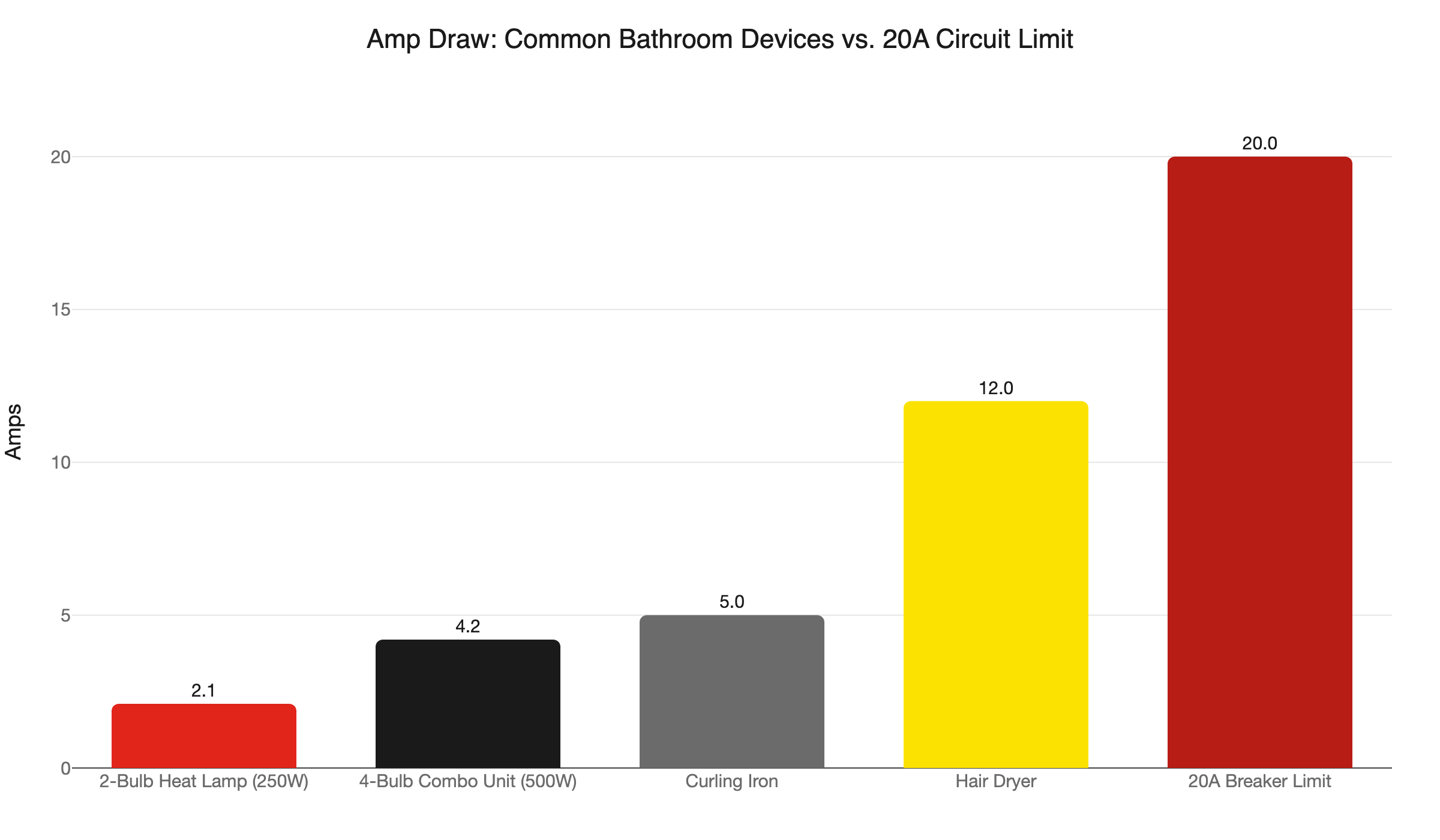
A shared 20A bathroom circuit fills up faster than most homeowners expect. A hair dryer alone pulls 12 amps. Add a curling iron (5A) and a 4-bulb combo unit (4.2A) and you are at 21.3 amps on a 20A breaker. It trips before anything overheats, but it trips every morning.
Even when the NEC technically permits a heat lamp on a shared circuit, the real-world numbers often make a dedicated circuit the smarter call.
Here are the amp draws for common bathroom devices:
- 2-bulb, 250W heat lamp: 2.1 amps
- 4-bulb, 500W combo fan/heat/light unit: 4.2 amps
- Curling iron: 5.0 amps
- Hair dryer: 12.0 amps
- 20A circuit limit: 20.0 amps
Run a hair dryer, a curling iron, and a 4-bulb combo unit at the same time. That is 21.3 amps on a 20A breaker. The breaker trips. No one gets hurt, but it trips every morning at the worst possible time. The amp draw comparison makes the math visible.
This is exactly why many combo unit manufacturers write “dedicated circuit required” into their spec sheets. They know what else runs in a bathroom. A dedicated circuit eliminates the competition. The heat lamp or combo unit runs on its own circuit. The hair dryer and curling iron run on the existing bathroom circuit. No nuisance tripping, no overload risk, no cold showers because the breaker tripped mid-routine.
A dedicated circuit is not just a code convenience. It is the reason combo units work reliably over time.
What Does the Wiring Job Actually Look Like?
The scope varies significantly by fixture type. Replacing a bulb-style heat lamp in an existing fixture is a simple swap. Adding a dedicated 240V circuit for a hardwired IR heater is a multi-step project: panel work, a new wire run, a permit, and a licensed inspection.
Here is the breakdown by scenario:
Replacing a fixture on an existing compatible circuit: Remove the old fixture. Connect the new one to the existing wiring. Confirm the junction box is rated for the new fixture’s weight. No permit required for a like-for-like replacement.
Installing a combo fan/heat/light unit with a dedicated 120V circuit: Run new 12 AWG wire from the panel to the bathroom. Install a 20A GFCI breaker. Connect the fixture at the ceiling. Pull a permit before starting. Schedule a DLI inspection after the work is complete.
Installing a permanently wired 240V IR ceiling heater: Size the wire and breaker to the heater’s amperage draw. Install a 2-pole GFCI breaker. Run the appropriate wire gauge from the panel to the bathroom. Pull a permit. This project benefits from a licensed electrician, both for code compliance and for navigating the inspection correctly.
Junction box upgrade: Many older bathroom ceilings have fan boxes rated for a single lightweight fan. A heavy combo unit requires a fan-rated box capable of supporting its weight. A plastic utility box is not adequate. Confirm the box rating before mounting the fixture. This step is frequently missed in DIY installs and often discovered after the ceiling is already opened up.
When Should You Call an Electrician Instead of DIYing?
DIY is reasonable for like-for-like fixture replacements on existing circuits. Call a licensed electrician for any project involving a new circuit, 240V wiring, or panel work. A bathroom is a wet environment. The margin for error on these projects is thin.
Minnesota law allows homeowners to pull their own permits and do their own wiring. That does not mean every project is a good DIY candidate.
Where DIY is reasonable: You are replacing a fixture on an existing compatible circuit, in the same location, at the same wattage. No new wire runs. No panel work. Confirm GFCI protection is in place. Confirm the junction box is fan-rated and can support the new fixture. That is a manageable scope for a careful homeowner.
Where a licensed electrician makes sense: The project involves a new circuit, 240V wiring, panel work, or running wire through finished walls. The risk profile changes on these jobs. A bathroom is a wet environment. Water and a wiring mistake is the combination the NEC was written to prevent.
The honest math: A wiring error behind a finished ceiling is expensive to find and expensive to fix. The cost of a licensed electrician for a dedicated circuit is real. But so is the cost of an inspection failure after the wall is already closed, or a callback on a mistake that has been energized for six months.
No malarky: if you have any doubt about the scope of your project, talk to a licensed electrician before you commit to a fixture purchase. It costs nothing to ask, and it can change what you buy.
Northern Mister Sparky is locally owned and operated in the Twin Cities. Our team handles bathroom circuit work, dedicated circuit installations, panel additions, and the DLI permit and inspection process. We are America’s On-Time Electrician(R), and every job is backed by the UWIN(R) 100% satisfaction guarantee.
Call 763-200-5956 or book online to schedule your appointment.
Frequently Asked Questions
Does a bathroom heat lamp need its own dedicated circuit? +
Do I need a permit for bathroom heat lamp installation wiring in Minnesota? +
What is the difference between a plug-in heat lamp and a hardwired IR ceiling heater under the NEC? +
Need an electrician now?