
Bathroom Light Over Shower Code Requirements: 2026 NEC Guide
Key Takeaways
- The zone. NEC 410.10(D) bans certain fixture types within 3 feet horizontally and 8 feet vertically of the tub rim or shower threshold.
- The label. Fixtures inside the shower enclosure up to 8 feet high must carry an NRTL-listed wet or damp location rating. A sealed-looking fixture without that label fails inspection.
- GFCI. Every outlet and luminaire on the bathroom circuit needs GFCI protection, not just the ones closest to the shower.
- IC rating. Attic insulation sits directly above most Twin Cities bathroom ceilings. An IC-rated, and often AT-rated, fixture is the practical default here, not an optional upgrade.
- Permits vary. Minneapolis treats a true like-for-like fixture swap differently from most suburbs. Most suburbs require a permit for any bathroom luminaire work.
What Are the Bathroom Light Over Shower Code Requirements?
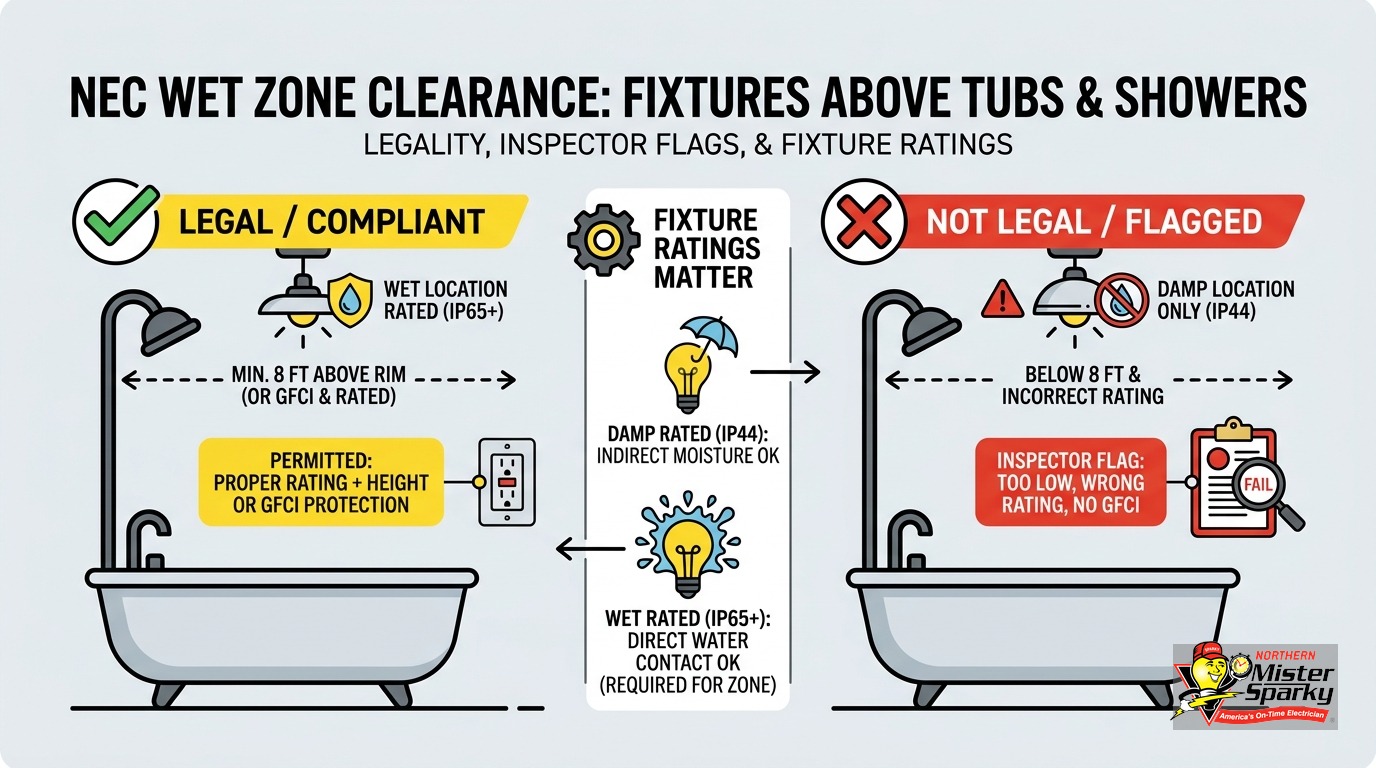
Quick answer: NEC 410.10(D) sets two rules. First, no cord-connected, pendant, chain-, or cable-suspended fixtures, lighting track, or ceiling fans with a light kit inside the 3-foot horizontal, 8-foot vertical zone. Second, any fixture inside the shower enclosure up to 8 feet high must carry a wet or damp location NRTL listing.
Those two rules sound simple. Most homeowners trip on two points: the exact geometry of the zone and the meaning of “wet” versus “damp.” Both deserve a closer look.
The zone includes everything within its boundaries, including the ceiling directly overhead. A light in the shower stall ceiling sits in the zone. Any light on the ceiling outside the stall but within 3 feet of the curb also sits in the zone. The 8-foot vertical limit is measured from the floor-level threshold, not the ceiling above.
The NEC does not ban all fixtures in the zone. It bans specific types: cord-connected fixtures, pendants, track, and ceiling fans with light kits. Hard-wired recessed or surface-mounted fixtures with the correct location rating are permitted.
The fixture-type rule and the location-rating rule are two separate requirements. A fixture can be the right type but carry the wrong rating. It still fails.
The 3-Foot, 8-Foot Zone Explained
Picture the shower threshold at floor level. From that edge, extend an imaginary boundary outward 3 feet on all sides. Any point within that boundary, up to 8 feet off the floor, falls inside the zone.
For a bathtub, the reference point shifts to the top of the tub rim. The zone extends 3 feet horizontally from the rim and 8 feet vertically above it.
This geometry creates a column of restricted airspace. A pendant hung over a freestanding soaking tub is exactly what NEC 410.10(D)(1) prohibits. The aesthetic looks inviting. The code does not permit it.
The IRC mirrors this rule in Section E4003.11, which means it applies to residential inspections, not only commercial work.
One timing note: the inspector applies the code edition in effect on the permit date. In Minnesota, any permit dated August 17, 2026 or later falls under the 2026 NEC. Pull a permit for bathroom lighting work today and the 2026 edition is what governs.
What Is the Difference Between a Wet and Damp Location Rating?
Quick answer: A wet-location fixture is rated to withstand direct water spray. A damp-location fixture handles humidity and condensation but not direct spray. The practical test: if the showerhead can reach the fixture, it needs a wet rating. If only steam and humidity reach it, damp is sufficient. This distinction is exactly what inspectors check at final.
This is the most common source of bathroom lighting failures. A fixture that looks watertight may carry only a damp-location listing. Install it where spray is possible and it fails.
NEC 410.10(D)(2) states that luminaires inside the tub or shower enclosure up to 8 feet high must be marked for damp locations at minimum. If the fixture can receive direct spray, the marking must read “wet locations.”
The listing must come from a Nationally Recognized Testing Laboratory (NRTL). UL and ETL are both NRTLs. The label must read “Suitable for Wet Locations” or “Suitable for Damp Locations.” A sealed or waterproof-looking fixture without that language does not meet the standard. Inspectors check the label, not the look.
A common scenario: a homeowner installs a sleek flush-mount LED in a tile shower ceiling. It looks completely sealed. The box reads “damp location only.” The showerhead can reach it. That is a failed inspection, regardless of cost or appearance.
For fixtures mounted just outside the shower but within the 3-foot zone, damp-location listing is generally sufficient when spray cannot reach them. A licensed electrician can confirm the geometry and the correct rating before you buy anything.
Has Minnesota’s Electrical Code Changed Recently?
Quick answer: Yes. Minnesota adopted the 2026 NEC effective August 17, 2026. Permits filed before that date fall under the 2023 NEC. Permits filed on or after that date fall under the 2026 NEC. Licensing exams transition to the 2026 NEC on September 8, 2026.
Minnesota does not maintain a standalone state electrical code. The state adopts the NEC directly under Minnesota State Building Code Chapter 1315. The effective date determines which edition applies. For permits pulled today, that edition changed less than two weeks ago.
The 2026 NEC did not substantially change the shower zone rules. NEC 410.10(D) geometry and the wet/damp labeling requirement carry forward. The 2026 edition made citation restructuring updates in this area, not rule changes.
The more significant update came with the 2023 NEC. Before 2023, all ceiling fans were banned inside the zone. The 2023 NEC narrowed that prohibition. Ceiling fans with light kits remain banned in the zone. Ceiling fans without light kits moved to Article 422.18(B) and are evaluated separately. That distinction carries into the 2026 NEC.
If you are replacing a ceiling fan with a light kit inside a bathroom, confirm the replacement clears the zone entirely. A fan-and-light combination inside the 3-foot, 8-foot boundary is still not permitted.
For any permit pulled today in Minneapolis, Maple Grove, Woodbury, Blaine, or anywhere else in the Twin Cities, the 2026 NEC is the applicable code.
What Do Inspectors Actually Fail People On?
Quick answer: The most common Twin Cities inspection failures for bathroom lighting are a damp-rated fixture in a wet location, missing GFCI protection on the full circuit, junction-box fill violations, and work performed without a permit. The label failure is the most frequent by far. Most homeowners assume a sealed fixture is code-compliant.
Here is what each failure looks like in practice.
Wrong location rating. A homeowner or DIYer buys a fixture that looks watertight, installs it in the wet zone, and discovers the listing reads “damp location only.” The inspector checks the label. Always confirm the listing before purchasing, not after installing.
Missing GFCI on the full circuit. NEC Section 210.8 requires GFCI protection for every outlet and luminaire on the bathroom circuit. The requirement covers the entire circuit, not just the receptacle near the sink. Protection comes from a GFCI breaker at the panel or a GFCI outlet wired upstream on the circuit. Any branch that bypasses that protection fails.
See our guide to GFCI outlet requirements for a full breakdown of where GFCI protection is required throughout your home.
Junction-box fill violations. When a fixture is swapped or new wiring is pulled, inspectors check that the junction box is not overfilled. DIY work is where this failure surfaces most often. An undersized box or too many conductors stuffed into the original enclosure is a code violation, even when the fixture itself is rated correctly.
Work done without a permit. Minneapolis has specific rules about like-for-like fixture swaps, and some true swaps may not require a permit in that city. Most Twin Cities suburbs require a permit for any luminaire work in a bathroom. Unpermitted work surfaces at home sale, when a buyer’s inspector finds it, or after a loss, when an insurer investigates.
A licensed electrician working under a permit eliminates all four failure points. That is the reason the permit system exists.
IC Ratings and Minnesota’s Cold Attics
This is the angle that out-of-state lighting retailers consistently miss.
Most Twin Cities single-story homes and ramblers have attic insulation sitting directly above the bathroom ceiling. Minnesota winters require it. But that construction creates a code requirement that surprises many homeowners during inspection.
Non-IC-rated recessed fixtures require 3 inches of clearance from insulation. With R-38 or R-49 insulation on the attic floor, that clearance is physically impossible. You would have to pull insulation away from every can light to get it. Inspectors do not accept trimmed-back insulation as a substitute for the correct fixture.
The correct fixture for a Minnesota bathroom ceiling is IC-rated. IC fixtures are designed to sit in direct contact with insulation without creating a fire hazard. For most Twin Cities homes, go one step further and choose an AT-rated fixture as well. AT stands for air-tight. An AT fixture seals against the ceiling drywall and limits the stack-effect air leakage that adds to heating costs every January and February.
The IC/AT combination is the standard recommendation for any recessed can in a Minnesota bathroom with an insulated attic above it. It costs more than a non-rated fixture. The return is a fixture that passes inspection and keeps conditioned air inside the house where it belongs.
Our post on IC-rated recessed lighting in insulated ceilings covers fixture selection and installation detail for Minnesota homes.
Do I Need a Permit to Replace a Shower Light in the Twin Cities?
Quick answer: It depends on the city. Minneapolis may allow a true like-for-like fixture swap without a permit. Most Twin Cities suburbs require a permit for any bathroom luminaire work. When uncertain, pull the permit. Unpermitted work creates problems at home sale and after an insurance claim.
The permit question generates inconsistent advice because the rules genuinely vary by municipality. Even within a single city, the permit office may interpret “like-for-like” differently than a homeowner expects.
A permit is always required when:
- New wiring is being run.
- The circuit is being altered or extended.
- A new fixture location is being added.
- The work involves upgrading the wire gauge or circuit breaker size.
A permit may or may not be required when only the fixture itself is being replaced, with no changes to wiring, box, or circuit. That determination depends on the city.
The cleanest path: call your local building department before starting work, or have a licensed electrician make that call. It takes a few minutes and removes all ambiguity. A licensed electrician can also pull the permit on your behalf. That protects you if the work is later questioned by a buyer’s inspector or an insurance adjuster.
How to Choose a Code-Compliant Shower Fixture
Choosing the right fixture comes down to four checkpoints.
1. Location rating. For a fixture inside the shower enclosure or anywhere in the wet zone, the label must read “Suitable for Wet Locations.” For a fixture outside the zone but still in the bathroom, “Suitable for Damp Locations” is acceptable. Verify the product box and the spec sheet, not just the listing page headline.
2. Fixture type. Confirm the fixture is not a pendant, chain-suspended, cord-connected, or track-mounted type if it sits inside the 3-foot, 8-foot zone. Hard-wired flush-mount and recessed fixtures are the right choices for in-zone installation.
3. IC and AT rating. If the fixture is a recessed can below an insulated attic, look for both IC and AT on the label. This applies to nearly every bathroom in a Minnesota single-family home.
4. NRTL listing. UL and ETL are the two common NRTLs. The fixture must carry one of those listing marks. The mark confirms independent testing to the standard the NEC requires.
Buying from a local lighting showroom or electrical supply house means knowledgeable staff can confirm ratings before you leave. Big-box retail mixes listed and unlisted fixtures on the same shelf. Product descriptions do not always show the location rating clearly, and the wrong purchase wastes a trip.
For a full picture of what a bathroom electrical rough-in needs to meet code, see our guide to bathroom remodel electrical requirements.
When to Call a Licensed Electrician
Bathroom electrical work consistently favors a professional over a DIY approach.
Water and electricity are a dangerous combination. The requirements stack: zone geometry, location rating, GFCI for the full circuit, and IC/AT for an insulated ceiling. Missing one layer fails the inspection. Missing two creates a safety hazard.
We are locally owned and operated in the Twin Cities. When you call us, you reach a Minnesota electrician who knows local permit offices. We know what inspectors in Maple Grove, Minneapolis, Woodbury, and Brooklyn Park look for. We can pull the permit on your behalf.
Our team handles indoor lighting installation and replacement from fixture selection through final inspection. If you are adding a bathroom exhaust fan or updating the full circuit, we scope that in a single visit.
No malarky: a bathroom light swap sounds simple until it is not. Call us at 763-200-5956 or book online to schedule with a licensed Twin Cities electrician.
Frequently Asked Questions
What is the NEC zone rule for lights above a bathtub or shower? +
What is the difference between wet and damp location ratings for shower lights? +
Does Minnesota have its own shower lighting code? +
Do I need a permit to replace a bathroom light fixture in Minnesota? +
Need an electrician now?