
Heated Driveway Electrical Requirements in Minnesota
Key Takeaways
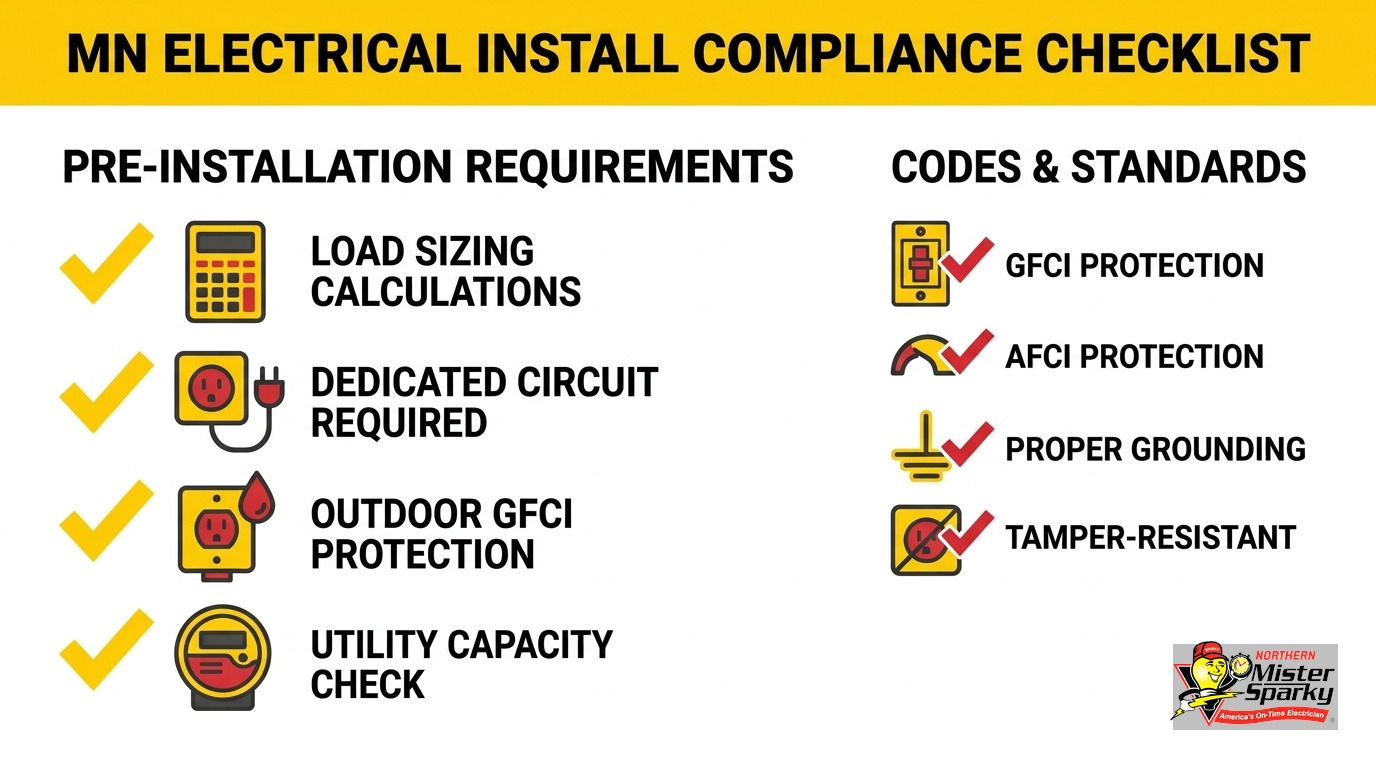
- Heated driveway electrical requirements in Minnesota fall under NEC Article 426. Most online guides never mention it.
- Snowmelt systems are a continuous load. Circuits must be sized at 125% of the calculated load, not 100%.
- The code requires GFPE (ground-fault protection of equipment), not a standard GFCI. These are different devices with different trip thresholds.
- A two-car driveway (400 to 500 sq ft) typically needs 2 to 3 dedicated 30-amp, 240V circuits.
- Homes with 100-amp service cannot support a heated driveway in most cases. A 200-amp or 400-amp service upgrade is usually required.
- Confirm transformer capacity with your utility before pulling a permit. Skipping this step can add weeks to your timeline.
- Minnesota’s 2026 NEC takes effect August 3, 2026. Permits filed on or after that date must meet the new standard.
- No Xcel Energy rebate exists specifically for snowmelt systems. But the panel upgrade this project almost always triggers qualifies for up to $2,500 in combined rebates, or up to $4,500 for income-eligible households.
What Are the Heated Driveway Electrical Requirements in Minnesota?
Quick answer: Heated driveway systems fall under NEC Article 426. They are classified as a continuous load, require ground-fault protection of equipment (GFPE), and must have dedicated circuits sized at 125% of the calculated load. A DLI permit is required before any work begins, and a rough-in inspection must pass before cables are buried.
Minnesota adopts the National Electrical Code as its statewide electrical standard. For heated driveways specifically, NEC Article 426 is the governing article. Its scope covers heating elements, junction boxes, raceways, and all non-heating circuit wiring connected to the system.
Most homeowners do not know Article 426 exists. Most generic online guides do not mention it either. The result is a lot of planning conversations that skip the details that actually determine cost, timeline, and whether the job passes inspection.
How Much Power Does a Heated Driveway Actually Need?
Quick answer: Residential snowmelt systems require approximately 37 watts per square foot. A single 30-amp, 240V circuit covers roughly 170 square feet. A standard two-car driveway, at 400 to 500 square feet, needs 2 to 3 dedicated 30-amp circuits.
That wattage figure is only the starting point. Under NEC Section 426.4, snowmelt systems are classified as a continuous load. That classification requires circuit conductors and overcurrent protection to be sized at 125% of the calculated load, per NEC Section 210.19(A)(1).
So a 6,000-watt heating zone needs a circuit rated for at least 7,500 watts. That is not optional. A two-car driveway puts two or three of those circuits on your panel simultaneously. If your panel is full or your service is undersized, that conversation has to happen before you pick a heating cable brand.
If your panel is already showing signs of strain, read Signs You Need an Electrical Panel Upgrade before scheduling an estimate.
NEC Article 426: The Code That Governs This Work
Three provisions inside Article 426 drive most of the technical conversation between a homeowner and a licensed electrician.
Section 426.4 - Continuous Load Classification As noted above, the 125% sizing rule applies to all conductors and overcurrent protection on the circuit. A circuit that looks adequate at face value often is not once this multiplier is applied.
Section 426.28 - Ground-Fault Protection of Equipment (GFPE) The system must include GFPE. This is not a standard GFCI outlet or breaker. The next section explains why that distinction matters.
Section 426.50 - Disconnect Requirements The system disconnect must open all ungrounded conductors simultaneously. It must be lockable and of the indicating type, meaning you can see at a glance whether it is open or closed. A toggle switch zip-tied to the wall does not meet this requirement.
An electrician who has not read Article 426 recently is not the right contractor for this project. Ask them directly which article governs heated driveway work. The answer tells you a lot.
Why Isn’t Standard GFCI Enough for a Heated Driveway?
Quick answer: NEC Section 426.28 requires ground-fault protection of equipment (GFPE), which trips at 6 to 50 milliamps. A standard GFCI trips at approximately 5 milliamps. They protect different things. Substituting one for the other is a code violation and will not pass a Minnesota inspection.
GFCI protection is calibrated to protect a human body from electrocution. GFPE is designed to protect equipment from ground-fault damage. The trip thresholds are set at different levels for different reasons. Installing a GFCI breaker where the code requires GFPE is not a compliant installation.
One exception exists inside Section 426.28: mineral-insulated, metal-sheathed cable embedded in a noncombustible medium like concrete is exempt from the GFPE requirement. Most residential heated driveway installations use polymer-coated cables, not mineral-insulated cable, so this exception rarely applies to homeowners.
This GFPE versus GFCI distinction is missing from almost every consumer guide on the topic. It is one of the most consequential details in the entire code section. If your contractor conflates the two, ask them to walk you through Section 426.28 before you sign anything.
For a broader look at GFCI requirements on outdoor circuits, see GFCI Outlet Requirements Explained.
Does Your Home’s Electrical Panel Have Room?
Quick answer: Homes with 100-amp service cannot support a heated driveway in most cases. You need at least 200-amp service. Larger driveways or combined projects can push the requirement to 400-amp service or a dual 200-amp configuration.
Here is the math that gets skipped. Add up what is already running on a typical Twin Cities home:
- HVAC system: 30 to 60 amps
- Electric water heater: 30 amps
- Electric dryer: 30 amps
- EV charger (if present): 48 to 80 amps
- Lighting and general receptacles: 20 to 40 amps
That is 160 to 240 amps of existing load before the driveway is added. A two-car snowmelt system adds another 60 to 90 amps of continuous load. A 100-amp service does not work. A 200-amp panel works for smaller driveways if the existing load is not already near capacity.
This is why a heated driveway project almost always triggers a panel upgrade. That is not an upsell. That is what the numbers require. And if you are planning an EV charger alongside the driveway, those two loads together almost certainly push the project to 400-amp service. Read more about that combination: EV Charger Installation in the Twin Cities.
The Utility Capacity Step Most Homeowners Skip
Before your electrician sizes the service, you need to confirm the street transformer can handle the added load. This step is almost never mentioned in consumer-facing guides.
Xcel Energy serves most of the Twin Cities metro. They may need to upgrade the transformer serving your property before your electrician can even pull a permit for a service upgrade. That process adds weeks, and sometimes months, to the project timeline.
Xcel also requires that all new or altered wiring comply with the current NEC and their own “Standard for Electric Installation and Use” before they will set a meter. If your project spans the August 3, 2026 NEC transition date, confirm which code version applies to your permit before work starts.
The correct sequence for this project is:
- Get a load calculation from a licensed electrician.
- Confirm transformer capacity with your utility.
- Pull the permit.
- Schedule the rough-in inspection before cables are buried.
- Pour concrete after the inspection passes.
Reversing steps 3, 4, and 5 is the most expensive mistake homeowners make on this project. If you pour before the inspector sees the rough-in, you may be required to break out the concrete. That has happened to Twin Cities homeowners.
What Are the Minnesota Permitting Requirements for a Heated Driveway?
Quick answer: All electrical work in Minnesota requires a DLI permit before work begins. The rough-in inspection must occur before heating cables are buried or embedded in concrete. Permits are non-negotiable and protect you at resale and in the event of a claim.
Minnesota’s Department of Labor and Industry (DLI) issues electrical permits for most of the state. The permit process exists for one reason: it puts a licensed inspector between you and a failed installation. For heated driveway systems, the rough-in inspection is the critical gate. The inspector must see the cables laid, the conduit run, and the panel work complete before anything gets covered.
Do not let a contractor suggest skipping or delaying the permit. Any electrical work done without a permit is uninsured, unpermitted, and a liability if something goes wrong.
Minnesota’s August 3, 2026 Code Transition
Minnesota currently enforces the 2023 NEC under MN State Building Code Chapter 1315. The 2026 NEC becomes effective August 3, 2026. Permits filed on or after that date must meet the 2026 NEC requirements.
This is not a future consideration. It is live right now. If your heated driveway project is in planning and you expect work to start after August 3, your electrician needs to know which code version the permit will fall under before they spec the job.
Pull the permit before August 3 if you want to work under the 2023 NEC. File on or after that date and your contractor works under the 2026 NEC. Equipment specifications and inspection requirements may differ between the two versions. Clarify this with your contractor during the estimate, not after the permit is filed.
Which Minnesota Cities Have Their Own Electrical Permit Offices?
Quick answer: Plymouth, Maple Grove, and Saint Paul run their own electrical inspection programs. Contractors in those cities do not apply through state DLI. If you live in one of those three cities, your permit goes to the city, not the state.
The underlying electrical code is the same regardless of which office issues the permit. The process, the inspector, and sometimes the turnaround time differ. Always confirm jurisdiction with your contractor before work begins.
If you are in Minneapolis, Bloomington, Brooklyn Park, Woodbury, or Blaine, permits go through DLI. If you are unsure, your licensed electrician should know the answer before they start any paperwork.
Are There Rebates for Heated Driveway Electrical Work?
Quick answer: No dedicated Xcel Energy rebate exists for snowmelt or heated driveway systems as of July 2026. However, the panel upgrade this project almost always requires qualifies for meaningful rebates. Combined, those programs can offset $2,500 or more of your project cost.
Here is what is available:
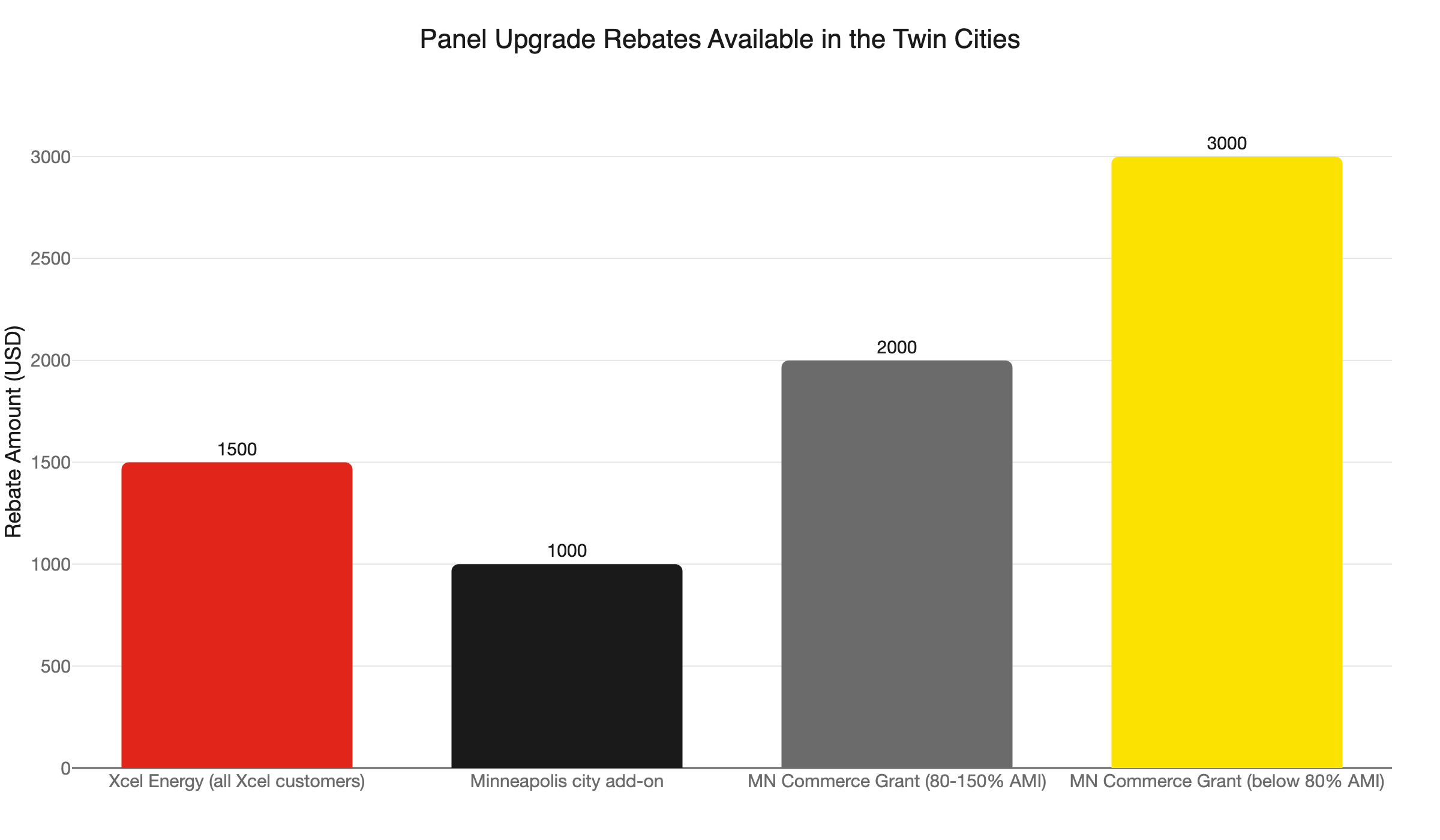
Xcel Energy Panel Upgrade Rebate Up to $1,500 when upgrading panel amperage. Must use a licensed electrician. Applies to single-family and small multi-unit homes (up to 4 units) served by Xcel Energy in the metro.
City of Minneapolis Add-On Minneapolis residents can stack an additional $1,000 city rebate, bringing the total to $2,500 for qualifying panel upgrades.
Minnesota Commerce Grant (Income-Eligible) The Minnesota Commerce Department offers up to $3,000 for households below 80% of area median income, and up to $2,000 for households between 80% and 150% AMI. This program is pending DOE approval for launch and is not retroactive.
None of these programs require you to install a heated driveway to qualify. The panel upgrade alone triggers eligibility. If your project is already pushing you to 200-amp or 400-amp service, these rebates reduce the effective cost of the entire job, not just the driveway.
Our team tracks these programs and will flag every rebate your project qualifies for when you call.
The Twin Cities Case for a Heated Driveway
The ROI math on heated driveways works better here than almost anywhere else in the country. Twin Cities averages more than 54 inches of snow per season. Freezing temperatures run October through April. That is six months of shoveling, salting, and potential slip-and-fall liability.
A system that runs automatically and keeps the surface clear has a different value proposition in Minnesota than in a market that sees snow twice a year. The electrical work is the expensive, once-in-a-generation part. The system itself can last decades with minimal maintenance.
If your home already needs a panel upgrade for other reasons, combining the work in a single project often saves on permitting and labor costs. Our team handles this type of project regularly across Minneapolis, St. Paul, Bloomington, Brooklyn Park, Woodbury, Blaine, Maple Grove, and Plymouth.
What to Ask Your Electrician Before You Sign Anything
Not every electrician has installed a heated driveway system. These questions separate contractors who know the code from those who will figure it out on your driveway:
- Have you pulled heated driveway permits in Minnesota before?
- Which NEC article governs this work, and which section covers GFPE?
- Will this project require a load calculation and a utility capacity check before you pull the permit?
- Which code version will my permit fall under, given the August 3, 2026 transition?
- Will you coordinate with Xcel on transformer capacity before we start?
- When does the rough-in inspection need to happen, and what does the inspector need to see?
A contractor who hesitates on those questions is not the right fit for a job this technical. A contractor who answers them without hesitation has done this before.
Ready to Plan Your Heated Driveway Project?
The heated driveway electrical requirements in Minnesota are specific, sequential, and unforgiving when ignored. The key is working with a licensed electrician who has read Article 426, knows the DLI permitting process, and will not skip the utility capacity check.
Northern Mister Sparky is locally owned and operated in the Twin Cities. We are America’s On-Time Electrician(R), and we back every job with the UWIN(R) 100% satisfaction guarantee. We pull the permits, schedule the inspections, coordinate with Xcel, and get the job done right the first time. No malarky.
Call us at 763-200-5956 or book online to schedule your estimate. We serve Minneapolis, St. Paul, Bloomington, Brooklyn Park, Woodbury, Blaine, Maple Grove, Plymouth, and the surrounding Twin Cities metro. We will give you a straight load calculation, walk you through the inspection timeline, and flag every rebate your project qualifies for.
Frequently Asked Questions
Do heated driveways require a permit in Minnesota? +
What size electrical panel do I need for a heated driveway? +
Is there a rebate for heated driveway electrical work in Minnesota? +
Need an electrician now?