
E-Bike Charging Station Home Installation: Minnesota Guide
Key Takeaways
- An e-bike charger draws 150-500W on a standard 120V outlet. It does not require a 240V circuit or any EV charging hardware.
- A dedicated circuit is still the right call. Overnight charging on a shared garage circuit alongside a freezer or door opener creates real overload risk.
- NEC 625.54 and NEC 210.8(A) both require GFCI protection on a garage e-bike outlet. A GFCI breaker at the panel covers both code requirements in one step.
- Minnesota adopted the 2026 NEC on August 17, 2026. Any new circuit requires a state DLI electrical permit and inspection.
- Charge in a heated space. Lithium-ion batteries should not be charged below 32 degrees F. An unheated detached garage in a Twin Cities winter is a poor choice.
- Xcel Energy offers up to $500 toward an EV charger and wiring installation ($1,200 income-qualified). Minnesota Power offers a $200 e-bike rebate in its service area.
- Call 763-200-5956 or book online to schedule with a locally owned and operated Northern Mister Sparky electrician.

Is an E-Bike Charging Station the Same as an EV Charger?
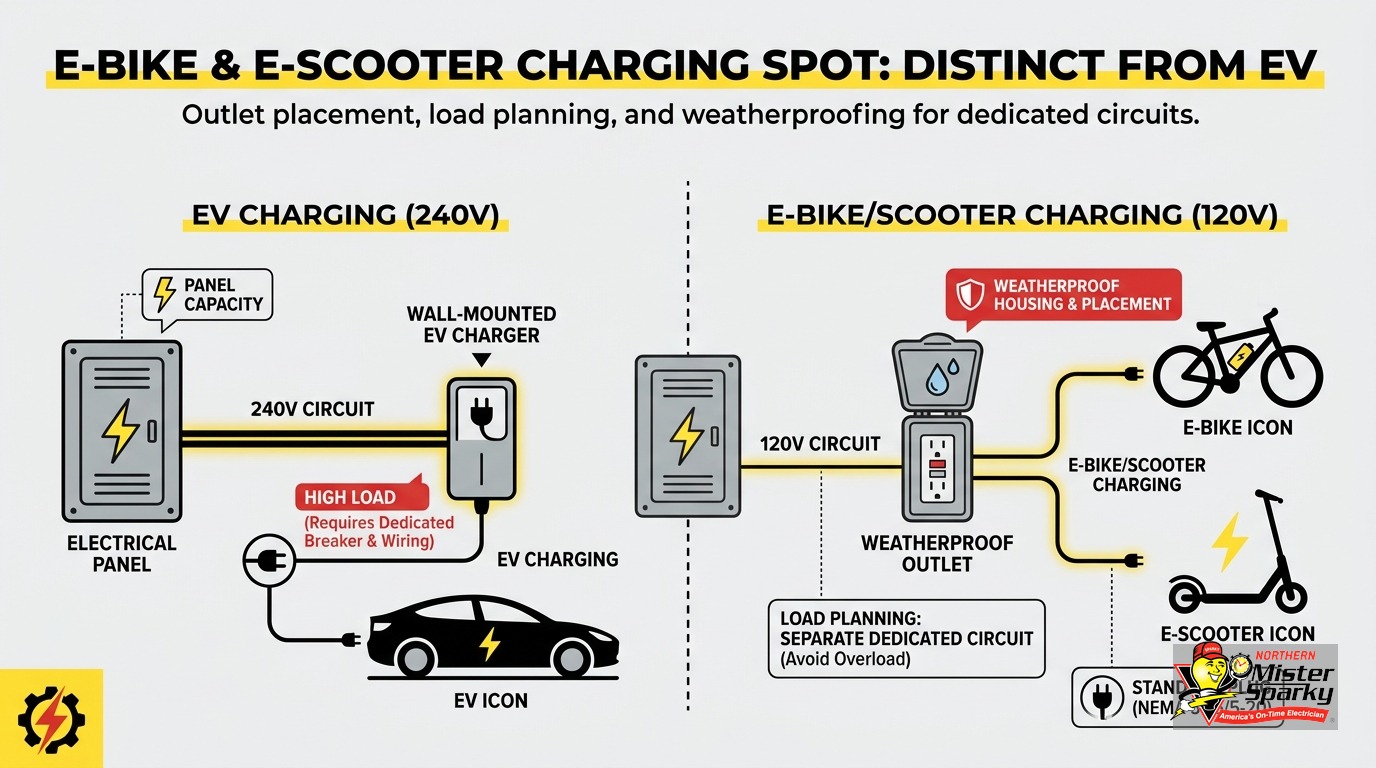
No. An e-bike charger uses a standard 120V household outlet and draws 150-500W. A car-level EV charger runs on 240V and draws 7,680-11,520W. The circuit requirements differ by one to two orders of magnitude.
This distinction matters because most online content ranking for e-bike charging terms is actually written about car EV chargers. Those articles describe Level 2 installations at 32-50A on 240V. None of that applies to a bicycle charger. If you read those articles and assumed you need a major panel upgrade, you assumed wrong.
A typical e-bike charger is closer in draw to a window air conditioner than to a car charger. E-bike chargers draw different amounts of power depending on the battery size and model, with small commuter bikes drawing less than large-battery cargo bikes. All US-sold e-bikes use a standard household plug.
All US-sold e-bike chargers terminate in a NEMA 5-15 or 5-20 plug. There is no special connector. There is no EVSE box. The charger plugs directly into the outlet, just like a laptop or a power tool.
If you are also planning a full Level 2 EV charger for a car, our guide to EV charger installation in the Twin Cities covers the 240V side in detail. For an e-bike, this guide is the right starting point.
What Circuit Does an E-Bike Charger Actually Need?
A single e-bike charges fine on any 15A or 20A circuit. But for most Twin Cities homes, that circuit should be dedicated. Overnight charging on a shared garage circuit alongside a freezer or door opener creates sustained load risk that a dedicated line eliminates entirely.
E-scooter chargers draw similar power to e-bike chargers depending on battery size. Compare that to a car-level EV, which draws significantly more power. E-bike and e-scooter charging is a fraction of that load.
The risk with e-bike charging is not a single charger overloading the circuit. The risk is overnight charging on a shared circuit. That same circuit may carry a chest freezer, a garage door opener, or a workbench outlet. Those loads do not coordinate. Add an e-bike charger running for six hours and you have sustained draw near the circuit’s limit for most of the night.
The NEC continuous load rule limits how much current a circuit can carry continuously, and most e-bike chargers use only a small fraction of a typical home circuit’s capacity. A freezer cycling on adds another 100-200W. A workbench battery charger adds more. The combined load can approach or exceed the continuous rating with no single device obviously to blame.
The clean solution is a dedicated 20A circuit for e-bike charging. It isolates the load and gives you room to add another bike later. It also eliminates the overnight surprise: a tripped circuit leaving all four bikes uncharged by morning. Our broader guide on dedicated circuits for appliances and specialty loads explains the code reasoning behind this approach in more detail.
Why Does GFCI Protection Matter for E-Bike Charging?
GFCI protection is required by code for any e-bike outlet in a garage. Skipping it exposes you to real shock risk if the charger faults near moisture.
GFCI stands for ground fault circuit interrupter. It monitors the difference in current between the hot and neutral wires. If current leaks even 5 milliamps through an unintended path, the GFCI trips in milliseconds. That response time is fast enough to prevent a fatal shock.
Two NEC sections apply simultaneously for a garage e-bike outlet. NEC 625.54 requires GFCI protection on all receptacles installed for EV charging, including 120V outlets used for e-bikes, regardless of location. A separate NEC section also requires GFCI on all garage receptacles. Both rules apply at once.
The simplest path to compliance is a Class A GFCI breaker at the panel. It protects the full branch circuit. A standard GFCI receptacle (the familiar outlet with TEST/RESET buttons) also satisfies both requirements for a 120V e-bike outlet. Standard GFCI receptacles are not rated for 240V circuits, but they are fully appropriate for the 120V e-bike use case.
If you are unsure whether your existing garage outlets are GFCI protected, press the TEST button on the outlet nearest the panel. If nothing trips, those outlets may not be on a protected circuit. Our guide to GFCI outlet requirements explained walks through how to check and what each configuration means for your home.
Where Should You Put the Outlet in a Minnesota Home?
Put it in a heated space. For Twin Cities homeowners, the difference between an attached heated garage and an unheated detached structure is not just a matter of convenience. It directly affects how long your battery lasts.
Lithium-ion batteries, the chemistry in every e-bike and e-scooter sold today, should not be charged below 32 degrees F (0 degrees C). Charging a cold lithium cell forces current into a battery that cannot accept it efficiently. The result is faster cell degradation. Charging at 10 or 15 degrees F accelerates wear and can leave the bike with noticeably less range by spring. Minnesota winters push unheated garages well below freezing from November through March.
If you have an attached, heated garage, put the outlet there. If your only garage space is unheated, consider a basement outlet near a utility area. You can bring the bike inside to charge during cold months. Then move the charging spot back to the garage when weather allows.
Outlet height and placement matter for daily use. An outlet mounted 12-18 inches off the floor, near where the bike parks, reduces cord clutter and trip hazards. If you store bikes on a wall-mount system, position the outlet close to where the charger cord reaches the stored bike.
Thinking ahead saves a return visit. A 20A dedicated circuit with a duplex outlet handles two bikes simultaneously. A four-gang box with two duplex outlets on the same 20A circuit covers a family of four bikes. No additional wiring is needed if the circuit is sized right from the start.
Do You Need a Permit for an E-Bike Charging Outlet in Minnesota?
Yes. Any new dedicated circuit in Minnesota requires a state DLI electrical permit and inspection. This applies regardless of how simple the work looks. Homeowners doing their own work on a single-family home they own and occupy may pull their own permit. A licensed electrician pulls the permit automatically for any hired job.
Minnesota adopted the 2026 NEC effective August 17, 2026. Any permit pulled on or after that date falls under the new code. Minnesota was among the first states to enforce it.
A new dedicated circuit in the garage requires a Minnesota DLI electrical permit and inspection. The inspection exists to catch workmanship errors before they become hazards. An unpermitted circuit can affect your homeowner’s insurance coverage if a fault causes a fire or damage. It can also surface as a problem when you sell the home. Inspectors do find unpermitted work.
Our electricians handle the permit and coordinate the inspection as part of every job. You do not manage that process separately. Our guide to electrical permits in Minnesota explains exactly what the inspection process looks like step by step.
Weatherproofing: When the Outlet Goes in the Garage or Outside
A standard outlet cover is not enough for an outdoor or damp-location e-bike charging spot. Code requires an in-use weatherproof enclosure.
The NEC requires a weatherproof enclosure on any EV charging receptacle installed in a wet location. The cover must be rated weatherproof with the plug cap inserted or removed. A standard flip-lid cover only protects the outlet when nothing is plugged in. An in-use cover has a deep hood that stays weatherproof while the charger cord is connected.
This applies to any outdoor or damp-location e-bike outlet: an exterior wall of the house, a carport column, a covered patio, or an unfinished garage where condensation forms. Unfinished garages with exposed concrete walls and slab floors are damp locations year-round in Minnesota. The humidity swings between our warm summers and dry heated winters create conditions standard covers cannot handle.
For an outdoor e-bike outlet, two requirements apply at once. The circuit needs GFCI protection. The outlet needs an in-use weatherproof enclosure. A GFCI breaker at the panel handles the circuit-level requirement. The in-use cover is a separate mechanical requirement at the outlet box itself.
Pairing GFCI protection with a weatherproof enclosure is exactly the kind of code detail that a DIY installation misses and an inspection will catch.
How Many E-Bikes Can One Dedicated Circuit Handle?
Three or four e-bikes can charge simultaneously on a single dedicated 20A circuit. Four typical chargers at 300W each pull 1,200W, well within the 1,920W continuous limit. Four high-draw chargers at 500W each total 2,000W, which exceeds the cap and calls for a second circuit.
Here is the math. The NEC 80% continuous load rule caps a 20A circuit at 1,920W of continuous draw. A typical e-bike charger runs at about 300W. Four chargers at once pull 1,200W. That is 62% of the circuit’s continuous capacity. You have comfortable margin even if one bike has a larger charger.
At the upper end, four chargers running at 500W each pull 2,000W, slightly above the 1,920W cap. That household needs a second 20A dedicated circuit, or a load calculation to confirm whether the specific chargers in use stay under the limit in practice.
A licensed electrician will calculate the actual load for your chargers before sizing the circuit. Do not assume the worst case until you know your actual draw.
Minnesota Rebates for E-Bike and EV Charging
Two Minnesota utility programs offer money back on related electrical upgrades in 2026.
Minnesota Power, which serves Duluth and northern Minnesota (not the Twin Cities metro), offers a $200 residential e-bike rebate, with $400 available for income-qualified customers. The program runs April 1 through December 31, 2026. Higher-tier eligibility requires LIHEAP enrollment or enrollment in Minnesota Power’s income discount program.
Xcel Energy, which serves most of the Twin Cities metro, does not have a specific e-bike rebate. It does offer rebates toward an EV charger and associated wiring, with higher amounts available for income-qualified customers. That program targets Level 2 car chargers, but the wiring cost qualifies as a covered expense. A licensed electrician is required to qualify. Enrollment in the charging program comes first, and funding is first come, first served.
Xcel also offers a separate panel upgrade rebate of up to $1,500. That rebate stacks with the EV charger and other eligible programs. If your panel needs capacity work before a new circuit can be added, the combined rebates can offset a meaningful share of the project cost.
Our team checks panel capacity before any work begins. If a panel upgrade is the right call, we walk you through the rebate stack before any work starts.
What Does an E-Bike Charging Station Home Installation Include?
A straightforward installation covers wire routing from the existing panel, a new dedicated breaker, GFCI protection at the breaker or outlet, and a code-compliant outlet with an in-use cover if the location is damp or outdoor. The permit is pulled and the inspection scheduled as part of the job.
Running a new circuit from the panel to the garage is a multi-step job. It involves routing wire through finished walls or conduit, sizing the breaker correctly, installing GFCI protection, mounting the outlet, and pulling a state DLI permit. None of those steps are a plug-and-play outlet swap. And the inspection that follows is not optional.
If the panel is out of breaker slots, adding a circuit may require a tandem breaker or a panel upgrade. Our electricians check capacity during the estimate. We will not recommend more than the project actually needs.
If you are also considering a Level 2 EV charger for a car, bundling both projects saves on the visit and may improve your Xcel rebate position. The e-bike outlet is a quick add-on alongside a larger electrical job.
No malarky: a dedicated e-bike charging circuit is one of the simpler installations we handle. As locally owned and operated electricians backed by the “America’s On-Time Electrician(R)” standard, we pull the permit, coordinate the inspection, and back every job with the UWIN(R) 100% satisfaction guarantee.
Call 763-200-5956 or book online to schedule. We serve Minneapolis, St. Paul, Bloomington, Brooklyn Park, Woodbury, Blaine, Maple Grove, Plymouth, and the surrounding Twin Cities area.
Frequently Asked Questions
Does charging an e-bike need a dedicated circuit? +
Do I need a permit to install an e-bike outlet in my Minnesota garage? +
Can I charge multiple e-bikes on one outlet? +
Need an electrician now?