
EV Charger Rental Property Installation: MN Landlord Guide
Key Takeaways
- Minnesota has no right-to-charge law. Landlords decide whether to install chargers, and tenants cannot compel them.
- Sub-metering is legal under MN Statute 216B.02. A landlord who resells electricity for EV charging is not classified as a public utility.
- A licensed electrical contractor always pulls the permit on a rental property. The self-permit exception covers owner-occupied homes only.
- The IRS 30C tax credit expired June 30, 2026 for new installations.
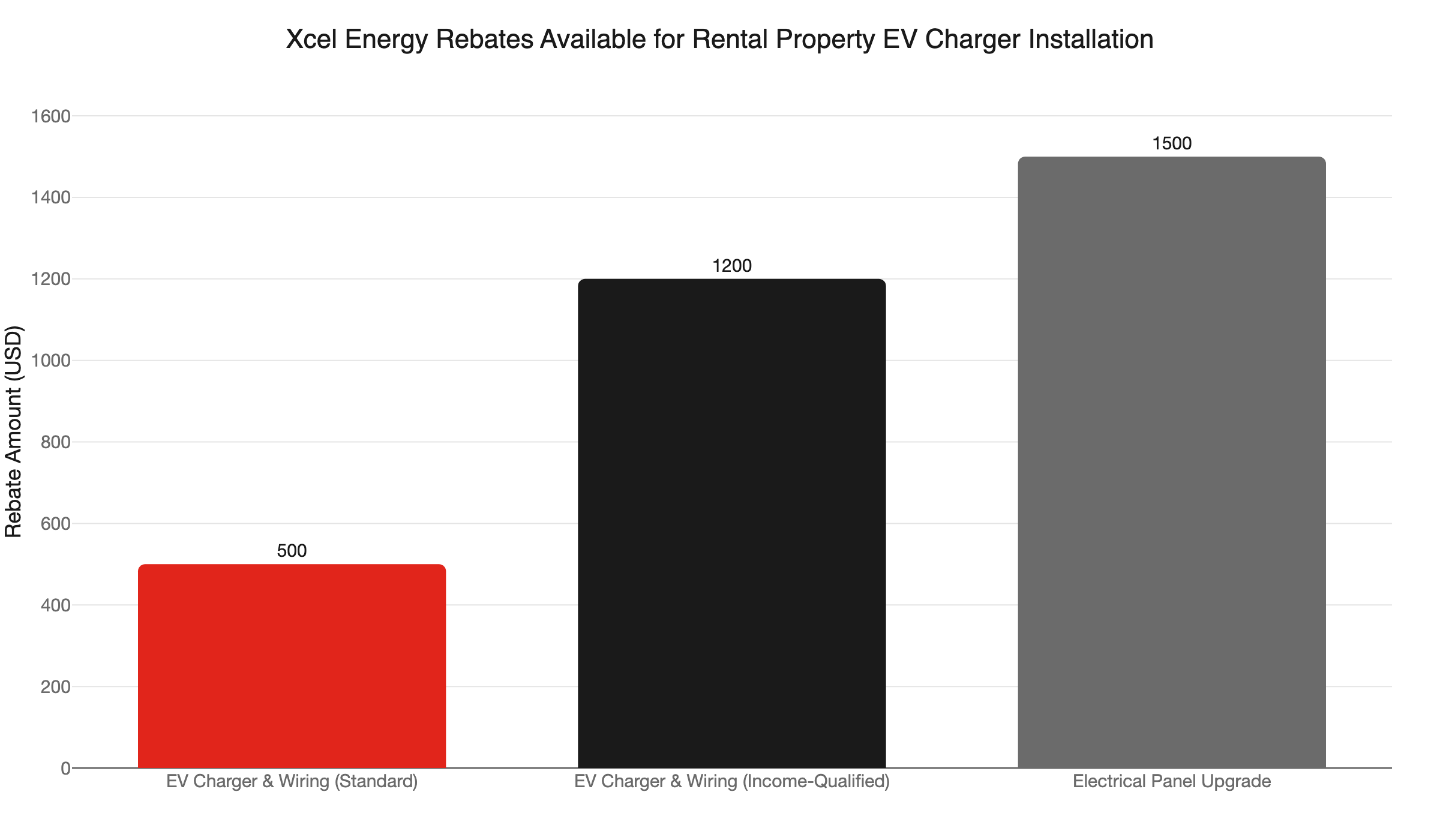
- Xcel Energy offers up to $500 for a charger and wiring (up to $1,200 income-qualified) plus up to $1,500 for a panel upgrade. Enrollment must happen before installation starts or the rebate is forfeit.
- Minnesota’s 2025 retail charger law adds a $100 per port annual inspection fee if you charge tenants per-kWh. Model this into your ROI from day one.
- A quality Level 2 installation at a Twin Cities rental property can pay back in two to four years with a modest rent premium and electricity cost recovery through sub-metering.
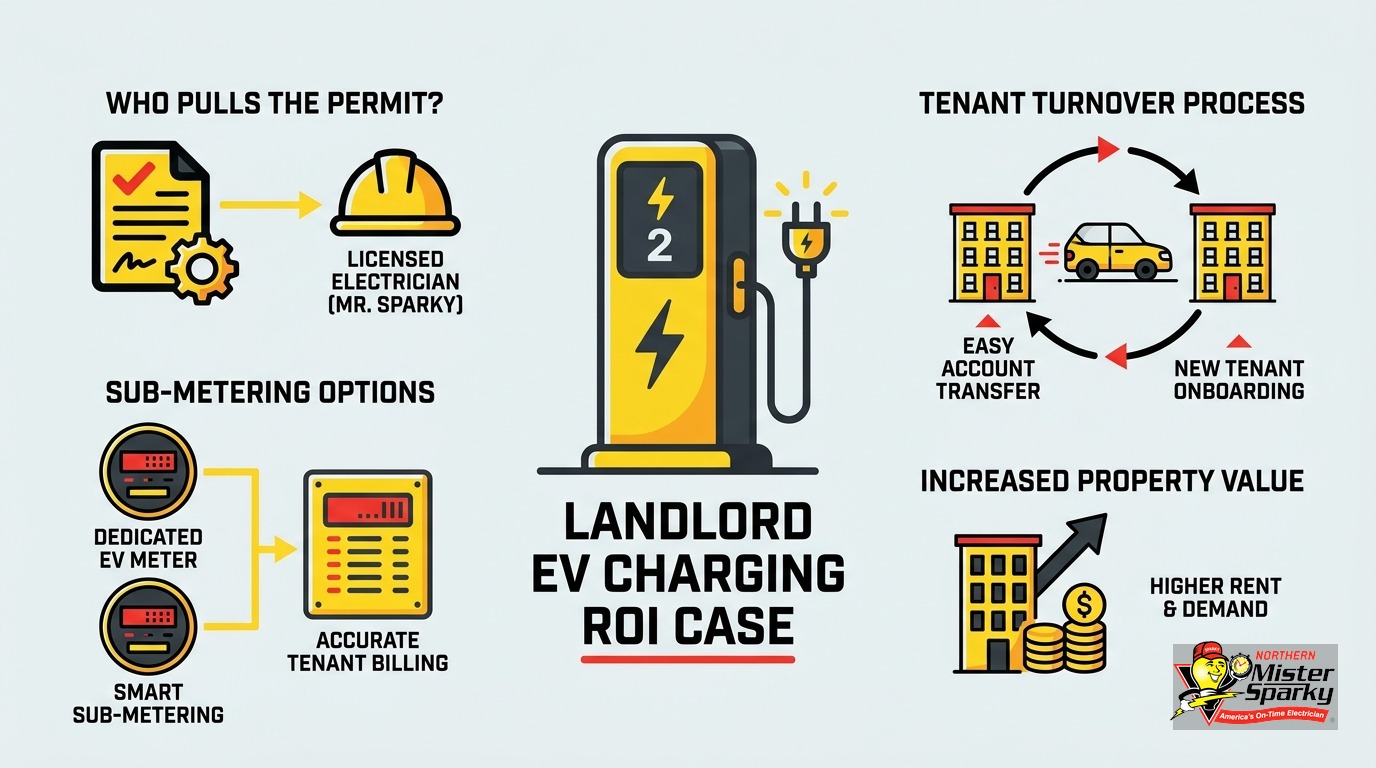
Adding an EV charger to a rental property is no longer a novelty. EV charger rental property installation is now a genuine amenity decision in the Twin Cities. Think of it like adding in-unit laundry a decade ago: early adopters gained a tenant retention edge before it became table stakes. This guide covers the ROI case, Minnesota’s legal framework, sub-metering options, permit rules, and how tenant turnover works in practice.
Why EV Charger Rental Property Installation Makes Business Sense Now
EV adoption in Minnesota is accelerating. More prospective tenants drive electric vehicles, and dedicated home charging is one of the sharpest pain points they face.
Without Level 2 charging at home, a tenant either plugs into a slow 120V outlet or pays public charging rates every night. You can solve that problem. When you do, you build a concrete reason to renew.
This guide is built on verifiable facts, not speculative projections. The case for installation stands on its own.
Does Minnesota Require Landlords to Install EV Chargers?
Minnesota has no right-to-charge law. Landlords are not required to install EV charging equipment. Tenants cannot compel installation, and there is no Twin Cities metro ordinance that overrides this at the state level. Check with your specific city if you own in a newly developing municipality, but statewide, installation is purely voluntary.
This makes EV charger rental property installation a business decision, not a compliance one. The question is whether it pencils out for your specific property and tenant profile.
Is Sub-Metering Legal for EV Charging in Minnesota?
Yes, and state law explicitly protects it. MN Statute 216B.02 states that a landlord who resells electricity to recharge an EV battery is not a public utility. You can charge tenants for the electricity they consume without triggering utility regulation or licensing requirements.
This fact changes the ROI model significantly. If you absorb the electricity bill with no recovery mechanism, the payback timeline stretches. With sub-metering, you pass through the per-kWh cost and can apply a margin if you choose.
Minnesota’s average electricity rate is approximately $0.175 per kWh. A typical EV uses about 30 kWh per 100 miles. At 12,000 miles per year, a tenant’s annual charging electricity cost runs roughly $630. That is the pool you recover through accurate sub-metering.
One tool that can reduce your cost basis before you set tenant rates: MN Statute 216B.1614 requires every Minnesota public utility to offer a time-of-day or off-peak rate for EV charging to residential customers. Enrolling in that rate before installation means you buy electricity cheaper overnight. You then pass it through at the standard rate. Ask our team about Xcel’s off-peak enrollment when you call.
What Does Minnesota’s 2025 Retail Charger Law Require?
If you charge tenants per-kWh through a metered charger, MN Statute 239.90 applies. Enacted June 14, 2025, this law classifies that charger as a “retail” charger. It requires price-per-kWh, power level, energy transfer type, and applicable fee disclosures on the unit itself. The MN Department of Commerce inspects annually. You pay $100 per port per year.
No competitor article mentions this cost. Build it into your ROI calculation from day one.
The law also requires compliance with NEC Article 625 and 16 CFR Part 309, which governs commercial-grade metering accuracy. Install a code-compliant unit from a reputable manufacturer. The cheapest hardware available online often does not meet these standards.
One workaround some landlords explore: billing a flat monthly convenience fee instead of a per-kWh charge. That structure may sidestep the retail charger classification and the annual inspection requirement. Talk to a Minnesota property attorney before choosing that path.
Who Pulls the Permit for EV Charger Rental Property Installation?
A licensed electrical contractor pulls the permit, always. In Minnesota, rental property owners cannot self-permit electrical work. The self-permit option applies only to owner-occupied residences, with strict limits even there. The Minnesota Department of Labor and Industry (DLI) licenses and regulates all electrical contractors in the state.
When you hire Northern Mister Sparky, we file the permit with your local jurisdiction as part of the job. You do not chase city offices or guess which form applies.
Two reasons this matters beyond compliance: First, an unpermitted installation can void your landlord’s insurance policy. Second, if an incident occurs on an unpermitted circuit, liability shifts squarely to you. The permit protects your tenants and your investment.
Individual electricians can also earn EVITP (Electric Vehicle Infrastructure Training Program) certification, a Department of Energy-backed credential for EV charger installation. EVITP-certified electricians in Minnesota are searchable by state at evitp.org. It is a reasonable question to ask any contractor before hiring.
Our post on electrical permits in Minnesota covers what inspectors check and what triggers a failed inspection. It is useful background if this is your first permitted electrical project on a rental property.
The ROI Case: What Does a Level 2 Charger Cost and Return?
Typical all-in cost for a single rental unit depends on panel capacity, the distance from the panel to the parking area, and whether conduit is required. A straightforward garage installation with an existing nearby panel typically runs $1,000 to $2,000 before rebates. A longer conduit run or a panel that needs an upgrade adds to that figure.
A quality Level 2 EVSE (the charger unit itself) runs $300 to $800. Labor and materials make up the rest. We give firm quotes after seeing the property, not ballpark ranges over the phone.
Return side:
Level 2 charging is a tangible amenity in a Twin Cities rental market where it remains uncommon. A tenant who values it may pay $50 to $150 more per month in rent. Over 12 months, that is $600 to $1,800. Combined with electricity cost recovery through sub-metering, a single-port installation can pay back in two to four years at a modest rental premium. Reduced vacancy and longer tenancies from EV-owning tenants extend that return.
These are directional figures based on verified data, not guarantees. Every property has different starting conditions.
On the federal tax credit:
The IRS 30C Alternative Fuel Vehicle Refueling Property Credit expired June 30, 2026 for new installations. Chargers placed in service on or before that date can still be claimed on a 2026 return via Form 8911. The business and investor credit was 6% of cost up to $100,000 per port, or 30% for installations meeting prevailing wage and apprenticeship requirements. For new work starting now, 30C is no longer a factor.
How Do Xcel Energy Rebates Work, and Why Does Sequence Matter?
Sequence matters more than most landlords expect. Xcel’s rebate program requires enrollment in the EV charging rate plan before any installation work begins. Starting work first forfeits the rebate with no appeal process.
Xcel offers two stackable rebates for rental property EV charger installation:
- EV Charger and Wiring Rebate: Up to $500 (up to $1,200 for income-qualified properties). Requires a licensed electrician.
- Electrical Panel Upgrade Rebate: Up to $1,500 if the installation requires a panel upgrade.
The correct sequence is:
- Call us for a quote and site assessment.
- Enroll in Xcel’s EV program before we schedule the installation date.
- We pull the permit and complete the installation.
- Submit the rebate application with the permit and invoice.
For properties with older 100-amp panels, a Level 2 charger may push load to the point of requiring a service upgrade. Our post on 100-amp vs. 200-amp electrical service explains when that threshold actually triggers. If an upgrade looks borderline, ask us about load management first.
Can Load Management Help You Avoid a Panel Upgrade?
Often yes. NEC 625.42 explicitly permits Energy Management Systems (EVEMS). These systems monitor total panel load and throttle the EV charger’s output when the panel nears capacity. The charger still functions, but it draws less power during peak household demand periods.
For a rental property, this is significant. A panel upgrade can add $1,500 to $4,000 to a project. Load management hardware may eliminate that cost entirely.
Our guide on EV load management for avoiding panel upgrades explains how these systems work and when they make sense. We assess panel capacity on every site visit. If the panel has headroom, we say so plainly. If it does not, we show you what a managed load solution versus a full upgrade each costs, and you make the call.
How Do You Handle Tenant Turnover When a Charger Is Installed?
The charger is your property, not the tenant’s. When a tenant moves out, the unit stays. The next tenant inherits a home with Level 2 charging already in place. In the Twin Cities rental market, that remains a differentiated feature. You pay for it once.
Cover these items in your lease and lease addendum:
- Ownership clause: Specify that the charger is a landlord-owned fixture. It is not tenant property and does not leave with them at move-out.
- Billing method: If you sub-meter, describe the rate and billing process in writing. Reference the 239.90 disclosures that are visible on the charger unit itself.
- Parking assignment: In multi-unit buildings, designate which parking space ties to which charger port. Ambiguity leads to disputes.
- Damage reporting: Require tenants to report malfunctions or physical damage promptly. Delayed reporting can escalate a minor issue into a larger one.
At move-out, inspect the charger the same way you inspect any appliance. Normal wear is expected. Cord damage from a vehicle driving over it is not, and tenant responsibility for that kind of damage should be spelled out in the addendum.
One practical alternative for landlords who want to sidestep the 239.90 retail charger inspection requirement: install a dedicated 240V outlet (a NEMA 14-50, for example) and let tenants supply their own portable EVSE. This approach is less polished as an amenity, but it avoids the annual $100 per port inspection fee and the retail charger classification entirely. A licensed electrician still installs the circuit, and a permit is still required.
Does EV Charging Equipment Need to Meet Minnesota Standards?
Yes. MN Statute 325F.185 requires that EV chargers sold or installed in Minnesota work with any EV make or model, comply with SAE standards, and support bi-directional charging capability once utilities can achieve it cost-effectively. A standard SAE J1772-compliant Level 2 unit from a reputable manufacturer meets these requirements out of the box.
This is another reason not to source the cheapest hardware available online. A non-compliant unit is a code violation. It can also create warranty and liability exposure if a tenant’s vehicle sustains damage from a faulty connection.
We supply and install units that meet MN 325F.185 requirements. The permit inspection confirms compliance before the job closes.
What About Multi-Unit Properties?
Multi-unit buildings add complexity, but not impossibility. The main questions are:
- How many parking spaces need charger access?
- Does the building have a shared electrical service or individual unit meters?
- Is there a common-area panel serving the parking area?
In buildings with a common-area panel, a dedicated sub-panel for EV charging is often the cleanest approach. Each port gets its own breaker. Sub-metering hardware tracks per-tenant usage independently. Under 216B.02, you bill back to tenants without utility regulation applying to you.
In buildings with individual unit meters, running a circuit from each tenant’s panel to a designated parking space is another option. It requires tenant coordination during installation and clear lease language defining who controls the circuit breaker.
For any multi-unit project where load is a question, a full site assessment is worth doing before you commit to a scope. We model the options and give you the numbers to make the decision.
What Happens at Installation?
Our team handles everything from permit to final inspection. Here is the sequence:
- Site visit and quote. We check panel capacity, measure the run to the parking area, and confirm the conduit path. No surprises in the final invoice.
- Rebate enrollment support. Before we schedule the installation, we walk you through Xcel’s pre-installation enrollment so the rebate stays intact.
- Permit. We file with your local jurisdiction through the DLI-licensed contractor process. You do not touch this step.
- Installation. We run the circuit, mount the EVSE, and verify wiring for the load.
- Inspection. We schedule and attend the required permit inspection.
- Rebate documentation. We provide the invoice and permit paperwork you need to submit the Xcel rebate application.
See our EV charger installation service for full scope details and to book a site visit.
Ready to Add EV Charging to Your Rental Property?
The legal framework in Minnesota is landlord-friendly: no mandate to install, explicit protection for sub-metering under 216B.02, and a clear permit process run entirely by your licensed contractor. The Xcel rebate stack is real. The ROI, for the right Twin Cities property, is genuine.
We are Northern Mister Sparky, locally owned and operated in the Twin Cities and backed by America’s On-Time Electrician(R). Every job comes with the UWIN(R) 100% satisfaction guarantee. No malarky, just a firm quote and a date on the calendar.
Call 763-200-5956 or book your EV charger installation online to get started.
Frequently Asked Questions
Who pulls the electrical permit for an EV charger in a Minnesota rental property? +
Is it legal for a Minnesota landlord to charge tenants for EV charging by the kilowatt-hour? +
Does the federal 30C tax credit still apply to new EV charger installations? +
What does Minnesota's 2025 retail EV charger law require? +
Need an electrician now?