
February Electrical Inspection: A Twin Cities Guide
Key Takeaways
- February is peak sustained electrical load in Minnesota, so hidden faults surface now.
- Booking now beats the spring rush, when panel and service work backs up fast.
- Minnesota requires a permit and inspection for most electrical work, with real fees.
- Many Twin Cities suburbs use a Local inspector, not the State, so verify first.
- Electrical failures drive tens of thousands of U.S. home fires each year.
- The federal 25C panel credit expired Dec. 31, 2025, but the Xcel panel rebate is still live.
A February electrical inspection is one of the smartest moves a Twin Cities homeowner can make. Winter pushes your home’s wiring to its limit, and February is peak load. Book the inspection now, and you clear panel or service work before the spring rush hits.
Why Is February the Best Month for an Electrical Inspection?
February is when Twin Cities homes draw the most sustained power. Space heaters, block heaters, and long hours of indoor lighting stack on aging panels. Latent faults surface now, not in mild months. Booking a February electrical inspection catches those problems while inspector calendars are still open.
Your panel does not fail in the summer. It fails when you ask the most of it. In a Minnesota February, that is every day.
Cold weather stacks loads that rarely run together in warmer months. Space heaters run in bedrooms and basements. Block heaters and car heaters pull from garage outlets. Holiday lights give way to long, dark evenings with lights on for hours. All of it lands on the same panel, and often an aging one.
That sustained draw is why a hidden fault shows itself now. A loose connection warms up. A tired breaker trips more often. An outlet feels warm to the touch. These are your home telling you something, and February is when it speaks loudest. For more on how winter demand strains local homes, see our guide on January winter electrical demand.
We are locally owned and operated, so we know exactly what a Twin Cities winter does to a residential panel. That local read is the whole point of scheduling now.
What Does a February Electrical Inspection Actually Check?
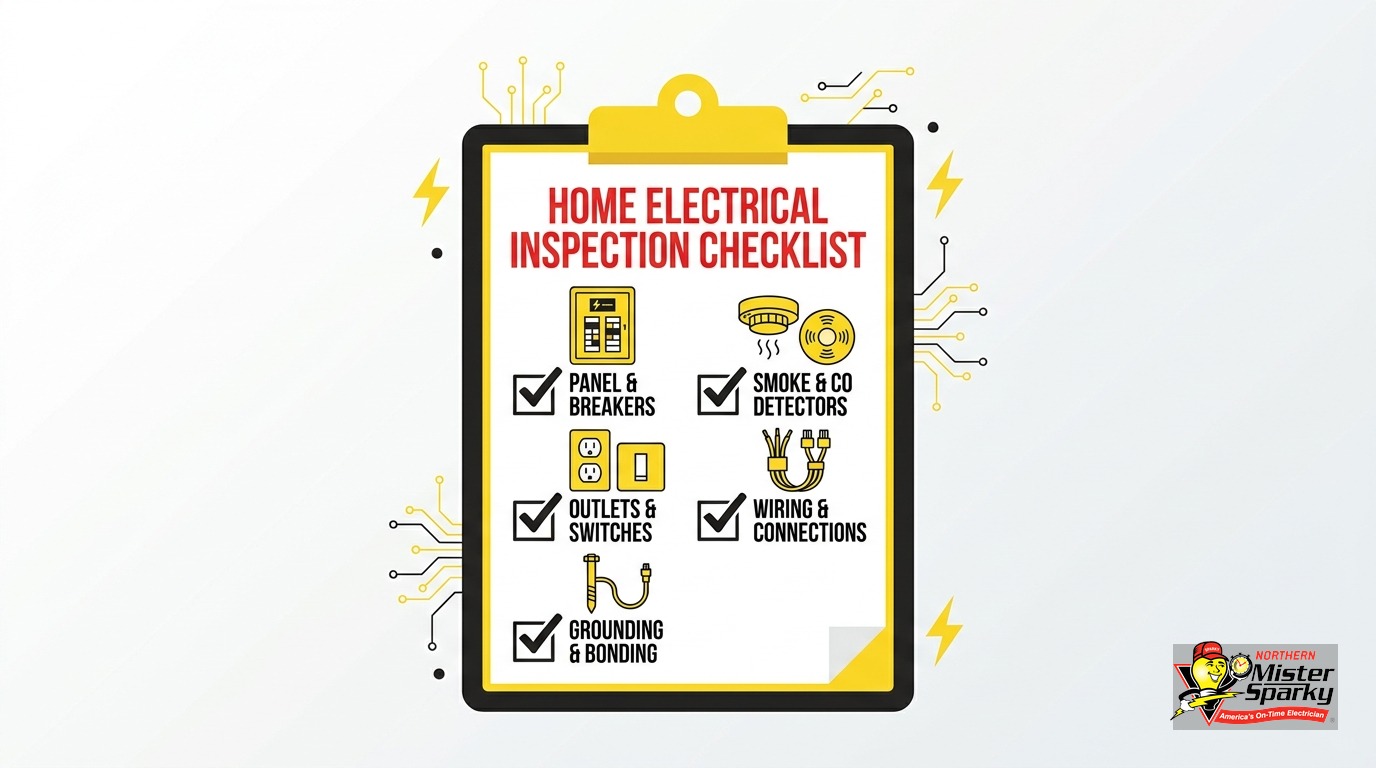
A February electrical inspection reviews your panel, breakers, wiring, grounding, and outlets for winter stress. The electrician looks for heat damage, overloaded circuits, loose connections, and outdated components. You get a clear report of what is safe, what needs repair, and what to plan before spring projects begin.
A good inspection is more than a glance at the panel. Our team walks the whole system. Here is what we look at:
- Panel and breakers: signs of heat, corrosion, rust, or breakers that trip often.
- Circuit load: whether key circuits are overloaded for how you actually live.
- Wiring: aging, damaged, or overloaded wiring that can start an arc fault.
- Grounding and bonding: proper grounding that protects people and devices.
- Outlets and switches: warm plates, scorch marks, or loose connections.
- Safety devices: working smoke and carbon monoxide detectors, plus arc-fault and ground-fault protection.
You leave with a plain-language report. No jargon. Just what is safe and what to fix.
How Does Twin Cities Winter Load Expose Hidden Faults?
Cold weather forces your electrical system to carry heavy, constant loads for weeks. Space heaters and block heaters draw hard on circuits that were never sized for them. That steady stress heats up weak spots. So loose wires and tired breakers reveal themselves in deep winter rather than in mild spring weather.
Electrical parts fail under heat and repeated stress. Winter delivers both.
A single space heater can pull 1,500 watts. Run two on shared circuits, add a block heater in the garage, and an older panel starts to strain. The breaker that trips during the coldest week is not a nuisance. It is a warning.
Aging wiring makes it worse. Worn or overloaded wiring is a leading source of arc faults, which start more than 35,000 home fires a year according to the Electrical Safety Foundation International. The same source notes the CPSC estimates arc-fault breakers could prevent more than half of home electrical fires. February load is what pushes a marginal circuit over the edge. If you are seeing repeated trips, read about overloaded circuits and how we fix them.
Who Inspects Your Home in Minnesota, the State or Your City?
It depends on where you live. Minnesota splits inspection authority between the State and local governments. Before you file a permit or call for inspection, check the state inspector directory. If the AHJ column says State, you file with the Department of Labor and Industry. If it says Local, your city or township handles it.
This is the step generic blog posts skip, and it matters.
Minnesota uses an Authority Having Jurisdiction, or AHJ, model. Some areas are inspected by the State. Many Twin Cities suburbs are Local, meaning the city or township runs its own inspections. You have to know which one applies before you file per the Minnesota Department of Labor and Industry.
Check the state inspector directory first. Find your city, look at the AHJ column, and file accordingly. Guess wrong, and your permit stalls. When you hire us, we handle this for you. We know the local jurisdictions across Minneapolis, St. Paul, Bloomington, Blaine, Maple Grove, and the surrounding suburbs.
What Does an Electrical Permit and Inspection Cost in Minnesota?
For homeowner permits filed with the State, Minnesota charges a $25 permit fee plus a $1 surcharge. Each inspector trip to your home carries a minimum $55 inspection fee. Your total is the calculated fee or $55 times the required trips, whichever is greater. Local jurisdictions may set their own fees.
Real numbers help you plan. Here is what the State charges homeowners under the DLI fee schedule:
- Permit fee: $25 per permit.
- Surcharge: $1 per permit.
- Inspection: a minimum $55 fee per inspector trip to the site.
The rule is simple. You pay the calculated fee or $55 per required trip, whichever is greater. Timing matters too. A separate electrical permit must be filed at or before the start of any work that needs inspection. And all wiring must be inspected before it is concealed. If it gets closed up early, it has to be re-exposed. That is a costly redo you avoid by planning now.
One more detail worth knowing. Permits filed on or after July 1, 2023, are inspected to the 2023 National Electrical Code per DLI. Older work may not meet current code, which is exactly what an inspection catches.
Can Minnesota Homeowners Do Their Own Electrical Work?
Sometimes. Minnesota lets you do wiring on the single-family home you live in without a personal license. You still need a permit and inspection. But you cannot do the wiring on duplexes, condos, townhomes, rentals, or any property occupied by others. Those jobs require a licensed electrician.
The do-it-yourself rule is narrower than many people think.
You can wire your own single-family home if you live in it as the DLI explains. You cannot do the work on a duplex, condo, townhome, rental, or a home occupied by someone else. Those all require a licensed electrician.
Even when do-it-yourself work is allowed, the risk is real. Small mistakes cause big problems, from failed inspections to fires. For anything past a simple fixture swap, calling a licensed pro is the safer call. It protects your home, your permit, and your family.
How Big Is the Home Electrical Fire Risk?
It is significant. Home electrical fires cause an estimated 51,000 fires a year in the United States. Those fires cause nearly 500 deaths, more than 1,400 injuries, and about $1.3 billion in property damage annually. Electrical failure or malfunction ranks among the leading causes of U.S. home fires.
The numbers are worth stating plainly.
Home electrical fires cause an estimated 51,000 fires a year, nearly 500 deaths, more than 1,400 injuries, and about $1.3 billion in property damage reports the Electrical Safety Foundation International. The NFPA consistently ranks electrical failure or malfunction among the leading causes of U.S. home fires in its research reports.
Most of these fires start small, out of sight, in wiring and connections you never see. That is the case for an inspection. A trained electrician finds the warm connection or the overloaded circuit before it becomes a headline. It is some of the cheapest protection you can buy for your family.
What Rebates Can Cut the Cost of a Panel Upgrade in 2026?
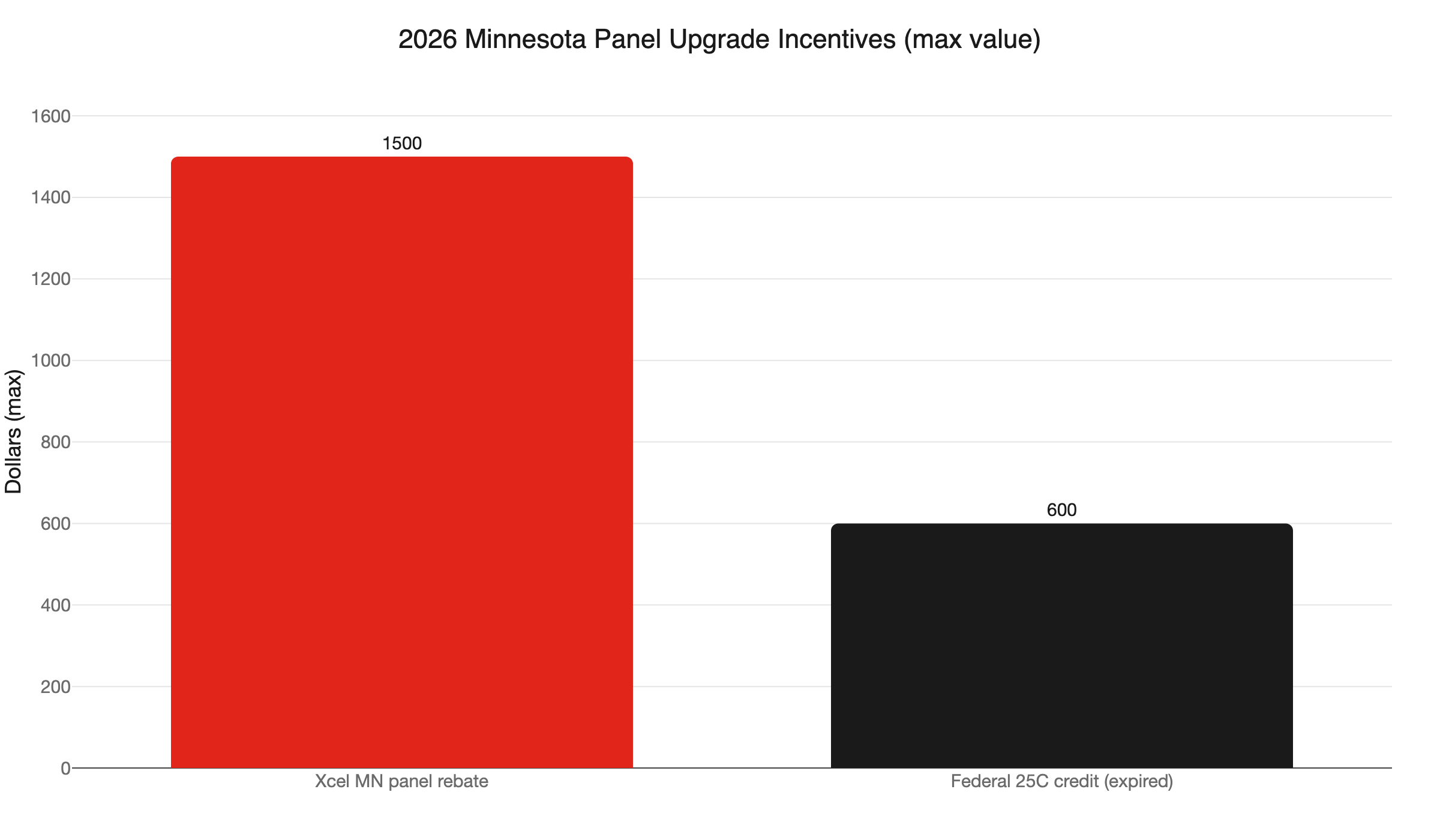
The big one is the Xcel Energy Minnesota panel rebate. It covers your full project cost up to $1,500 when you upgrade to a higher-amperage panel. The federal 25C credit that once helped is gone. It expired Dec. 31, 2025, so new 2026 panel projects no longer qualify.
Here is where timely local facts save you money.
The Xcel Energy Minnesota rebate covers full project cost up to $1,500 when you upgrade your panel to higher amperage per Xcel Energy. A few rules apply. Replacing a broken panel with the same amperage does not qualify. You must be an Xcel residential electric customer. The home must be single-family or up to four units. And a Minnesota DLI-licensed electrician must do the work. Rebates process in about six to eight weeks.
What about the federal credit? The 25C Energy Efficient Home Improvement Credit had covered qualifying 200-amp-plus panel upgrades up to $600. It expired Dec. 31, 2025 according to the IRS. New 2026 projects no longer qualify, though a qualifying 2025 install can still be claimed on a 2026 return.
More help may be coming. Home Electrification and Appliance Rebates for income-qualified Minnesota households are expected to reach homeowners in 2026 through the Minnesota Department of Commerce per the Center for Energy and Environment. Xcel and CenterPoint customers can also book a Home Energy Squad visit, and income-qualified customers may qualify for free visits through Xcel Energy.
Ready to plan the work? Our panel upgrade service walks you through amperage, permits, and the rebate paperwork.
Why Book a February Electrical Inspection Before the Spring Rush?
Because spring floods every electrician’s calendar. Once the ground thaws, homeowners add decks, hot tubs, EV chargers, and air conditioning. All of it needs electrical work at the same time. Booking a February electrical inspection now means any panel or service upgrade clears before that wave, not during it.
Winter gives you a scheduling advantage. Use it.
Frozen ground slows outdoor and service work, so contractors book out fast once it thaws. Spring remodels, decks, hot tubs, EV charger installs, and new air conditioning all land on the same schedules. If your inspection turns up a panel that needs upgrading, you want that done before the rush, not stuck behind it.
February timing also means inspector calendars are open. Permits move faster. Your project clears while everyone else is still waiting for the snow to melt. For a full look at getting ahead, see our guide on February and spring project prep.
Your February Electrical Inspection Checklist
Use this simple checklist before you book:
- Note any breaker that trips more than once a month.
- Check for warm or discolored outlet and switch plates.
- Listen for buzzing at the panel or outlets.
- Count how many space heaters and heavy appliances share circuits.
- Confirm your smoke and carbon monoxide detectors work.
- Look up whether your city is a State or Local AHJ.
- Gather your Xcel account details in case a panel rebate applies.
Bring this list to your appointment. It helps our team focus on what matters most in your home.
Schedule Your Twin Cities Electrical Inspection Today
February is the smart month, and the window is open now.
We are your locally owned and operated Twin Cities electrician, backed by the trusted Mister Sparky name. We show up on time as America’s On-Time Electrician(R), and every job is backed by the UWIN(R) 100% satisfaction guarantee.
Do not wait for a breaker to fail during the coldest week of the year. Book your inspection while calendars are open and any follow-up work can clear before spring.
Call 763-200-5956 or book online today. Fast scheduling, honest answers, and no malarky.
Frequently Asked Questions
When should I schedule an electrical inspection in Minnesota? +
Do I need a permit for electrical work in Minnesota? +
Is the federal tax credit for panel upgrades still available in 2026? +
Can I do my own electrical work in Minnesota? +
Need an electrician now?