
Garage Door Opener Electrical Requirements in Minnesota
Key Takeaways
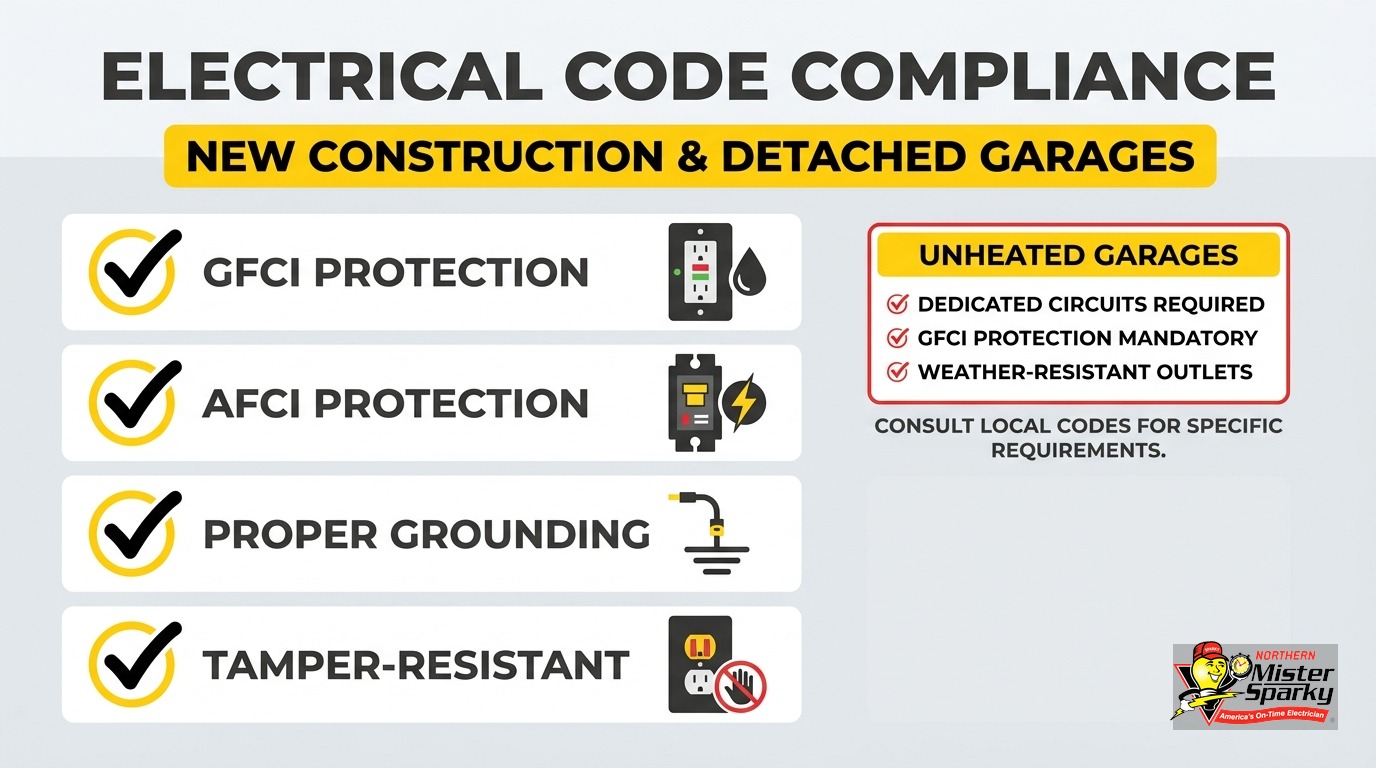
- Garage door opener electrical requirements include a GFCI-protected ceiling outlet on a 15- or 20-amp circuit. That GFCI protection must be resettable from the floor, not from a ladder.
- Minnesota code requires at least one dedicated 20-amp vehicle-bay circuit. In a single-bay garage, the opener can share it. In multi-bay garages, it cannot.
- Ceiling outlets cannot use a standard plug-in GFCI receptacle. Use a GFCI circuit breaker at the panel or a wall-level GFCI outlet wired upstream that protects the ceiling outlet on its load side.
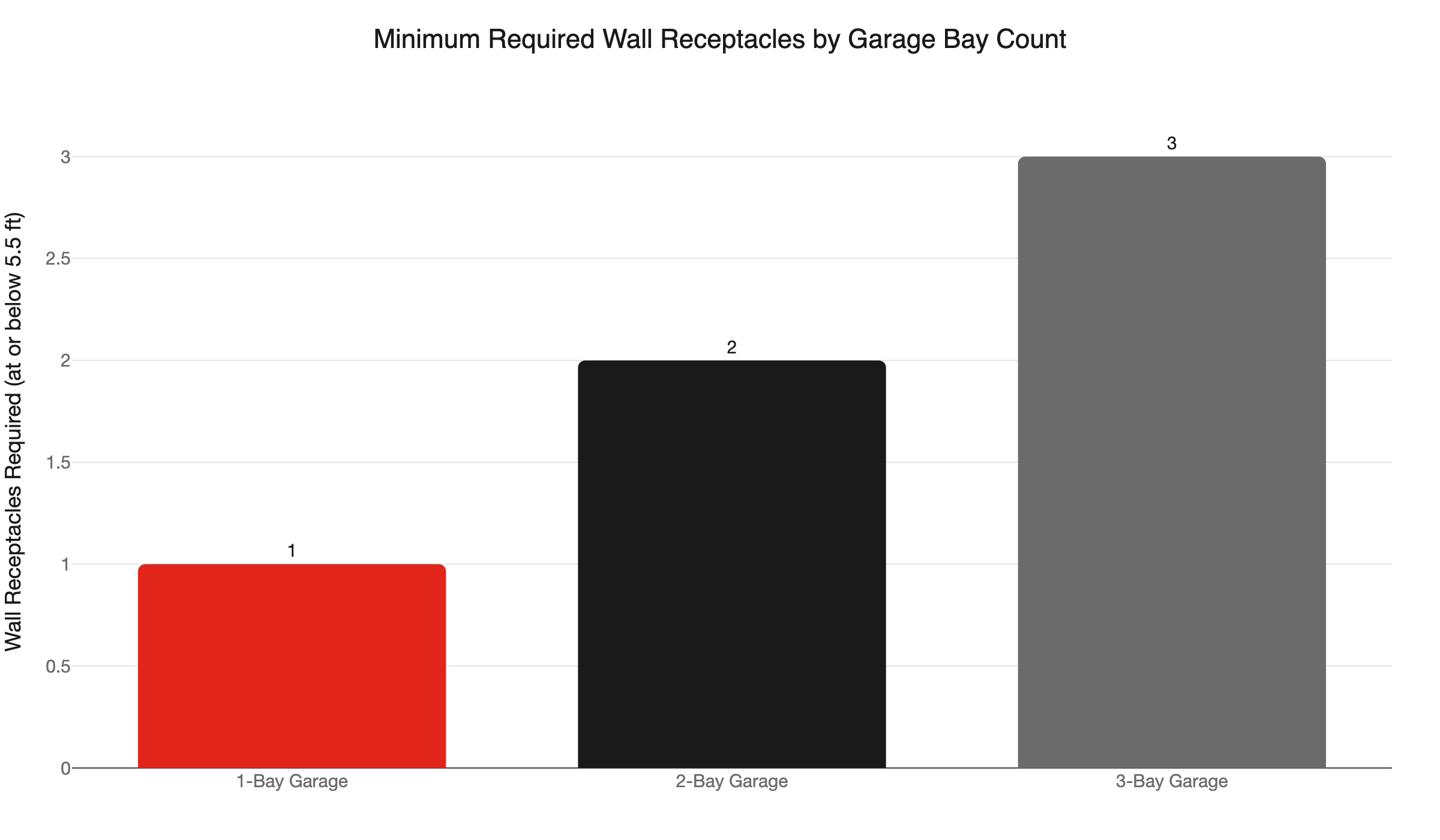
- Wall outlets must be placed at or below 5.5 feet, with one per vehicle bay. The ceiling opener outlet is separate and does not count toward this.
- Detached garages need a feeder to a sub-panel or disconnect inside the garage. Separate circuits run directly from the house panel are not compliant.
- Minnesota transitions from the 2023 NEC to the 2026 NEC on August 3, 2026. Permits before that date use the 2023 NEC. Permits on or after use the 2026 NEC.
- Garage wiring requires a separate electrical permit. Your building permit does not cover it.
What Are the Garage Door Opener Electrical Requirements?
The short answer: An opener needs a ceiling outlet on a GFCI-protected 15- or 20-amp circuit. Minnesota code also requires a dedicated 20-amp vehicle-bay circuit for wall receptacles, with the opener sharing it in single-bay garages only. The GFCI protection must allow the reset button to be reached from the floor.
Most residential garage door openers draw between 5 and 8 amps during operation. That is a modest load. The requirements are not about the opener’s power draw. They are about circuit organization, safety protection, and code compliance.
Getting garage door opener electrical requirements right means satisfying three overlapping rules:
- Circuit type: What circuit the opener shares or owns.
- GFCI protection: How to protect a ceiling outlet in a code-compliant way.
- Physical placement: Where wall outlets must be located relative to vehicle bays.
Each rule comes from a different section of the 2023 NEC. Satisfying one does not automatically satisfy the others.
There is also a Minnesota-specific timing issue active right now. The state transitions from the 2023 NEC to the 2026 NEC on August 3, 2026. Which edition applies to your project depends on when the permit is filed. We cover this in its own section below.
Does a Garage Door Opener Need Its Own Dedicated Circuit?
The short answer: Not in every case. The 2023 NEC Exception No. 2 to 210.11(C)(4) allows a single-bay garage’s required 20-amp vehicle-bay circuit to also serve the opener and other equipment under NEC 210.23(B)(1) and (B)(2). Multi-bay garages do not qualify - the vehicle-bay circuit there must stay dedicated.
This is a 2023 NEC change. Under the 2017 and 2020 NEC, the dedicated rule applied more broadly. The 2023 edition recognized that requiring a separate opener circuit in a single-stall garage added cost without a clear safety benefit.
Single-bay garages
One 20-amp circuit can serve both the wall-level receptacle and the door opener. GFCI protection still applies to the ceiling outlet. The circuit must still be 20 amps.
Two-bay and three-bay garages
The dedicated rule applies without exception. NEC 210.11(C)(4) requires the vehicle-bay circuit to have “no other outlets.” No opener, no lighting, no extra receptacles on that circuit. The opener needs its own dedicated circuit.
Why this matters for planning
In a two-car garage, you are likely looking at: one dedicated 20-amp vehicle-bay circuit, one circuit for the opener, one lighting circuit, and potentially a 240V circuit for a welder or compressor. If you are also adding an EV charger in the Twin Cities, that is another dedicated 40- to 50-amp circuit. All of this should be planned before rough-in. Adding circuits after drywall is in place costs significantly more.
The Two-Circuit Minimum: What Minnesota Code Requires
Two baseline circuits are required for any garage that receives electrical power.
Circuit 1: The dedicated 20-amp vehicle-bay circuit
NEC 210.11(C)(4) is direct: at least one 20-amp branch circuit must be provided for vehicle-bay receptacles. That circuit “shall have no other outlets.” This means no lighting, no door opener in multi-bay garages, no chest freezer. It is a dedicated circuit for power tools, battery chargers, and shop equipment.
Circuit 2: The opener circuit
In multi-bay garages, the opener gets its own circuit. A 15-amp circuit is sufficient for most residential openers. In single-bay garages, the 2023 NEC allows the opener to share the vehicle-bay circuit. Either way, the ceiling outlet must be GFCI-protected.
Lighting gets its own circuit
A 15-amp lighting circuit is standard. Do not load it onto the 20-amp vehicle-bay circuit. Keep circuits separate so a tripped breaker does not take down the entire garage at once.
What if your panel is near capacity?
A garage addition is a good time to assess whether your main panel can handle the added load. Older 100-amp panels sometimes cannot absorb multiple new circuits cleanly. If yours is near capacity, plan the panel work alongside the garage build. Doing both in one mobilization is significantly cheaper than returning later.
What Is the GFCI Ceiling-Outlet Trap?
The short answer: Every garage outlet requires GFCI protection under NEC 210.8(A). But a standard GFCI receptacle at the ceiling fails because the reset button is not reachable without a ladder. The correct solutions are a GFCI circuit breaker at the panel, or a wall-level GFCI outlet that protects the ceiling outlet on its load side.
This is one of the most common code violations in Minnesota garages. The opener works fine. The GFCI is present. The installation fails inspection because no one can reset the outlet without climbing a ladder.
Why unheated garages need GFCI protection
Minnesota garages sit below freezing for four to five months each year. In spring and fall, a warm car drives in, melts snow onto the concrete floor, and then temperatures drop overnight. That condensation creates exactly the moisture conditions that ground faults exploit. GFCI protection in an unheated Minnesota garage is not overcautious. It directly addresses the moisture environment our climate produces.
The two compliant solutions
Option 1 - GFCI circuit breaker at the panel: The breaker handles the ground fault trip. The reset button sits on the panel door at a reachable height. Every outlet on that circuit, including the ceiling one, is protected.
Option 2 - Wall-level GFCI outlet wired upstream: A GFCI outlet is installed on the same circuit at a reachable height. The ceiling outlet connects to the “load” side. The wall outlet’s GFCI protects it. The reset is accessible without a ladder.
A plug-in GFCI at the ceiling satisfies neither requirement. If yours is installed that way, it is a code violation and must be corrected before your electrical inspection passes.
The 2023 NEC expanded GFCI to 240-volt outlets
NEC 210.8 now covers 125-volt-to-250-volt single-phase receptacles rated 150 volts-to-ground or less. A 240V outlet for a welder or air compressor in an unheated detached garage now requires GFCI protection. Standard GFCI outlets only protect 120V circuits. A two-pole GFCI circuit breaker handles 240V protection.
For a broader look at GFCI requirements, see GFCI outlet requirements explained.
Outlet Placement: Height, Count, and Tamper Resistance
Three placement rules routinely catch homeowners off guard.
Height: 5.5 feet or below
NEC 210.52(G)(1) requires at least one receptacle per vehicle bay at or below 5.5 feet. This is the accessible wall-level outlet. The ceiling opener outlet does not satisfy this requirement. A three-bay garage needs three wall-level outlets - one per bay - plus the ceiling outlets separately.
Count: One per vehicle bay, minimum
Code sets one wall receptacle per parking space as the floor. Most builds add more for practical use. If you are expanding a single-car garage to two cars, the new bay needs its own wall outlet at or below 5.5 feet.
Tamper-resistant receptacles required
NEC 406.12 requires tamper-resistant receptacles for all 15- and 20-amp, 125-volt outlets. This applies to new installs and replacements. If you are swapping out a receptacle during a garage remodel, the replacement must be tamper-resistant. Outlets in wet or damp locations need extra-duty weather-resistant covers.
Does a Detached Garage Need a Sub-Panel?
The short answer: Yes, in effect. NEC 225.31 requires a means to disconnect all power at the feeder entry point inside the detached garage. You run one feeder from the house. A sub-panel or disconnect inside the garage distributes individual circuits from there. Running separate circuits directly from the house panel to a detached garage is not code-compliant.
Sizing the sub-panel
A 60- to 100-amp sub-panel handles a single-car or two-car detached garage with a door opener, lighting, and wall receptacles. Add an EV charger, a 240V welder outlet, or a heated floor and 100 amps becomes the better starting point. Size for future expansion. Adding circuits is far easier when the sub-panel has open slots.
The underground feeder run
A feeder from the house to a detached garage must be buried or run overhead at the required clearance. Direct-buried cable typically goes at least 24 inches deep. Conduit requires a minimum of 6 inches in most residential applications. The route and method affect total project cost. An electrician can assess the best path for your property before the first shovel goes in.
What if circuits are already run directly from the house?
This is a common condition in older detached garages. The wiring is not necessarily dangerous, but it does not meet current code. It will need correction before any new permit work or before the house sells. See our post on detached garage sub-panel installation for what that correction involves.
Minnesota’s Code Transition: Does Permit Timing Matter Right Now?
The short answer: Yes, and significantly. Minnesota adopted the 2026 NEC with an effective date of August 3, 2026. Permits filed before that date use the 2023 NEC. Permits filed on or after that date must comply with the 2026 NEC. If you are planning a new garage in July 2026, the timing of your permit application matters.
A contractor who quoted your project in June may have based estimates on the 2023 NEC. If the permit gets pulled in August, the inspector enforces the 2026 NEC. Scope and cost can shift between quotes and inspections.
The 2026 NEC is not expected to fundamentally overhaul garage circuit requirements. The vehicle-bay circuit, GFCI rules, and outlet placement rules are well-established across several code cycles. But specific thresholds and exceptions can change between editions. Confirm with your electrician which edition applies to your permit, not the edition they memorized three cycles ago.
One note on rebates: no utility rebates apply to standard garage electrical work. Xcel Energy and CenterPoint rebates focus on HVAC, insulation, and EV charger infrastructure. Basic garage wiring is not rebate-eligible.
Do You Need a Separate Electrical Permit for Garage Wiring?
The short answer: Yes. Your building permit for the garage structure does not cover the electrical. A separate electrical permit must be pulled and inspected. Licensed electricians pull the permit on your behalf. Owner-occupants of a single-family home can pull their own under MN Statute 326B.31.23, but must physically do all the work themselves. Hiring someone to do the labor under your owner-occupant permit is not compliant.
Permit requirements are consistent across the Twin Cities metro. Coon Rapids, St. Paul, and Bloomington all enforce the NEC as written with no significant local amendments. Fees and inspection scheduling vary. Contact your city building department for current timelines.
Skipping the permit carries real risk. An uninspected install can void homeowner’s insurance coverage for a fire originating in the garage. It also creates a disclosure obligation when the house sells. If uninspected work is discovered during a future permit pull, you may be required to open walls for inspection.
For a full overview of the Minnesota permit process, see electrical permits in Minnesota.
Garage Door Opener Electrical Requirements: What a Minnesota Inspection Covers
When an inspector visits after your garage rough-in, here is the checklist they work from.
Circuits
- At least one dedicated 20-amp vehicle-bay circuit with no other outlets - or the single-bay sharing exception properly applied.
- A separate opener circuit in multi-bay garages.
- Lighting on its own circuit, not combined with vehicle-bay receptacles.
GFCI compliance
- All garage receptacles GFCI-protected.
- Ceiling opener outlet protected by a GFCI circuit breaker or a wall-level GFCI wired upstream - not a ceiling-mounted plug-in GFCI.
- 240V receptacles in an unheated garage protected by a two-pole GFCI circuit breaker.
Placement
- At least one wall-level receptacle per vehicle bay at or below 5.5 feet.
- All 15- and 20-amp, 125-volt receptacles tamper-resistant.
- Wet-location outlets with extra-duty weather-resistant covers.
Detached garages
- Sub-panel or disconnect installed at the feeder entry point inside the garage.
- Feeder buried or run overhead at the required clearance.
Permits
- Electrical permit pulled before work started.
- Inspection requested before walls are closed.
Northern Mister Sparky is locally owned and operated in the Twin Cities. No malarky, no surprises on the invoice. As America’s On-Time Electrician(R), we back every garage electrical project with the UWIN(R) 100% satisfaction guarantee.
Call 763-200-5956 or book online to schedule your garage electrical assessment. We serve Minneapolis, St. Paul, Bloomington, Maple Grove, Plymouth, Woodbury, Blaine, Brooklyn Park, and the surrounding Twin Cities metro.
Frequently Asked Questions
Does a garage door opener need its own dedicated circuit? +
Can I use a standard GFCI outlet for a garage door opener ceiling receptacle? +
Do I need an electrical permit to wire a garage in Minnesota? +
What NEC code applies to garage wiring in Minnesota right now? +
Need an electrician now?