
Half the Outlets in Room Not Working? Find the Cause
Key Takeaways
- Half the outlets in a room going dead usually means one fault in a chain, not a dozen separate problems.
- Rule out half-hot (switched) outlets first. They are normal and not a fault.
- Check every GFCI in the house, including the garage, exterior, basement, and bathrooms.
- Find the last working outlet and the first dead one. The fault is usually at or just upstream of that first dead outlet.
- A failed backstab connection is a common culprit. It runs hot, so treat any scorch mark as an emergency.
- An open neutral is trickier. A hot wire can test live while a real load still gets no power.
- Stop and call a licensed electrician for scorching, a burning smell, or a suspected open neutral on a shared circuit.
- Always shut off the breaker before you remove a cover plate or touch a wire.
Why Are Half the Outlets in My Room Not Working?
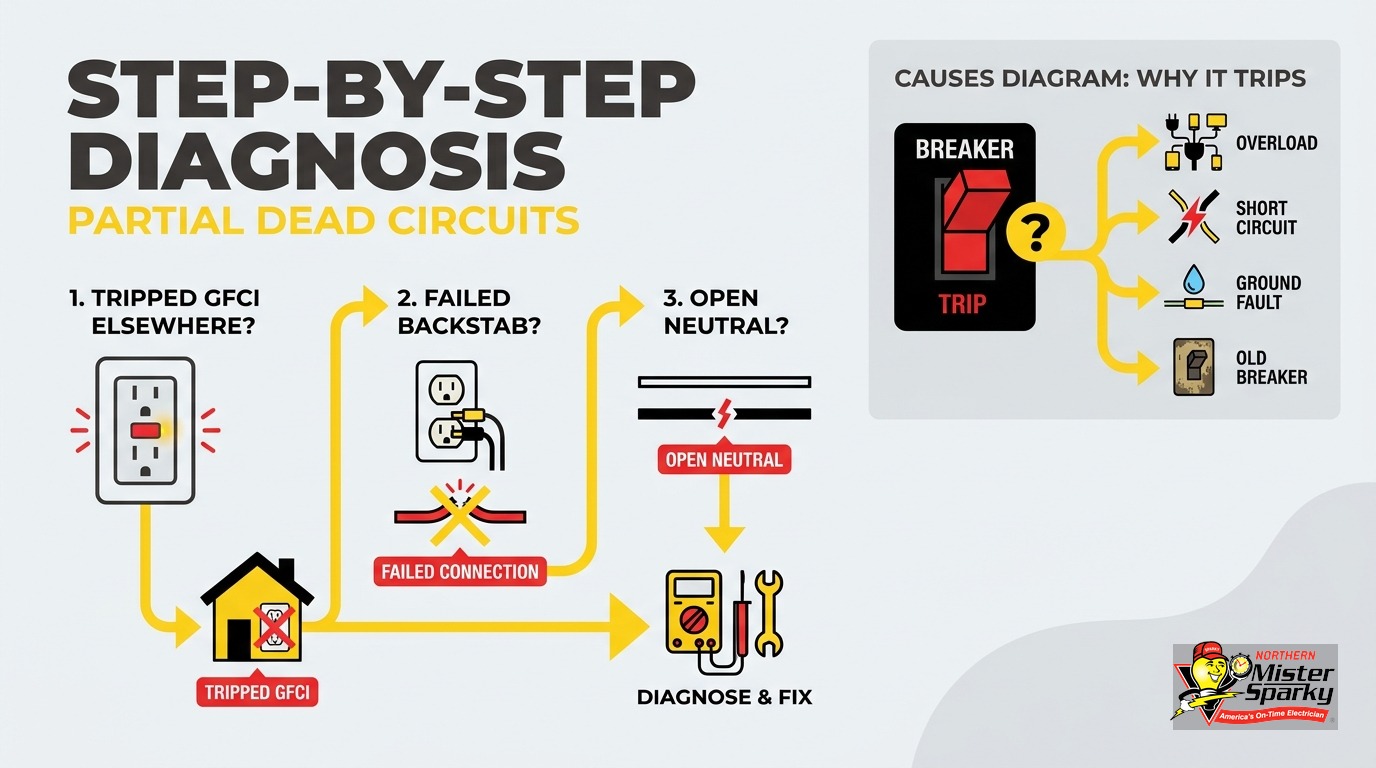
Usually one connection or one protective device has failed, and everything after it in the chain lost power. The cause is often a tripped GFCI elsewhere, a failed backstab connection, or an open neutral. Each one leaves a different clue.
Outlets in a house are wired in chains. Power enters at the panel and passes from one outlet to the next. If the chain breaks at one point, every outlet after that point goes dead.
That is why the dead outlets in your room often sit together. They share the same break. The outlets that still work sit before it.
We are Northern Mister Sparky, a locally owned and operated electrician serving the Twin Cities. We see this problem in newer subdivisions, in 1950s ramblers, and in older St. Paul homes. The causes repeat, and so does the testing order.
A general DIY guide to outlet problems lists the usual suspects: a half-hot outlet, a GFCI that needs a reset, a tripped breaker, a blown fuse, a burnt outlet, and loose wires. That list is a fine start. It doesn’t say what order to check them in, or how to tell harmless causes from dangerous ones.
The sequence below starts with easy, safe checks. It ends with the problems that belong to a pro.
What Safety Rules Come Before Any Testing?
Turn off power at the breaker before you open any outlet. Confirm the power is off with a tester. Never touch bare wires on a live circuit. If you see scorching, melted plastic, or smell burning, stop and call an electrician.
Most steps below are safe for a careful homeowner. You only look, reset, and plug things in. A few steps involve removing a cover plate and checking wires. Take extra care there.
Follow these ground rules:
- Switch off the breaker for the circuit before you unscrew anything.
- Use a non-contact voltage tester to confirm the wires are dead.
- Keep one hand away from metal boxes when you test a live outlet.
- Do not work in wet areas or on a wet floor.
- Never bypass a breaker or a GFCI to “make it work.”
If any of this feels uncomfortable, that is a good reason to call. Our outlet repair service exists for exactly this situation.
How Do You Rule Out a Half-Hot Outlet First?
A half-hot outlet has one receptacle controlled by a wall switch and one that is always on. This is normal wiring, and nothing is broken. Flip nearby switches and test each plug of each outlet with a lamp before you assume something is faulty.
Many Twin Cities homes have switched outlets. Builders use them so a floor lamp can turn on from the doorway. In some rooms, the switch controls only the top or bottom plug.
Here is the quick test:
- Plug a lamp that works into each plug of the “dead” outlet.
- Flip every wall switch in the room, one at a time.
- Watch whether the lamp turns on with a switch.
If a switch brings the outlet to life, nothing is wrong. You found your switched outlet. We cover that setup in our post on half-hot outlets and floor lamps.
If no switch changes anything, move on. You have a real fault.
Test the lamp too. Plug it into an outlet you know works. A bad bulb or cord wastes a lot of troubleshooting time.
Could a Tripped GFCI Somewhere Else Be the Cause?
Yes. A GFCI outlet or breaker can protect other outlets downstream of it. When it trips, those outlets lose power, even in another room or on another floor. Find and reset every GFCI in the house before you check anything else.
This is the most common cause and the cheapest to fix. People also miss it often. They check the bathroom GFCI, see nothing, and give up.
A GFCI cuts power in a fraction of a second when it senses current leaking where it should not. It has a TEST button and a RESET button.
Builders often wire one GFCI to protect several outlets downstream of it. That group can include rooms that have nothing to do with water. A bedroom outlet can hang off a garage GFCI.
Check these spots:
- The garage, including outlets behind storage shelves
- Exterior outlets on the front, back, and deck
- The basement, laundry area, and utility room
- Every bathroom, including a half bath
- The kitchen counter and any wet bar
- Outlets on a different floor from the dead ones
Press RESET firmly on each one. A good GFCI clicks and restores power. Then test the dead outlets again.
Minnesota winters add a twist. Outdoor and garage GFCIs sit in cold air, and freeze-thaw cycles bring moisture into covers and boxes. In our experience, this makes cold-weather trips more common. That is our own field observation, not a researched statistic.
If the GFCI will not reset, that is a separate problem. Read our guide on what to do when a GFCI outlet won’t reset. Do not keep forcing it.
Check the panel as well. A tripped breaker often sits in the middle position, slightly off from the others. Push it fully to OFF, then back to ON.
How Do You Find the First Dead Outlet in the Chain?
Map the circuit. Plug a lamp into every outlet in the dead area and nearby rooms. Note which ones work and which do not. The fault usually sits at or just upstream of the first dead outlet, so find the last working outlet and the first dead one.
This turns a vague problem into a short list of suspects. Grab a notepad and sketch the room.
Mark each outlet as working or dead. Then think about how the wire likely runs. Outlets in a chain often run along a wall, then turn a corner into the next room.
Look for the pattern. The working outlets form a path. The dead ones begin where the path stops.
The break is usually at one of two spots:
- The last working outlet, where the wire leaves toward the next outlet
- The first dead outlet, where the wire arrives
Often the culprit is the first dead outlet itself. It may have a loose or failed connection that passes power to nothing downstream. Sometimes the last working outlet has the bad connection on its outgoing side.
You can learn a lot before you open anything. Watch for outlets that work only sometimes. A lamp that flickers when you bump the plug points to a loose connection right there.
Check the outlets for signs of heat too. Look for:
- Brown or black marks around the slots
- A warm cover plate
- A melted or soft spot on the plastic
- A faint burning or fishy smell
Any of these means stop. Read our post on burning smells from outlets or breakers and call a pro. That is not a DIY repair.
What Is a Failed Backstab Outlet Connection?
A backstab is a push-in hole on the back of an outlet that grips a wire with a small spring contact. Over time that contact can lose its grip, build resistance, and heat up. The result is an intermittent or dead connection that cuts power to every outlet after it.
Many outlets offer two ways to connect a wire. One is a screw terminal on the side. The other is the push-in hole on the back.
The push-in style is fast to install, which is why builders and some quick repairs use it. The wire slides in and the spring holds it.
The trouble is the contact area. A spring grips the wire at a small point. A screw terminal wraps the wire and clamps it with real force.
A weak grip creates resistance. Resistance makes heat when current flows. Heat loosens the grip further, and the connection gets worse over time. Eventually it goes intermittent, then dead.
This is practitioner knowledge from our own work. We did not find a government or safety-agency source that quantifies backstab failure, so we won’t hand you a number. We do replace failed backstabs regularly.
Here is how it shows up:
- Outlets downstream of one device go dead
- Power returns when you wiggle a plug or tap the wall
- Lights or devices flicker on and off
- The outlet face is warm, discolored, or buzzing
The standard fix is straightforward. A licensed electrician turns off the power, pulls the outlet, and inspects the wire ends. Damaged copper gets trimmed back to clean metal. Then we wrap the wires onto the screw terminals. Or we use short “pigtail” wires, which connect to the outlet and join the circuit wires with a proper connector.
Pigtails take the outlet out of the middle of the chain. If the outlet fails later, the rest of the circuit keeps power.
Do not shove the wire back into the hole. That repeats the original problem. If you see scorched wire insulation, the wire itself may be damaged. That calls for a pro, and likely more repair than a new outlet.
What Is an Open Neutral, and How Does It Act?
An open neutral is a break in the wire that carries current back to the panel. The hot wire can still be live, but a working load has no return path. Devices may not run, or they may act strangely. It can be dangerous on shared circuits.
Every circuit has two working wires. The hot wire brings power out. The neutral wire carries it back. Current only flows when it can make the full loop.
If the neutral breaks, the loop is open. Your outlet may still have voltage on the hot side. Yet a lamp or a toaster plugged in gets nothing.
That makes this fault confusing. A basic tester may say the outlet is fine. The outlet looks alive, but it cannot do any work.
Common signs include:
- Outlets that read live but will not power a device
- Lights that glow dimly or act oddly
- Devices that work on one outlet and not the next
- A tester that gives confusing or inconsistent results
An open neutral can come from a loose wire nut, a failed backstab on the neutral wire, a damaged cable, or a bad connection at the panel. Sometimes the neutral wire fails in the same outlet as a hot-side problem.
Shared circuits raise the stakes. Some homes use a multiwire branch circuit, where two hot wires share one neutral. If that shared neutral opens, the voltage on each side can shift in odd ways. Devices can get too much or too little voltage. Learn more in our post on multiwire branch circuits and shared neutrals.
We could not find an authoritative government or safety-agency page that spells out open-neutral testing for homeowners. So we describe it here as practitioner knowledge. Ideally, a licensed electrician should confirm any open-neutral diagnosis in person. We also decline to quote voltage figures from vendor blogs, because they are unverified.
If you suspect an open neutral, don’t keep plugging things in to test. Stop and call.
How Do You Compare Readings Under Load and Without It?
A meter or plug-in tester with no load can read normal on a circuit with a broken neutral. A real load, like a lamp or a small heater, draws current and exposes the problem. Compare readings with and without a load to catch what a basic tester misses.
Here is the idea in plain terms. With nothing plugged in, almost no current flows. A weak or open connection can still show voltage, because the meter draws almost nothing.
With a load plugged in, current must flow through every connection. A bad connection drops voltage or fails entirely. The reading changes, and that change is your clue.
If you own a multimeter and know how to use it safely, the sequence is:
- Test the outlet with nothing plugged in. Note the reading.
- Plug in a lamp or a modest, safe load.
- Test again, with the load on. Note any drop or change.
- Repeat at the last working outlet and the first dead one.
A large drop under load points to a poor connection somewhere in the path. A reading that looks fine with no load but fails with a load points toward a bad connection or open neutral.
Know the limits. Treat this as a diagnostic idea. Do not probe a live panel or a shared circuit. Measuring live wiring carries real risk.
If you are not trained to use a meter on live circuits, skip this step. A plug-in outlet tester is safer. Just remember that it can miss problems, as noted above.
When Should You Stop and Call a Licensed Electrician?
Call a licensed electrician right away for scorching, melted plastic, a burning smell, buzzing, sparks, or a suspected open neutral on a shared circuit. Also call if you reset a GFCI or breaker and it trips again. These signs point to heat or a wiring fault.
Some problems are simple. A tripped GFCI is a good example. A wall full of dead outlets with no obvious cause is not.
Call us if you notice any of these:
- Brown or black marks on an outlet or cover plate
- A burning, fishy, or hot-plastic smell
- Buzzing, crackling, or sparks
- A GFCI or breaker that trips again right after reset
- Dead outlets that returned, then failed again
- Lights that dim or surge when you use a device
- Any sign of an open neutral on a shared circuit
- Old wiring such as aluminum or cloth-covered cable
Heat is the main risk. A bad connection that carries current can get hot enough to damage the box and nearby materials. You will not always see it from the front.
In a cold Minnesota winter, a dead circuit also may mean no power for space heaters, sump pumps, or medical devices. If the outage is urgent, our emergency electrician service is ready to help.
We back our work with the UWIN(R) 100% satisfaction guarantee. As America’s On-Time Electrician(R), we aim to show up when we say we will. And no malarky: if the fix is a ten-minute pigtail repair, we will tell you that.
Do You Need a Permit or Inspection for Outlet Repairs in Minnesota?
We cannot give a blanket yes or no. Minnesota law requires inspection of electrical installations, but exempts minor repair work as defined by rule. We could not confirm whether replacing a receptacle counts. Check with your local building department or the state before you start.
The key statute is Minn. Stat. 326B.36. It requires inspection of every new electrical installation in any construction, remodeling, replacement, or repair. It makes an exception for minor repair work, as the rule defines it.
We could not find the rule that defines minor repair. Neither state page we reviewed says whether receptacle work qualifies. So we won’t tell you a permit is, or is not, required to replace an outlet.
Here is what we do know from the state’s homeowner page. Homeowners apply for electrical permits online and need an account to get permits and pay additional fees. The Minnesota Department of Labor and Industry’s homeowner permit page also tells you to check the Authority Having Jurisdiction, or AHJ, in the inspector directory.
If the AHJ is “State,” you file with the state. If it is “Local,” you contact the city or township. That matters in the Twin Cities, where many cities run their own inspections.
For questions the pages do not answer, the state lists a contact: iMS.support.dli@state.mn.us.
Code editions matter too. Minnesota’s Board of Electricity adopted the 2026 NEC with an effective date of Aug. 17, 2026. The state’s code adoption page says, “Electrical permits filed before Aug. 17, 2026, must comply with the 2023 NEC.” Today is Oct. 31, 2026, so the 2026 NEC now governs new permits.
We have not verified whether the 2026 edition changed GFCI rules in a way that affects your home. Ask your electrician or inspector about specifics. Our older post on the 2023 code changes for Minnesota homeowners is useful background, but the 2026 edition now applies to new permits.
When we do the work, we handle permits and inspections as the job requires. You don’t have to sort out who has jurisdiction.
What Will a Twin Cities Electrician Do to Fix It?
We work through the same order you just read, with better tools. We check GFCIs and breakers, map the circuit, find the first dead outlet, inspect the connections, and test under load. Then we repair the fault and verify every outlet works before we leave.
A typical visit looks like this:
- Listen and look. We ask when the outlets died and what changed. A recent renovation, storm, or new appliance helps.
- Rule out the simple causes. We check switches, GFCIs, and the panel.
- Map the chain. We find the last live outlet and the first dead one.
- Open and inspect. We shut off power, confirm it is dead, and inspect each connection.
- Repair. We replace failed devices, trim damaged wire, and move connections to screw terminals or pigtails.
- Test under load. We verify voltage and function with a real load, not just a plug-in tester.
- Explain. We show you what failed and what we did.
If we find a deeper problem, we tell you before we do anything. An open neutral at the panel, damaged cable inside a wall, or old wiring may need a larger repair. Our home wiring repair service covers those jobs.
We are locally owned and operated, so the person on your doorstep lives here too. We know Twin Cities homes, from Minneapolis bungalows to Maple Grove new builds. We know how our winters stress wiring and outdoor GFCIs.
Call Northern Mister Sparky for Dead Outlets
If you find heat, a burning smell, or signs of an open neutral, stop. Hand the job to a licensed pro.
Call Northern Mister Sparky at 763-200-5956 or book online. We will find the break, fix it right, and leave your power on.
Frequently Asked Questions
Why are half the outlets in my room not working? +
Can a GFCI in another room kill power to my outlets? +
What is a backstab outlet connection? +
Is an open neutral dangerous? +
Do I need a permit to replace an outlet in Minnesota? +
Need an electrician now?