
Heated Entry Mat Outlet Electrical Requirements in Minnesota
Key Takeaways
- A single plug-in entry mat draws 1.9 to 5.3 amps at 120V. One mat on a lightly loaded 15A circuit is fine on amperage - but the outlet still must meet code.
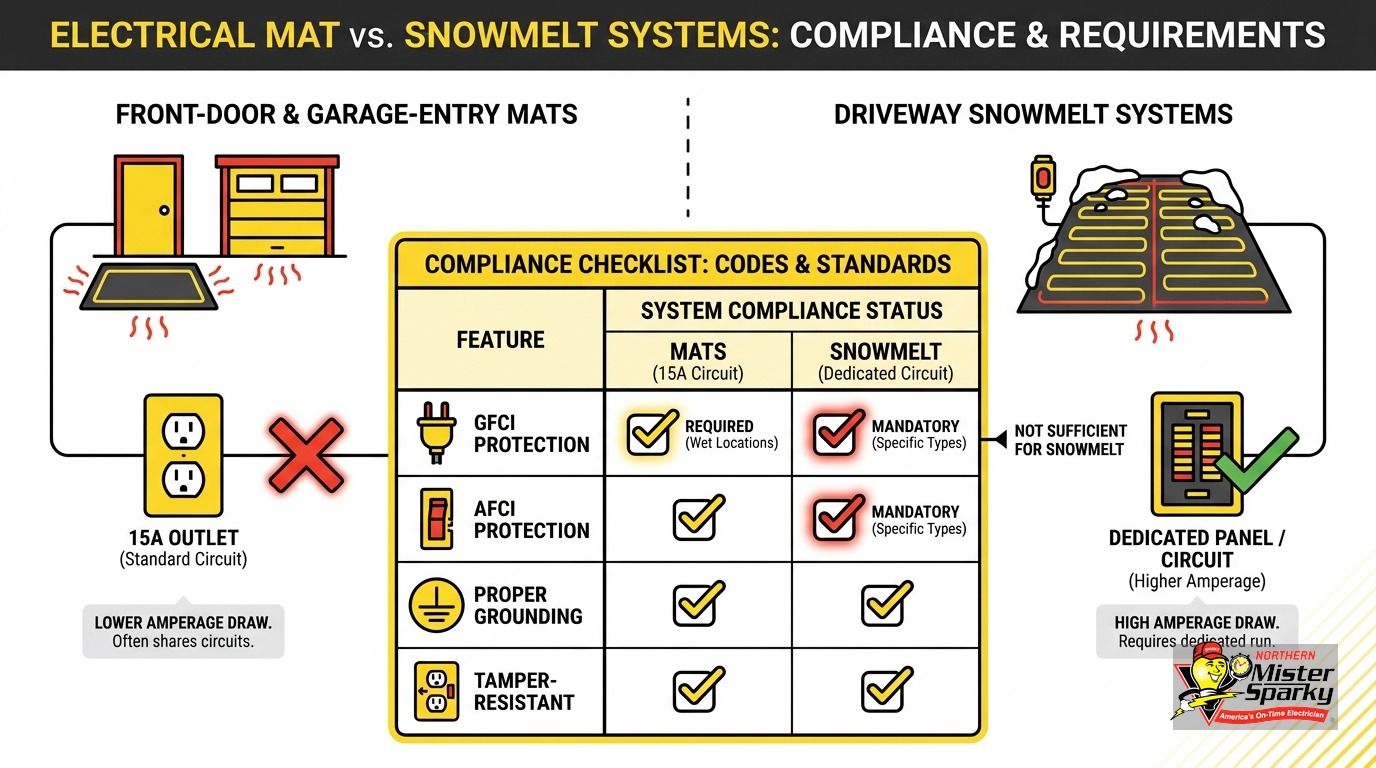
- Any outdoor or garage-entry outlet must be GFCI-protected and WR-rated per NEC 210.8(F) and NEC 406.9. An unprotected outdoor outlet is a code violation and a shock hazard, with or without a mat.
- The ELCI built into the mat’s power cord handles equipment protection at 30 mA. It does not substitute for GFCI protection at the outlet (5 mA). You need both.
- Walkway mats chained to the 13A-per-unit limit exceed the 80-percent continuous-load rule on a standard 15A circuit. A dedicated 20A circuit is required.
- Adding a new outdoor or garage outlet in Minnesota requires an electrical permit and inspection under the 2026 NEC, which took effect August 17, 2026.
What Are the Electrical Requirements for a Heated Entry Mat?
A plug-in heated entry mat needs a GFCI-protected, WR-rated receptacle on a circuit with capacity for a continuous load. A single mat draws 1.9 to 5.3 amps at 120V, which fits a standard 15A circuit - provided the outlet meets NEC 210.8(F) and NEC 406.9 and the circuit is not already heavily loaded. Multi-mat daisy chains that reach the 13A-per-unit limit require a dedicated 20A circuit.
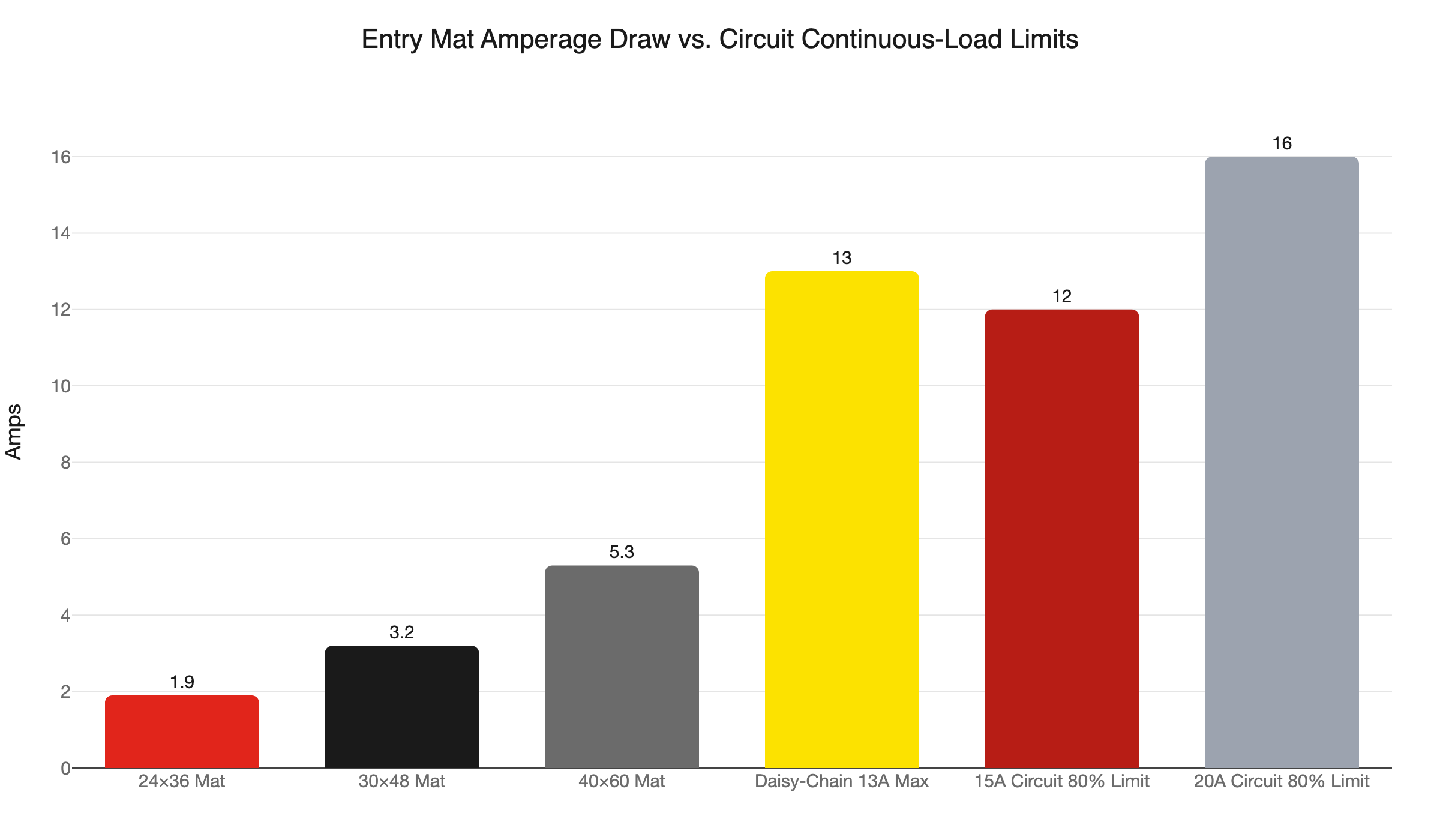
HeatTrak entrance mats draw 1.9 amps at 24”x36” and 3.2 amps at 30”x48”, and the large 40”x60” model pulls 5.3 amps. Those are modest draws. A single mat occupies a small fraction of a 15A circuit’s capacity.
The outlet is where most installations fall short.
A front-stoop or garage-entry outlet installed a decade or two ago likely lacks GFCI protection and uses a standard rather than WR-rated device. That outlet does not meet current NEC standards and should not be trusted with a moisture-exposed mat on a Minnesota stoop. Plugging a heated mat into a non-GFCI outdoor outlet creates the exact scenario that GFCI protection is designed to prevent: a person contacts a wet surface connected to a faulted circuit, and nothing trips in time to protect them.
Entry mats make this visible because the installation prompts homeowners to look closely at the outlet for the first time. What they often find is an outlet that was never updated to meet the code standard that applies to it, independent of the mat.
Does the Outlet Near My Front Door Actually Meet Code?
Probably not, if the home is more than 10 to 15 years old and the outlet has never been updated. The NEC requires GFCI protection on all outdoor receptacles at dwelling units on single-phase circuits. Class A GFCI devices trip at 5 milliamps - the threshold set to protect people. An unprotected outdoor outlet is a code violation regardless of what is plugged into it.
Beyond GFCI, NEC 406.9 requires outdoor receptacles to use WR-rated devices. A WR-rated outlet uses materials that resist moisture degradation over time - standard outlet materials break down faster under outdoor temperature swings and humidity. At grade level and in locations exposed to weather - a front stoop, a side-entry garage landing, a covered walk - the outlet also requires an in-use (bubble) cover. The standard flip-up cover on older outdoor outlets is rated only for dry locations and does not protect the connection when the plug is inserted. A bubble cover stays closed around the cord while it is in use, keeping rain, snow, and ice melt away from the energized contacts. More detail on what cover type the code requires is in our post on outdoor in-use weatherproof covers.
In a covered entry that stays dry, you may still be in a damp-location classification under NEC, which carries its own requirements. If you are not certain whether your entry counts as a wet or damp location, that is worth confirming before you plug anything in. Both upgrades - GFCI and WR-rated cover - are modest scope for a licensed electrician. Neither is a skip-the-permit item in Minnesota.
Why the Mat’s Built-In ELCI Does Not Replace Outlet GFCI
The power cord on a plug-in entry mat includes an Equipment Leakage Circuit Interrupter (ELCI). That device satisfies the Ground-Fault Protection of Equipment (GFPE) requirement in NEC 426.28, which applies to plug-in outdoor electric heating equipment. The ELCI trips at approximately 30 milliamps to protect the mat’s heating element from damage caused by a sustained ground fault.
That is not the same job as Class A GFCI.
A Class A GFCI trips at 5 milliamps - the threshold set to protect people from lethal current. Thirty milliamps is well above the level where sustained contact can cause cardiac arrest. The IAEI’s technical analysis of heat trace and snow melt ground fault protection explains this distinction: GFPE protects equipment and GFCI protects people. They are not interchangeable protection types, and one does not satisfy the other.
The mat cord’s ELCI does its job. It protects the mat from equipment damage. The outlet’s GFCI does a separate job: it protects the person using the mat in a wet outdoor environment. Both must be present under NEC 210.8(F). A mat plugged into a non-GFCI outdoor outlet fails the code requirement regardless of what protection the mat’s cord provides.
This same distinction explains a related question that sometimes comes up: why do fixed snowmelt systems use GFPE at the circuit level rather than GFCI? Fixed heat cable generates capacitive leakage in cold, wet conditions that can exceed 5 milliamps without any real fault present. A 5 mA GFCI would nuisance-trip every winter. GFPE at 30 mA protects the equipment without false trips. Plug-in entry mats sidestep this problem because their short power cords do not generate significant capacitive leakage. The 5 mA GFCI at the outlet works cleanly for a plug-in mat - and is required.
What Happens When You Chain Multiple Mats on One Circuit?
Walkway and stair mats can be connected in sequence for coverage over a longer front-entry path. But the total amperage of all mats connected to a single Power Unit must stay within its rated capacity. At 120V, 13 amps equals 1,560 watts. Heated mats are a continuous load - they run for extended periods without cycling off - and NEC requires continuous loads to stay within 80 percent of the breaker rating. On a 15A breaker, that limit is 12 amps. A fully loaded 13A daisy chain already exceeds the 80-percent continuous-load limit by 1 amp. A dedicated 20A circuit is required.
At 80 percent, a 20A breaker allows 16 amps of continuous load. That gives a fully loaded mat run 3 amps of headroom - enough margin for a code-compliant installation with room to spare.
There is a second layer to this calculation. A garage or entryway circuit already carries a load before any mat is plugged in. A garage door opener, circuit lighting, and convenience outlets all draw current on a typical shared 15A or 20A garage circuit. The continuous-load calculation applies to the mat’s rated draw, not to a measured average over time. Adding a 13A rated-load mat to a shared circuit that already carries active devices creates a code violation on continuous-load grounds regardless of what the opener and lights are drawing at any given moment.
For any front-entry run that covers multiple chained sections, plan the circuit before purchasing the mats. Our comparison of 15A and 20A circuits covers the wire gauge requirements and what changes between each. Installing a dedicated 20A circuit for a mat run is a clean, bounded project. Diagnosing a tripping breaker or a code violation mid-winter because the circuit was undersized is not.
How Is a Heated Entry Mat Different from a Heated Driveway?
This is the framing that product pages skip. A heated entry mat and a heated driveway both fall under NEC Article 426’s outdoor electric heating provisions - but they sit at completely opposite ends of the electrical spectrum.
A plug-in entry mat draws 1.9 to 5.3 amps at 120V. It plugs into a receptacle. The ELCI in its cord handles the GFPE requirement NEC Article 426 places on outdoor heating equipment. The outlet requirements come from NEC 210.8 and 406.9. Code compliance for a single mat reduces to: the right outlet and the right circuit capacity.
A fixed driveway snowmelt system is permanently installed wiring covered under NEC 426 as a fixed heating system. These systems consume 35 to 50 watts per square foot and typically run at 240V. A 240V, 30-amp breaker handles approximately 175 square feet at 4-inch cable spacing, and a 600-square-foot heated driveway can demand more than 100 amps total - more than the total service draw of many older Twin Cities homes. NEC 426.4 requires fixed snowmelt circuits to be sized at 125 percent of the calculated load because the load runs continuously. A project at that scale almost always requires a panel capacity review and often a service upgrade.
The entry mat project is the low end of that range. The driveway system is the high end. Both require code-compliant electrical work, but the comparison of scope is not even close. If you are considering a fixed driveway system and want to understand what that project involves, our guide to driveway snowmelt electrical requirements in Minnesota covers it from circuit sizing through panel impact.
Do You Need a Permit to Add an Outlet for a Heated Entry Mat in Minnesota?
Yes. Any new outdoor or garage receptacle in Minnesota requires an electrical permit and inspection. The permit is what triggers the inspection, which verifies that the outlet meets current code before the work is put into service.
Minnesota adopted the 2026 NEC effective August 17, 2026, replacing the prior edition. Any permit pulled on or after that date must comply with 2026 NEC requirements. That applies to new outdoor outlet installations, outlet replacements that involve opening a wall or adding a circuit, and new circuits added to serve entry areas or garages. An outlet that existed before the 2026 NEC is not grandfathered when it is replaced as part of a new project - any replacement or addition must meet the current standard.
Skipping the permit creates two separate problems. First, an uninspected outdoor outlet at a wet-location entry point is a real safety risk, specifically at the contact between a mat, melting snow, and a potentially defective connection. Second, unpermitted electrical work surfaces at home sale. Minnesota buyers’ inspectors flag unpermitted work and open permits, and correcting it under the time pressure of a closing costs more than doing it right the first time. Our guide to the Minnesota electrical permit process covers the full steps, including inspection timelines and what the inspector looks for on outdoor receptacle work.
What About Heated Mats Used Inside an Entry or Mudroom?
Some homeowners prefer a heating mat installed in the mudroom or entryway floor rather than a plug-in stoop mat. The code requirements change depending on the installation type.
A plug-in mat used inside a conditioned space still requires GFCI protection if the outlet is within six feet of a sink or in a location where moisture could reach the receptacle. NEC 210.8(A) governs indoor wet-location receptacle rules. A mudroom that drains wet boots and coats all winter can qualify as a damp or wet location depending on how it is constructed and where the outlet sits.
A fixed thin-film radiant floor mat - the type set in thin-set adhesive under tile and wired to a dedicated thermostat circuit - is a different category of work entirely. There is no plug-in option for that type. It requires a dedicated circuit, a thermostat, and an electrician to do the wiring. A permit and inspection are required in Minnesota. Our mudroom electrical planning guide covers outlet spacing, heated floor wiring, and rough-in requirements for both types of mudroom installations.
The underlying principle - match the outlet to the environment - applies in other parts of the house too. Our post on battery backup sump pump outlet requirements shows how the same NEC wet-location rules apply in a basement context. The code logic is consistent; the specific location just determines which subsection applies.
What Our Team Checks Before Installing Your Entry Mat Outlet
When Northern Mister Sparky adds or upgrades an outlet for a heated entry mat, we go through the full NEC checklist before we start.
We verify:
- The outlet location is classified correctly - outdoor, wet, or damp - even if it sits under a covered entryway or inside a garage that stays nominally dry.
- The receptacle is GFCI-protected per NEC 210.8(F) and WR-rated per NEC 406.9.
- An in-use (bubble) cover is installed at grade-level and wet locations.
- The existing circuit is not already loaded to the point where adding a continuous mat draw would push it past the 80-percent limit.
- If the project includes a multi-mat daisy chain, the combined load is calculated against the 13A per-unit limit, and a dedicated 20A circuit is added where the math requires it.
- A permit is pulled and an inspection is scheduled before we call the job done.
We are locally owned and operated here in the Twin Cities, and we back every job with the UWIN(R) 100% satisfaction guarantee. As America’s On-Time Electrician(R), we show up when we say we will - no malarky about it.
Call us at 763-200-5956 or book online to get the outlet right before Minnesota’s first hard freeze. We serve Minneapolis, St. Paul, Bloomington, Woodbury, Maple Grove, Plymouth, Blaine, Brooklyn Park, and the surrounding Twin Cities metro.
Frequently Asked Questions
Can a homeowner install an electrical outlet in Minnesota? +
How thick is an electric underfloor heating mat? +
Need an electrician now?