
Mudroom Electrical: Outlets, Heated Floor Wiring, and EV Rough-In
Key Takeaways
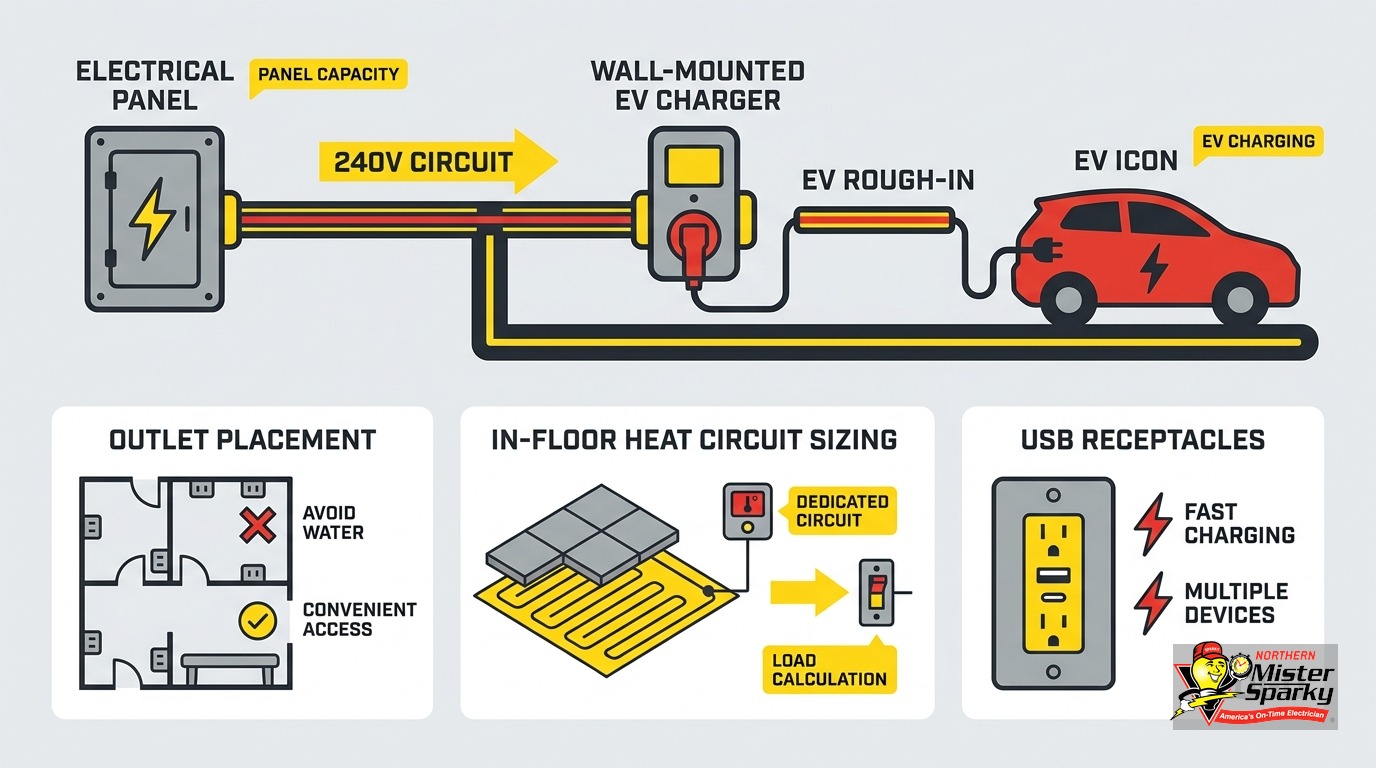
- The NEC requires a receptacle on every wall section of sufficient width in any qualifying entry space. Doorways and floor-to-ceiling windows do not count as wall space.
- Heated floor systems are a continuous load. The circuit must be sized at 125% of the mat’s amp draw - usually a dedicated 20A circuit.
- Minnesota adopted the 2026 NEC on August 17, 2026. Any permit pulled today falls under the new edition.
- USB receptacles are not code-required in mudrooms, but when installed they must be tamper-resistant and listed as a single integral unit (NEC 406.12 + 406.3(F)).
- 2026 NEC Section 210.17 requires an EV-ready 240V outlet in the garage for new construction and qualifying additions. This is now baseline, not optional.
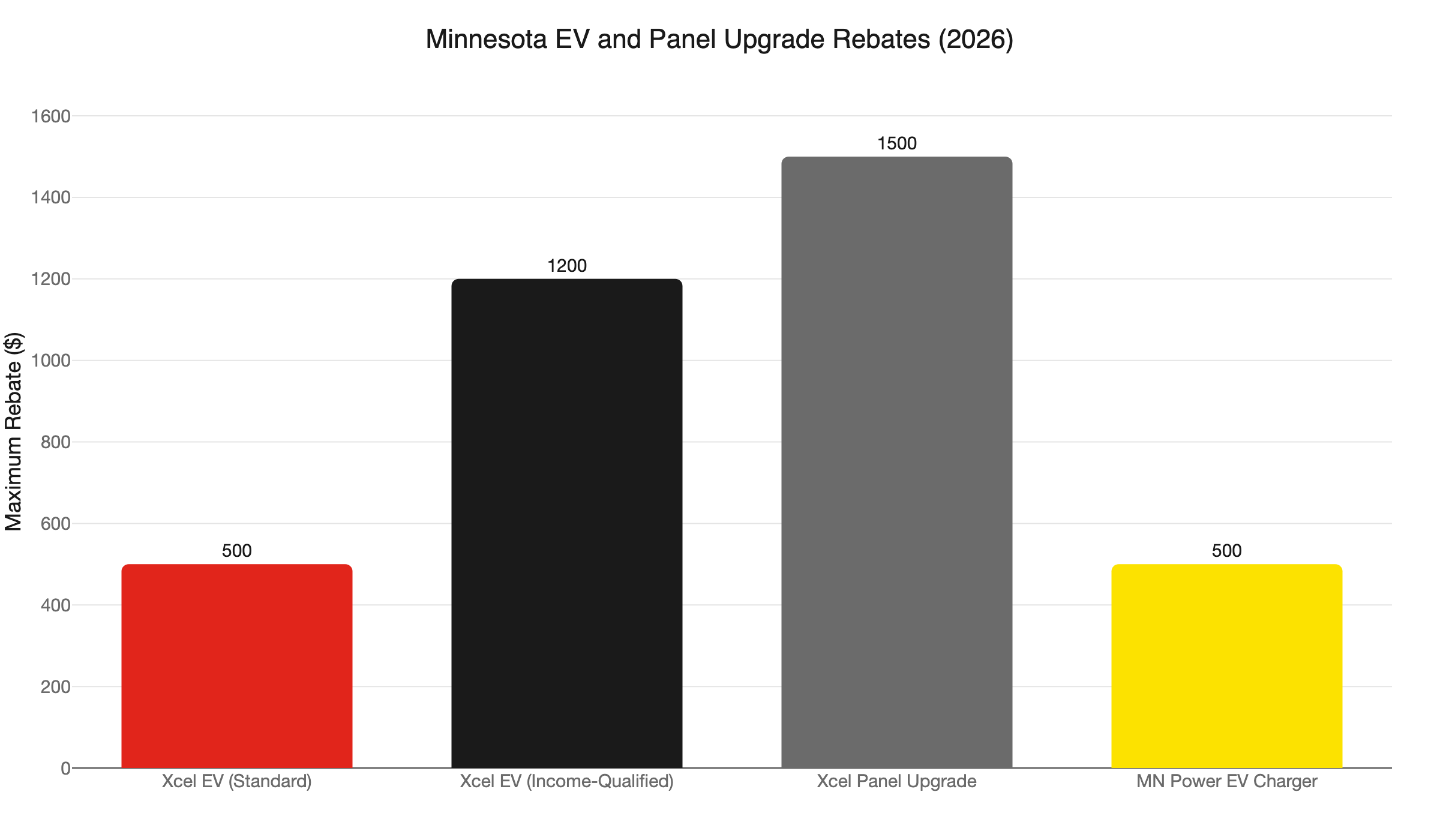
- Xcel Energy offers up to $1,500 for a panel upgrade and up to $500 standard (or $1,200 income-qualified) for EV charger wiring. The federal 30C tax credit expired June 30, 2026.
- Every heated floor installation in Minnesota requires an electrical permit and two inspections. No permit means no legal installation.
Planning Your Mudroom Electrical Outlets and Heated Floor Wiring
A mudroom is the hardest-working room in a Minnesota home. It absorbs boots, wet coats, hockey gear, and muddy dogs every single morning from November through April.
During a remodel or addition, homeowners concentrate on the bench, the cubbies, and the tile. Mudroom electrical outlets and heated floor wiring get pushed to the back of the list. That is a costly mistake.
Electrical rough-in must happen before the floor goes down and before the drywall closes. Once tile is set, adding a heated floor circuit costs roughly three times what it would have during the remodel. The right time to plan every circuit, every outlet location, and every conduit sleeve is before your contractor locks the schedule.
This guide covers what the 2026 NEC requires for a Twin Cities mudroom, how to size each circuit correctly, what USB outlets actually need by code, whether EV rough-in is worth adding, which rebates remain active, and when a permit is required.
What Does the 2026 NEC Require for Mudroom Electrical Outlets?
Minnesota adopted the 2026 NEC on August 17, 2026. Any permit pulled for a mudroom remodel or addition today must comply with the new edition. Key provisions affect outlet spacing in entry spaces over 60 square feet, replacement receptacle standards, and the new EV-ready mandate for garages. Permits filed before August 17 follow the 2023 NEC instead.
The most important outlet rule for mudrooms has been in place for several NEC cycles, but most homeowners encounter it for the first time during plan review - when it is too late to reroute conduit cheaply. The 2026 edition also tightened what happens when you swap out an existing receptacle during a remodel.
The foyer rule most homeowners miss
The NEC is the rule that surprises people mid-project. Any foyer or entry space, not classified as a hallway, that exceeds 60 square feet must have a receptacle on every wall section that is 3 feet wide or wider. Doorways and floor-to-ceiling windows do not count as available wall space.
A typical Twin Cities mudroom addition easily clears 60 square feet. That makes outlets on multiple walls code-required, not optional design choices. If your quote shows a single outlet near the door and nothing else, plan for a failed inspection.
Replacement receptacles trigger an upgrade evaluation
NEC 406.4(D) is a significant 2026 NEC change for remodel work. When you replace a receptacle anywhere in the home, you must evaluate it against current GFCI, AFCI, tamper-resistant, and weather-resistant requirements for that specific location. A mudroom remodel that touches existing outlets forces those outlets up to current code. You cannot swap in a plain duplex outlet where code now requires a GFCI or tamper-resistant device.
How Many Outlets Does Your Mudroom Need by Code?
NEC 210.52(I) requires a receptacle on every wall section 3 feet or wider in any entry space over 60 sq ft. A mudroom addition with three usable wall sections and a utility sink could require five or more outlets before you add a thermostat box, a bench charging station, or a vacuum circuit. Budget for more than you think you need.
Here is the practical count for a typical 10x8 mudroom addition. Two 10-foot walls and two 8-foot walls give you a starting point. Subtract doorways and any window openings. The remaining wall sections almost all clear the 3-foot threshold. That is four walls potentially requiring receptacles before you touch specialty circuits.
Now add the heated floor thermostat box, which takes its own dedicated circuit and panel slot. Add a USB combo outlet near the bench for phones and earbuds. Add a utility outlet for a vacuum, boot dryer, or steamer. You are looking at six to eight devices minimum before the heated floor circuit and any EV rough-in appear on the panel schedule.
The time to plan the full device list is before rough-in, not after drywall closes. Relocating a box after the walls are sealed is expensive and disruptive. Getting it right the first time is why you hire a licensed electrician and pull a permit.
What Circuit Does a Heated Floor Actually Need?
Electric floor heating is a continuous load under the NEC. The circuit must be sized at 125% of the mat’s amp draw (NEC 424.3(B) + 210.19(A)(1)). A mat drawing 16A needs a dedicated 20A circuit. Most mudroom heated floor installations land on a single dedicated 20A circuit paired with a dedicated thermostat.
The 125% continuous load rule
The NEC classifies electric floor heating as a continuous load. Take the mat’s rated amp draw and multiply by 1.25. The result is the minimum circuit size.
- A mat drawing 16A needs a dedicated 20A circuit.
- A mat drawing up to 15.9A fills the full 20A circuit slot.
- Multiple mats sharing one thermostat work only if the combined draw stays under 15A. Above that threshold, you need a relay or a separate circuit for each zone.
A 50 square foot mudroom mat typically draws between 10A and 16A at 120V. A single dedicated 20A circuit handles the typical mudroom installation cleanly.
GFCI protection and the concrete slab
Many Twin Cities mudroom additions are built on a concrete slab. NEC 424.44(G) requires GFCI protection for any heating cable embedded in concrete or poured masonry. GFCI can live at the thermostat - many smart thermostats include built-in GFCI protection - or at the circuit breaker. Either approach satisfies code.
For thermostat rough-in, use a 4-inch square, 2-1/8-inch deep box with a single mud ring. Install two 1/2-inch conduit sleeves running from the box down to the floor base so the sensor lead has a clear path. Mount the box 4 to 5 feet off the finished floor.
What operating a heated mudroom floor actually costs
A 50 square foot mudroom heated floor runs approximately $0.04 to $0.08 per hour on typical Minnesota utility rates. That is well under a dollar per day for a space that sees hard daily use from November through April. Materials for the mat run $175 to $420. A smart thermostat adds $100 to $250. These are material-only figures; electrical rough-in and installation are separate line items.
Minnesota winters make a warm, dry mudroom floor a functional tool rather than a luxury. A surface where boots come off and stay dry makes a real difference in a room that takes that kind of daily punishment.
What About GFCI Protection in a Mudroom?
If your mudroom includes a utility sink, NEC 210.8(A) requires GFCI protection on all 125V-250V receptacles within 6 feet of the sink. In a compact mudroom, that radius covers nearly every general-use outlet in the space. A GFCI circuit breaker upstream protects every outlet on the circuit without needing individual GFCI devices at each location.
Many Twin Cities mudroom remodels include a utility sink for boot rinsing, pet washing, or coat cleaning. That single fixture changes the code requirements for every outlet in the vicinity.
The NEC requires GFCI protection on receptacles in laundry areas and within 6 feet of any sink. In most mudrooms, that 6-foot radius covers the entire room. A mudroom that doubles as a laundry area triggers full GFCI coverage on its own.
GFCI protection can be delivered at each outlet individually or at a single GFCI circuit breaker upstream. When multiple outlets in a small space all need GFCI coverage, a GFCI breaker is often the simpler, cleaner solution. It protects the entire circuit with one device and eliminates the nuisance of coordinating which outlet is the upstream GFCI for the others.
For a full breakdown of which locations in a home require GFCI protection and why, see our guide to GFCI outlet requirements.
Are USB Receptacles Allowed by Code?
No NEC edition requires USB receptacles in residential mudrooms. They are a convenience upgrade, not a code mandate. When installed, NEC 406.12 requires them to be tamper-resistant and NEC 406.3(F) requires the USB circuitry to be listed as an integral component of the device. A snap-on faceplate charger over an existing standard outlet does not meet code.
USB combo outlets are a consistent request in mudrooms. A dedicated charging spot near the bench means phones, earbuds, and GPS units stay powered without hunting for an adapter block or stringing a cord across the room.
Here is what the code actually requires. NEC 406.12 mandates that all receptacles installed in dwelling units be tamper-resistant - USB combo devices included. NEC 406.3(F) requires the USB circuitry to be a listed integral component of the receptacle assembly. A faceplate charger that clips or screws over an existing outlet is not a listed integral device and is not code-compliant.
The 2026 NEC added Section 406.16(D)(3), which limits faceplate USB chargers to 1 watt output and requires unpainted copper-alloy screw heads. The practical takeaway is straightforward: buy a listed combo outlet that ships as a single assembled unit from a recognized manufacturer. Do not try to retrofit a separate charger faceplate over an existing receptacle.
USB combo outlets do count toward the NEC 210.52(I) outlet spacing requirement, as long as they are listed, tamper-resistant receptacles. One near the bench can satisfy both a spacing requirement and a practical charging need at the same time.
EV Rough-In: Is the Payoff Worth It?
If your mudroom addition shares a wall with an attached garage, 2026 NEC 210.17 may now require an EV-ready 240V outlet in the garage as part of your permit scope. Even when the mandate does not apply, roughing in a 50A circuit during the mudroom permit costs $280 to $450. Retrofitting the same circuit after the walls close runs $800 or more.
What 2026 NEC 210.17 now requires
2026 NEC Section 210.17 is one of the more significant additions in the new edition. All new one- and two-family dwellings must now include an EV-ready outlet in the garage or designated parking area: a 240V NEMA 14-50 or equivalent outlet on a dedicated 50A circuit. This is not advisory language. It is a code requirement.
If your mudroom addition is part of a new construction project or triggers a full permit review that classifies the scope as new construction, EV rough-in is now required, not optional. Even when the mandate does not technically apply to a remodel-only scope, the economic argument for roughing it in anyway is strong.
Circuit sizing for Level 2 EV charging
NEC 625.41 applies the 125% continuous load rule to EV charging equipment, the same principle as heated floors.
- A 40A Level 2 EVSE requires a 50A dedicated circuit. Minimum wire: 8 AWG copper. Conduit: 3/4-inch EMT or PVC Schedule 40.
- A 48A EVSE requires a 60A dedicated circuit. Minimum wire: 6 AWG copper. Conduit: 1-inch EMT or PVC Schedule 40.
NEC 625.54 requires GFCI protection for cord-and-plug connected EVSE. Garage outlets for EV charging also fall under NEC 210.8(A) GFCI requirements, so the protection is required on both counts.
Why the mudroom permit is the right moment
A mudroom addition sharing a wall with an attached garage is the ideal opportunity to run conduit. You stub out a box, reserve a 50A breaker space in the panel, and leave the line ready for a future charger. You do not need to purchase the charger now.
When you are already in the walls, no malarky, this is the move. Adding the rough-in to the mudroom permit scope costs $280 to $450. Coming back after the walls are finished costs $800 or more, plus a second permit and new drywall patching.
Our guide to EV charger installation in the Twin Cities covers charger selection and the full installation process when you are ready to finish the job.
Xcel Energy Rebates: What Is Still Available
Rebates on electrical upgrades change fast, and one major incentive has already gone away. Here is what is verified and current as of September 2026.
EV charger and wiring rebate (Xcel Energy): Up to $500 for standard customers. Up to $1,200 for income-qualified households. You must enroll in Xcel’s EV charging program before applying for the rebate. A licensed electrician is required. Funds are distributed first come, first served.
Panel upgrade rebate (Xcel Energy): Up to $1,500 when upgrading to higher amperage service. A like-for-like replacement of a failed panel at the same amperage does not qualify. This rebate stacks with EV, heat pump, and water heater rebates when multiple improvements happen in the same project.
Minnesota Power (northern Minnesota and Duluth-area customers): If you are not served by Xcel, Minnesota Power offers $500 for a Level 2 charger and $500 for a second service drop. Different structure, worth checking before assuming the Xcel rates apply to you.
Federal 30C tax credit: gone. The federal EV charger tax credit, which covered 30% of installation costs up to $1,000 for residential customers, expired for property placed in service after June 30, 2026. Any source still quoting this credit is out of date. It does not apply to work done today.
Source: Minnesota EV Charger and Panel Rebates
If your mudroom remodel is already pushing you toward a panel upgrade to accommodate new circuits, stacking the Xcel rebates can take a meaningful bite out of the total cost. See our post on signs you need an electrical panel upgrade to check whether your current panel has capacity for the new load.
Do You Need a Permit for Mudroom Electrical Work in Minnesota?
Yes. Every heated floor installation, every new circuit, and every new outlet in a Minnesota mudroom requires an electrical permit. A rough-in inspection must pass before the floor is covered. A final inspection closes the permit after work is complete. Skipping the permit means no legal installation and potential complications when you sell the home.
Minnesota’s electrical code is codified at MN Rules Chapter 1315, administered by the Department of Labor and Industry. The permit is not optional and there is no small-scope exception. The inspection schedule matters: your tile contractor cannot set the heated floor until the rough-in inspection is complete and approved. Coordinate the inspector’s visit into the project timeline before anyone picks up a trowel.
Skipping the permit creates real problems at resale. Open permits and missing permits surface in title searches. The buyer’s inspector will ask for the permit history. Correcting an unpermitted electrical installation after the floor is set is expensive and disruptive in ways that dwarf the permit cost.
Our guide to electrical permits in Minnesota walks through what the permit process involves, what the inspector verifies at each stage, and how to sequence the work correctly.
We pull permits as part of every job. That is the legal standard in Minnesota, and it protects both sides.
Putting the Full Mudroom Electrical Plan Together
Here is what a complete mudroom electrical scope looks like on a single permit pull for a typical Twin Cities addition.
General outlets (NEC 210.52(I)): One receptacle on every wall section 3 feet wide or wider. Budget for three to five general-use outlets before adding specialty circuits. GFCI-rated if a sink is in the space.
Heated floor circuit: One dedicated 20A circuit. GFCI protection required if the slab is concrete. Thermostat rough-in at 4 to 5 feet above the finished floor, with two 1/2-inch conduit sleeves for the sensor lead.
GFCI coverage: Full GFCI on all outlets if a sink is present or if the space qualifies as a laundry area. A GFCI circuit breaker protects multiple outlets cleanly with one upstream device.
USB outlet: One listed, tamper-resistant combo receptacle near the bench. Counts toward the outlet spacing requirement. Satisfies both a code need and a practical charging need in the same location.
EV rough-in (if the garage is adjacent): One 240V, 50A circuit stubbed to a box in the garage wall, with a 50A breaker space reserved in the panel. Approximately $280 to $450 added to the mudroom permit scope. Significantly more expensive as a standalone retrofit later.
The mudroom electrical plan is not complicated, but it does require coordination with your general contractor, your tile installer, and your inspector before anyone starts work. Getting those sequencing conversations out of the way before rough-in is the difference between a clean project and an expensive do-over.
Call us at 763-200-5956 or book online to schedule a mudroom electrical consultation. We are locally owned and operated in the Twin Cities. As America’s On-Time Electrician(R), we show up when we say we will. Every job is backed by the UWIN(R) 100% satisfaction guarantee.
Frequently Asked Questions
How many electrical outlets does a mudroom need in Minnesota? +
Does a heated mudroom floor need its own dedicated circuit? +
Is the federal EV charger tax credit still available in Minnesota? +
Do I need a permit to install a heated floor in a Minnesota mudroom? +
Need an electrician now?