
Home Ethernet Wiring Installation: A Twin Cities Guide
Key Takeaways
- Home ethernet wiring installation in Minnesota requires any contractor to hold a Power Limited Technician (PLT) license. Most how-to guides miss this entirely.
- In-wall cable needs at minimum a CL2 or CL3 jacket. Vertical riser runs require CMR-rated cable. Runs through air-handling plenum spaces require CMP-rated cable.
- Cat6a is worth specifying on runs over 165 feet. Most Twin Cities homes have at least a few that qualify.
- Conduit (ENT, EMT, or PVC) lets you pull new cable in the future without opening walls. It is the single upgrade most installers skip.
- Hire a licensed electrician when conduit runs near the panel, circuit work is involved, or a sub-panel is part of the project.
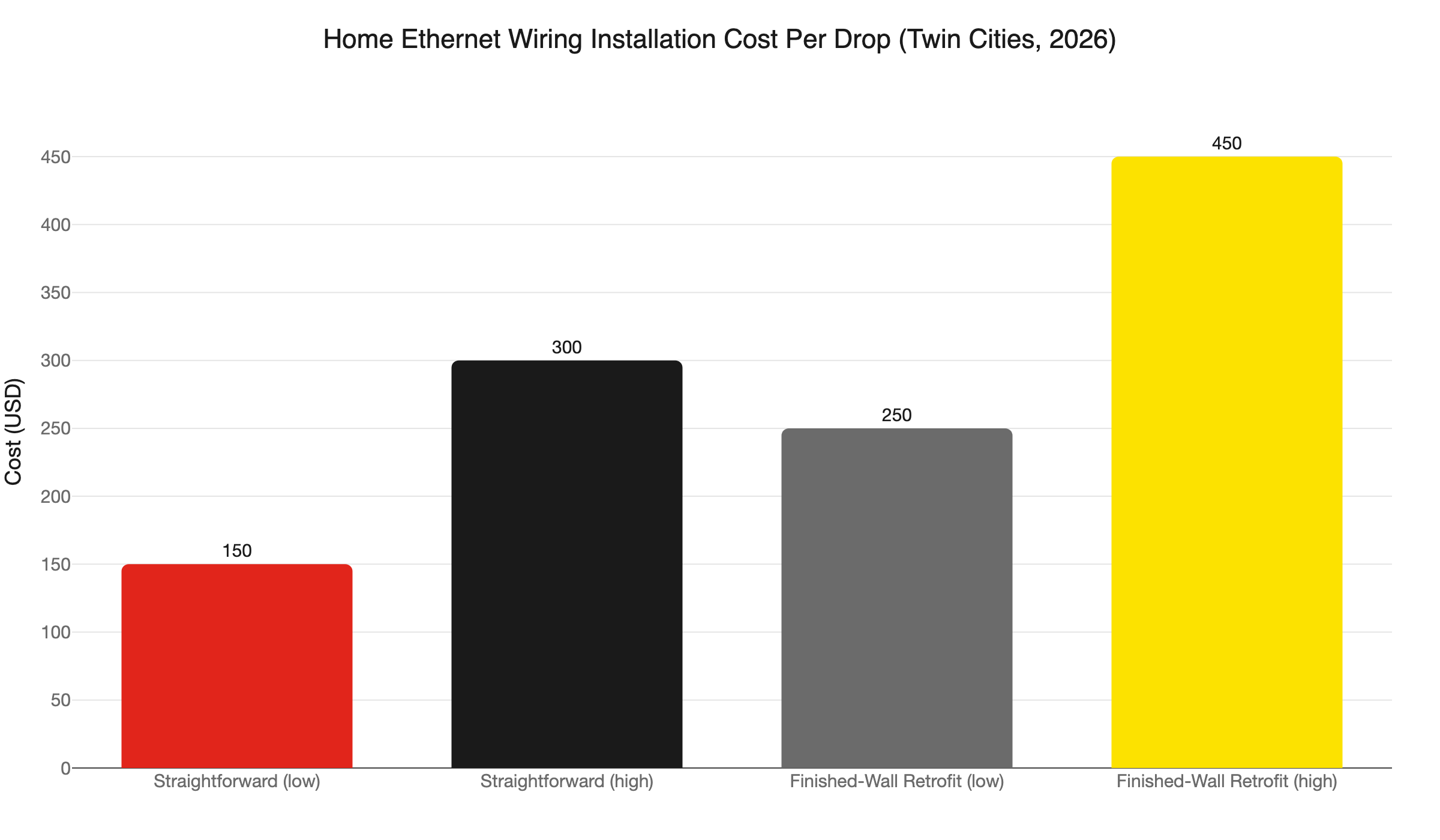
- Costs run $150-$300 per drop for a straightforward install and $250-$450+ per drop for finished-wall retrofits, common in older Minneapolis and St. Paul homes.
- Minnesota moved to the 2026 NEC on August 17, 2026. Permits filed on or after that date must comply with the new code.
Why Home Ethernet Wiring Installation Is Worth Doing Right
Wi-Fi is convenient. Wired ethernet is reliable. If you have ever had a video call drop in a room two walls from the router, you already know the difference.
A whole-home wired network delivers dedicated bandwidth at every workstation, TV, gaming console, and security camera. It eliminates interference from neighbors’ networks. Smart home devices actually respond on the first command.
But home ethernet wiring installation is not a weekend hobby project. Once the walls close, they stay closed, at least until someone pays to open them again. Getting the cable spec, conduit decision, and licensing right the first time is the difference between a 30-year installation and one that needs rework in five.
Here is what Twin Cities homeowners need to know before they hire anyone.
Does Home Ethernet Wiring Installation Require a License in Minnesota?
Quick answer: Yes, for contractor work. Minnesota requires a Power Limited Technician (PLT) license for anyone doing ethernet cabling for hire. The hiring company must hold a Technology Systems Contractor (TSC) license. Hiring an unlicensed contractor is a code violation. It leaves the homeowner exposed if anything goes wrong.
Minnesota is one of the strictest low-voltage licensing states in the country. Even pure Cat6 data cabling falls under the PLT license scope per Minn. Stat. §326B.33. A general electrician license does not cover this work. These are two separate trades with two separate license tracks.
A PLT earns their credential through approximately 6,000 hours of supervised field experience under a licensed PLT or Master Electrician, or an approved apprenticeship program. The TSC business license requires a designated responsible PLT plus a $25,000 surety bond. Getting licensed takes 60 to 120 days and costs $600 to $1,800.
Why does this matter to you? Three reasons. First, it separates serious contractors from unlicensed handymen. Second, licensed work is insurable and inspectable. Third, if an unlicensed installer damages something, your insurance company will want to know who did the work and under what license.
Ask any ethernet contractor for their TSC license number before they start. A legitimate contractor will have it ready.
What Cable Does the Code Require for In-Wall Runs?
Quick answer: In-wall residential runs need at minimum a CL2 or CL3 rated jacket. Vertical runs between floors require CMR (riser-rated) cable. Any run through a return-air plenum space, a configuration common in Twin Cities forced-air homes, legally requires CMP (plenum-rated) cable. Using the wrong rating is a code violation.
NEC Article 800 governs communications wiring, including ethernet. The jacket rating is not a marketing tier. It is a fire and smoke safety specification. In a wall-cavity fire, a lower-rated jacket spreads smoke and toxic gases faster than CMR or CMP would.
In the Twin Cities, the CMP requirement catches homeowners off guard. Most homes here rely on forced-air HVAC. If a dropped ceiling or raised-floor cavity is part of the return-air path, that space is a plenum by definition. Every cable running through it must be CMP-rated. Ask your installer directly whether any of your proposed runs pass through air-handling spaces.
Cat6 vs. Cat6a: Both support 10 Gbps. Cat6 only holds that speed over shorter distances, while Cat6a maintains 10 Gbps at the full 328-foot (100m) channel length. In a larger Twin Cities home with long runs to remote bedrooms, a finished basement, or a detached garage, Cat6a is worth specifying. The price difference on bulk cable is modest. The cost of pulling new cable through finished walls years from now is not.
One more spec to know: Cat6 cable has a maximum pull tension of about 25 lbs and a minimum bend radius of four times the cable diameter. Exceeding either permanently damages the internal twist geometry and degrades signal. Proper installation technique matters as much as cable grade.
Quality low-voltage wiring, properly installed, is rated to last 20 to 30 years. Spec it for the long run.
Should You Pay Extra for Conduit on Your Ethernet Install?
Quick answer: Almost always yes. Conduit lets you pull new cable in the future without touching drywall. It is a modest upcharge during rough-in or any open-wall renovation. Without it, future upgrades mean fishing new cable through finished walls, patching, and repainting.
Three conduit types come up in residential ethernet work:
ENT (Electrical Nonmetallic Tubing, commonly called “smurf tube”): Flexible corrugated plastic conduit. The most common choice for new construction and open-wall renovation. It bends easily, installs inside wall cavities, and is allowed in concealed residential locations under NEC 362. If you are doing any renovation that opens walls, ENT is the obvious call. It adds minutes to the rough-in and saves hours later.
EMT (Electrical Metallic Tubing): Rigid metal conduit. Best for mechanical-exposure areas: garages, exposed basement runs, and utility spaces. EMT provides strong physical protection and holds up well to the temperature swings a Minnesota garage sees. Temperatures swing from -20F to 80F or above in the same year. That range stresses unprotected cable jackets over time.
PVC conduit: Rigid and moisture-resistant. The standard for outdoor and underground runs. For a buried run to a detached garage or outbuilding, PVC is the right choice. Bury it at minimum 6 inches for low-voltage (verify with your local AHJ). Above-grade outdoor sections require UV-rated PVC.
The contractor who does not bring up conduit is not necessarily a bad contractor. But ask directly. It is a modest line item during rough-in. The regret of skipping it is expensive.
For more on when conduit makes sense versus direct-run wiring in the broader residential context, see our guide on conduit versus Romex in residential wiring.
Should You Hire an Electrician or a Low-Voltage Contractor?
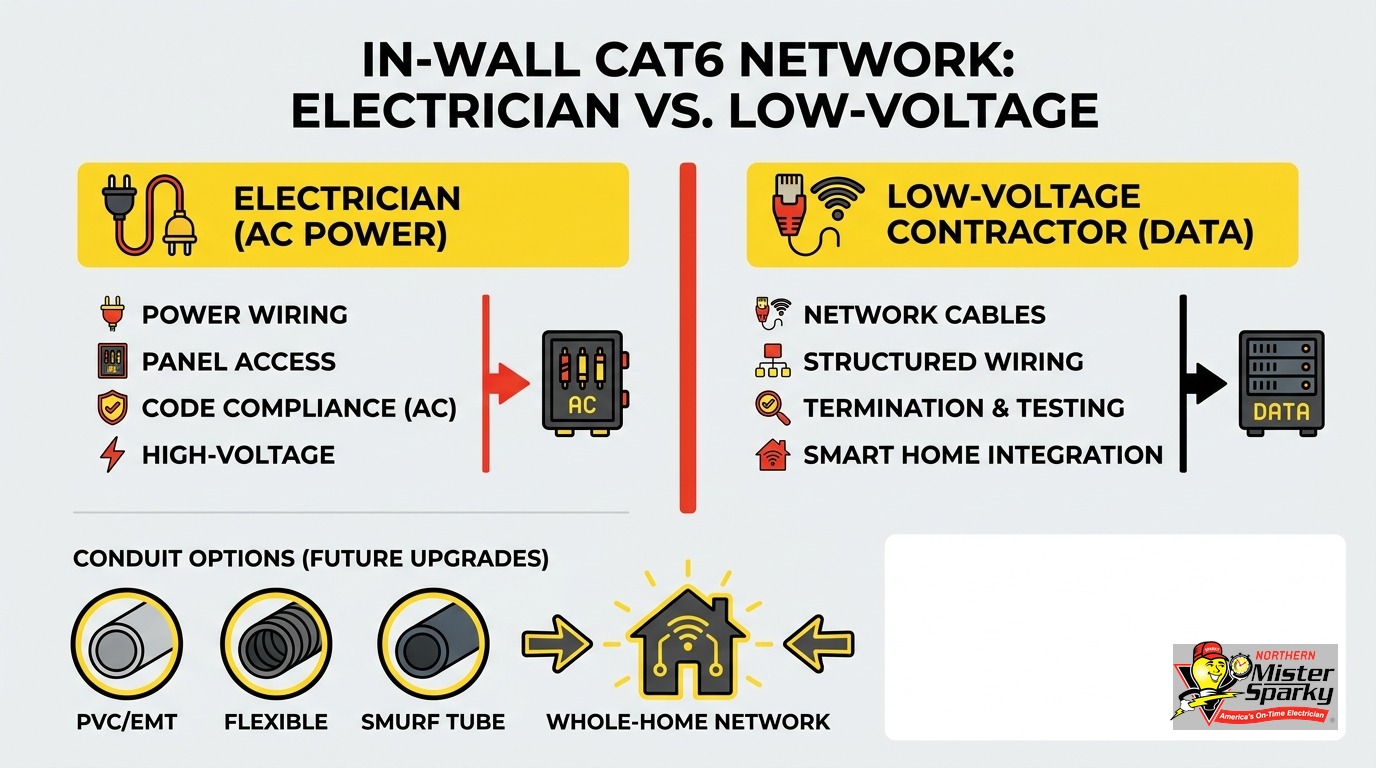
Quick answer: For a pure ethernet-cabling project in a finished home, hire a TSC/PLT-licensed low-voltage contractor. Hire a licensed electrician when the scope touches the electrical system: conduit near the panel, circuit additions, a sub-panel, or PoE devices that require dedicated circuits.
The distinction is practical, not just legal. A licensed electrician is trained and licensed to work with power conductors. A PLT is trained and licensed for structured cabling, network design, and low-voltage systems. These are different trades with different scopes of work.
Hire a licensed electrician when:
- Conduit runs will pass in the vicinity of the main service entrance or panel
- The ethernet project is part of a larger electrical rough-in: new construction, a gut rehab, or a home addition
- PoE devices need circuit modifications alongside the data cabling
- A sub-panel or dedicated home-office circuit upgrade is part of the same project
Hire a TSC/PLT-licensed low-voltage contractor when:
- The project is purely data cabling in a finished home
- The scope includes network design, security cameras, AV integration, or multi-system work
- You need certified run testing with a paper trail
On new construction, the standard approach has the electrician installing conduit during the rough-in phase while the low-voltage contractor pulls and terminates later. That split keeps each trade in their licensed scope and avoids scheduling conflicts.
If your project pairs ethernet cabling with circuit additions or a home office build-out, our home office electrical upgrades guide covers the electrical side of that planning.
Can You DIY Your Home Ethernet Wiring in Minnesota?
Quick answer: Yes, with important conditions. Minnesota homeowners can pull permits and do electrical work on their own home. The contractor PLT licensing requirement does not apply to homeowners doing their own work. But permit and inspection requirements still apply. The cable specification does not change.
If you go the DIY route, three things to get right:
Use the correct cable rating. CMP is required in plenum spaces whether the installer is licensed or not. The NEC does not care.
Pull a permit. Minnesota uses a two-track system: if the Authority Having Jurisdiction is the state, permit through the Department of Labor and Industry; if local, contact your city. Minneapolis and St. Paul use their own inspectors. Many suburbs route through the state DLI system. Pre-concealment inspection is required before walls close.
Be realistic about difficulty. An open-stud rough-in is manageable for a careful DIYer. Fishing cable through horsehair plaster in a 1920s Minneapolis bungalow is a different project entirely.
How Much Does Home Ethernet Wiring Installation Cost in the Twin Cities?
Quick answer: Expect $150-$300 per drop in straightforward conditions. Finished-wall retrofits with plaster walls, tight chases, or patch coordination run $250-$450 or more per drop. The higher end is common in older Twin Cities homes.
Professional installation in 2026 runs $150-$300 per drop in standard conditions and climbs steeply when walls are finished, ceilings are inaccessible, or routing requires extensive fishing.
Several factors push costs up in the Twin Cities market:
Plaster walls: Pre-1950s Minneapolis and St. Paul homes frequently have horsehair plaster or hard-coat plaster over wood lath. Fishing cables through plaster takes significantly more time than drywall. It requires more patching and often a painter callback.
Long runs: Older large homes push cable runs longer. This is where Cat6a pays for itself. The modest upcharge on bulk cable is far cheaper than a second install.
Conduit: Adding ENT or EMT during the install adds labor and material. Weigh that line item against your expected tenure in the home and the future cost of fishing without it.
Number of drops: A whole-home project with 8 to 12 drops in one visit costs less per drop than a one-drop service call. If you are wiring the house, wire the house.
Get quotes from at least two licensed TSC contractors. Ask each to itemize conduit spec, cable grade (Cat6 vs. Cat6a), and termination style.
Older Twin Cities Homes: Why the Job Is Harder
The Twin Cities housing stock skews old. Minneapolis and St. Paul have large concentrations of pre-1950 construction: bungalows, foursquares, Tudor revivals, and Colonials built before modern wiring methods.
These homes present specific challenges:
Horsehair and hard-coat plaster: Plaster over wood lath is dense, brittle, and unforgiving to drilling. A run that takes 20 minutes in a drywalled home can take an hour in plaster. Budget for it.
Minimal interior chases: Modern construction builds pathways for mechanical runs. Older homes did not. Routing from the utility room to a second-floor bedroom often requires creative paths through closets, under floors, or along baseboards with surface raceways.
Older wiring in proximity: If your home has knob-and-tube or cloth-insulated wiring, an electrician should review routing plans that run ethernet near existing power conductors. Our overview of cloth wiring hazards in older homes covers what to watch for in pre-1950 construction.
Limited attic access: Many older homes have low-pitch roofs with minimal attic clearance. Fishing from above, the easiest route in modern construction, may not be an option.
If your home fits any of these categories, budget the higher end of the per-drop cost range. Ask your contractor specifically about their experience in plaster-wall homes before signing anything.
What Does the 2026 Electrical Code Change for Ethernet Wiring?
Quick answer: Minnesota adopted the 2026 National Electrical Code on August 17, 2026. Permits filed on or after that date comply with 2026 NEC. Permits filed before that date follow 2023 NEC. The 2026 code does not remove or relax any Article 800 cable-rating requirement.
The core ethernet wiring rules carry forward: CMP in plenum spaces, CMR in risers, CL2/CL3 minimum in concealed walls. That did not change.
The practical implication is timing. If you have a permit in flight from before August 17, it runs under 2023 NEC. A project starting now follows 2026 standards. Licensing exams transition to 2026 NEC on September 8, 2026.
Ask any contractor you interview which code edition their current work follows. A licensed TSC/PLT contractor will have a crisp answer. Vagueness here is a yellow flag.
Schedule Your Home Ethernet Wiring Installation
Properly installed Cat6 or Cat6a wiring, run in conduit, terminated cleanly, and inspected by the AHJ, is a 20-to-30-year infrastructure investment. It is not the place to cut corners on licensing, cable spec, or conduit. No malarky.
Northern Mister Sparky is locally owned and operated in the Twin Cities. We are America’s On-Time Electrician(R), backed by the UWIN(R) 100% satisfaction guarantee. When your ethernet project involves conduit near the panel, circuit additions, sub-panel work, or a full home pre-wire, our licensed electricians handle the electrical side and coordinate with your low-voltage contractor on the structured cabling.
Planning a broader project that pairs ethernet with smart home devices or a home office? Our smart home pre-wiring guide covers how to plan the full scope before walls close.
Call 763-200-5956 or book online. We show up on time, do the work right, and do not leave until you are satisfied.
Frequently Asked Questions
Do I need a permit for ethernet wiring installation in Minnesota? +
Should I hire an electrician or a low-voltage contractor for home ethernet wiring? +
What is the difference between Cat6 and Cat6a? +
Need an electrician now?