
Hardwired Security Camera Installation Electrician Guide
Key Takeaways
- Hardwired security cameras involve two distinct categories of work: Cat6 or coax signal wiring for the cameras, and a 120V power circuit for the NVR or PoE switch.
- Minnesota requires a Power Limited Technician (PLT) license for professional camera signal wiring and a licensed journeyworker or master electrician for the 120V panel work.
- Most security integrators hold only a PLT credential and cannot legally add a circuit at your panel. That creates the two-contractor problem many homeowners discover mid-job.
- Minnesota’s electrical code changes on August 3, 2026. Permits filed before that date follow the 2023 NEC; permits after follow the 2026 NEC.
- A licensed hardwired security camera installation electrician who carries both credentials handles the full job in one visit.
- Call 763-200-5956 or book online. Our locally owned team serves the Twin Cities.
Why Homeowners Switch from Wireless to Hardwired Cameras
Wireless cameras sell on convenience. Setup takes minutes. No cable runs. No holes drilled through soffits.
That simplicity has a ceiling.
Battery-powered units need regular charging. Wi-Fi signals drop during storms. Motion clips buffer at the wrong moment. A camera that goes offline at 2 a.m. isn’t protecting anyone.
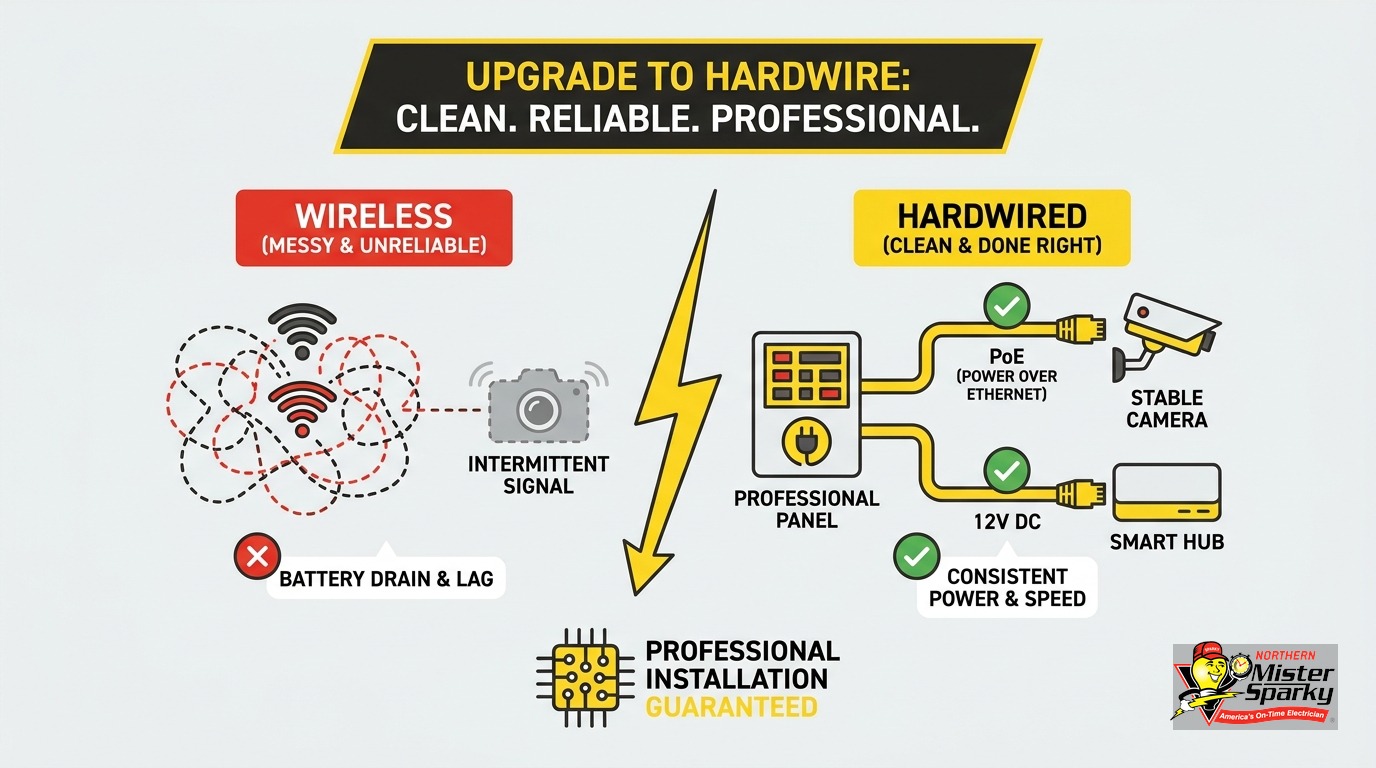
PoE cameras run on a single Cat6 cable. That cable carries both data and power to the camera. Once installed, a PoE camera records continuously. It doesn’t drop off your network. It doesn’t run low on battery before a long weekend.
Analog systems use 18/2 or coaxial cable and operate independently of your Wi-Fi entirely. Either technology is a meaningful reliability upgrade over wireless.
The tradeoff is installation complexity. Running cables through finished walls, drilling rooflines and soffits, and pulling a dedicated 120V circuit for the NVR are not weekend projects. They require planning, the right tools, and in Minnesota, the right licenses.
Homeowners who call a security company expecting a full turnkey job often discover mid-project that the quote covered hardware and cable runs but not the panel work. Understanding the licensing picture upfront saves both time and money.
What Does a Hardwired Security Camera Installation Electrician Do?
A hardwired security camera installation electrician handles the 120V power side of the system: the dedicated circuit or outlet that feeds the NVR or PoE switch, conduit where required, and any panel work. A licensed electrician who also holds a PLT credential can cover the full job, including the camera signal cable runs, in a single visit.
A full installation involves four phases.
Route planning and layout. The electrician identifies camera mounting locations, maps cable paths through walls and attic spaces, and determines where the NVR or PoE switch will live. Good planning prevents cutting into finished walls twice.
Cable pulls. For a PoE IP system, Cat6 runs from each camera location back to the NVR. For an analog system, 18/2 or coaxial cable does the same job. Cables running through unconditioned attic spaces need temperature-rated jackets suited to Minnesota conditions.
Power installation. The NVR or PoE switch needs a reliable 120V source. Adding a circuit or outlet requires a licensed electrician. Garage and soffit locations typically require a GFCI-protected outlet under current Minnesota code.
Mounting, termination, and testing. Camera housings go up. Cables terminate at the NVR. Every camera is verified live before the crew leaves. All outdoor connections are weather-sealed.
Each phase carries different licensing requirements in Minnesota. That distinction surprises most homeowners.
Why Does One Camera Job Require Two Different Licenses?
Because hardwired security camera installation spans two legally separate categories of electrical work. The camera signal cable is a Class 2 limited-energy circuit under NEC Article 725. Minnesota requires a PLT license for those runs under MN Statute 326B.33. The 120V circuit powering the NVR is standard electrical work requiring a licensed journeyworker or master electrician.
NEC Article 725 classifies low-voltage signaling cable as Class 2 limited-energy circuits. The voltage is low, but the licensing requirement is real. Minnesota follows that framework. MN Statute 326B.33 requires a PLT license for anyone who professionally installs security camera signal wiring.
The 120V side of the job operates under a completely separate licensing tier. Adding a new circuit from the panel to power the NVR, installing an outlet in a finished utility room, or running conduit to a garage all require a licensed electrician. The PLT license does not cover those tasks.
Most security integrators hold the PLT credential. They can run Cat6 cable and mount camera housings legally. But when the job requires an outlet that doesn’t exist or a new circuit from the panel, they are outside their licensing scope. That’s when the homeowner finds out they need a second contractor.
The clean solution is one contractor who holds both credentials. Under MN Statute 326B.35, Minnesota’s definition of “electrical work” explicitly includes technology circuits and systems. Security camera wiring is not a gray area.
What Is a Power Limited Technician (PLT) License in Minnesota?
The PLT license covers low-voltage security, communication, and technology wiring under MN Statute 326B.33. It requires 36 months of qualifying power-limited-systems experience or a four-year electrical engineering degree. Anyone who professionally installs security camera signal wiring in Minnesota must hold one.
Most homeowners have never heard this credential mentioned. The phrase “low voltage” makes camera wiring sound informal and unregulated. It isn’t.
Minnesota’s electrical licensing framework separates standard electrical work (journeyworker and master electrician tiers) from power-limited work (PLT tier). A hardwired camera installation touches at least two of those tiers: PLT for signal wiring and standard electrician for the 120V panel work.
The PLT license applies across a range of low-voltage technology work: security and alarm systems, structured data cabling, intercom wiring, and similar circuits. A company advertising hardwired security camera installation in Minnesota needs staff with this credential for the camera cable runs.
Under MN electrical licensing requirements, unlicensed workers may only assist under direct supervision of a licensed individual at the same company. Having a licensed person on staff is not the same as that individual doing or directly supervising your specific job.
Ask before you hire: does your company have a licensed PLT for the camera wiring and an electrical contractor license for the panel work?
Does a Hardwired Camera Installation Need a Permit in Minnesota?
Yes, for most of the work. The 120V circuit or outlet powering the NVR or PoE switch requires an electrical permit. Under MN Statute 326B.35, technology circuits also fall under Minnesota’s electrical permit requirements. Inspections verify that work meets code before walls close up.
Homeowners sometimes wonder whether permits are really necessary for a camera install. The answer is yes, and the stakes are practical.
Unpermitted electrical work can create insurance problems. A claim that traces back to unpermitted wiring may be contested. That risk outweighs any convenience of skipping the permit.
Unpermitted work also becomes a problem at sale time. A buyer’s home inspection can flag it, and resolving it under time pressure during a transaction is expensive and stressful. A clean permit record protects the value of the project.
The permit also protects you directly: an inspection is how errors get caught before walls close up.
Our team pulls the required permits as part of every job. Permit jurisdiction in the Twin Cities varies. The Minnesota Department of Labor and Industry (DLI) handles state-jurisdiction areas, while Minneapolis, St. Paul, and Minnetonka run their own inspection programs. We know which counter handles your address.
For a full breakdown of how Minnesota electrical permits work, see our post on electrical permits in Minnesota.
What Changes After Minnesota’s August 3, 2026 Code Cutover?
Minnesota is transitioning from the 2023 NEC to the 2026 NEC on August 3, 2026. Permits filed before that date follow the 2023 NEC. Permits filed on or after follow the 2026 NEC. Licensing exams also transition on September 8, 2026. If you are planning a camera install this summer, the timing matters.
This is a practical planning factor for any Twin Cities homeowner working on a security camera project right now. It is not abstract regulatory background.
The 2023 NEC, which is Minnesota’s current code until August 3, expanded GFCI protection requirements compared to prior editions. It requires GFCI coverage in more outdoor and garage locations. That applies directly to any outlet powering a camera NVR or PoE switch in a garage or soffit location.
The 2026 NEC carries its own set of changes. A permit filed in July follows the 2023 requirements. A permit filed in September follows the 2026 requirements. The rulebook is different. A licensed electrician tracks which version governs your permit and installs accordingly.
If you are ready to move forward on a hardwired camera system, there is a straightforward argument for not waiting until fall. The code is changing, and a licensed electrician handles that complexity for you.
Cold Weather, Hot Attics: What Twin Cities Climate Means for Camera Installs
Minnesota does not forgive cheap materials. The camera housing at your eave faces -30F in January. The cable running through the attic behind it hits 150F in July. Most of the country does not deal with that combination.
Materials selection and installation method matter here.
Cable jacket ratings. Standard indoor Cat6 is rated for a narrower temperature range than a Minnesota attic demands. Plenum-rated or direct-burial-rated Cat6 handles the thermal swings without degrading over years of use. The wrong cable jacket leads to brittle insulation in winter and premature failure in summer heat. Specify the right cable for any unconditioned attic run.
Outdoor connection sealing. Every power connection at a soffit, eave, or exterior wall needs a weather-resistant junction box, sealed cable entries, and weather-resistant connectors. A small gap that admits moisture in October becomes a corroded connector and an offline camera by March. Proper sealing is not optional in this climate.
Underground conduit for perimeter runs. A camera covering a driveway or detached garage may require cable to run underground. Minnesota code requires conduit for those installations. The conduit protects the cable from the freeze-thaw ground movement the Twin Cities sees every spring.
Older Minneapolis and St. Paul homes from the 1960s and 70s often have unconditioned attic spaces with limited access to interior wall cavities. Our team plans cable routes around those constraints before any wire gets pulled.
Can a Homeowner Pull Their Own Electrical Permit?
Yes, with clear limits. Minnesota law allows homeowners to pull an electrical permit and perform electrical work on a residence they own and occupy as their primary residence. Work must still pass inspection. This exception does not apply to rental property or work on a neighbor’s home.
The homeowner permit exception is a genuine carve-out for people doing careful work on their own home. The inspection backstop remains in place.
The practical question is whether it makes sense for your specific project.
Running a new 120V circuit from the panel to a utility room is within reach for an experienced DIYer who reads the relevant code sections, has the right tools, and is comfortable with electrical work. Running Cat6 through finished walls and drilling exterior soffits is labor-intensive but not inherently dangerous.
What most homeowners find: the combination of route planning, materials sourcing, tool acquisition, code research, permit scheduling, and inspection wait time adds up quickly. A licensed hardwired security camera installation electrician arrives with the right materials, files the permit, passes inspection, and hands you a finished system.
The PLT license requirement applies to professional installers of camera signal wiring. A homeowner running their own camera cables is not subject to that licensing requirement, but takes full responsibility for the work quality at inspection time.
For a direct look at where DIY electrical work tends to go wrong, see our post on DIY electrical dangers.
One Contractor or Two? The Right Way to Hire
Hire one contractor who holds both credentials: a licensed residential electrician who also carries a PLT license. A security integrator without electrical contractor licensing cannot legally add a circuit at your panel. The two-contractor path creates scheduling friction and typically costs more overall.
This is the most common source of frustration on Twin Cities camera installation projects.
A security company quotes the hardware and cable runs. The scope sounds complete. The install starts. Someone checks the NVR location and finds no nearby outlet, or finds a shared circuit that can’t support the load cleanly.
The security company stops. They are not licensed to pull a new circuit from the panel. The homeowner is now coordinating a second contractor for a single item that a properly licensed crew would have handled in the same visit.
The question to ask before any contractor begins: are you licensed to add circuits and install outlets under Minnesota electrical contractor licensing, and does your team hold a PLT credential for the camera signal wiring? Yes to both is the minimum. No to either means plan for a second call.
Minnesota requires electrical contracting businesses to carry $100,000 per-occurrence liability insurance and post a $25,000 surety bond. The business must designate a licensed master electrician as its responsible individual. A security company without that structure is not legally positioned to contract the electrical side of your camera job.
What to Expect When You Call Northern Mister Sparky
We are locally owned and operated right here in the Twin Cities. When you call 763-200-5956, you reach our team directly.
Here is how a typical hardwired security camera installation with us looks.
Initial call. We talk through the scope: number of cameras, coverage areas, whether you have hardware already or need recommendations, and where the NVR or PoE switch will live.
On-site assessment. We walk the property, map cable routes through walls and attic, and check your panel for available capacity. We identify any cold-climate routing challenges or material concerns before any work is committed.
Permit filing. We pull the required permits. We know whether your address falls under DLI jurisdiction or a city program like Minneapolis or St. Paul.
Installation. We run the cable, install the power circuit or outlet, mount camera housings, and weather-seal all outdoor connections. All work follows the current Minnesota code, whether 2023 or 2026 NEC depending on your permit date.
Inspection. We schedule and pass the inspection. You receive documentation.
System test. Every camera is confirmed live before we leave.
Larger installations, including full perimeter systems with underground conduit runs or projects that also need a panel upgrade, may qualify for financing. Ask when you call.
We are your electrical contractor. For HVAC, our sister company Northern One Hour is the right call. For plumbing, that’s Northern Benjamin Franklin Plumbing.
As America’s On-Time Electrician(R), we arrive when we say we will. Our UWIN(R) 100% satisfaction guarantee backs every job.
Call 763-200-5956 or book online to schedule your hardwired security camera installation in the Twin Cities.
Frequently Asked Questions
Do I need a licensed electrician to install hardwired security cameras in Minnesota? +
What is a Power Limited Technician (PLT) license in Minnesota? +
Does hardwired security camera installation require a permit in Minnesota? +
What does it cost to have a hardwired security camera system professionally installed? +
Need an electrician now?