
Jetted Tub Electrical Requirements: Minnesota Code Guide
Key Takeaways
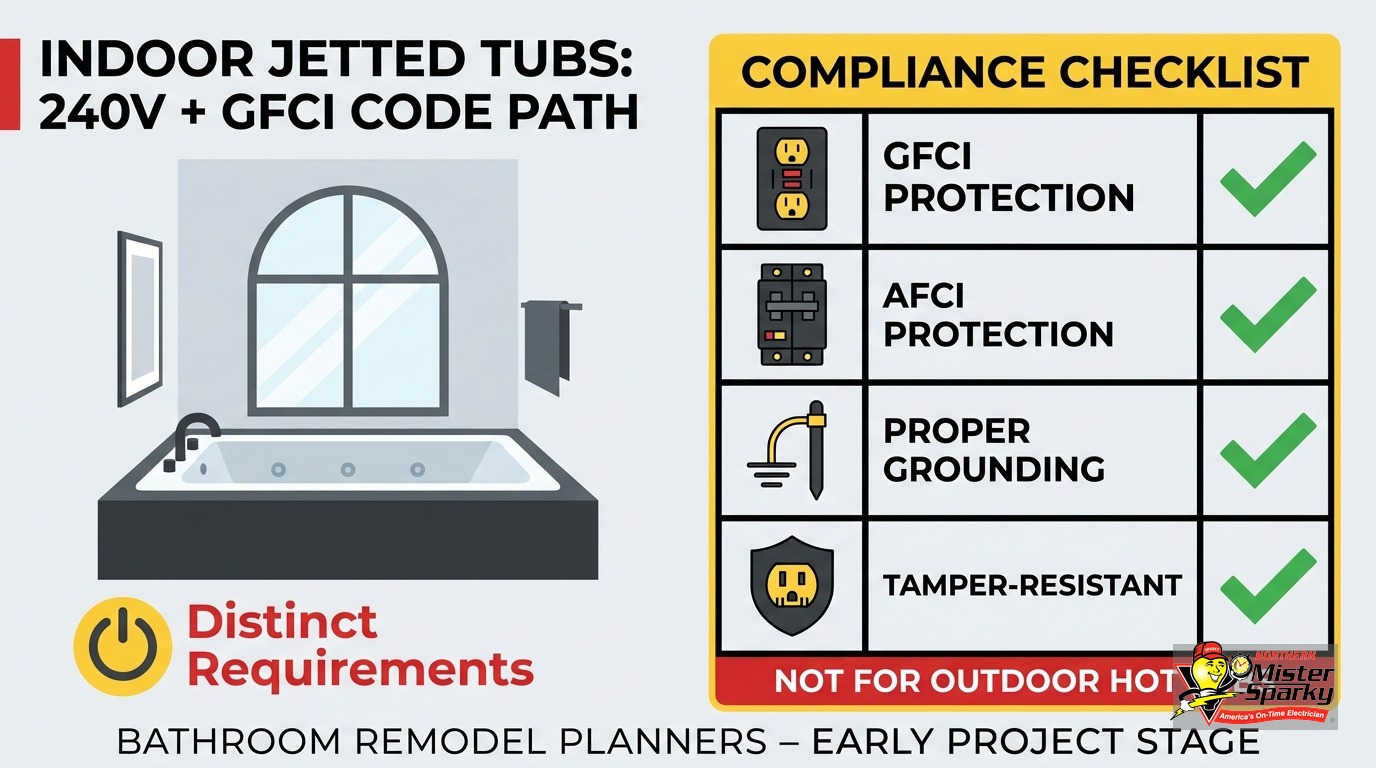
- An indoor jetted bathtub that drains after every use is a “hydromassage bathtub” under the NEC, not a hot tub or spa. The wiring rules are different and simpler.
- It requires a dedicated individual branch circuit protected by a GFCI breaker. That GFCI must stay readily accessible after the tile goes up.
- Any 240V model requires #6 AWG copper wiring and must be hardwired. No plug-in option exists.
- If the tub has a separate heater, that heater needs its own dedicated circuit.
- The motor and wiring must remain reachable without tearing out tile. Plan the access panel before the surround is built.
- Minnesota requires both an electrical permit and a plumbing permit. Both need inspection before the surround is closed.
- Minnesota transitioned to the 2026 NEC on August 17, 2026. Permits filed on or after that date are inspected under the new edition.
What Type of Tub Do You Have?
Quick answer: If your tub is built into the floor, drains after every use, and runs jets through a recirculating pump, it is a hydromassage bathtub under the NEC. If it holds water between uses, it is a spa or hot tub - even when installed indoors. The distinction determines which code section governs the electrical work.
This is the question that trips up most bathroom remodel planners - and most of the guides that rank online.
Search “jetted tub electrical requirements” and the top results describe elaborate outdoor spa panels, disconnect boxes mounted 5 feet from the unit, and underground conduit runs. That is NEC Article 680, Parts I and II - the outdoor hot tub code. It does not apply to the product most bathroom remodelers are shopping.
An indoor jetted bathtub that fills, circulates, and drains after each use is legally classified as a “hydromassage bathtub.” It falls under NEC Article 680, Part VII (sections 680.70 through 680.74) - a separate section with its own, simpler requirements. Getting this wrong before you call a contractor leads to one of two problems: an over-scoped quote for equipment the code does not require, or an unpermitted installation built to the wrong standard.
Here is how to identify your tub type before you make a single call.
Hydromassage bathtub: Built into the floor or deck, plumbed to the home’s drain system, empties after each use. Jets recirculate water only while the tub is running. This is the most common jetted tub in a bathroom remodel and the focus of most of this post.
Indoor spa or hot tub: Free-standing or set into a surround, but the water stays in the unit between uses. It has its own heater and a separate recirculating system. This falls under NEC Article 680, Part IV - covered below.
Outdoor hot tub or spa: Located outside the conditioned space of the home. Covered under NEC Article 680, Parts I and II. This is the most demanding code path - and the one most online guides describe, incorrectly, for all three categories.
Knowing which category applies before the first quote saves time and the awkward moment when an inspector fails the rough-in.
What Are the NEC Electrical Requirements for a Hydromassage Bathtub?
Quick answer: The NEC requires a dedicated individual branch circuit with GFCI protection, a readily accessible GFCI breaker or device, equipment that can be removed without damaging the building structure, and bonding of any metal piping to the pump’s grounding lug. Other electrical in the bathroom follows normal rules.
Here is a section-by-section breakdown from NEC Article 680, Part VII.
NEC 680.71 - Dedicated circuit and GFCI protection. The tub must have its own branch circuit. No sharing with other bathroom loads. The circuit must be GFCI protected, and that GFCI must be “readily accessible” - meaning it cannot be buried behind tile, a fixed panel, or a permanent wall. A GFCI breaker in the main panel satisfies this if it is easily reachable. A device walled in during the tile work does not.
This requirement is frequently violated during bathroom remodels. Installers tile over the GFCI device or cover access to the breaker, and the installation fails inspection. Plan for accessibility before the surround goes in.
NEC 680.71 also governs nearby receptacles. All 125V receptacles rated 30 amps or less within 6 feet of any inside wall of the tub must be GFCI protected. Any outlet near the tub needs GFCI protection regardless of its relationship to the tub’s circuit. Our post on GFCI outlet requirements explains where these protections apply throughout the bathroom.
NEC 680.72 - Other electrical in the bathroom. Switches, receptacles, lighting, and exhaust fans not directly associated with the tub follow normal NEC Chapters 1 through 4 rules. The extended clearances that apply to outdoor spas do not apply here. You do not need to reroute every fixture in the room just because a jetted tub is present.
NEC 680.73 - Access for inspection and service. All electrical equipment for the tub must be removable or exposed without damaging the building structure. If the motor or its wiring is accessible only by demolishing tile, the installation fails this section. The access panel must be planned before the surround is built.
NEC 680.74 - Bonding of metal piping. If the home has a metal piping system, a solid #8 AWG copper conductor must bond it to the circulating pump’s equipment grounding terminal. This equalizes voltage between the water and surrounding metal, reducing shock risk. If the pump motor is double-insulated, bonding is not required.
The Circuit: Wire Gauge and Breaker Size
The specific wiring depends on whether your tub operates on 120V or 240V.
120V tubs plug into a standard GFCI-protected outlet on a dedicated circuit. Most smaller units and entry-level jetted tubs run at 120V.
240V tubs must be hardwired. A plug-in receptacle is not permitted for 240V units. The installation requires a direct connection from the panel. Most full-size jetted bathtubs and whirlpool tubs operate at 240V.
For 240V installations, #6 AWG copper conductors are standard for most full-size tubs. Aluminum wire is prohibited in all Article 680 applications. Any aluminum wiring in this circuit is a code violation.
If the tub includes a dedicated heater separate from the jet motor, that heater requires its own dedicated circuit. A single circuit cannot carry both the motor load and the heater load. Many buyers learn this only when the first electrician quote comes back higher than expected.
Pull the installation manual for your specific tub model before you call for a quote. The manufacturer’s spec sheet shows the voltage, amperage draw for the motor, and whether the heater circuit is separate. Your electrician needs those numbers to size the breaker and wire correctly.
For a broader picture of how dedicated circuits fit into a bathroom project, see our post on bathroom remodel electrical requirements.
The Access Panel Requirement Most Remodelers Miss
NEC 680.73 says that motor and electrical components for a hydromassage tub must be reachable without tearing out tile or drywall. This is where remodel projects fail inspection most often.
Most jetted tubs ship with a specified access panel location documented in the installation manual. That location must remain serviceable after the surround is finished. If your remodel plan calls for full tile around all four walls of the tub, you need to coordinate the access panel location before a single tile goes down.
The common failure looks like this: the tile contractor wraps all four sides of the tub in ceramic, the inspector arrives, and there is no way to reach the motor without a hammer. The installation fails. The tile comes out.
Build the access panel into the design at the beginning. Identify which wall the manufacturer specifies for motor access, then plan a removable panel, a hinged door, or an open utility chase from an adjacent closet or mechanical space. An electrician who regularly works on jetted tub installations will flag this before the rough-in starts.
Does an Indoor Spa Follow Different Rules Than a Bathtub?
Quick answer: Yes. An indoor spa or hot tub that holds water between uses falls under NEC Article 680, Part IV - not Part VII. It requires at least one 15A or 20A, 125V receptacle installed 6 to 10 feet from the tub wall, GFCI protection on all receptacles powering the unit, and specific ceiling clearances for luminaires and fans above the water.
If you are installing a free-standing indoor spa rather than a bathtub-style unit, the requirements are more involved.
NEC 680.43(A) requires at least one 15A or 20A, 125V receptacle no closer than 6 feet and no farther than 10 feet from the tub wall. All receptacles that supply the unit must be GFCI protected.
Ceiling fixtures and fans get their own clearance rules. Under NEC 680.43(B)(1), any luminaire or ceiling fan within 5 feet horizontally of the tub must be at least 12 feet above the water if not GFCI protected. With GFCI protection, the minimum height drops to 7.5 feet. Plan ceiling fixtures and exhaust fan locations with these clearances in mind before the rough-in begins.
Wiring specs are largely the same: 240V units are hardwired, #6 AWG copper is standard, and aluminum wire is prohibited.
Our post on hot tub electrical wiring requirements covers the indoor spa and hot tub path in more detail.
What About GFCI and Nearby Receptacles?
Quick answer: Any 125V, 30A-or-less outlet within 6 feet of the tub’s inside wall must be GFCI protected. This applies to the tub’s dedicated circuit and to other outlets in the room. The GFCI device or breaker must remain accessible after the surround is built.
GFCI protection near water is not optional. In a bathroom remodel that includes a jetted tub, treat any outlet within the 6-foot zone as a GFCI project. If the bathroom already has non-GFCI outlets that fall within that boundary, those outlets need to be updated as part of the remodel.
A GFCI outlet device counts for the circuit it protects. A GFCI breaker in the panel covers the whole circuit. Either approach satisfies the code - but the device must be accessible. Do not let tile or the surround cover the GFCI outlet face or block the path to the panel.
What Minnesota Permits Do You Need for a Jetted Tub?
Quick answer: Two permits. An electrical permit from the Minnesota Department of Labor and Industry and a plumbing permit for the recirculating piping system. Both must be inspected before tile or a surround seals up the rough-in work.
Minnesota’s electrical code is Chapter 1315 of the State Building Code. It adopts the NEC as published. Minnesota’s Board of Electricity adopted the 2026 NEC effective August 17, 2026. Permits filed before that date are inspected under the 2023 NEC. Permits filed on or after August 17, 2026, are inspected under the 2026 NEC.
For most homeowners, the practical difference between the two editions is minor on a hydromassage bathtub project. The core requirements in Article 680, Part VII have been stable across multiple NEC cycles. But the edition matters to your inspector, so know which one governs your permit before the rough-in.
DLI issues electrical permits statewide, but the authority having jurisdiction varies across the Twin Cities. Some cities use DLI state inspectors. Others run local programs. Confirm your AHJ before filing.
The plumbing permit requirement catches people off guard. A jetted tub involves a recirculating piping system, and Minnesota DLI requires a plumbing permit for that work. Both the electrical and plumbing inspections must happen before walls or the surround go up. Missing this sequencing means cutting tile to expose rough-in for the inspector.
Our post on the Minnesota electrical permit process walks through the filing steps in detail.
Can a Homeowner Pull Their Own Electrical Permit in Minnesota?
Quick answer: Yes. A Minnesota homeowner can file their own electrical permit at ims.dli.mn.gov for work on an owner-occupied single-family home. If a licensed electrician does the work, the contractor pulls the permit instead.
Minnesota allows homeowners to permit and inspect their own electrical work on owner-occupied, single-family homes. You cannot self-permit work on a rental property or a multi-family building.
The catch: pulling the permit yourself does not mean doing the work yourself. A jetted tub circuit sits at the intersection of high-voltage wiring, water, and a specific NEC code section that most DIY guides get wrong. The combination of 240V hardwiring, GFCI requirements, bonding, and the access-panel constraint creates multiple points where an inexperienced installer can create a real safety hazard or a failed inspection that requires tile demo to fix.
Homeowner electrical permits are filed through ims.dli.mn.gov. If you hire a licensed electrician, they pull the permit as part of the job. Most Twin Cities contractors include permit coordination in their quote, and letting the contractor handle filing eliminates one sequencing task from an already complex remodel.
What Should You Tell Your Electrician Before the Quote?
Quick answer: Have the tub’s model number and spec sheet ready. You need the voltage, motor amperage, and whether there is a separate heater circuit. Also know the tub’s location relative to your panel, where the manufacturer’s access panel falls, and whether your project pulls a permit before or after August 17, 2026.
The more specific you are upfront, the more accurate your quote will be. Here is what to gather before the first call.
The tub model and manufacturer specs. Your electrician needs the voltage (120V or 240V), the amperage draw for the motor, and whether the tub has a separate heater circuit. This one piece of information determines breaker size, wire gauge, and whether you need one circuit or two.
Distance from the panel to the tub location. Wire run length directly affects material cost. A tub on the second floor with a panel in the basement will cost more to wire than a tub on the same level as the panel.
Existing bathroom electrical near the tub location. Any outlet or device within 6 feet of the tub may need GFCI updates. Walk your electrician through the current bathroom layout before the quote.
The surround design and access panel location. Where are the tile walls going? Which wall does the manufacturer specify for motor access? Getting the tile contractor and electrician talking before either starts saves a demo job later.
Your AHJ and permit timing. Know whether your city uses DLI state inspectors or a local program. If your project pulls a permit close to August 17, 2026, know which NEC edition applies to your inspection.
Why a Licensed Electrician Should Handle This
A jetted tub circuit is not a great DIY project. The high-voltage wiring, GFCI requirements, bonding rules, and access-panel constraint combine in ways that catch even experienced homeowners off guard. A missed GFCI, walled-in access panel, or aluminum conductor used on an Art. 680 circuit is not a minor paperwork problem - it is a safety hazard or a tile-demo inspection failure.
Northern Mister Sparky is locally owned and operated in the Twin Cities. Our licensed electricians pull permits on every job, know which Minnesota cities run their own inspection programs, and will flag the access-panel constraint before the tile goes down - no malarky, no shortcuts. As America’s On-Time Electrician(R), we show up when we say we will. If anything about the job falls short, the UWIN(R) guarantee covers it.
Planning a bathroom remodel with a jetted tub? Call us at 763-200-5956 or book online to schedule a rough-in consultation. Get the electrical plan right before the tile goes down, and the rest of the project runs clean.
Frequently Asked Questions
What electrical circuit does a jetted tub require? +
Is a jetted tub the same as a hot tub under the NEC? +
What Minnesota permits are required for a jetted tub? +
Can a Minnesota homeowner pull their own electrical permit for a jetted tub? +
Need an electrician now?