
Manufactured Home Electrical Panel Upgrade in Minnesota
Key Takeaways
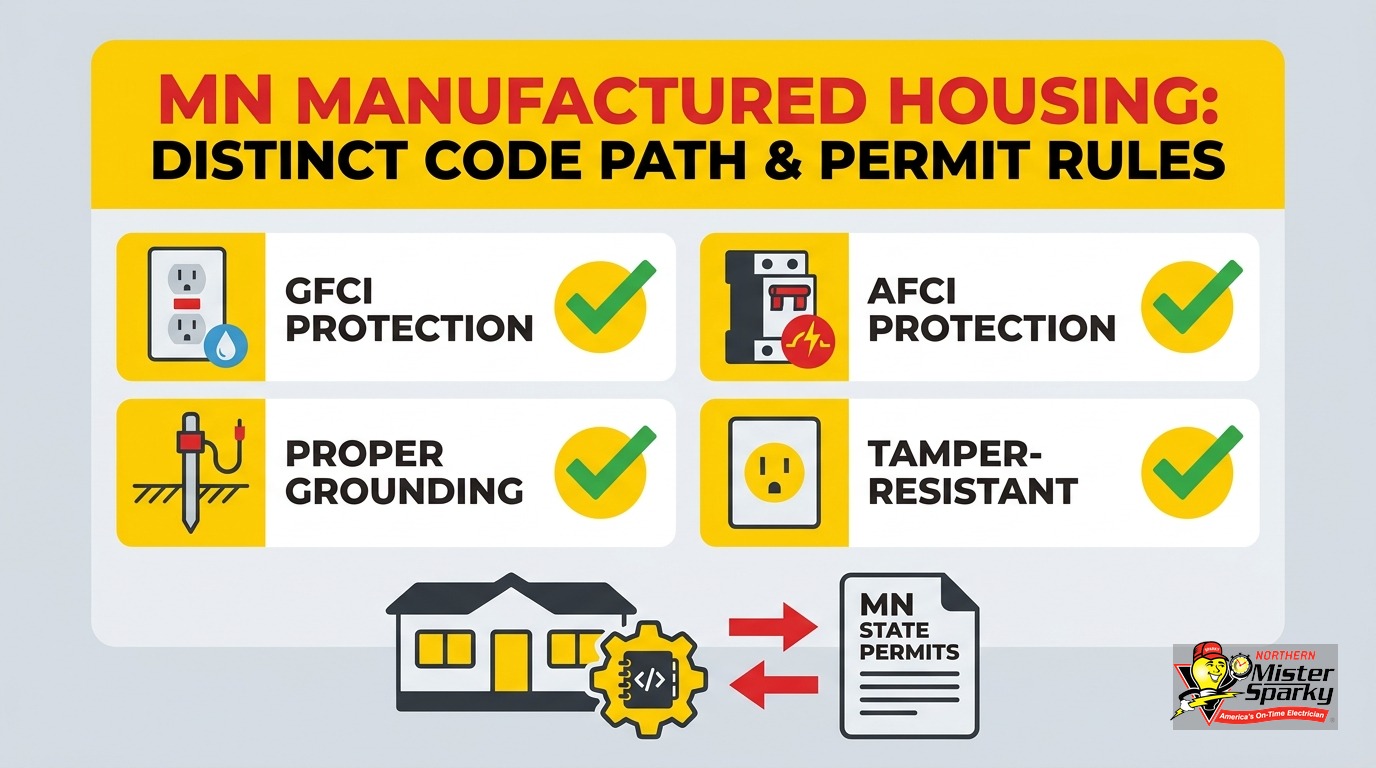
- Manufactured homes run under two separate codes: federal HUD 24 CFR Part 3280 governs the factory wiring; NEC Article 550 plus Minnesota’s state electrical code governs any post-installation upgrade, including a panel change.
- Minnesota law requires a licensed electrical contractor for all manufactured home electrical work. Homeowners cannot pull their own permit here, unlike owners of stick-built single-family homes.
- A home designed for 100-amp or larger service cannot legally run from a legacy 50-amp lot cord. Your park’s pedestal may need upgrading at the same time, and that obligation typically belongs to the park owner.
- A permit must be filed before work begins under Minnesota state statute.
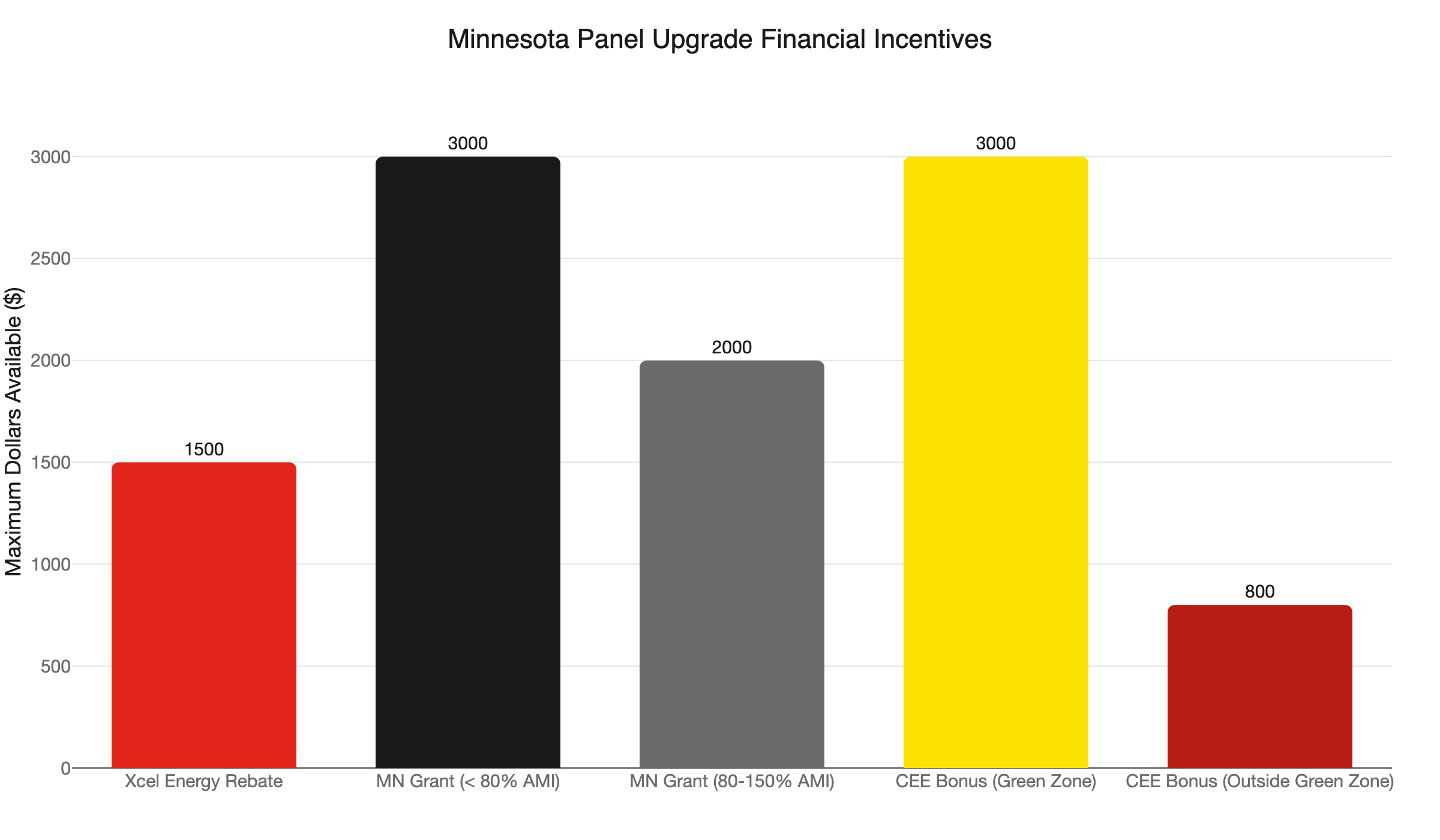
- Xcel Energy offers up to $1,500 for a qualifying panel upgrade. A Minnesota state grant adds up to $3,000 for eligible income levels. The federal electric panel upgrade tax credit expired December 31, 2025.
- Permits filed on or after August 17, 2026 must follow the 2026 NEC.
What Makes a Manufactured Home Electrical Panel Upgrade Different?
A manufactured home’s factory wiring lives under federal HUD construction standards, not the NEC. Once any post-installation alteration begins, including a panel upgrade, NEC Article 550 and Minnesota’s state electrical code take over. That transition between two separate regulatory systems is why this job requires a contractor who understands both.
The metal HUD label on the exterior of your home is not decorative. According to 24 CFR Part 3280 Subpart I, manufactured homes are those built under HUD code. NEC Article 550.2 ties this label directly to which rules govern any alteration. If your home carries that label, any electrician you hire is working across two regulatory systems at once.
The factory wiring was built for a 50-amp world.
The standard manufactured home leaves the factory with a 50-amp cord connection. It is wired to a 120/240V, 3-wire AC grounded-neutral system. That setup was adequate for a few lights, a furnace, and a window air conditioner. Today’s home might carry a heat pump, an EV charger, an induction range, and a heat pump water heater. A 50-amp service cannot safely support that load. The HUD standard itself requires a permanent feeder rather than a cord when the calculated load exceeds 50 amps.
What to ask any contractor you consider.
Before hiring anyone for this job, ask two questions. First: have they done manufactured home panel upgrades in Minnesota, specifically, not just in other states? Second: do they know where HUD-governed wiring ends and the state-code alteration begins inside your home? Those two questions will surface contractors who know this work from those who are guessing.
Our guide to upgrading to 200-amp electrical service in Minnesota covers what the panel side of that upgrade looks like for any Twin Cities home.
The Two Codes That Govern Your Home’s Wiring
Two separate regulatory layers apply to every manufactured home in Minnesota. Knowing which one governs which portion of your home helps you ask the right questions before any work starts.
HUD 24 CFR Part 3280 governs how the home was built. This includes the original breaker box, all factory wiring, and the cord or feeder connection at the entry point. State electrical inspectors do not work within this layer during a standard alteration permit.
NEC Article 550 plus Minnesota state electrical code covers anything added, modified, or repaired after the home was placed on its site. According to DLI, additions, modifications, repairs, or replacements to a manufactured home’s factory electrical design may be performed under the state electrical code. DLI treats these alterations equivalently to a remodel of a single-family dwelling, with inspection required before any work is concealed.
That concealment requirement has a practical meaning: your electrician cannot close up walls, cover junction boxes, or bury conduit until the state inspector signs off. Plan for at least one inspection visit during the job, not just after it wraps.
One date matters for permits right now: permits filed on or after August 17, 2026 must comply with the 2026 NEC. Permits filed before that date use the 2023 NEC. If you are pricing an upgrade today for work that will not start until autumn, confirm with your contractor which code version applies to your permit filing date.
The practical consequence of working across two codes: your electrician must know exactly where the HUD-governed wiring ends and the state-code alteration begins. Getting that boundary wrong creates an inspection failure and a code violation that can follow the home’s title through future sales.
Can a Minnesota Homeowner Pull Their Own Electrical Permit?
No. Owners of manufactured homes in Minnesota cannot do their own electrical work or file their own permits. This is the most common point of confusion we hear from manufactured home owners calling for a quote.
DLI’s manufactured home page is explicit: manufactured homes, condominiums, apartments, and rentals always require a licensed electrical contractor. An electrical alteration permit must be filed at or before work begins, under MN Statutes 326B.36 subd. 1. Pre-work documentation must be submitted to the state agency or the local authority having jurisdiction before the job starts.
This differs from the rules for stick-built homes. Owners of a single-family home in Minnesota can pull their own electrical permit for work on their primary residence. That exemption does not extend to manufactured homes. The distinction is not a technicality. It reflects the dual-code system: HUD compliance and state code run together, and both require a licensed professional to keep them aligned.
Skipping the permit creates real liability. Unpermitted electrical work in a manufactured home surfaces during home sales, insurance claims, and future safety inspections. It can also affect HUD compliance if the work was done incorrectly. Our post on unpermitted electrical work and Minnesota home purchases explains the resolution path if you are already in that situation.
For a broader look at the permit process and what it covers, see our post on electrical permits in Minnesota.
Does the Park’s Lot Feeder Need an Upgrade Too?
Possibly yes, and knowing this upfront can prevent a multi-week delay after your panel is already installed. The code constraint is firm: a home designed for 100-amp or larger service cannot legally draw from a 50-amp lot connection. If your new panel requires more feeder capacity than the current pedestal provides, the park owner must upgrade their side before your electrician can energize the new panel.
The DLI bulletin on electrical safety requirements for manufactured home parks lays this out plainly. A manufactured home designed for 100-amp or larger service cannot be supplied from an existing 50-amp circuit or outlet. That arrangement violates NEC Article 550.33, Minnesota Manufactured Home Code Parts 1350.3400 and 1350.3800, and federal regulations CFR 3820.801 and 3820.803(K).
The same DLI bulletin requires that feeders for homes needing 100-amp or larger service consist of four insulated and color-coded conductors. That requirement includes a properly sized insulated equipment-grounding conductor. Your electrician will look for the required ampacity label near the feeder entrance point of your home. That label, not a visual estimate, determines whether the current lot supply is sufficient for the new panel.
Who owns the pedestal problem?
In most Minnesota manufactured home parks, the park owner is responsible for the lot pedestal and supply wiring. That includes the run from the utility connection to the pedestal. The homeowner is responsible for wiring from the pedestal into the home.
If your new 200-amp panel needs feeder capacity the current pedestal cannot deliver, the park owner must upgrade their infrastructure before the job can be completed. This is not a hypothetical edge case. We raise it during the initial site assessment on every manufactured home job, because a park owner who is unaware or slow to respond can stall an otherwise complete installation by weeks. Starting that conversation early, with the specific ampacity requirement from the home’s label in hand, is the move that keeps your project on schedule.
What Signs Tell You It’s Time for an Upgrade?
If your panel is underpowered or aging, warning signs appear before a failure does. The clearest ones: breakers that trip under normal use, lights that dim when large appliances start, and a panel that feels warm to the touch. Act on these signals early, not after something fails permanently.
- Breakers trip under ordinary load. Running the microwave and coffee maker together should not pop a breaker. Repeated trips under normal household use mean the panel is out of capacity.
- Lights dim when large appliances start. A voltage drop visible in your light fixtures signals an overloaded service, not just a minor inconvenience.
- The panel feels warm or smells burnt. Heat or a burning odor from an electrical panel is never normal. Call an electrician the same day.
- You are adding a major new load. EV chargers, heat pumps, induction ranges, and heat pump water heaters each require dedicated circuits. A 50-amp or undersized panel typically has no room for them.
- You are still on a 50-amp cord connection. If your home’s calculated load exceeds 50 amps, running that cord is a code violation regardless of whether anything has tripped or failed yet.
- Your panel is a known hazardous brand. Some older Federal Pacific and Zinsco panels installed in manufactured homes have documented safety issues. If you are unsure what panel brand your home has, find out before the next Minnesota winter.
What Size Panel Does a Manufactured Home Need?
For most Twin Cities manufactured homes adding modern electrical loads, 200 amps is the right target. That capacity supports an EV charger, a heat pump, and future circuits without returning for another upgrade in five years.
The required ampacity label near your home’s feeder entrance point states the minimum supply the home is designed to receive. Your electrician reads that label first and sizes accordingly.
A 100-amp panel may be sufficient for a small home with modest, stable electrical demand. But if you are adding any significant new load, 200 amps provides room to grow without immediately hitting the ceiling again. Minnesota’s state grant program also requires the upgrade to reach at least 200 amps to qualify for funding. If grant money is part of your budget calculation, the 200-amp threshold is not optional.
For homes pursuing full electrification at once, meaning a heat pump, heat pump water heater, and EV charger together, load calculations occasionally point toward a higher service level. Our post on 400-amp electrical service upgrades covers when that capacity makes sense and what the installation involves.
The load calculation itself is a formal process. A contractor who sizes your panel based on a quick visual inspection rather than a calculated load assessment is skipping a step the code requires. Ask for the calculation.
What Rebates and Grants Can Help Pay for This Upgrade?
The financial stack for a manufactured home panel upgrade in Minnesota has three potential layers. Each has its own eligibility rules, and not all of them are active yet.
Xcel Energy rebate: up to $1,500
Xcel Energy offers up to a $1,500 rebate for upgrading to a higher-amperage panel. You need an active Xcel residential electric account and a licensed Minnesota electrician. The rebate is structured for single-family homes and small multi-unit buildings up to four units. The program page does not explicitly confirm manufactured home eligibility, so contact Xcel directly to verify before building this rebate into your project budget.
Minneapolis CEE bonus: stacked on top of Xcel
Minneapolis homeowners pairing a panel upgrade with a qualifying heat pump or heat pump water heater can add a CEE bonus on top of the Xcel rebate, up to $3,000 in a designated Green Zone. The bonus attaches to the efficiency equipment, not the panel alone. If you are doing both upgrades at the same time, the stacked total can be significant.
Minnesota state panel upgrade grant: up to $3,000
The Minnesota Department of Commerce residential panel upgrade program offers $3,000 for homeowners below 80% AMI and $2,000 for those between 80-150% AMI. The total program pool is approximately $5.8 million. The upgrade must reach at least 200 amps. As of the June 12, 2026 program page update, the program had not yet launched, and work completed before the launch date does not qualify retroactively. Monitor this program, but do not delay a needed upgrade to wait for it. A failing panel does not care about grant timelines.
Federal 25C tax credit: expired
The federal electric panel upgrade credit, which covered 30% of costs up to a $600 maximum, expired December 31, 2025. There is no active federal panel credit in 2026. Do not include it in your planning.
For a full look at what Xcel offers across electrical upgrades in Minnesota, see our post on Xcel Energy electrical rebates in Minnesota.
What to Expect on Installation Day
A manufactured home panel upgrade follows a predictable sequence when the permit and park coordination are handled in advance.
Before the crew arrives. Your contractor files the permit with DLI or the local authority having jurisdiction. If the park pedestal needs upgrading, that work is scheduled separately and should be complete before panel day. Xcel or your utility coordinates a brief power outage for the meter pull. The timing of that outage is usually the longest scheduling variable in the entire job.
The work itself. The electrician disconnects the existing service, removes the old panel or cord connection, and installs the new panel and associated wiring. For a 200-amp upgrade, that means a new main breaker panel, new service entrance cable, and feeder conductors meeting the four-conductor, color-coded requirement from the DLI bulletin. Any work that will be concealed is left accessible until the inspection is complete.
Inspection. Minnesota requires inspection before upgraded wiring is concealed. The inspector reviews the permit, the panel installation, the grounding and bonding, and the feeder connection. A pass closes the permit. Your contractor handles the scheduling with DLI or the local inspector, but your availability for a brief access window is part of the coordination.
Timing. The electrical work itself takes one day for a straightforward manufactured home panel upgrade. Permit filing, utility scheduling, and park coordination add one to three weeks of lead time. That lead time is longer in fall and winter, when electrical work in the Twin Cities books up fast heading into heating season. If you are seeing warning signs now, do not wait until December to call.
We are a locally owned and operated Twin Cities electrical contractor, backed by the national Mister Sparky brand. When you are ready to move forward, call us at 763-200-5956 or book online. As America’s On-Time Electrician(R), we show up when we say we will. The UWIN(R) 100% satisfaction guarantee means if something is not right, we make it right. No malarky.
Frequently Asked Questions
Does Minnesota require a licensed electrician for manufactured home panel work? +
Can I stack the Xcel Energy rebate with the Minnesota state panel grant? +
What is the difference between a manufactured home and a mobile home for electrical code purposes? +
Need an electrician now?