
Outdoor Ceiling Fan Wiring for a Covered Porch: What Changes
Key Takeaways
- A covered porch is a damp location under the NEC. Every wiring component must be rated for that environment.
- NM cable (Romex) is prohibited outdoors, even under a covered porch roof. It is not a substitute for wet-rated wire.
- All outdoor conduit is treated as a wet location. Conductors inside must be wet-rated, such as THWN-2.
- The electrical box must be fan-rated per NEC 314.27(B) and carry a damp or wet location listing.
- Standard wire nuts corrode in damp locations. Use gel-filled or silicone-sealed weatherproof connectors.
- GFCI protection is required on all outdoor circuits, including porch ceiling fan circuits.
- Minnesota adopted the 2026 NEC effective August 17, 2026. Permitted work must comply with the updated code.
- Minneapolis and St. Paul residents permit through their city’s department, not state DLI.
- Minnesota freeze-thaw seasons require expansion fittings on long PVC conduit runs outdoors.
Why Outdoor Ceiling Fan Wiring on a Covered Porch Is Different
A covered porch fan swap looks like an indoor project. The ceiling is overhead, the bracket goes up the same way, and the wire colors match. But the wiring behind that ceiling does not follow indoor rules.
Every outdoor location, covered porch included, is governed by moisture-protection requirements. Those requirements apply to every component from the breaker to the last connection inside the fan canopy. Materials that work fine in a bedroom wall are prohibited on a porch ceiling.
Most guides cover fan selection and color-matching. None explain what actually changes in the wiring. This post covers exactly that: the wire type, conduit, electrical box, wire connectors, and GFCI protection a covered porch fan circuit requires. Twin Cities homeowners also get the Minnesota-specific details, including the 2026 NEC that took effect in August 2026 and freeze-thaw conduit rules that no national guide addresses.
What Makes a Covered Porch Fan Installation Different from an Indoor One?
A covered porch is classified as a damp location under the NEC. Every wiring component from the breaker to the splice inside the fan canopy must be rated for damp or wet conditions. The wire type, conduit, electrical box, wire connectors, GFCI protection, and fan rating all change compared to an indoor install. Indoor materials do not qualify.
For an indoor fan, you can use NM cable stapled along framing, a standard light fixture box, and regular wire nuts. That combination is code-compliant in a bedroom. On a covered porch, none of those materials pass.
Here is exactly what changes:
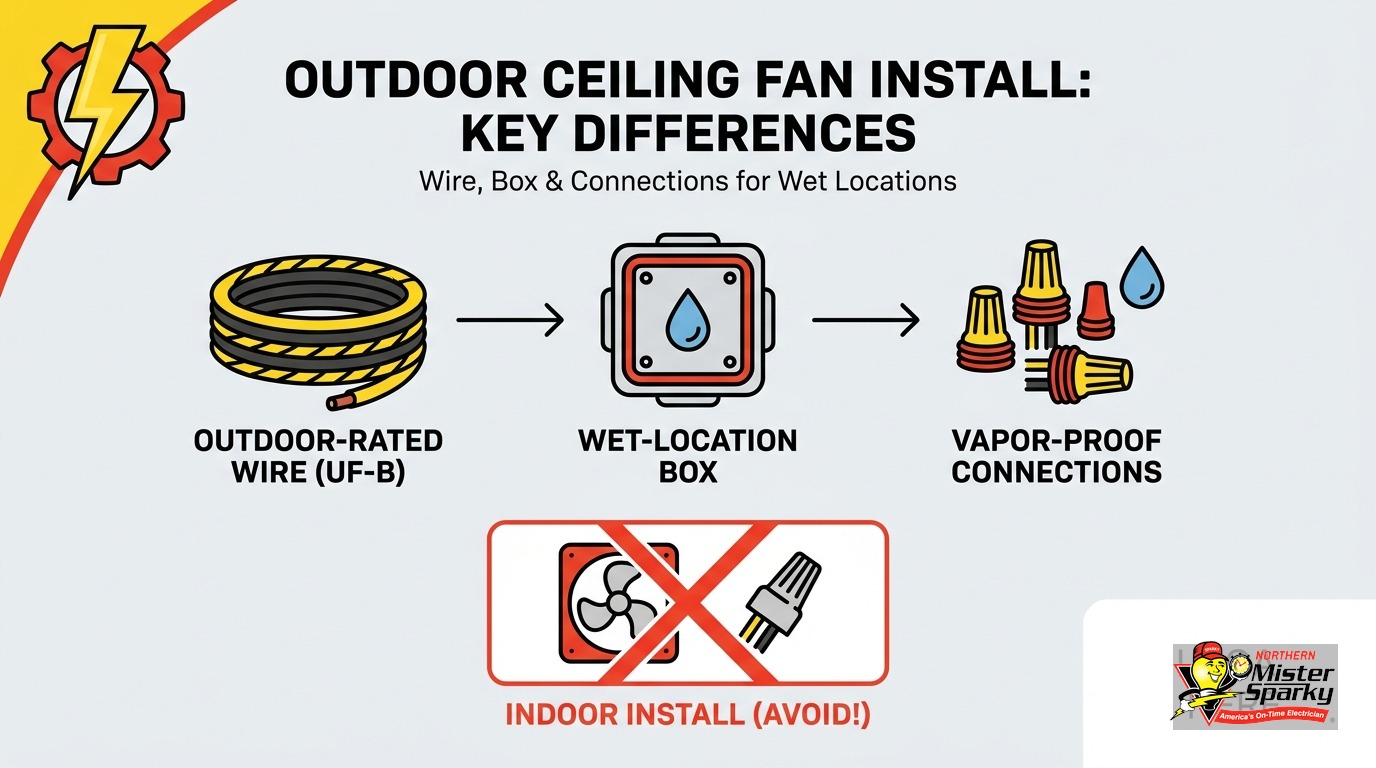
- Wire type: NM cable is prohibited. THWN-2 conductors in approved conduit are required.
- Conduit: Must be an NEC-approved type for outdoor, above-ground use.
- Electrical box: Must be fan-rated and carry a damp or wet location listing.
- Wire connectors: Standard wire nuts corrode outdoors. Weatherproof sealed connectors are required.
- GFCI protection: Mandatory on all outdoor circuits.
- Fan rating: A damp-rated fan is the minimum for a covered porch.
Every item on that list is a code requirement, not a recommendation. Skip any one of them and the job is not done correctly.
Why Is NM Cable (Romex) Not Allowed on a Porch Ceiling?
NEC Article 300.9 prohibits NM cable in outdoor locations, including covered porches, because all outdoor conduit is treated as a wet location. NM insulation is rated only for dry, protected indoor use. Once that cable leaves the house envelope and enters a porch ceiling, it is in outdoor territory. It no longer complies with code.
This is the most common mistake on porch fan installs. A homeowner sees cable on the existing ceiling, assumes it matches the indoor wiring, and swaps the fan without touching the wire. Sometimes that cable was run by a previous contractor who did not know the rule.
Regardless of how it got there, NM cable on a porch ceiling is a deficiency. The insulation is not rated for sustained humidity. Over time it degrades, creating a shock hazard at splice points and a potential fire risk at connections.
If you are unsure whether your porch uses NM cable, look at the outer sheathing. NM cable has a gray or white plastic jacket with “NM-B” printed on it. If you see that label on a porch ceiling, the wire must be replaced before the job is finished.
For a broader look at when conduit is required versus when NM cable is acceptable, see our guide to conduit vs. Romex in residential wiring.
What Wire Type Does Outdoor Ceiling Fan Wiring on a Covered Porch Require?
Use THWN-2 conductors pulled through NEC-approved conduit. NEC Articles 352, 358, and 344 specify which conductors are permitted inside outdoor conduit. THWN-2 carries a wet-location rating and a heat rating of 90 degrees C, making it the standard choice for any outdoor conduit run, including a covered porch ceiling.
The “W” in THWN-2 stands for wet-location approved. The “2” indicates compliance with the higher heat threshold. Both matter on a porch ceiling, where summer heat and direct sun can warm a conduit run considerably.
For a typical porch fan circuit, you will pull:
- A black hot conductor
- A white neutral conductor
- A green or bare copper ground conductor
- A red hot conductor if you want separate fan motor and light kit switching
Wire gauge follows the breaker size. A 15-amp circuit uses 14 AWG conductors. A 20-amp circuit uses 12 AWG. Do not mix gauges on the same circuit.
THWN-2 comes in individual spools. Unlike NM cable, which bundles all conductors in one sheath, you pull each conductor through the conduit separately. That is standard practice and how it has to be done in a wet-location conduit system.
Which Conduit Type Should You Use on a Porch Ceiling?
EMT and sunlight-resistant PVC are the most practical choices for a residential porch ceiling run. The NEC approves EMT, PVC Schedule 40/80, RMC, and IMC for outdoor, above-ground installations. Each has different trade-offs in weight, cost, and maintenance requirements, especially given Minnesota’s climate.
Here is how the main options compare:
EMT (Electrical Metallic Tubing): Approved for above-ground outdoor use. Rigid, easy to cut and bend, and widely available. Not approved for direct burial. Expands and contracts less than PVC in temperature swings. A solid choice for an exposed or semi-concealed porch ceiling run.
PVC Schedule 40 or 80 (sunlight-resistant): Lighter than metal conduit and corrosion-proof. Must carry a sunlight-resistant rating for outdoor use. Schedule 80 has thicker walls and is required where physical damage is a risk. PVC expands and contracts more than metal conduit in temperature changes, which matters in Minnesota (more on that below).
RMC and IMC: Approved and durable. Heavier and more expensive than EMT or PVC. Less common on residential porch projects but fully code-compliant.
For most porch fan circuits in the Twin Cities, EMT or sunlight-resistant PVC Schedule 40 handles the job well. EMT is the lower-maintenance choice for Minnesota winters.
Does Your Electrical Box Need to Change for a Porch Fan?
Yes. NEC 314.27(B) requires a fan-rated box for any ceiling fan installation, and that box must also carry a damp or wet location listing to match the porch environment. A standard indoor light fixture box fails on both counts. It is not rated for fan motor loads and is not listed for moisture exposure.
Fan-rated boxes are tested for the weight and vibration of a rotating motor. A light fixture box handles only static load. A fan vibrating against an under-rated box will loosen over time, and in the worst case, the fan pulls away from the ceiling.
Look for the listing mark on the box itself. It will read “Suitable for Damp Locations” or “Suitable for Wet Locations.” The listing mark is the only thing that counts. Do not assume a box qualifies based on how it looks.
Heavy fans also require a fan-rated structural support bracket per NEC 314.27(C) when the ceiling joist is not positioned where the box needs to be. Expanding brace bars span between joists and give the box a solid, rated anchor point without opening the ceiling.
If your covered porch currently has a light fixture box, replace it before the fan goes up. Do not install a ceiling fan on an unlisted, non-fan-rated box.
Why Do Standard Wire Nuts Fail in a Damp Location?
Standard wire nuts are not sealed against moisture. In a damp location, moisture wicks into the connection, corrodes the conductors, and increases resistance at the splice. Increased resistance generates heat. Over time, that heat damages the surrounding insulation and creates a fire risk inside a box you cannot see without opening it.
This is the detail that almost every outdoor fan guide skips. The connections inside the box matter as much as the wire type and the conduit.
In a bedroom, a standard wire nut works perfectly. On a porch ceiling, that same wire nut sits in a damp environment and degrades over years. The failure is usually quiet. The fan slows down gradually. The light kit flickers. By the time a homeowner calls, the connection has been failing for months.
The fix is simple and inexpensive. Use weatherproof wire connectors listed for wet locations. Gel-filled connectors are the most common choice. The gel fills the space around the wire twist and excludes moisture completely. Silicone-sealed connectors work on the same principle.
Both types cost only marginally more than standard wire nuts. There is no good reason to use standard wire nuts in an outdoor electrical box.
Is GFCI Protection Required on a Covered Porch Fan Circuit?
Yes. All outdoor circuits, including porch ceiling fan circuits, require GFCI protection under the NEC, for both new installs and replacement circuits. GFCI protection can be provided at the breaker panel with a GFCI breaker or via a GFCI outlet upstream on the same circuit. Both approaches satisfy the requirement.
A GFCI breaker is usually the cleanest solution for a dedicated porch fan circuit. It protects the entire circuit from the panel and does not require finding a location for a GFCI outlet on the porch itself. If the porch fan shares a circuit with other outdoor outlets, a GFCI outlet at the first point on that circuit can protect everything downstream, but this must be verified by an electrician, not assumed.
Do not skip this step. People stand barefoot on concrete, lean against metal railings, and work near water on a covered porch. GFCI protection is the safety layer between a faulty connection and a dangerous shock.
For more on where GFCI protection is required around the home’s exterior, see our guide to outdoor GFCI outlet installation.
Do You Need a Permit for Outdoor Ceiling Fan Wiring in Minnesota?
Yes, if you are running a new circuit. Minnesota homeowners may pull their own electrical permit on an owner-occupied single-family home through the Department of Labor and Industry (DLI). Minneapolis and St. Paul residents permit through their city’s permit department rather than the state DLI system. Do not use the DLI portal for a Minneapolis or St. Paul address.
Minnesota adopted the 2026 NEC effective August 17, 2026. Any permit pulled on or after that date, whether by a homeowner or a licensed contractor, must comply with the updated code. Every requirement in this post reflects those current standards.
If you are replacing an existing fan on a circuit that was already correctly installed, the permit requirement may differ depending on the scope of work. Check with DLI or your city before you start.
An unpermitted electrical job creates risk beyond the code violation itself. Insurance carriers can deny claims on fires traced to unpermitted wiring. When you sell the home, unpermitted electrical work comes up in buyer inspections and can delay or complicate closing.
For a full overview of how the permit process works in Minnesota, see our guide to electrical permits in Minnesota.
Minnesota Freeze-Thaw: The Conduit Rule That National Guides Skip
National wiring guides do not cover this. In Minnesota, it matters every time conduit runs through an exterior porch ceiling.
PVC conduit expands and contracts with temperature. The swing between a January morning and a July afternoon in the Twin Cities is significant. A conduit run from a porch ceiling into an unconditioned wall cavity can shift considerably across those seasons.
Minnesota electrical inspection checklists require expansion capability on outdoor conduit runs to prevent thermal movement from damaging conductors. Expansion fittings allow the conduit to lengthen and shorten without stressing joints or pulling connections apart at boxes and fittings.
A cracked PVC fitting is worse than no fitting at all. It opens the conduit interior to moisture, which defeats the entire reason for running wet-location conduit in the first place.
EMT metal conduit expands and contracts less than PVC and is a lower-maintenance choice in Minnesota’s climate. For short porch ceiling runs, either option works. For longer runs, or anywhere the conduit passes through an exterior wall into an unconditioned space, expansion fittings are not optional.
One additional note: if a porch fan circuit involves conductors rising from grade, the code requires RMC, IMC, or Schedule 80 PVC from 18 inches below grade to the termination point above.
Damp-Rated vs. Wet-Rated Fans: Which One Do You Need for Your Porch?
A covered porch is a damp location, so a damp-rated fan is the minimum acceptable listing. A wet-rated fan is also acceptable on a covered porch and is required for open pergolas or uncovered decks where the fan is directly exposed to rain.
Here is how the two ratings map to common outdoor settings:
- Covered porch, screened porch, or soffited area: damp location. Damp-rated or wet-rated fan is acceptable.
- Open pergola, uncovered deck, or direct-rain exposure: wet location. Wet-rated fan required.
An indoor-only fan on a covered porch is a code violation. The motor bearings, winding insulation, and blade hardware are not sealed for humidity. The fan will fail sooner than expected, and moisture exposure degrades insulation over time, raising the shock risk.
Look for “ETL Listed for Damp Locations” or “UL Listed for Wet Locations” on the packaging. The listing is a code requirement, not a marketing claim. Inspectors look for it, and it should match or exceed the location rating where the fan is installed.
Call Northern Mister Sparky for Your Twin Cities Porch Fan Install
Replacing a fan on an existing, code-compliant outdoor circuit is manageable for a confident homeowner. But most covered porch fan projects in the Twin Cities involve at least one of these conditions:
- Existing NM cable that must be replaced with THWN-2 in conduit
- No existing circuit at the porch ceiling, requiring a new run from the panel
- An electrical box that is not fan-rated or not damp-location listed
- A circuit without GFCI protection
Any one of those conditions turns a fan swap into a wiring project. Running conduit through a finished porch ceiling, pulling new circuits, and replacing boxes in place takes skill and, in Minnesota, a permit.
We are locally owned and operated in the Twin Cities. Our electricians pull permits, work to the 2026 NEC, and do the job right so it passes inspection and holds up through Minnesota winters. No malarky, no shortcuts.
Our ceiling fan installation service covers full porch fan installs, including wire, box, conduit, GFCI upgrades, and permit coordination.
Call us at 763-200-5956 or book online. We will evaluate your porch circuit and handle everything from start to inspection.
Frequently Asked Questions
Can I use Romex wiring for a ceiling fan on a covered porch? +
What kind of electrical box do I need for a covered porch ceiling fan? +
Do I need a permit to wire an outdoor ceiling fan in Minnesota? +
Why can't I use regular wire nuts in an outdoor electrical box? +
Need an electrician now?