
Septic Pump Electrical Requirements in the Twin Cities
Key Takeaways
- Mound and pressure-dose systems always include a pump. That pump requires a dedicated 20-amp circuit.
- The pump circuit and the alarm circuit must be on separate breakers. A shared breaker silences the alarm during a pump fault.
- Minnesota Rules 7080.2100 requires an alarm device on every septic system with a pump, activated at 75% tank capacity.
- Never wire pump and alarm on a 12/3 multiwire branch circuit. A common-trip breaker kills both legs at once.
- GFCI protection is required for pump circuits in wet locations. Use a GFCI breaker in the panel for hardwired pumps.
- Minnesota adopted the 2026 NEC effective August 17, 2026. Permits filed on or after that date use the new code.
- Budget $80-$150 minimum for a two-circuit DLI permit before any city fees.
What Do Septic Pump Electrical Requirements Actually Cover?
Septic pump electrical requirements cover the circuits, wiring, and protective devices that power an effluent pump and its alarm. That includes breaker size, wire gauge, cable type, GFCI protection, disconnect means, and the critical rule that pump and alarm must be on separate breakers. This post covers the electrical side only.
The septic tank, drainfield, and pump hardware are your septic contractor’s responsibility. The wiring from your main electrical panel to the control box, the breakers that feed it, and the grounding all belong to a licensed electrician.
Scott County alone has over 8,700 homes relying on septic systems for on-site wastewater treatment. Chisago and Wright counties are among the fastest-growing exurban counties in the Twin Cities region. Most of that growth sits on mound systems installed in the 1990s and early 2000s. Those systems are now at or near the end of their designed 20-30 year service life. When a mound system gets replaced, the electrical rough-in gets inspected too.
If you have never had an electrician look at your septic control panel wiring, this is the post that explains what they are checking for and why it matters.
Why Are Mound and Pressure-Dose Systems Electrically Different?
A conventional gravity septic system has no pump and needs no electricity. A mound or pressure-dose system is different: it uses a pump to distribute effluent across the drainfield on a timed cycle. That constant, repeated electrical load in a wet underground environment creates specific code requirements that gravity systems never face.
Minnesota Rules 7080.2220 defines mound systems as the required design when soil conditions prevent conventional drainfield trenches. High water tables, shallow bedrock, and slowly permeable soils are common across Chisago, Wright, and Scott counties. That is why mound systems are widespread in the Twin Cities exurbs.
The effluent pump in a mound system is not a pump-out unit that runs only during scheduled cleanings. It doses the drainfield automatically, pushing measured volumes of effluent through a distribution network on a timer. The pump cycles many times per day, every day of the year, regardless of weather or season.
That load profile, combined with a wet buried environment, drives the specific electrical requirements below. A gravity system never needs any of this. Every mound system does.
Does an Ejector Pump Need a Dedicated Circuit?
Yes. A dedicated circuit serves only one device. For a residential septic effluent pump, the standard is a 20-amp, 120-volt circuit on 12 AWG copper, feeding only the pump. No other loads share the breaker. A shared circuit risks nuisance tripping and can take the pump offline without warning.
The dedicated circuit rule applies to any motor-driven device that cycles frequently and cannot tolerate unexpected outages. The same logic behind planning a separate circuit for home entertainment or high-draw household equipment applies here. A pump that shares a circuit with garage outlets or a bathroom light is a pump waiting to fail silently.
For pumps rated 240V (typically 1 HP and above), a dedicated 240-volt circuit is required. Check the pump nameplate for voltage and full-load amperage before your electrician sizes the circuit. An undersized circuit produces voltage sag. Voltage sag forces the motor to draw higher current to maintain torque. That extra current runs the motor hot and shortens pump life well before the system itself wears out.
The Two-Circuit Rule: Pump and Alarm Need Separate Breakers
This is the electrical requirement most homeowners get wrong. Many installers do too.
Minnesota Rules 7080.2100, subp. 2, item D mandates an alarm device on any Minnesota ISTS (individual sewage treatment system) that includes a pump. The alarm must activate when the tank reaches 75% capacity. It is there to warn you before sewage backs up into the house. That warning fails completely if the alarm shares a breaker with the pump.
Here is the failure mode. The pump develops a fault and trips its breaker. Because the alarm is on the same breaker, it loses power at the exact same moment. The tank fills. You get no alert. Sewage comes back through a floor drain or toilet before anyone realizes the pump stopped. This is not a hypothetical. It happens when the control panel was wired by whoever showed up after the septic contractor finished, and they ran one cable to keep the job simple.
The correct setup uses two circuits:
- Pump circuit: 20-amp dedicated breaker, 12 AWG copper, serving the pump only.
- Alarm and control circuit: 15-amp dedicated breaker, 14 AWG copper, serving the control panel and alarm only.
Two separate cable runs. Two separate breakers. Independent protection on each.
Trade guidance on septic pump wiring identifies this as a required separation. Using 12/3 cable to feed both circuits is a code trap. The NEC requires a common-trip breaker on a multiwire branch circuit. That means a single pump fault kills both the pump and alarm legs at the same time. Two separate 12/2 runs from two separate breakers is the correct approach, no exceptions.
How Many Amps Does a Septic Pump Draw?
The answer is on your pump’s nameplate. Residential effluent pumps vary by size and model. Standard practice calls for a 20-amp dedicated circuit, which provides enough headroom for the pump’s running load and the higher inrush current that spikes briefly each time the motor starts. A pump drawing close to or above 20 amps running warrants an electrician’s review before you wire the circuit.
The 20-amp rating is conservative on purpose. A circuit loaded near its limit produces voltage sag. Voltage sag causes the pump motor to draw more current than rated to maintain output. More current means more heat. More heat means shorter motor life. The headroom built into a 20-amp circuit protects the motor as much as it protects the wiring.
For 240-volt pumps, typically 1 HP and above, the running amperage drops significantly at the higher voltage. The dedicated circuit rule still applies, and the circuit is still sized to the nameplate. See our post on how circuit sizing works for high-draw equipment rated at 240 volts for a comparison.
What Wire and Cable Does a Septic Pump Circuit Require?
For a 20-amp, 120V pump circuit: 12 AWG copper in conduit or as UF-B cable rated for direct burial. For a 20-amp, 240V circuit: 12 AWG copper on a 2-pole breaker, same cable options. Both runs need a grounding conductor. Minimum burial depth is 24 inches for direct-buried UF-B cable.
Minnesota Rules 7080.2100, subp. 2, item F requires all electrical work on a septic system to comply with the NEC as adopted in Minnesota. For the underground cable run from your panel to the control box:
- UF-B cable (direct burial rated): minimum 24 inches below grade under lawn areas.
- Rigid metal conduit (RMC) or intermediate metal conduit (IMC): minimum 6 inches below grade.
- PVC conduit (Schedule 40 or 80): minimum 18 inches below grade.
Confirm burial depth and conduit requirements with your local authority having jurisdiction (AHJ). Some Twin Cities-area municipalities require conduit regardless of cable type. Your electrician will know the local rule and account for it in the permit filing.
Disconnect requirements
For pumps rated 1 HP or greater, the disconnecting means must be within sight of the pump chamber or lockable in the open position, and clearly labeled. For pumps below 1 HP, a motor-rated receptacle and plug at the control panel qualifies as the disconnect. Your septic control panel may include a built-in disconnect switch. Confirm with your electrician that it meets the disconnect rating requirement for your specific pump before the system is energized.
Do Septic Pump Circuits Require GFCI Protection?
Yes. Septic effluent pumps sit in wet sumps. NEC 422.5(A)(6) requires Class A GFCI protection for sump pumps rated 150V or less and 60A or less, and local AHJs routinely apply the same requirement to septic effluent pumps in equivalent wet conditions. For a hardwired pump, use a GFCI breaker in the panel, not a GFCI receptacle.
NEC 422.5(A)(6) has been adopted by Minnesota. For hardwired pumps, GFCI protection must come from a GFCI circuit breaker at the panel or a GFCI device integrated into the control panel assembly. A GFCI outlet is only appropriate where the pump plugs in. Most residential effluent pumps are hardwired. A GFCI breaker protects the entire circuit, including the underground cable run and the pump motor itself.
The same requirement applies to sump pumps, which face nearly identical installation conditions. The dedicated circuit requirements for a sump pump follow the same logic: wet location, motor load, GFCI mandatory. A pump motor in a wet pit that develops a ground fault can energize metal connected to the system. GFCI protection trips the circuit before that fault reaches anyone.
If your existing septic panel wiring has no GFCI protection, that is a finding any inspector will flag. It is also a real safety issue, not a paperwork technicality.
What Does Minnesota’s 2026 NEC Adoption Mean for Your Permit?
Minnesota adopted the 2026 NEC effective August 17, 2026. Permits filed on or after that date must comply with the 2026 NEC. Permits filed before August 17, 2026 fall under the 2023 NEC. If you are replacing a mound system now or in the coming months, your electrical permit is under the 2026 code.
The Minnesota Department of Labor and Industry (DLI) governs the state’s NEC adoption cycle. Each cycle can revise GFCI applicability rules, disconnect requirements, and wiring method details. The core rules for septic pump circuits - dedicated circuits, separate pump and alarm breakers, proper grounding - have not materially changed between the 2023 and 2026 cycles. The details, however, matter at inspection.
A failed inspection delays your septic system going back into service. That is not a delay you want during an active mound system replacement. Work with a licensed Minnesota electrician who stays current with the adopted code cycle. The permit filing itself confirms which cycle applies.
What Does a Two-Circuit Permit Cost in Minnesota?
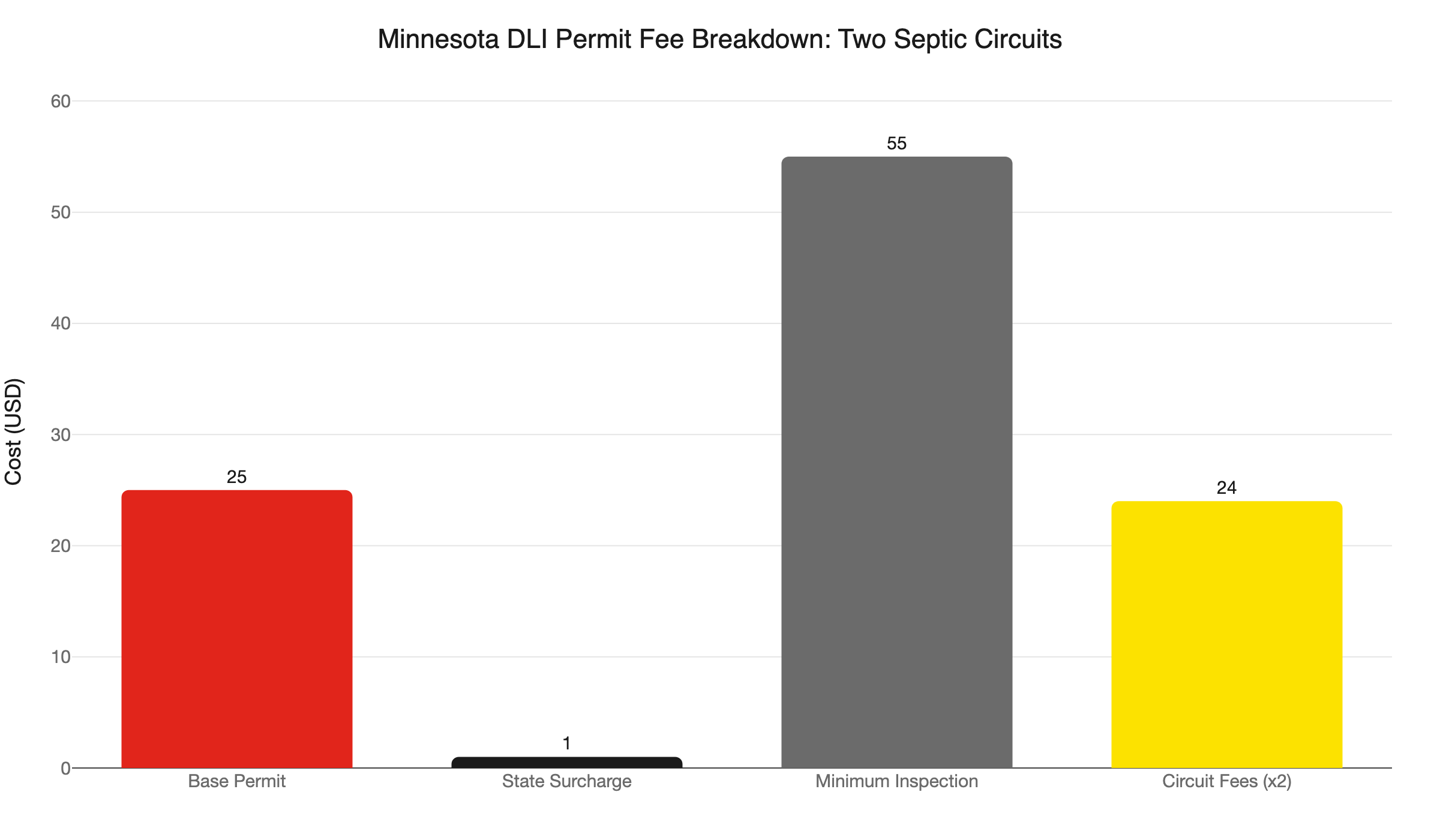
Through Minnesota DLI, a two-circuit electrical permit runs roughly $93-$105: a $25 base permit, $1 state surcharge, a $55 minimum inspection fee, and $12 per circuit. City and municipal inspection fees add to that total in many Twin Cities-area communities. Budget $80-$150 as a floor before any city fees.
DLI electrical permit fees apply statewide, but some Twin Cities and exurban municipalities run their own electrical inspection departments with separate fee schedules. Your electrician handles permit filing and knows the local requirement. Do not skip the permit. An unpermitted septic circuit is a code violation, a liability at resale, and will appear on any home inspection.
The permit is also what gets an inspector on site to verify the two-circuit setup, the GFCI protection, and the disconnect means. Electrical work that goes underground stays underground. Inspection is the only practical opportunity to confirm it was done correctly before the trench is filled.
When Should You Call an Electrician Instead of the Septic Company?
Call an electrician when the work moves from septic hardware into the electrical system: new circuit runs, breaker sizing, GFCI installation, disconnect work, or any wiring between the control panel and the main panel. Septic contractors typically end at the control panel enclosure. Everything past that point requires a licensed Minnesota electrician.
Signs that your current septic electrical setup may need attention:
- The pump and alarm share a single breaker.
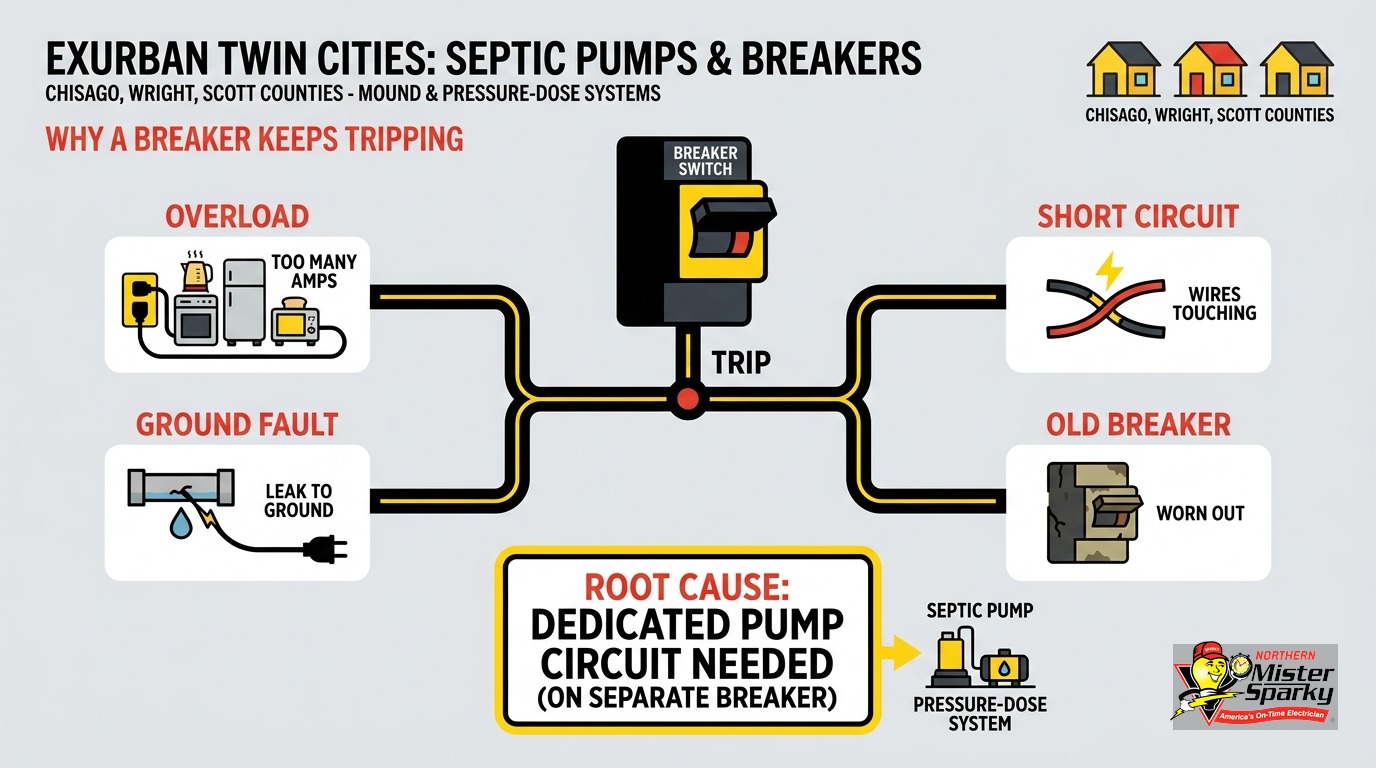
- The breaker for the septic system has tripped more than once in the past year.
- There is no GFCI protection on the pump circuit.
- The wiring at the control panel is aluminum, cloth-wrapped, or an unknown gauge.
- The control panel shows signs of moisture intrusion or corrosion.
- The system was installed before 2000 and the electrical has never been inspected.
Any one of these is a reason to call before the next scheduled septic service, not after a backup. For context on how a similar dedicated circuit job is scoped and permitted for a standalone piece of high-draw equipment, see how we approach single-circuit outdoor appliance work.
If a mound system is being replaced on a property in Chisago, Wright, or Scott County, the replacement triggers a full electrical inspection of the control panel wiring. Aging DIY wiring from 1990s-era installations often does not pass that inspection. Getting the electrical assessed before the septic work begins lets you budget for both sides of the job, not just one.
We are a locally owned Twin Cities electrical company serving Minneapolis, St. Paul, Bloomington, Brooklyn Park, Woodbury, Blaine, Maple Grove, Plymouth, and the surrounding exurban counties. We wire, inspect, and permit septic pump circuits across the metro and out into Chisago, Wright, and Scott.
As America’s On-Time Electrician(R), we show up when we say we will, work to current Minnesota code, and back every job with the UWIN(R) 100% satisfaction guarantee. No malarky.
Call 763-200-5956 or book online. We can inspect your existing control panel wiring, pull the permit for both circuits, and bring the installation up to current code before your next septic service visit.
Frequently Asked Questions
What kind of septic pump do I need? +
How do I know if my septic pump is working? +
Need an electrician now?