
Instant Hot Water Dispenser Electrical Outlet Under Sink
Key Takeaways
- Dispenser manufacturers specify a grounded 120-volt outlet. Plan its spot before the cabinets and plumbing are set.
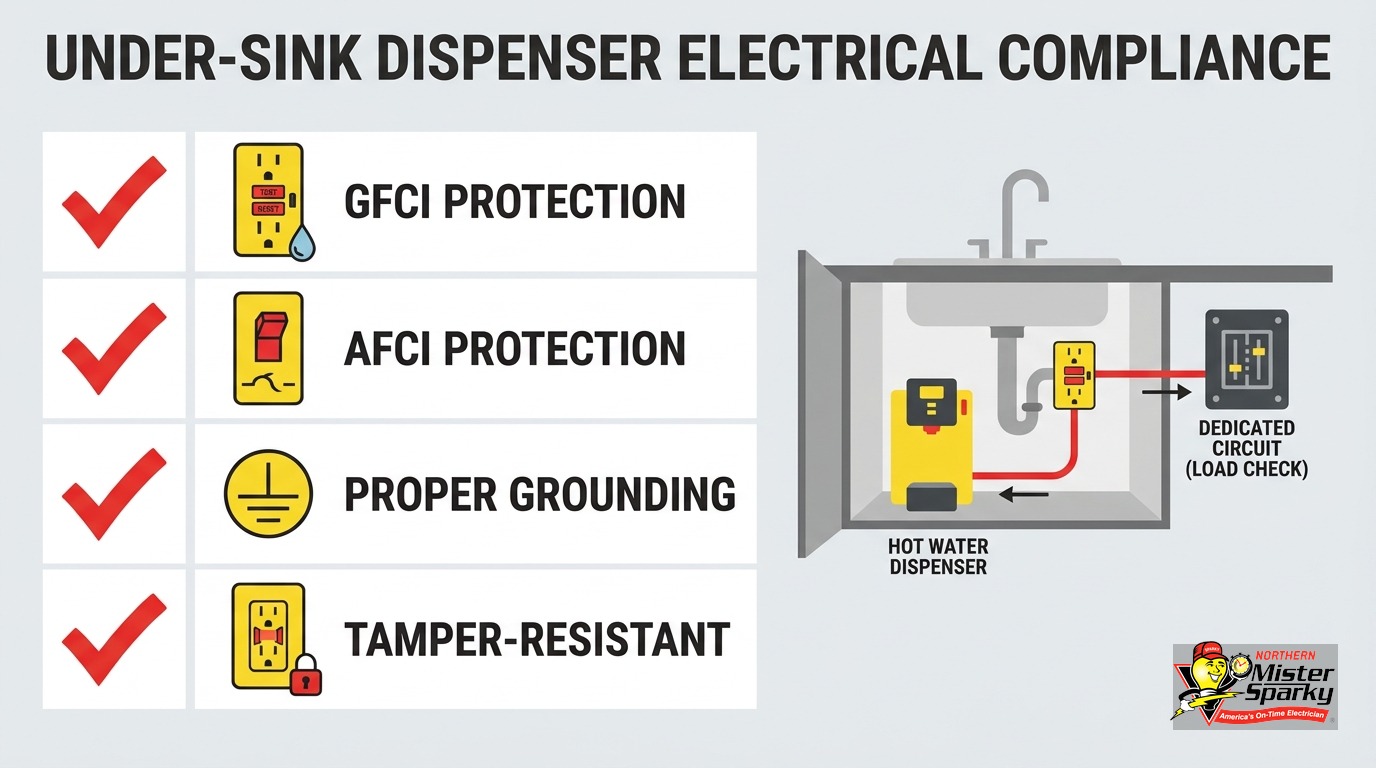
- Under the 2023 NEC, all receptacles on single-phase branch circuits in a dwelling kitchen need GFCI protection. The under-sink location does not exempt it.
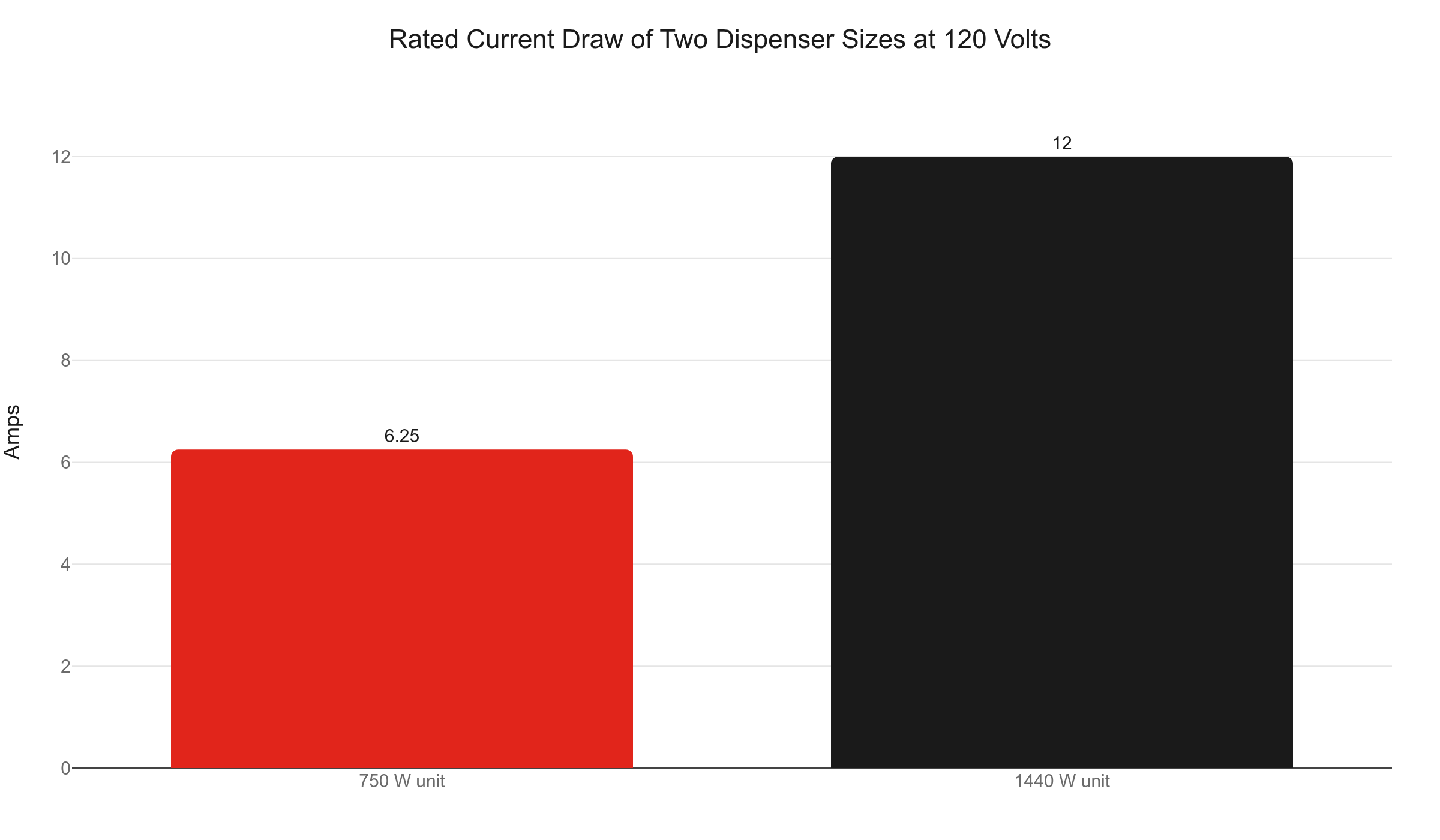
- One manufacturer lists a 6.25-amp model and a 12-amp model. The larger unit deserves real circuit planning.
- Count everything else on the circuit, such as a disposal or dishwasher, to avoid nuisance trips.
- Put GFCI protection where you can reach and reset it without emptying the cabinet.
- A new outlet or circuit generally needs a permit. Confirm who issues it before work starts.
- St. Paul enforces the 2026 NEC on permits obtained on or after August 17, 2026. Ask your inspector what that means for your project.
Why Plan the Outlet Before the Cabinets Go In
An instant hot water dispenser looks simple. A small faucet sits on the sink deck, and a tank hides in the cabinet below. Then you notice the cord.
That cord needs somewhere to plug in. In a finished kitchen, the answer is often an extension cord or a crowded outlet behind the disposal. Neither is a good fix.
A remodel gives you a clean chance to do it right. The walls are open and the cabinets are not set. Running a new cable now costs far less than fishing one through finished walls later.
We are Northern Mister Sparky, a locally owned and operated Twin Cities electrician. We wrote this for homeowners in Minneapolis, St. Paul, Bloomington, Plymouth, and nearby suburbs who are planning a kitchen update.
We handle the electrical side only. The water line and tank hookup belong to a plumber. For that part, our sister brand Northern Benjamin Franklin Plumbing can help.
Most product pages tell you to plug the unit into a grounded outlet and check your cabinet space. That is true, but it skips the questions that decide whether the install works for years. What code applies? What protects you from shock? What else is on that circuit?
What Kind of Outlet Does an Instant Hot Water Dispenser Need?
Dispenser manufacturers specify a grounded 120-volt outlet. One manufacturer’s product page says its unit plugs into a standard 120-volt outlet. In a remodel, that means a grounded receptacle under the sink, with GFCI protection, on a circuit that can carry the load.
Nothing exotic is needed. It is the same style of outlet that serves a toaster or a coffee maker. There is no 240-volt wiring and no special receptacle shape.
The details around that outlet matter more. Check the installation sheet for your exact model before the electrician roughs in the wiring. Models differ in cord length, clearances, and power rating.
The tank explains why location matters. The same manufacturer says its tank holds 2¾ quarts and dispenses 203°F water, adjustable down to 149°F. That is a heated vessel in a cabinet full of water lines. Arrange the outlet, cord, and tank so nothing gets wet, hot, or pinched.
We recommend a few ground rules:
- Use a real, permanent receptacle. Do not use an extension cord or a power strip.
- Keep the outlet inside the sink base, close enough for the cord to reach without strain.
- Choose a grounded receptacle. Never use a two-prong adapter.
- Confirm the receptacle will be GFCI protected, as the next section explains.
Does an Under-Sink Outlet Need GFCI Protection?
Yes. Under the 2023 NEC, all receptacles on single-phase branch circuits in a dwelling kitchen need GFCI protection. The old test of countertop service or within six feet of the sink is gone. An outlet under the sink falls inside the rule, wherever it sits.
The IAEI explains that under section 210.8(A)(6), kitchen location, sink proximity, and countertop service no longer matter. A second source agrees. ECM Magazine says that “all the receptacles in the kitchen shall be GFCI protected.”
A GFCI device compares the current going out and coming back on a circuit. If some leaks, through water or a person, it shuts power off fast. That matters under a sink, where supply lines drip, drains sweat, and cabinets get wet.
A dispenser adds a second reason. A hot, plugged-in tank sits near plumbing, and a GFCI adds a safety margin if a fitting weeps onto the cord or plug.
If your kitchen already has an under-sink outlet, do not assume it meets today’s rules. Older outlets often predate the current code. They may lack GFCI protection, or even a ground. Our guide to GFCI breakers versus GFCI outlets can help you compare your options.
How GFCI Rules Changed Across Code Editions
Homeowners hear mixed advice about kitchen GFCI because the rule changed over time. Knowing the history helps you spot outdated advice.
Here is how the IAEI describes the shift:
- 2017 NEC: It “only requires GFCI protection in dwelling unit kitchens for receptacles serving countertops or within six’ of a sink.”
- 2020 NEC: The ampere-rating limit was dropped.
- 2023 NEC: All receptacles on single-phase branch circuits in a dwelling kitchen need GFCI protection.
An installer working from the 2017 mindset might argue that a receptacle low in a cabinet, away from the countertop, is exempt. Under the 2023 language, that argument no longer holds.
The IAEI also covers a separate rule, section 210.8(D), for appliances. Appliances rated 60 amperes or less and 150 volts to ground or less need GFCI protection, whether hardwired or cord-and-plug. The listed examples include microwaves, wall ovens, ranges, and dishwashers.
A dispenser is not among those examples. It does not need to be, because the kitchen receptacle rule already covers the outlet it plugs into.
Design to the stricter rule. GFCI protection on the dispenser outlet costs little at rough-in and is a headache to add later.
Which Code Edition Applies to Your Remodel in Minnesota?
Minnesota moved to the 2026 NEC. St. Paul states that the 2026 National Electrical Code will be enforced on all permits obtained on or after August 17th, 2026. The state agrees: the Department of Labor and Industry says the Board of Electricity adopted the 2026 NEC with an effective date of Aug. 17, 2026.
That date has passed. A permit you pull now falls under the 2026 edition.
Here is what we can and cannot tell you. The 2023 language above is well documented. We are not claiming the 2026 edition changes the kitchen GFCI rule in either direction. Your inspector has the final word on how your jurisdiction reads it.
Older state pages still show the 2023 edition. They have been superseded, but they can turn up in a web search. Before you finalize plans, confirm the current adoption details with the state or your city.
Our advice holds under either edition. Protect the under-sink receptacle with GFCI. Plan the circuit with headroom. Pull the permit. That approach stands up in an inspection.
Who issues the permit depends on where you live. The state DLI tells homeowners to check the Authority Having Jurisdiction first. That is the office that issues permits and inspects the work. We cover this further below.
How Many Amps Does an Instant Hot Water Dispenser Draw?
It depends on the model. One manufacturer lists a 750-watt unit that draws 6.25 amps and a 1440-watt unit that draws 12 amps. Both plug into a standard 120-volt outlet. Check the nameplate on your exact unit, then plan the circuit around that number.
The math is easy. Amps equal watts divided by volts. A 750-watt unit on 120 volts draws 6.25 amps. A 1440-watt unit draws 12 amps.
That gap matters. A 6.25-amp unit is a modest load. A 12-amp unit takes a big slice of a common 15-amp kitchen circuit and leaves little room for anything else.
The heating element does not run all the time. It heats the tank after fill and reheats after you draw water. But it can run just as you start a disposal or dishwasher. That overlap is when breakers trip.
We size circuits with headroom, so normal use stays well below the breaker rating. That is a design choice, not a code figure. It keeps the kitchen from tripping at a bad moment, like a holiday meal.
Here is how to use the number in your plan:
- Find the wattage on the unit’s nameplate or spec sheet.
- Divide by 120 to get amps.
- Add the other devices on the same circuit.
- Ask your electrician whether the circuit has room.
If you are unsure what a given breaker or wire can carry, our wire gauge and breaker size guide explains the basics in plain language.
What Else Shares the Circuit Under Your Sink?
Anything else on the same circuit adds to the load. In many kitchens, a garbage disposal or dishwasher sits near the sink and may share wiring. Count every device on the circuit before you add a dispenser. If the total runs close to the breaker rating, give the dispenser its own circuit.
Product pages never ask this. They tell you to plug in the dispenser, not what else draws power from that cable.
Picture the sink base. You may have a disposal, a dishwasher, a water filter, and now a dispenser. Some are hardwired and some are plugged in. Depending on how the home was wired, they can end up on the same breaker.
Signs of a shared-circuit problem include:
- The breaker trips when the disposal runs while the dispenser heats.
- The GFCI trips when the dishwasher starts.
- Lights or small appliances flicker when the dispenser reheats.
A breaker trip and a GFCI trip are different events. A breaker trips from too much current. A GFCI trips when it detects a leak to ground. Knowing which one tripped helps your electrician find the cause.
A dedicated circuit solves several problems at once. The dispenser has its own capacity, a fault trips only the dispenser, and you can pick the best GFCI approach for that one run.
A remodel is the cheapest time to add that circuit. We can plan the cable path during rough-in, while the walls are open. Our kitchen remodel electrical rough-in schedule shows when each electrical step happens.
If a disposal lives in the same cabinet, our post on garbage disposal wiring covers how it ties into the layout.
Should You Use a GFCI Receptacle or a GFCI Breaker?
Both give GFCI protection, but you reset them in different places. A GFCI receptacle has test and reset buttons at the outlet. A GFCI breaker resets at the panel. Under a sink, a hard-to-reach receptacle is a service headache, so we choose based on access and the rest of the circuit.
This part is our field experience, not a code citation. The code requires protection. It does not say which device is easier to live with.
Here are the common setups:
- GFCI receptacle at the dispenser. The reset sits right where the problem is. But the outlet sits behind the tank and pipes, so you may need to empty the cabinet to press a button.
- GFCI receptacle in an easy-to-reach spot upstream. A GFCI placed nearby, such as in an adjoining cabinet or on an accessible wall, can protect a standard receptacle under the sink. You reset it without crawling under the sink.
- GFCI breaker at the panel. It protects the whole circuit, including the wiring in the wall. The reset is at the panel, which may be in the basement. This pairs well with a dedicated circuit.
Which is best? If the dispenser has its own circuit, a GFCI breaker is clean and tidy. If the circuit is shared, an accessible GFCI receptacle may serve better.
GFCI devices have a test button. Press it from time to time and confirm it trips. A device that never trips under test is not protecting you.
If a GFCI outlet will not reset, do not keep forcing it. See our guide on what to do when a GFCI outlet will not reset or call us.
Where Should the Outlet Go Under the Sink?
Place the outlet high inside the sink base cabinet, off to the side, away from the drain and water lines. Keep it where you can reach it without moving the tank. Follow the dispenser’s installation sheet for clearances. Mark the spot before the cabinets go in, so the electrician and cabinet installer agree.
Think of the cabinet as a small, wet room. Water lines and the drain run through it, and the tank fills much of it. You want a spot that stays dry and reachable.
Use these placement rules as a starting point:
- Above drip paths. Mount the receptacle above and beside the plumbing, not under a trap or shutoff valve.
- Clear of the disposal. Disposals shake and get bumped. Keep the cord and outlet out of that zone.
- Within cord reach. Check the cord length on your unit. Do not stretch it, and do not add an extension.
- Reachable for service. You should be able to unplug the unit without removing everything in the cabinet.
- Clear of pull-outs and drawers. A trash pull-out can snag a cord. Plan around it.
Cabinet space is the other half of the puzzle. The tank, a filter, a disposal, and a soap dispenser tank all compete for room. The tank on one popular model holds 2¾ quarts, which is small, but it still needs a footprint plus airflow and clearance.
The cord needs a path, too. A small grommet hole in the cabinet side keeps it tidy and protects the insulation. Tell your cabinet installer if the cord must pass through a divider.
Finally, coordinate with the countertop. The faucet needs a hole in the deck, and stone tops are cut before install. A missed hole is an expensive fix, so confirm it early.
Do You Need a Permit to Add an Under-Sink Outlet?
A new outlet or circuit generally needs an electrical permit. Check the Authority Having Jurisdiction in the state DLI directory first. If it says State, file with DLI. If it says Local, file with your city or township. Licensed contractors handle this routinely.
The DLI homeowner permit page lays out that two-step check. Contractors follow the same check, according to the DLI contractor permit page.
Cities add their own forms. St. Paul lists separate homeowner residential permit forms for new work and for repair or alter work. It also lists a Homeowners Affidavit and marks it required.
Why bother? An inspection gives a second set of eyes on the work and leaves a clear record. That record can matter when you sell, or when an insurer asks about electrical work.
Unpermitted work can cause trouble later, because buyers and inspectors ask about it. Our guide to electrical permits in Minnesota explains when you need one and what to expect.
When we do the work, we pull the permit for you. We coordinate the inspection around your remodel schedule, which keeps the project moving and the paperwork off your plate.
What to Settle at Rough-In
Rough-in is when you lock in your electrical plan. The wiring goes in before drywall and cabinets. Decisions made here are cheap. Decisions made later are not.
Bring this checklist to your electrician:
- Model and wattage. Share the exact dispenser spec sheet, so we can confirm the amp draw.
- Circuit load. List the disposal, dishwasher, and anything else near the sink.
- Dedicated or shared. Decide whether the dispenser gets its own circuit.
- GFCI type and location. Choose receptacle or breaker, and make sure the reset is reachable.
- Outlet position. Mark the height and side inside the sink base.
- Cord path. Plan any holes through cabinet dividers.
- Permit. Confirm who issues it and who files it.
- Plumber and countertop coordination. Align the faucet hole and the water line.
The usual order runs like this. The electrician roughs in the wiring and the inspector checks it. Drywall and cabinets follow, then the countertop. The plumber connects the water, and the electrician finishes the devices.
If any step shifts, tell us. A change in cabinet layout can move the outlet. We would rather adjust a cable at rough-in than patch a wall later.
Need a new receptacle or a dedicated line? Our outlet installation service covers both. If load planning shows you need a bigger circuit or a panel upgrade, ask us about financing for the larger work.
Why Homeowners Call Northern Mister Sparky
We are locally owned and operated, and we work in the same Twin Cities neighborhoods we live in. We know Minnesota permits, local inspectors, and the quirks of older homes and new builds alike.
We are proud to be America’s On-Time Electrician(R). When we give you a window, we keep it. Our work comes with the UWIN(R) 100% satisfaction guarantee. You get straight answers and no malarky.
Planning a kitchen remodel with an instant hot water dispenser? Call 763-200-5956 or book online. Tell us the model and your cabinet plan, and we will map out the outlet, the GFCI protection, and the circuit before the walls close.
Frequently Asked Questions
Does an under-sink hot water dispenser outlet need GFCI protection? +
How many amps does an instant hot water dispenser draw? +
Should an instant hot water dispenser have its own circuit? +
Do I need a permit to add an outlet for a hot water dispenser? +
Need an electrician now?