
What Does a Whole Home LED Lighting Conversion Cost?
Key Takeaways
- A whole home LED lighting conversion costs between $500 and $8,000, depending on fixture count, dimmer scope, and wiring conditions.
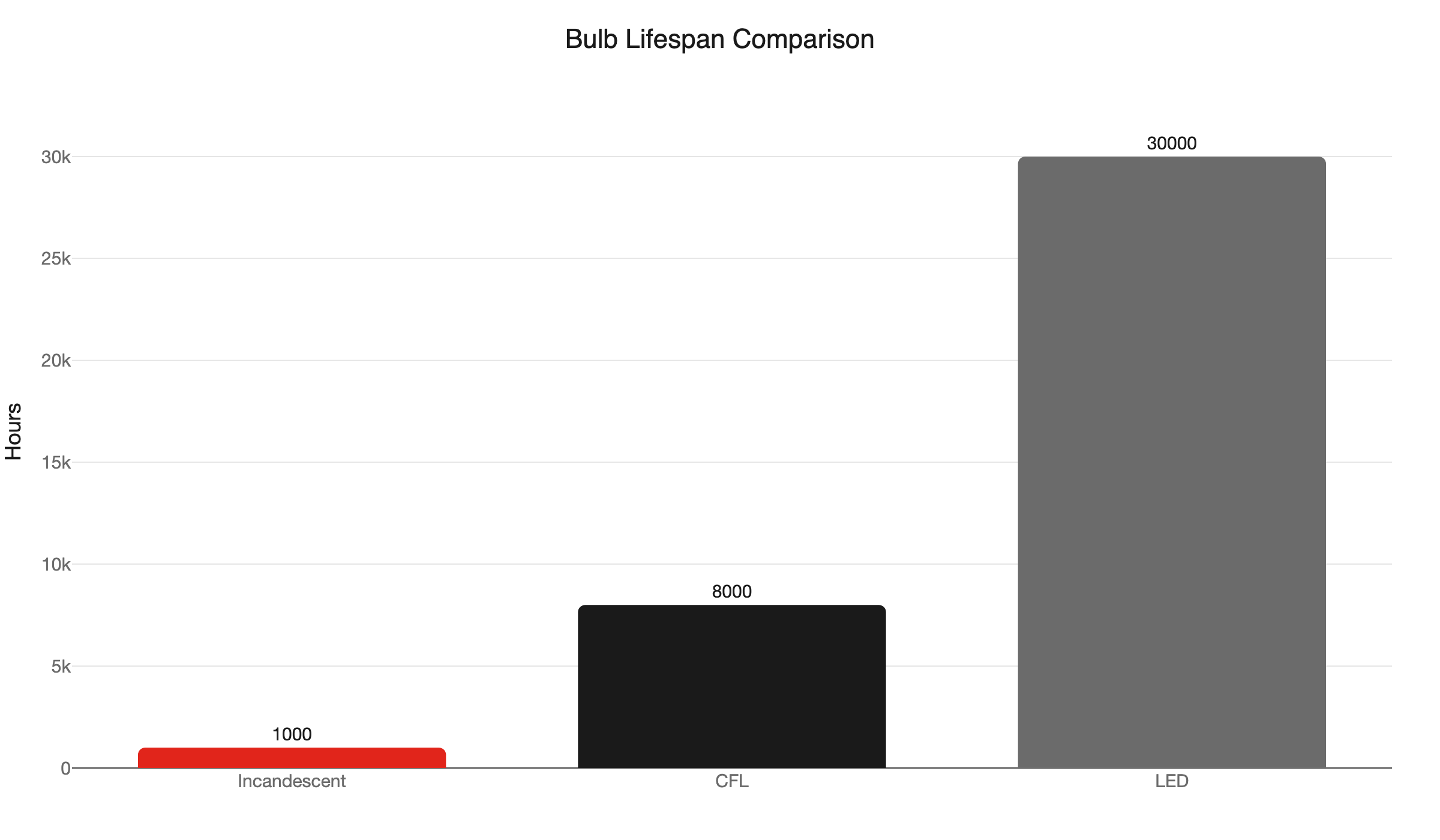
- LEDs use significantly less energy than incandescent bulbs and last 30,000 to 50,000 hours, versus roughly 1,000 hours for incandescent.
- The average household saves on energy costs after converting to LED.
- Legacy dimmers cause LED flicker, buzz, and failures. Running an LED load on an incandescent dimmer is a code violation under NEC 404.14(F).
- In Minnesota, swapping a standard switch for a dimmer likely requires a permit and may trigger an AFCI breaker upgrade under the 2026 NEC.
- Northern Mister Sparky scopes the full job upfront: dimmer audit, neutral wire check, AFCI exposure review, and panel load documentation.
What Is the Whole Home LED Lighting Conversion Cost?
The short answer: A full whole-home LED conversion in the Twin Cities runs between $500 and $8,000. Simple bulb swaps in standard on/off fixtures land at the low end. Projects that include dimmer replacements, permit work, neutral wire runs, or AFCI breaker upgrades push toward the high end.
Inch Calculator and LatestCost.com both report this range for whole-home projects. Electricians charge $50 to $200 per hour. A full retrofit can exceed 20 hours of labor. Individual LED bulbs run $3 to $12 each. For a home with 50 bulbs, materials alone are $150 to $600.
The problem with most published estimates is what they leave out. Most results list a per-bulb price and a project range. Then they add a vague note about hiring an electrician for hardwired work. They do not explain why dimmers must be replaced. They skip what triggers a permit in Minnesota. They never mention that a bedroom dimmer swap can require an AFCI breaker upgrade. Those line items are what move a project from $1,000 to $5,000.
If you want a clear picture of what electrician labor costs before requesting a whole-home quote, the electrician cost guide for the Twin Cities covers hourly rates, service call fees, and what drives project pricing in this market.
What Does an Electrician Scope Before Quoting an LED Retrofit?
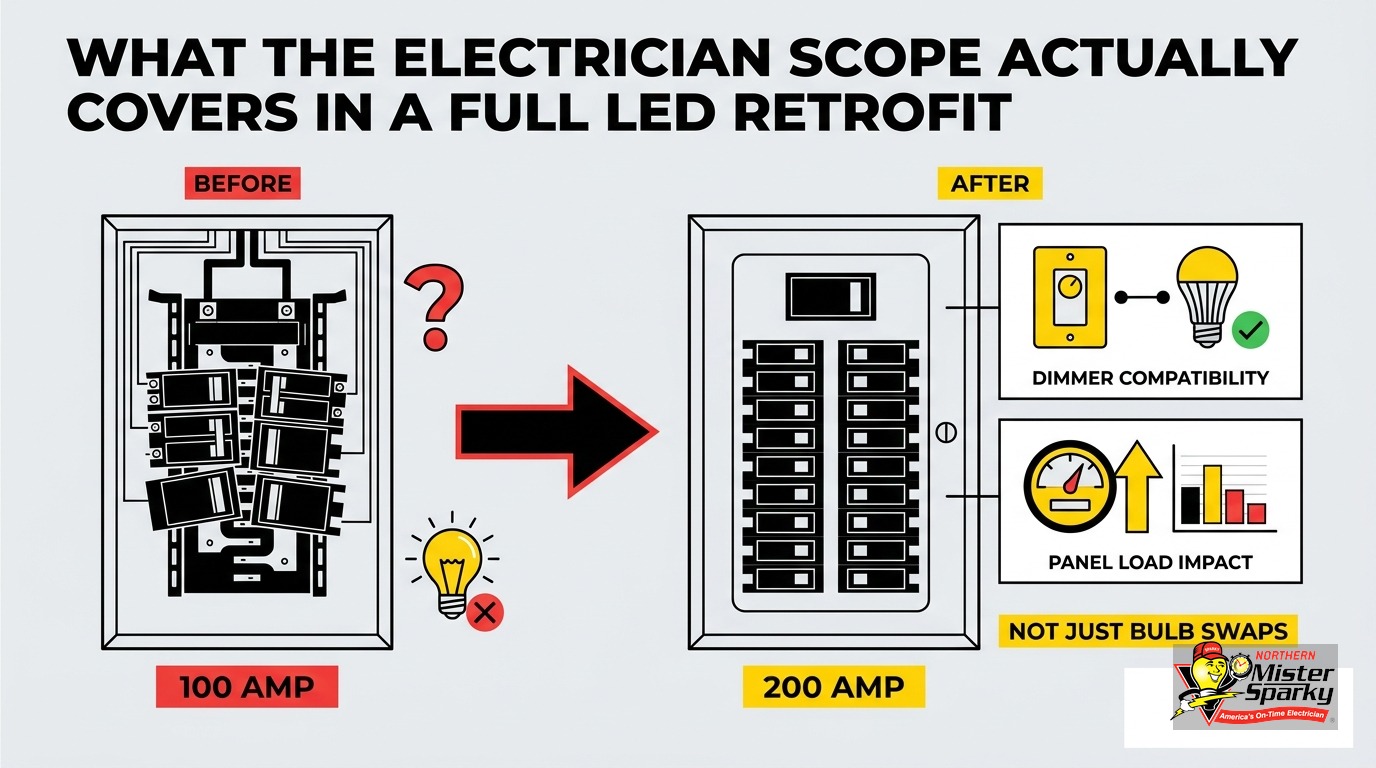
The quick answer: An electrician’s quote covers five areas: fixture inventory, dimmer compatibility, neutral wire availability at each switch location, AFCI exposure on modified circuits, and panel load delta. Understanding what each one means helps you read any quote line by line.
Here is what each area means for your project.
Fixture inventory. The electrician walks the home and catalogs all fixture types: recessed cans, surface mounts, pendants, undercabinet strips, and outdoor fixtures. Some fixtures accept a direct LED replacement bulb. Others, particularly older recessed cans, require a listed retrofit kit. That distinction affects both cost and code compliance.
Dimmer compatibility. Every dimmer location is assessed against the proposed LED load. Pre-2015 dimmers are almost always leading-edge types designed for resistive incandescent loads. LED drivers are not resistive loads. Each incompatible dimmer comes off the wall.
Neutral wire availability. Modern LED-compatible dimmers require a neutral conductor at the switch box. Many Minnesota homes built before the mid-2000s used switch-loop wiring with only two conductors at the switch. Running a neutral to those locations may require opening walls or fishing wire through finished spaces. That is not a minor add-on.
AFCI exposure. Any circuit where the electrician modifies a switch or device in a bedroom, living room, dining room, kitchen, or hallway triggers a review under NEC 210.12. Minnesota enforces this on circuit modifications, not only new construction. If the existing circuit has a standard breaker, the electrician pulling a permit must upgrade it.
Panel load delta. A 70 to 90 percent reduction in lighting load frees up meaningful capacity on your panel. The electrician documents this figure. It matters directly if you are planning to add an EV charger or any other high-draw circuit in the future.
Why Do Your Dimmers Need to Be Replaced?
The quick answer: Legacy dimmers were designed for minimum 40 to 60 watt incandescent loads. A 300-watt incandescent load replaced with a 30-watt LED load falls well below that minimum. The dimmer cannot regulate the lower wattage. The result is flicker, audible buzz, or unexpected shutoff. Budget $50 to $150 per switch location for LED-rated replacements.
Jarvis Lighting’s troubleshooting guide explains the mechanism: pre-2015 dimmers use leading-edge phase-cutting technology built for resistive loads. When the connected load drops below the dimmer’s minimum threshold, the dimmer loses its phase reference. The LED driver responds erratically, producing the flicker and buzz homeowners report.
This is not a situation where you can try it and upgrade later if it causes problems. NEC 404.14(F) requires that general-use dimmer switches may only control loads they are listed to control. Running an LED load on an incandescent-rated dimmer is a code violation, regardless of whether the dimmer visibly malfunctions.
The neutral wire issue adds cost beyond the dimmer unit itself. Most modern LED dimmers require a neutral conductor at the switch box to power their internal electronics. In a home with switch-loop wiring, the neutral is not there. Every affected location may involve fishing a wire through a finished wall or ceiling. Before finalizing a quote, the electrician identifies which switch boxes already have neutrals and which do not. The LED dimmer switch compatibility guide covers how different dimmer technologies match up with specific LED driver types if you want to understand the options before your appointment.
What Permits Does LED Work Require in Minnesota?
The quick answer: Like-for-like bulb swaps require no permit. Swapping a standard switch for a dimmer likely does require a permit under Minnesota Rules 3800.3500, because a dimmer is not a like-for-like replacement. It is a different device type. It often requires a neutral conductor the existing box does not have.
Minnesota’s minor repair exemption covers replacing a switch with an identical device. A dimmer is not identical to a standard switch. Adding a neutral wire to a switch box is wire-running work. Both items fall outside the exemption.
Minnesota enforces the 2026 NEC for permits filed on or after August 17, 2026, with no state amendments. An electrician pulling a permit today is working under that standard.
Permit jurisdiction is local. Minneapolis and St. Paul have their own inspection processes. Suburbs like Woodbury, Maple Grove, Bloomington, and Blaine route permits through their respective city inspectors. Your electrician handles the filing. The DLI sets the code; the city inspector does the walk-through.
The practical implication is straightforward. A homeowner who hires an unlicensed handyperson to swap dimmers skips the permit, skips the inspection, and accumulates unpermitted work. That surfaces when the house is sold. An electrician’s quote that looks expensive includes the permit fee, the inspection visit, and a documented compliance record.
AFCI Requirements: The Line Item That Surprises Homeowners
NEC 210.12 requires combination-type AFCI protection on all branch circuits in bedrooms, living rooms, dining rooms, kitchens, hallways, and similar spaces in a dwelling. In Minnesota, this requirement applies to circuit modifications and extensions, not only new construction.
The DLI 2026 NEC inspection checklist is specific on this point: replacing a dimmer switch counts as modifying the circuit device. If the circuit feeds a bedroom and currently runs through a standard breaker, the electrician pulling a permit must upgrade it to a combination-type AFCI breaker before the inspection passes.
The cost per breaker is modest: $30 to $60 for the breaker, plus labor to install and label it. The surprise comes when six to eight bedroom and living-area circuits each need an upgrade. That adds $240 to $480 in materials, plus labor.
What you get for that cost is real. AFCI breakers detect arcing faults inside walls: the kind that starts fires that standard breakers do not trip on. That protection is especially relevant in older Minnesota homes where loose connections and wire degradation are more common. For more on how this requirement applies and what circuits are covered, the AFCI breaker requirements guide has the full breakdown.
How Much Does It Cost to Replace Halogen Downlights with LED?
The quick answer: Halogen-to-LED retrofits for recessed cans typically cost $75 to $210 per fixture in combined materials and labor. Materials for the retrofit kit run $25 to $60 per fixture. Labor adds $50 to $150 per fixture, depending on ceiling access, dimmer scope, and whether the existing can accepts a listed retrofit kit.
The code requirement is not optional. NEC requires luminaire retrofit kits to be listed by an approved testing laboratory. An unlisted retrofit assembly is a code violation, even if it fits the existing can and appears to work correctly. This is why an electrician cannot source any generic LED module from a big-box shelf and snap it into an old recessed housing. The kit must carry a listing mark for that specific application.
If your recessed cans are in an insulated ceiling, which is common in Minnesota homes directly below an attic or above a garage, the retrofit kit must also be rated for insulation contact. The IC-rated recessed lights guide for insulated ceilings explains how to confirm your existing fixtures qualify and what the IC and airtight ratings mean for your home.
For a large home with 30 or more recessed cans plus dimmer replacements at each location, this portion of the project alone can reach $3,000 to $6,000 in combined labor and materials.
How Much Do Electricians Charge to Install Ceiling Lights?
The quick answer: Replacing an existing ceiling fixture with a new LED fixture typically costs $100 to $300 per fixture in labor when the wiring and box are already in place. Running a new circuit to an unboxed location adds $150 to $400 for the circuit run, on top of the fixture cost and installation.
For a whole-home LED conversion, most ceiling fixtures are replacements rather than new circuit runs. Per-fixture labor drops when an electrician works through an entire home in one project rather than individual service calls. One mobilization for 20 fixtures is more efficient than 20 separate visits, and the pricing reflects that.
Two common add-ons affect ceiling fixture cost. First, heavier fixtures, including pendants, chandeliers, and any fixture over 35 pounds, require a fan-rated electrical box in the ceiling. Standard light boxes are not rated for that load. If the existing box is not fan-rated, the electrician replaces it before hanging the new fixture.
Second, some ceiling lights run on pull chains with no wall switch. Converting a pull-chain ceiling light to a wall switch is a separate circuit modification with its own permit considerations. The guide on adding a wall switch to a pull-chain ceiling light covers what that work involves and when it requires a permit in Minnesota.
Does Converting to LED Free Up Capacity on Your Electrical Panel?
The quick answer: Yes. LEDs use significantly less energy than incandescent bulbs, which means a proportionally lower amperage draw from your panel. For a home with 40 to 50 fixtures, that reduction is significant, and a licensed electrician documents it as part of the project scope.
The Department of Energy estimates meaningful energy savings for households after switching to LED. The DOE has also finalized new general-service lamp efficiency standards effective July 2028, projecting more than $27 billion in cumulative savings over 30 years. The energy bill benefits are real and start from day one.
The panel load benefit matters beyond the electricity bill. When you add a major load, such as an EV charger, a hot tub, or a large appliance circuit, your electrician runs a load calculation to confirm the panel has capacity. A 70 to 90 percent reduction in lighting load across all fixtures can be the difference between adding a new circuit cleanly and needing a panel upgrade first.
One more Minnesota note worth including: LEDs outperform CFLs in cold garages and exterior fixtures. No warm-up delay in below-zero temperatures, and no mercury disposal concern. Exterior CFL floodlights and garage ceiling fixtures are strong early candidates for replacement.
Pairing a whole-home LED conversion with a whole-home surge protector installation protects the new LED drivers, dimmer electronics, and any smart switches from voltage spikes. It is a natural combination for any home-wide electrical upgrade.
What About Xcel Energy Rebates for LED Lighting?
The quick answer: Xcel Energy does not offer a traditional cash rebate for residential LED fixture or retrofit kit installation. The primary program for Minnesota homeowners is the Whole Home Efficiency program, which includes free LED bulb installation through the Home Energy Squad. That visit requires a Standard Audit to start and does not cover dimmer replacement, permit work, or listed retrofit kit installation.
Set expectations accurately before requesting a quote. The free-bulb visit is a good starting point for simple screw-in replacements. It does not offset the cost of a professional retrofit. The financial return on a full conversion comes from the $225 or more per year in energy savings that compound from year one, on top of the avoided maintenance cost of replacing 1,000-hour incandescent bulbs over and over.
For a complete list of electrical rebate and incentive programs available to Minnesota homeowners, the Xcel Energy electrical rebates guide covers the current program set, including programs that do apply to larger electrical projects.
Schedule Your LED Conversion with Northern Mister Sparky
Northern Mister Sparky is locally owned and operated in the Twin Cities. We scope whole-home LED projects before we quote them: dimmer audit, neutral wire check, AFCI exposure review, and panel load documentation. You know the full scope before any work begins.
Call 763-200-5956 or book online to schedule your LED consultation. We back every job with the UWIN(R) 100% satisfaction guarantee. As America’s On-Time Electrician(R), we show up when we say we will.
Frequently Asked Questions
How much do LED lights cost to run per hour? +
Can I do part of a whole-home LED conversion myself? +
Need an electrician now?