
Whole House Fan Electrical Wiring Cost: Twin Cities Guide
Key Takeaways
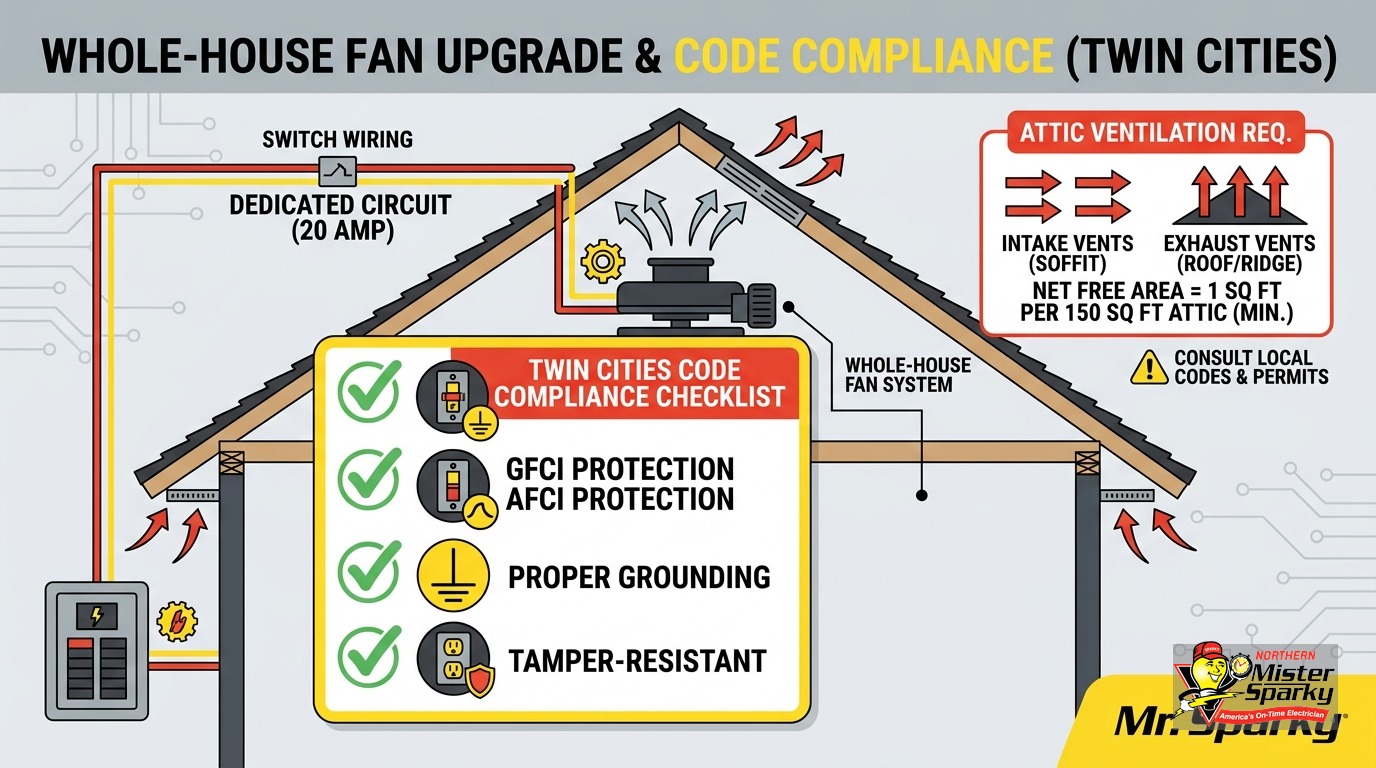
- Dedicated circuit: Almost always required by code, either by NEC motor-load rules or by the fan manufacturer’s UL listing instructions.
- Switch wiring: Your electrician runs a home-run cable from the panel to a wall switch box, then a second run up to the fan. Multi-speed and timer switches are the standard choice.
- Attic venting: Undersized attic vents are the most common scope-expander. Budget $300-$650 if vent upgrades are needed.
- Permits: Required for every new circuit in Minnesota. File with your city if it is a local AHJ, or with the state DLI at ims.dli.mn.gov/ims.
- NEC cutover: August 17, 2026 is live. Permits pulled on or after that date must follow the 2026 NEC.
- Xcel rebate: None. Xcel Energy does not offer a whole house fan rebate in Minnesota.
- Next step: Call 763-200-5956 or book online to get a site-specific estimate.
What Does Whole House Fan Electrical Wiring Cost in the Twin Cities?
Quick answer: Expect $250-$900 for a dedicated circuit and wall switch. Electrician labor runs $50-$130 per hour on top of that. The electrical scope alone typically takes one to two hours, putting the all-in electrical cost in the $300-$1,160 range before permit fees.
Those numbers track national cost data from Fixr. Twin Cities labor rates sit in the middle-to-upper part of that range. City permit fees add a flat cost that varies by municipality.
Here is the cost breakdown by scope:
- Dedicated circuit, panel to fan, no separate switch leg: $150-$400
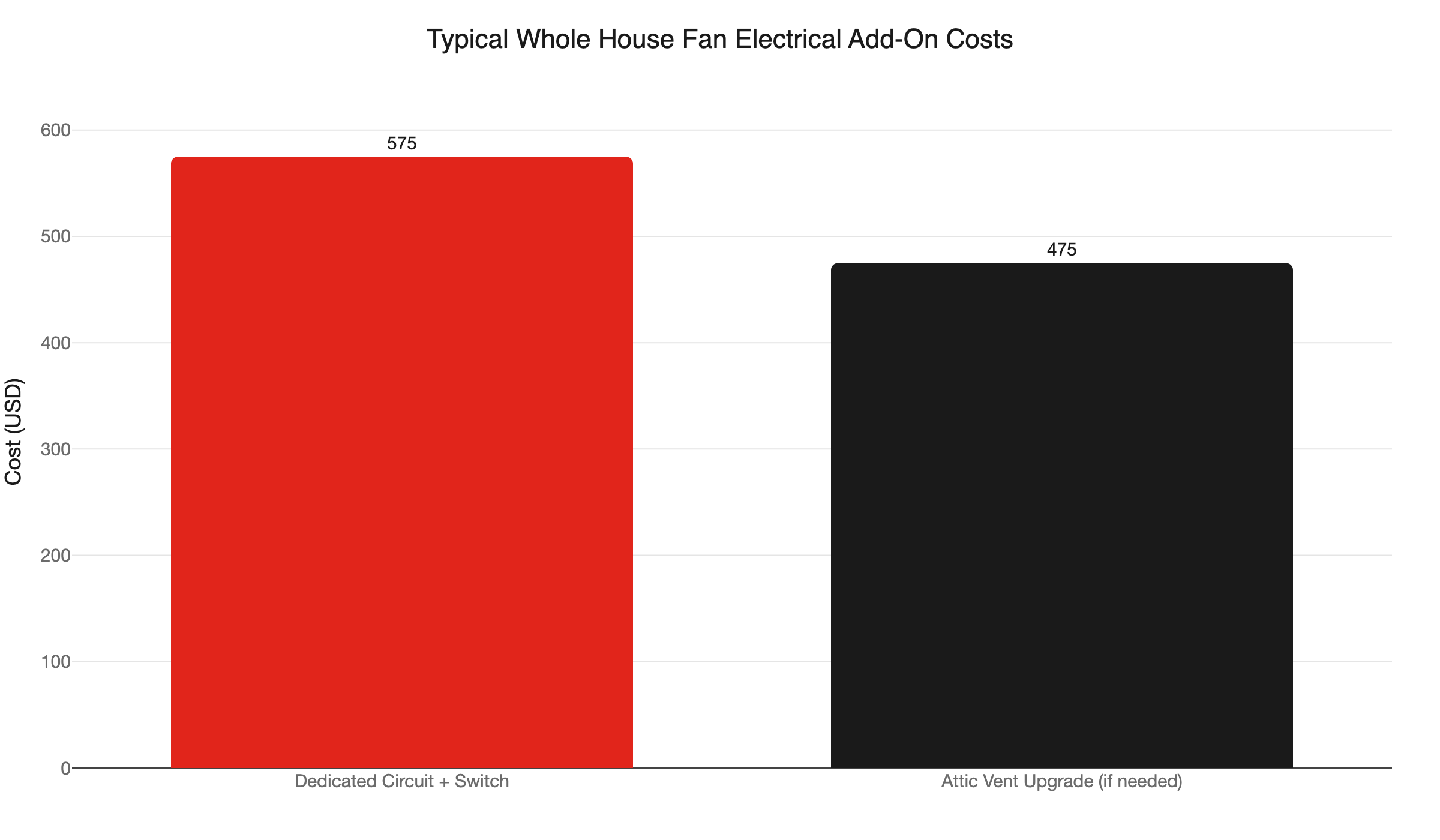
- Dedicated circuit plus multi-speed or timer wall switch: $250-$900
- Attic vent upgrade, when needed: $300-$650
The spread is wide because three factors move the number the most. First is how close the panel is to the fan location. Second is what the walls look like: finished versus open framing. Third is whether the attic has enough net free area to handle the fan’s airflow without straining against it.
A one-story rambler with an accessible attic and a nearby panel is the easiest job. A two-story home with finished walls, a basement panel, and a centrally mounted fan is the most labor-intensive.
The wiring scope does not include the fan unit, its mounting hardware, or the ceiling cutout. Those fall to the HVAC or general contractor. Make sure any quote you receive is clear about which scope belongs to whom.
Does a Whole House Fan Need a Dedicated Circuit?
Quick answer: Almost always yes. Motors over 1 HP require a dedicated circuit under NEC Article 430 motor-load rules. Manufacturer UL listing instructions make a dedicated circuit mandatory for many smaller fans too, regardless of the motor-load calculation.
Here is the technical side. NEC Article 430 governs motor branch circuits. Section 430.42(A) allows motors not over 1 HP to share a general-purpose circuit. The catch: specific load calculations under Sections 430.32 and 430.53 must be satisfied. For most whole house fans, those calculations fail and a dedicated circuit is required.
The more common enforcement path is NEC Section 110.3(B). That section requires electricians to follow the manufacturer’s UL listing instructions as part of the installation. Many whole house fan manufacturers specify a dedicated circuit in their listing. When the listing says dedicated circuit, that requirement is code-mandatory. End of analysis.
Assume your install needs a dedicated circuit. It is almost always the correct assumption.
One exception worth knowing: if your home already has an unused dedicated circuit to the attic from a previous project, it may be reusable. The wire gauge and amperage must match the new fan’s specs exactly. Your electrician can verify that during the estimate visit.
This is the same logic that applies to large household appliances that require dedicated circuits: each gets its own home-run to eliminate nuisance trips and code violations.
What Size Circuit Does a Whole House Fan Need?
Quick answer: Most residential whole house fans require a 15-amp or 20-amp, 120-volt dedicated circuit. The correct size depends on the fan’s full-load amperage listed on its nameplate or in the installation manual. Have that information ready before your electrician visits.
A fan’s amperage draw determines wire gauge and breaker size. A 15-amp circuit uses 14-gauge wire. A 20-amp circuit uses 12-gauge wire. Running the wrong gauge is a code violation and a fire risk. There is no guessing your way through this.
Most fans in the 3,000-4,500 CFM range run on 120V/15A or 120V/20A. Larger, two-speed belt-drive fans can require 240V. That changes the circuit cost and complexity. A 240V home-run from the panel requires different wire, a double-pole breaker, and more material and labor.
The fan’s nameplate is the source of truth. Do not rely on the retailer’s product page alone. Pull the installation manual before your estimate appointment. If you have already purchased the fan, bring the manual to the site visit. It saves a return trip.
What Does Switch Wiring for a Whole House Fan Actually Involve?
Quick answer: Your electrician runs a cable from the panel to a wall switch box. Then they run a second cable from that switch box up to the fan. The switch box gets a multi-speed or timer switch, not a standard single-pole device. That two-leg run is the core of the switch wiring scope.
In a simple install, the wiring is straightforward. In a more complex home, every obstacle adds labor:
- Finished walls: The electrician fishes cable through insulation, fire blocks, and finished drywall. This takes longer and may require small access cuts for patching later.
- Two-story construction: Running the home-run from a basement panel to a second-floor fan means crossing multiple floors and more obstacles.
- Long panel-to-fan runs: More material cost per linear foot of wire, and more time in the attic or walls.
Multi-speed switches let you run the fan at low, medium, or high. Timer switches shut the fan off after a set run time. That is useful for overnight cooling: the fan runs while outdoor air is cool, then shuts off before temperatures climb the next morning. Either switch type costs $25-$80 for the device. Installation labor is the same for both.
If you already have a ceiling fan in that location, the existing switch box usually cannot be reused for the whole house fan. The dedicated circuit requirement means a new home-run regardless. Your electrician can confirm during the estimate.
How Attic Ventilation Affects Your Whole House Fan Wiring Cost
Quick answer: If your attic does not have enough net free area to exhaust the fan’s airflow, the project scope expands. Undersized venting can add $300-$650 in vent work. This is the most common budget surprise in a whole house fan install.
A whole house fan pulls air through open windows and pushes it into the attic. If the attic vents cannot exhaust that volume fast enough, pressure builds against the fan. The fan strains, uses more energy, and wears out faster.
The sizing rule from fan manufacturers and industry sources: allow at least 1 square foot of net free area (NFA) per 750 CFM of fan capacity. Some manufacturers use 1 square foot per 500 CFM as the conservative standard.
A typical Twin Cities home needs real airflow. The CFM requirement for an 1,800-square-foot rambler runs 3,600-5,400 CFM. At the 1:750 ratio, that requires 4.8-7.2 square feet of NFA in the attic vents.
Minnesota’s building code sets a baseline of 1/150 for attic venting: 1 square foot of NFA per 150 square feet of attic floor. In Climate Zones 6 and 7, which cover all of Minnesota, you can drop to 1/300 with a qualifying vapor retarder on the warm side of the ceiling. But the whole-house fan industry standard is often stricter than the building code baseline, especially for larger fans.
Before you book, do a quick attic check:
- Are soffit vents clear and not blocked by settled insulation?
- Is there a ridge vent running the length of the peak?
- Are gable vents open and unobstructed?
Blocked soffits are common in older Twin Cities homes with blown-in insulation that has settled over the years. If the attic looks tight, say so when you call. We can assess vent capacity during the estimate visit and price the full scope upfront, rather than discovering the problem midway through the job.
While we are in your attic for a whole house fan install, it is also a good time to look for pest-damaged wiring. Rodent chew damage to attic wiring is more common than most homeowners expect. Catching it during a scheduled visit costs nothing extra to identify.
What Permits Are Required for Whole House Fan Wiring in Minnesota?
Quick answer: Minnesota requires an electrical permit for any new circuit, including a whole house fan circuit. About 66 Minnesota cities are local AHJs and accept permits directly. If your city is not one of them, file with the state DLI at ims.dli.mn.gov/ims.
Minneapolis, St. Paul, and most first-ring suburbs have their own inspection departments. If you live there, the permit goes to city inspections. Outer suburbs and most outstate cities use the state DLI portal. Your electrician knows which system applies to your address and files the permit before starting work.
The permit process goes like this:
- Electrician files the permit before work begins.
- Electrician completes the wiring.
- Inspector visits and verifies code compliance.
- Inspector signs off and the permit closes.
Do not skip the permit. Unpermitted circuits create real problems. Buyers’ inspectors flag them at home sale. Insurance companies may deny claims for fires traced to unpermitted work. Correction costs after the fact are higher than doing it right the first time.
Permit fees vary by city and scope. A simple circuit permit in the Twin Cities metro typically runs $50-$150. Your electrician will include the permit fee in their quote or call it out as a separate line item.
The August 2026 NEC Code Transition: What to Know Before You Pull a Permit
Minnesota is in the middle of a code transition right now.
Per MN State Building Code Chapter 1315: permits filed before August 17, 2026 are governed by the 2023 NEC. Permits filed on or after August 17, 2026 must comply with the 2026 NEC.
For most whole house fan wiring, this transition does not change the core requirements dramatically. A standard 15A or 20A dedicated circuit and wall switch falls under stable, well-established NEC provisions. The bigger concern is if your project also touches panel work, AFCI protection scope, or other areas the 2026 cycle updated.
Why this matters right now: the cutover date is this month. Book your estimate now if you have been putting it off. Your electrician will price the job under the correct code version based on when the permit is pulled.
No national home improvement content mentions this transition. It is a real, current detail that affects every Twin Cities homeowner pulling an electrical permit right now.
Can You Wire a Whole House Fan Yourself in Minnesota?
Quick answer: Minnesota allows homeowner DIY electrical work only on your own single-family homestead, with a permit, with inspection, and only if you personally do the work. You cannot hire an unlicensed handyman to do it. Renters and condo owners are not eligible.
The homeowner exemption is narrow: single-family homestead only, owner-occupied, and the owner does the work personally. Rental properties, townhomes, and condos do not qualify. Delegating the work to someone without an electrical license does not qualify either.
Even if you are eligible, the work is not simple. Whole house fan wiring means opening a live panel, running cable through finished walls or an attic, and connecting a motor load. The wire gauge and amperage must match the fan’s specs exactly. The risks of a code mistake or unsafe connection are real. Our post on DIY electrical dangers covers the most common mistakes homeowners make when wiring their own circuits and what inspectors find when they do not.
The DIY cost math is also closer than it looks. Add up the permit fee, materials, tool rental, time, and a possible re-inspection if the work is flagged. A licensed electrician’s quote is often competitive with the DIY total.
We give free estimates. Call and see the comparison before you commit to either path.
Does Xcel Energy Offer a Rebate for Whole House Fans?
Quick answer: No. Xcel Energy’s Minnesota residential rebate program does not include whole house fans. Save yourself the phone call.
The current Xcel program covers heat pumps ($2,000), central AC ($400), smart thermostats ($50), and insulation. Whole house fans are not on the list.
The federal HOMES program (Home Efficiency Rebates) may apply to whole-home energy improvement projects, potentially $2,000-$8,000 based on predicted energy savings. This is not a direct whole house fan rebate. But if you are doing a broader efficiency project, ask an energy auditor whether the fan installation qualifies as part of the covered scope.
The energy savings case stands on its own in Minnesota’s climate. Most of the cooling season is dominated by shoulder-season days in May, June, September, and October. Outdoor temperatures at night drop into the 50s and 60s. A whole house fan flushes that cool air through the house in minutes. For many Twin Cities homeowners, that eliminates the need to run air conditioning until the afternoon heat peaks. The payback period is often shorter than people expect, even with no rebate stacking.
How to Get an Accurate Whole House Fan Electrical Wiring Cost Estimate
National averages give you the range. An on-site visit gives you the number.
Whole house fan electrical wiring cost for your specific home depends on several things your electrician needs to see in person:
- Panel location and capacity. A modern 200-amp panel with open slots near the attic access costs less to wire from. A full panel is a separate conversation. Our post on panels with no open breaker slots explains your options when there is no room left.
- Construction type. Open framing and accessible attic reduce labor. Finished walls, fire blocks, and non-standard framing add it back.
- Fan location. A central hallway ceiling with direct attic access is the simplest setup. A bedroom corner with no attic path requires more routing.
- Attic vent condition. Undersized venting expands the scope by $300-$650. Knowing this before we start means no surprises midway through.
- Permit fees. Set by your city or the state, depending on your address.
Before your estimate visit, pull the fan’s installation manual. It lists the full-load amperage, the required circuit size, and whether the manufacturer’s UL listing specifies a dedicated circuit. That information speeds up the estimate and avoids a return visit to confirm specs.
Northern Mister Sparky is locally owned and operated in the Twin Cities. As America’s On-Time Electrician(R), we show up when scheduled. Every job is backed by the UWIN(R) 100% satisfaction guarantee.
Call 763-200-5956 or book online to schedule your whole house fan electrical estimate. We quote the full scope upfront so there are no surprises when the work is done.
Frequently Asked Questions
How much does whole house fan electrical wiring cost? +
Does a whole house fan need a dedicated circuit? +
Do I need a permit to wire a whole house fan in Minnesota? +
Does Xcel Energy offer a rebate for whole house fans? +
What is the August 17, 2026 NEC code change in Minnesota? +
Need an electrician now?