
Wine Cellar Electrical Requirements: Split Cooling Systems
Key Takeaways
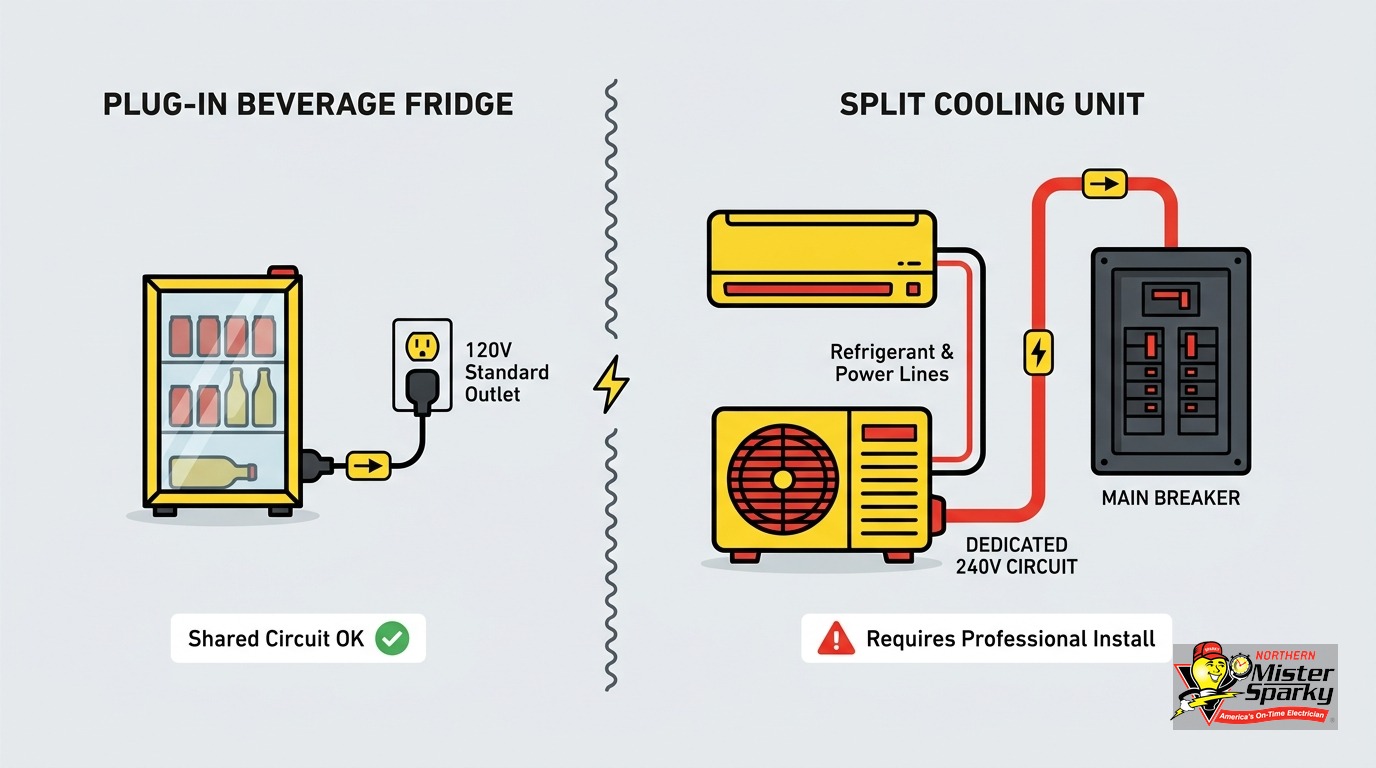
- Self-contained through-the-wall units run on 110-120V and plug into a dedicated outlet. Split cooling systems need a dedicated 240V circuit, a new breaker, and a permit.
- Circuit size comes from the MCA and MOCP values on the equipment nameplate. The “running watts” on the product listing are not used.
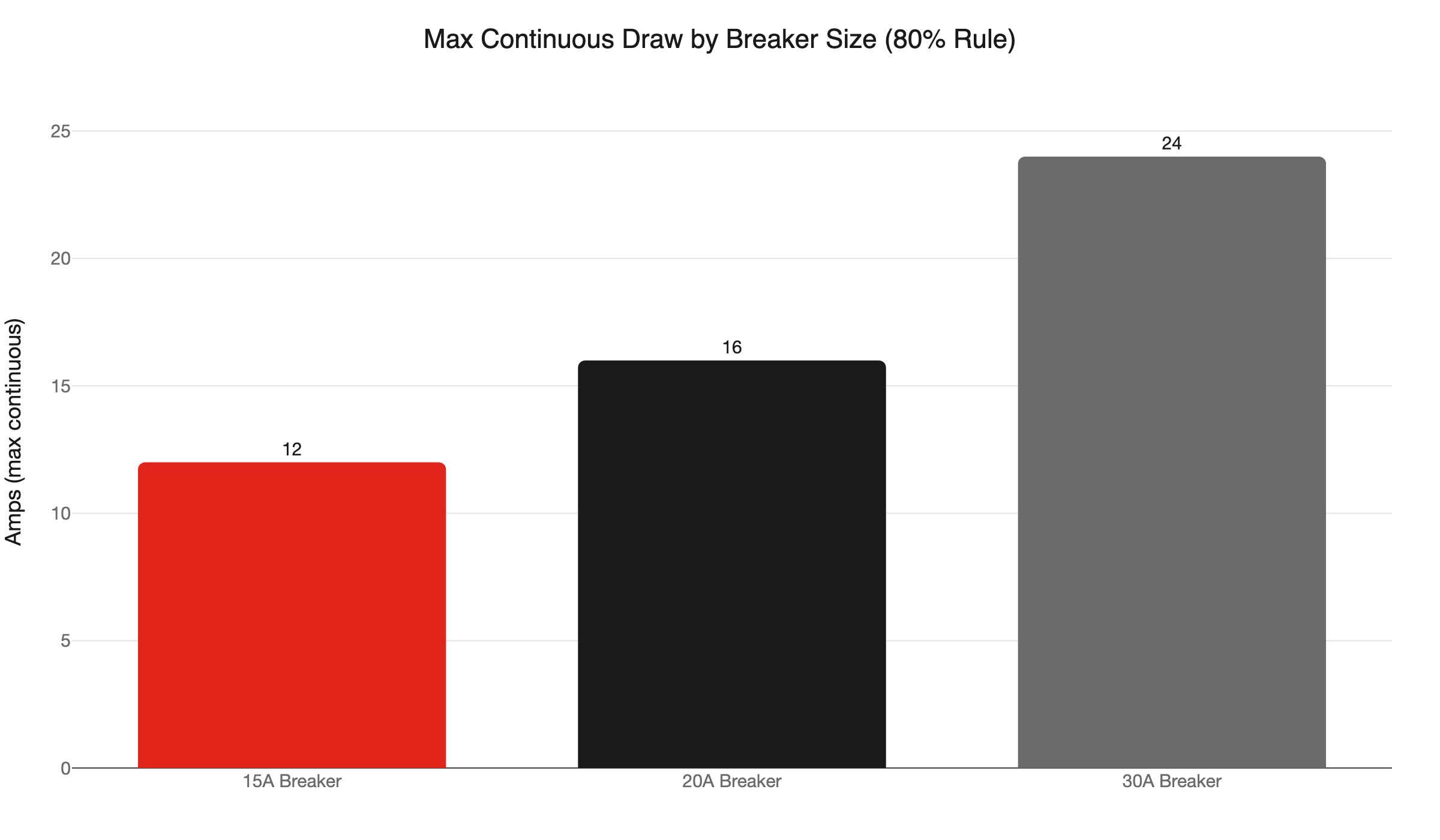
- Wine cooling units are continuous loads. The 80% rule means a 20A circuit safely carries only 16A of continuous draw.
- Compressor startup surge runs 400% to 600% of running amperage. That is why a unit drawing 8A at steady state typically needs a 20A circuit.
- Larger split systems often need two separate circuits: one for the evaporator and one for the condensing unit.
- In Minnesota, any new 240V circuit requires a permit. As of August 17, 2026, all new permits must comply with the 2026 NEC.
- GFCI protection is required in damp cellar environments.
Which Wine Cellar Cooling System Fits Your Space?
Short answer: Self-contained units suit smaller cellars with exterior wall access. Split systems handle larger spaces, interior rooms, and high-capacity builds. The choice determines whether the electrical work is a plug-in outlet or a licensed circuit installation from your panel.
Self-contained (through-the-wall) units house the evaporator and condenser in a single housing that mounts in an exterior or partition wall. The condenser faces outside; the evaporator faces the cellar. They run on 110-120V and draw 3-6 amps. A standard dedicated outlet handles them.
Split systems are a different scope. The evaporator mounts inside the cellar. The condensing unit mounts outside or in a separate mechanical room. The two connect by refrigerant lines and electrical conduit. Split systems are quieter inside the cellar, handle larger volumes, and work in rooms without exterior wall access. They run on 230V and draw 8-15 amps. They require a licensed electrician to wire.
Ducted split systems add a third category. They distribute cooled air through ductwork to the cellar space. Depending on the model, they run on 110V or 230V, with a 4-15 amp draw. The same dedicated circuit rules apply.
If you have a countertop wine cooler or beverage refrigerator, the post on wine cooler and beverage fridge dedicated circuits covers that smaller-scale case. For what a dedicated outlet looks like on the 120V side, types of electrical outlets for Twin Cities homes explains the requirements that apply to standard plug-in wine cooling equipment.
What Voltage and Amperage Does a Split Cooling System Require?
Short answer: Most ductless split systems run on 230V and draw 8-15 amps at steady state. The exact circuit requirements come from the equipment nameplate, not the product spec page. Have the model number ready before the electrician arrives.
Even a unit drawing only 3 amps at steady state requires its own dedicated circuit. That rule applies across all wine cooling unit types, not just split systems.
For a split system at 8-15A on 230V, a dedicated 240V circuit with a 20A breaker is the common starting point. The exact size is not pulled from the running-amps figure on the product listing. It comes from two values on the equipment nameplate: the MCA (Minimum Circuit Ampacity) and the MOCP (Maximum Overcurrent Protection). If you do not have the unit yet, share the model number with your electrician before the site visit. They can pull the manufacturer’s installation spec sheet and size the circuit accurately before you order.
Do Wine Cellar Cooling Systems Use a Lot of Electricity?
Short answer: They do not draw massive power, but they run almost continuously. That makes them a continuous load under the NEC. The 80% continuous-load rule applies: a 20A circuit safely carries only 16A of constant draw, even if the unit runs at 8A steady state.
Any load that operates for three or more consecutive hours qualifies as a continuous load under the National Electrical Code. A wine cellar cooling unit maintains a stable temperature around the clock. It qualifies.
A 15A breaker supports only 12A of continuous draw. A 20A breaker supports only 16A. This is the same rule that governs laundry room circuits and other continuous-draw appliances across Minnesota homes.
A unit running at a comfortable 8A steady state still needs a 20A circuit. Not because the running draw demands it, but because the math on continuous load and startup inrush requires the headroom. A 20A circuit is not oversized. It is correctly sized.
How Does Your Electrician Actually Size the Circuit?
Short answer: NEC Article 440 governs refrigerant motor-compressors. It requires branch-circuit conductors sized to at least 125% of the nameplate MCA. Maximum overcurrent protection is allowed up to 175% of compressor current. Both values appear on the equipment nameplate, not the product listing.
NEC Article 440 requires branch-circuit conductors sized to a minimum of 125% of the nameplate rated-load current (the MCA). Maximum overcurrent protection (the MOCP) is capped at a code-specified percentage of compressor current. The electrician reads those values from the nameplate and applies the code. The running-watts figure on the product page is not part of the calculation.
Startup surge is the second factor. When the compressor kicks on, it draws 400% to 600% of its running amperage. A unit with an 8A running draw can briefly pull 32-48A at startup. The breaker and conductors must handle that without nuisance tripping. The nameplate MOCP value accounts for it. The running-amps figure does not.
This is the same nameplate-driven sizing logic used for HVAC equipment, heat pump dryers, and other motor-compressor loads. Your electrician is reading the equipment, not guessing from the product description.
What Wire Gauge Does a Wine Cellar Circuit Need?
Short answer: 12 AWG is standard for a 20A circuit. Longer runs or higher-capacity split systems may require 10 AWG to keep voltage drop under 3% below nominal. Excess voltage drop causes the compressor motor to run hotter and shortens equipment life.
Code minimums are: 14 AWG for a 15A circuit, 12 AWG for a 20A circuit. For remote split systems, 10 or 12 AWG is often specified depending on run length and the equipment nameplate.
Voltage drop is the practical reason gauge matters beyond minimum ampacity. A long conduit run from the panel to a basement cellar is exactly where an electrician steps up to 10 AWG even when 12 AWG would meet the minimum requirement. The equipment warranty may also specify a maximum allowable voltage drop. Check the install manual before your electrician runs the wire.
When Does a Split System Need Two Separate Circuits?
Short answer: Larger split systems wire the evaporator and condensing unit on separate circuits. Expect a 15A circuit for the evaporator and a 20-25A circuit for the condensing unit. That is two breakers and two conduit runs, not one.
This surprises many homeowners. One cooling system, two separate breakers. The explanation is straightforward: the two components are separate electrical loads, and the manufacturer specifies them that way.
Larger split systems like the CellarPro line specify a dedicated 15A breaker for the evaporator and a separate 20-25A dedicated breaker for the condensing unit, with the exact amperage depending on the model.
If the electrician is quoting a split system installation and you expect one circuit, ask specifically about the condensing unit. If the model requires two circuits, the quote must reflect both. Have the model number ready before the site visit. That is the fastest path to an accurate estimate and prevents a surprise on the final invoice.
What Temperature Should a Wine Cellar Be?
Short answer: The accepted range for long-term wine storage is 55-58 degrees Fahrenheit. Reds are served around 60-65 degrees; whites at 45-55 degrees. The cooling system keeps that range stable year-round, and the circuit must support it at full continuous-load capacity through every Minnesota season.
The temperature setpoint is a cellar design question, not strictly an electrical one. But it has a practical effect on the electrical scope. A cellar that fights heat gain through thin insulation or a warm mechanical room will run the compressor more often, drawing continuous current for more of the day. The circuit must be sized to handle that at peak demand.
In Minnesota, that means accounting for both summer cooling demand and the damp basement conditions that drive condensation risk. A cellar built against a frost wall has different insulation requirements than one in a finished lower level. The cooling unit compensates for whatever the construction does not manage. The circuit must support the full continuous load, whatever that turns out to be.
What Are the Permit Requirements in Minnesota?
Short answer: Any new 240V dedicated circuit in Minnesota requires a permit. About 66 Minnesota cities, including Minneapolis and Saint Paul, are their own Authority Having Jurisdiction (AHJ). All others file with state DLI. As of August 17, 2026, all new permits must comply with the 2026 NEC.
Per Minnesota DLI, permits must be filed before work begins. Starting work without a permit triggers an investigation fee on top of normal permit costs. That is a real penalty, not a formality.
About 66 Minnesota cities operate as their own AHJ. Minneapolis, Saint Paul, and most major suburbs manage their own permit process and inspectors. Homeowners outside that list file with the state DLI at ims.dli.mn.gov.
A common question: can a homeowner pull the permit themselves? In Minnesota, a homeowner can pull their own permit on a single-family home they own and occupy. But the work still requires a licensed electrical contractor. Pulling the permit does not authorize you to do the wiring.
The electrical permit guide for Minnesota homeowners covers the full AHJ lookup, the filing process, and what inspectors check at rough-in and final.
Is GFCI Protection Required in a Wine Cellar?
Short answer: Yes, in a damp location. Most below-grade cellars qualify. The 2026 NEC tightened GFCI requirements for damp locations and outdoor condensing unit placements, effective August 17, 2026 in Minnesota. An inspection is the safeguard that catches gaps before they become a hazard.
GFCI protection is required in damp cellar environments. A below-grade or basement cellar that accumulates condensation qualifies as a damp location under the NEC. The outdoor condensing unit location also falls under GFCI and weatherproof cover requirements.
GFCI stands for Ground Fault Circuit Interrupter. It detects current leakage to ground and trips the circuit before a dangerous shock can occur. In a damp environment where moisture can compromise an outlet or connection, GFCI protection is not optional.
The 2026 NEC update, in force for all Minnesota permits filed on or after August 17, 2026, extended GFCI requirements for outdoor condensing units and broadened damp-location coverage. A licensed electrician running your cellar circuit will apply the right code provision to each part of the installation.
The Condensate Pump: A Second Circuit on the Quote
Split cooling systems produce condensate. In a cellar without a floor drain or gravity outlet, a condensate pump handles drainage. The pump needs power.
That power typically comes from a standard 120V outlet near the evaporator unit. In most installations, that outlet is on its own circuit, separate from the 240V cooling circuit. It is a small line item on the quote, but homeowners who have not read the install manual often do not know to ask about it.
When getting quotes, ask specifically: “Does the condensate pump require a separate outlet, and is that scope included?” The answer varies by system and cellar layout. Asking the question prevents a surprise on the final invoice.
Other specialty rooms in the home share this same circuit-planning discipline. If you are planning a high-investment space elsewhere, the post on home recording studio electrical requirements in Minnesota walks through the same dedicated circuit planning process for another purpose-built room.
What About Utility Rebates?
Short answer: There is no current Xcel Energy rebate for wine cellar cooling circuits or equipment. Xcel’s Conservation Improvement Program covers heat pumps, central A/C at or above 13.4 SEER2, smart thermostats, and insulation. Wine cellar cooling does not appear on the current program list.
If you are adding a wine cellar circuit alongside other energy efficiency work, it is worth checking whether the adjacent work qualifies under the CIP. For the cellar circuit and equipment itself, no utility rebate path has been identified based on current program terms.
Ready to Wire Your Wine Cellar?
A split wine cooling system is a real electrical project. It is not a plug-in appliance job. It involves a new 240V circuit, nameplate-driven conductor sizing, conduit from your panel, a permit, an inspection, and GFCI protection in a damp environment.
Done right, the circuit is sized to the nameplate, the wire runs clean, and the cooling system runs reliably for years.
Northern Mister Sparky is locally owned and operated in the Twin Cities. As America’s On-Time Electrician(R), we pull permits, pass inspections, and size circuits from the nameplate. Our UWIN(R) satisfaction guarantee means the work is right before we leave.
Call 763-200-5956 or schedule an appointment online to get a quote on your wine cellar electrical work.
Frequently Asked Questions
Can my wine cellar cooling unit share a circuit with another appliance? +
Can the condensate pump share the 240V cooling circuit? +
Need an electrician now?