
Wine Cooler Dedicated Circuit: Do You Really Need One?
Key Takeaways
- A wine cooler draws only 1-2 amps and 85-200 watts in steady operation. Any standard circuit can handle that load.
- The dedicated circuit question is about reliability, not raw power. Sharing a circuit works until it does not.
- The NEC does not strictly require a dedicated circuit. A wine cooler may share one of the two required 20A small appliance branch circuits in the kitchen.
- Most manufacturer manuals specify a dedicated, grounded outlet. NEC 110.3(B) makes those manuals part of the code. An inspector can require a dedicated circuit on that basis alone.
- Compressor-type wine fridges surge on startup. Thermoelectric models do not. The type changes the risk calculation.
- Kitchen wine cooler circuits require both AFCI and GFCI protection. Finished basement bar areas require AFCI protection too.
- Minnesota adopted the 2026 NEC effective August 17, 2026. Any permit pulled today falls under the new edition.
- A licensed electrician must pull the permit for any new circuit in Minnesota. DIY permits are not available for this type of work.
Does a Wine Cooler Need a Dedicated Circuit?
The NEC does not strictly require one, but your wine cooler’s manufacturer manual probably does. Under NEC 110.3(B), that manual carries legal code weight. If the breaker is tripping on a shared circuit, the fix is almost always a dedicated circuit - not a different outlet or a different spot on the kitchen counter.
A wine cooler draws very little electricity in normal operation: 1-2 amps and 85-200 watts, depending on model and capacity. Any standard 15A or 20A household circuit can handle that load many times over. Ampacity is not the issue.
What the NEC actually addresses is where a wine cooler is permitted to be placed. Section 210.52(B)(1) requires at least two 20A small appliance branch circuits for kitchen and pantry counter receptacles. A wine cooler may share one of those circuits. Exception No. 2 to that section also permits an individual branch circuit rated 15A or higher for an appliance like a wine cooler.
So far, no strict requirement. Here is where it changes.
Most wine cooler and beverage center manufacturers include a line in their installation manual that specifies a dedicated, grounded 15A or 20A outlet. NEC 110.3(B) requires that equipment be installed in accordance with its listing, labeling, and manufacturer instructions. That clause turns a manufacturer preference into a code requirement. An inspector can enforce it.
“Allowed by code” and “a good idea” are also different things. The circuit the code allows a wine cooler to share is the busiest branch in your house. It carries the coffee maker, toaster, air fryer, microwave, and every other counter appliance in the kitchen. Putting a compressor-cycle appliance on that branch is asking for trouble on any busy morning.
What Does the NEC Actually Say About Wine Cooler Dedicated Circuits?
The NEC permits sharing a circuit, but NEC 110.3(B) elevates the manufacturer’s installation instructions to code status. If the manual specifies a dedicated circuit, the inspector can require it - regardless of what the base wiring rules would otherwise allow.
The three sections every homeowner and remodeler should know:
NEC 210.52(B)(1) is the “two 20A SABCs for the kitchen” rule. These circuits carry the heaviest intermittent loads in a home. A wine cooler is technically permitted on one of them under the base rule.
NEC 110.3(B) is where the dedicated circuit requirement gets teeth. Equipment must be used in accordance with its listing and manufacturer instructions. Permit reviewers and inspectors apply this consistently to refrigerating appliances. If the manual says dedicated, the inspector treats it as code.
NEC 210.12 and NEC 210.8 cover AFCI and GFCI requirements. Kitchen circuits require arc fault circuit interrupter protection. Kitchen receptacles require ground fault circuit interrupter protection. Both apply to any circuit serving a kitchen wine cooler, whether dedicated or shared.
The practical takeaway: when you pull a permit to add a wine cooler circuit, the electrician verifies what your specific unit’s manual requires and what your location’s protection rules are. Plan for both.
Why Does a Wine Cooler Trip the Breaker on a Shared Circuit?
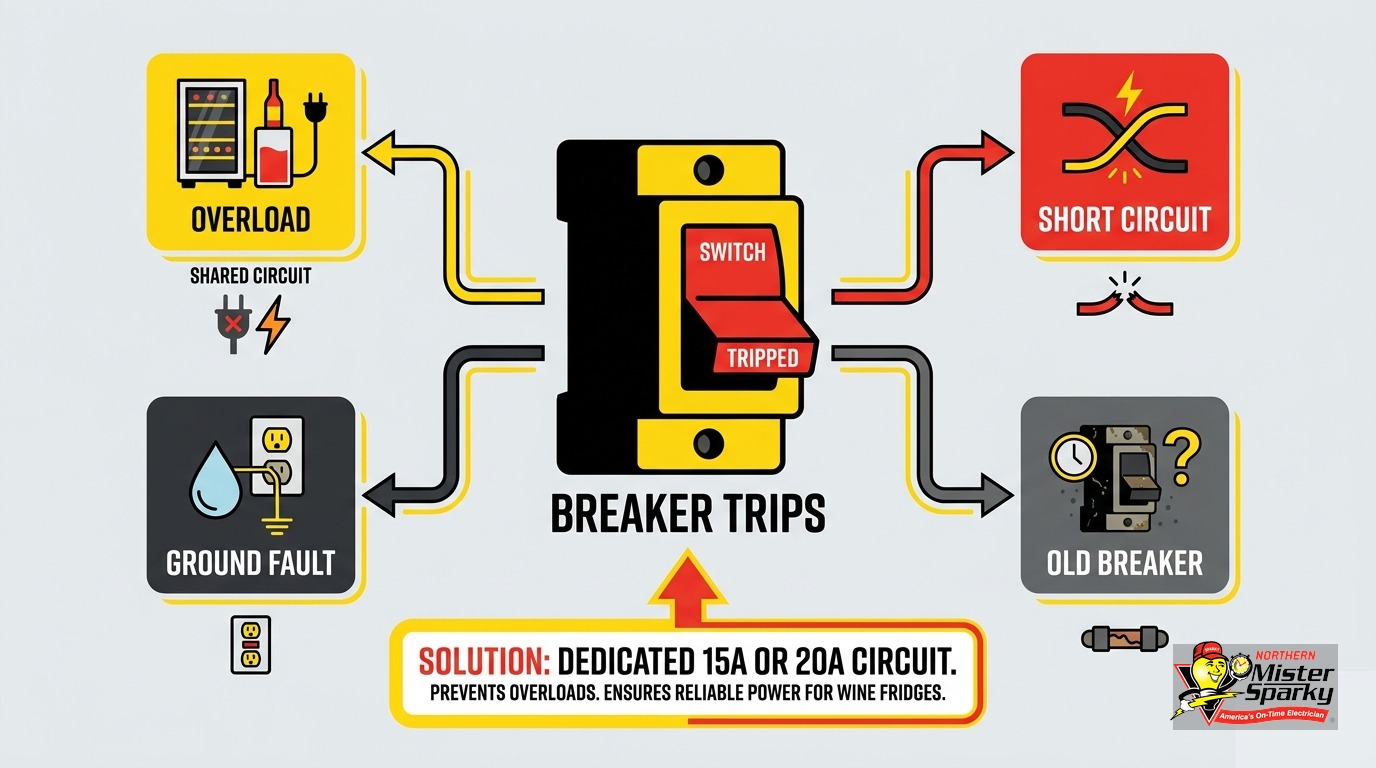
The wine cooler itself is not the heavy load. It draws only 1-2 amps running steady. The breaker trips because the compressor’s startup surge arrives at exactly the moment the toaster, coffee maker, or refrigerator defrost heater is already running. The combined inrush exceeds the breaker’s trip threshold.
This is the explanation competitors miss. The generic answer - “a wine cooler only draws 1-2 amps, so it should not trip anything” - is true in isolation. In a real kitchen, it is misleading.
Here is the sequence that actually causes the trip on a shared 20A small appliance branch circuit:
- The toaster runs. That is a sustained resistive load, several amps.
- The coffee maker heats water. Another sustained load on the same circuit.
- The refrigerator defrost heater fires. A defrost heater can pull roughly the same amperage as a coffee maker, suddenly and without warning, in the middle of an ordinary morning.
- At that exact moment, the wine cooler compressor cycles on. A motor starting from rest draws several times its steady-state amperage for the first fraction of a second. That inrush adds to the existing load on the branch.
- The combined instantaneous draw on the 20A breaker exceeds its trip threshold.
The breaker trips. The wine fridge takes the blame because its compressor was the last thing to switch on. But every appliance on that branch contributed.
This is a physics problem, not a circuit-quality problem. Moving the wine cooler’s plug to a different outlet on the same branch does not fix it. Running a dedicated circuit for the wine cooler eliminates the problem entirely. The compressor’s inrush has the whole branch to itself on startup.
One more factor: the compressor does not just surge on the first startup of the day. It cycles on and off repeatedly as it maintains temperature. Every cycle is another opportunity for the inrush to coincide with a loaded circuit.
Thermoelectric vs. Compressor Wine Fridges: Does the Type Matter?
Yes, significantly. A thermoelectric wine fridge has no compressor and no startup surge whatsoever. A compressor model behaves electrically like a small refrigerator and surges every time the compressor cycles. The type of unit changes the tripping risk calculation on a shared circuit.
Thermoelectric models use a solid-state module - the Peltier effect - to move heat out of the cabinet. No moving parts, no compressor, no startup surge. Steady-state draw is modest and consistent. If a thermoelectric wine fridge is tripping a circuit, look for an actual overload or a fault elsewhere on the branch, not compressor inrush.
Compressor models - which include most built-in 18-inch and 24-inch units, most larger-capacity wine fridges, and most beverage centers designed for regular use - cycle their compressors on and off to maintain the set temperature. Every cycle produces a short burst of inrush current. That burst is manageable on a dedicated branch. On an already-loaded shared circuit, it is the load that pushes the breaker over.
Larger built-in compressor wine coolers and dual-zone beverage centers deserve the same circuit planning consideration as a full-size refrigerator. If you are also sorting out the kitchen refrigerator circuit at the same time, our post on refrigerator dedicated circuit code covers those rules side by side.
The practical rule: if the manual says dedicated circuit and the unit has a compressor, run the dedicated circuit. That combination puts the question to rest.
Kitchen vs. Finished Basement: The AFCI and GFCI Rules Differ
Two of the most common locations for a built-in wine cooler are a kitchen remodel and a finished basement bar. The electrical protection requirements for each location are not the same - and the difference matters for permit compliance.
Kitchen installation. Any circuit serving a kitchen receptacle in a dwelling unit requires AFCI protection under NEC 210.12 and GFCI protection under NEC 210.8. AFCI (arc fault circuit interrupter) detects dangerous arc conditions that can ignite fires inside wall wiring. GFCI (ground fault circuit interrupter) cuts power in milliseconds when a fault-to-ground is detected near water.
Some jurisdictions recognize a GFCI exception for receptacles serving refrigeration equipment on a dedicated circuit. That exception is authority-having-jurisdiction (AHJ) specific - it depends on how your local inspector interprets the code. Do not assume it applies. A combination AFCI/GFCI breaker handles both requirements in a single device. Our post on combination AFCI/GFCI breakers explains how those work and when they are the right choice for an appliance circuit.
Finished basement bar. A common assumption in the Twin Cities: the basement is just GFCI territory. That is accurate for unfinished utility areas. A finished rec room or basement bar is a habitable space under the NEC, and habitable spaces require AFCI-protected circuits. If you are adding a wine fridge to a finished basement wet bar or a built-in cabinet, that circuit needs AFCI protection - not just a GFCI outlet.
This catches Twin Cities homeowners off guard more often than almost any other code requirement. Many finished basements were wired before AFCI requirements expanded to cover habitable spaces. When you pull a permit for a new circuit today, that new circuit is installed to current code, even if the rest of the basement wiring predates it.
If you are adding circuits to a finished basement and want to understand the full scope of what a project like that involves, our post on basement finishing electrical costs covers what a typical permit and installation looks like.
Minnesota’s 2026 NEC Update: What It Means for Your Wine Cooler Circuit
Minnesota adopted the 2026 NEC effective August 17, 2026. Any permit filed on or after that date is governed by the 2026 NEC. Permits filed before August 17 fall under the 2023 NEC. If you are mid-remodel and unsure which edition applies to your project, confirm with the AHJ for your municipality.
No Minnesota-specific amendments found in DLI materials change the wine cooler circuit requirements. The state follows NEC without major residential deviations on this topic. The core requirements - two 20A SABCs for the kitchen, AFCI in kitchen and habitable spaces, GFCI at kitchen receptacles, NEC 110.3(B) enforcing manufacturer instructions - have been consistent across recent code editions.
What the edition change means practically: inspectors in Minnesota are working from the 2026 NEC now. If your electrician previously had an interpretation they relied on under the 2023 edition, that needs to be confirmed under the new code before work starts. The straightforward path is to pull the permit and let the inspection process do what it is designed to do.
One requirement that has not changed and will not: a licensed electrical contractor must pull the permit for any new circuit in Minnesota. Chapter 1315 of the MN State Building Code adopts NFPA-published NEC, and homeowner self-permit for branch circuit work is not permitted under Minnesota electrical licensing law. If a contractor offers to add a circuit without pulling a permit, that is a clear warning sign.
What Does a Wine Cooler Dedicated Circuit Installation Involve?
A licensed electrician runs a new 15A or 20A branch circuit from the panel to the wine cooler location, installs the correct breaker type for the location (AFCI, GFCI, or both), puts in a properly rated grounded receptacle, and schedules the permit inspection. In most Twin Cities homes with an accessible panel and an open basement, this is a half-day job.
Here is the typical sequence from start to finish:
Panel assessment. The electrician confirms the panel has an available breaker slot and capacity for a new circuit. Older Twin Cities homes with undersized panels sometimes reach their slot limit during kitchen or basement remodels. If the panel is at capacity, the options include a tandem breaker (if the panel accepts them) or a panel upgrade. Your electrician will know after a look.
Permit. Required for new circuits in Minnesota. The electrician files it. Permit fees vary by municipality.
Wire run. The electrician routes wire from the panel to the wine cooler location. In an open unfinished basement with good access, this is straightforward. In a finished space - a tiled kitchen backsplash area, a drywalled basement bar - the electrician may need to fish wire through existing walls or run exposed conduit where it is code-permitted and aesthetically acceptable.
Breaker and receptacle installation. The breaker is sized for the circuit (15A or 20A) and selected for the required protection type: standard, AFCI, or combination AFCI/GFCI based on the installation location. A properly rated grounded receptacle goes at the wine cooler location.
Inspection. The permit requires an inspection. The inspector verifies the correct breaker type for the location, proper wire gauge matched to the breaker size, code-compliant receptacle, and overall workmanship. The wall cannot be closed before inspection on rough-in work.
For a rough sense of what circuit work costs in the Twin Cities, our post on the cost to run a new electrical circuit covers typical ranges. Finished-space runs cost more than open-basement runs, and longer distances from the panel add to the material and labor cost.
Is a Wine Cooler Dedicated Circuit Worth the Investment?
Yes, in most cases. The cost of a dedicated circuit is modest compared to the cost of wine spoilage, repeated breaker resets, and potential compressor damage from abrupt power shutoffs. If the manufacturer’s manual requires one, the question is already settled.
Here is how the decision breaks down:
You have a wine cooler and it is tripping the breaker. Run a dedicated circuit. The root cause is the shared branch and compressor inrush. No outlet rearrangement will fix a physics problem.
You are planning a kitchen remodel. Rough-in a dedicated wine cooler circuit during the project. Wiring during a remodel - when walls are open and the work is already permitted - costs far less than coming back to add it after the tile is up and the cabinets are in.
You are finishing a basement bar. Include the wine cooler circuit in the project scope from the start. The finished basement location requires AFCI protection regardless. Plan for it in the original permit scope, not as an afterthought.
Your unit is thermoelectric and has never tripped anything. A dedicated circuit still adds reliability. But the urgency is lower than for a compressor model. Check the manual. If it does not specify a dedicated circuit, the decision is optional.
Your manual specifies a dedicated circuit. Follow it. NEC 110.3(B) makes that instruction code-enforceable. Skip it now, and it becomes an issue during a future home inspection or sale.
The honest bottom line: wine coolers are low-draw appliances, but they share circuits with the highest-intermittent-load branch in the house. A dedicated circuit is inexpensive prevention. It eliminates a whole category of problems for the life of the installation.
Ready to Schedule Your Wine Cooler Dedicated Circuit?
Our team at Northern Mister Sparky handles wine cooler dedicated circuit installations throughout the Twin Cities - Minneapolis, St. Paul, Bloomington, Maple Grove, Plymouth, Woodbury, Blaine, and Brooklyn Park. We are locally owned and operated, and we pull permits the right way every time.
As America’s On-Time Electrician(R), we show up when we say we will. With our UWIN(R) 100% satisfaction guarantee, the work is done right or we make it right. No malarky.
Call 763-200-5956 or book online to get on our schedule.
Frequently Asked Questions
Does a wine cooler need a dedicated circuit? +
Why does my wine cooler keep tripping the breaker? +
Do I need a permit to add a wine cooler circuit in Minnesota? +
Need an electrician now?