
Cold Plunge Tub Electrical Requirements: A Minnesota Guide
Key Takeaways
- Cold plunge tubs fall into three electrical tiers: 120V passive (no chiller), 120V chiller, and 240V chiller. Each tier has different circuit and protection requirements.
- 120V circuits require GFCI protection. 240V circuits require GFEP (Ground Fault Equipment Protection), which is built into the panel-level breaker. There is no 240V GFCI receptacle.
- NEC 680.26 requires equipotential bonding of all metal structural components and any metal within 5 feet of the water. The bonding conductor must be at least 8 AWG solid copper. Bonding is separate from grounding.
- No receptacle is permitted within 5 feet of the inside wall of the tub. Receptacles between 5 and 10 feet must be GFCI-protected.
- Minnesota adopted the 2026 NEC on August 17, 2026. Permits pulled today are under the newer code edition.
- A permit is required for any new circuit serving a cold plunge in Minnesota. MN Statute 326B.33 requires a licensed electrician for this work. There is no DIY exemption.
- Outdoor installations require in-use weatherproof covers, conduit to frost depth, and NEMA 3R-rated enclosures.
What Are the Cold Plunge Tub Electrical Requirements?
Cold plunge tub electrical requirements depend on the unit’s voltage tier and whether it has a chiller. Plug-in 120V models need a GFCI-protected outlet at least 5 feet from the tub. Chiller-equipped 240V models require a dedicated circuit, GFEP protection at the panel, and equipotential bonding of all nearby metal components. A permit and licensed electrician are required for all of this work in Minnesota.
Cold plunge tubs have moved from niche athlete gear into mainstream home wellness. Walk into any Twin Cities hardware store and you will find models ranging from a few hundred dollars to over $5,000. What the marketing materials rarely explain: the electrical requirements vary dramatically by model. Get them wrong and you fail inspection, void your warranty, or create a shock hazard in standing water.
This guide covers the requirements that apply to Minnesota homeowners today, including what changed when Minnesota adopted the 2026 NEC on August 17, 2026.
Which Electrical Tier Does Your Cold Plunge Fall Into?
The biggest mistake homeowners make is treating all cold plunge tubs as the same electrical job. There are three distinct tiers, and the wiring requirements are completely different for each one.
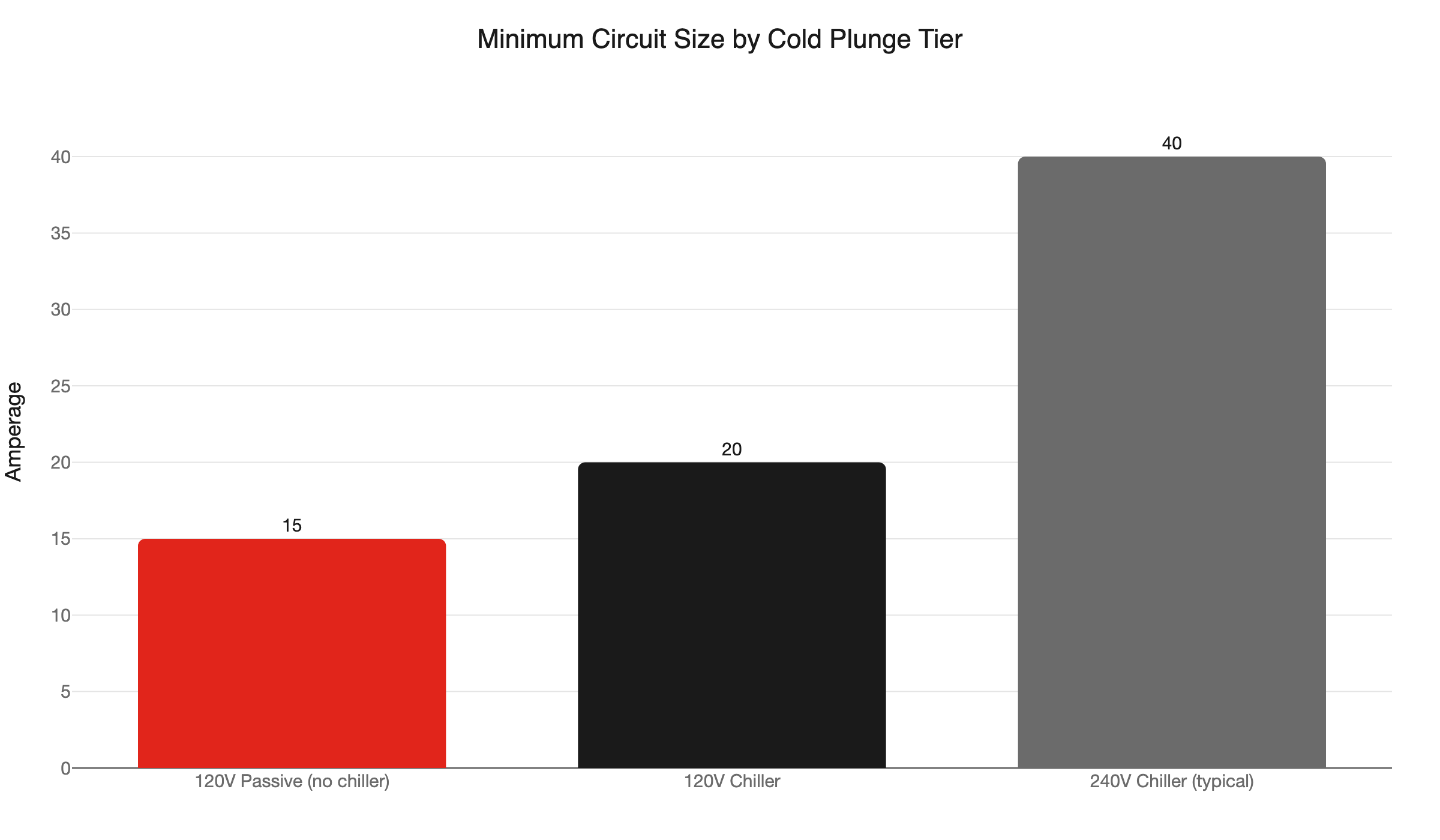
Tier 1: 120V passive (no chiller) These are barrel-style or inflatable tubs with no built-in cooling. You chill the water with ice. Electrically, these behave like a basic plug-in appliance. They typically draw 5 to 10 amps. A 15A or 20A GFCI-protected circuit handles the load. If the unit is truly portable and not permanently plumbed, it falls under the storable unit rules of NEC 680.42.
Tier 2: 120V chiller-equipped Some chiller units operate at 120V and draw 10 to 15 amps. They need a dedicated 20A GFCI-protected circuit. Sharing this circuit with other loads will cause nuisance tripping because chiller compressors draw a startup surge well above their running amperage.
Tier 3: 240V chiller-equipped Most mid-range and premium chiller units operate at 240V and draw anywhere from 15 to 40 amps depending on the model. These require GFEP protection at the panel level, not a standard GFCI outlet. The circuit requirements and bonding obligations are more involved. This tier also requires the correct receptacle type, commonly a NEMA 6-20 or NEMA 6-30, or sometimes a hardwired connection.
Check the unit’s nameplate or spec sheet before calling an electrician. It will list the voltage, amperage draw, and minimum circuit breaker size. That information is your starting point for the installation conversation.
What Is the Difference Between GFCI and GFEP Protection?
GFCI (Ground Fault Circuit Interrupter) is designed to protect people. It trips at 5 to 6 milliamps of ground fault current and is available for 120V circuits only. GFEP (Ground Fault Equipment Protection) is required by NEC Article 680 for 240V circuits in aquatic locations. It trips at a higher threshold designed to protect equipment and prevent electrolysis damage. The two are not interchangeable, and the distinction matters for anyone installing a 240V cold plunge.
This is the most common point of confusion in consumer cold plunge content, and it is also the most dangerous. A homeowner reads “you need GFCI protection” and tries to source a 240V GFCI outlet. That outlet does not exist. Standard GFCI receptacles are 120V devices.
For 240V circuits, the NFPA 70 (National Electrical Code) requires GFEP, which is typically built into the 240V circuit breaker at the main panel or provided by a listed GFEP device. A licensed electrician installs this during the circuit rough-in. You cannot add it after the fact with an adapter or a receptacle swap.
The rule comes from NEC Article 680, which governs pools, spas, hot tubs, and permanently installed immersion units. If your chiller-equipped cold plunge is hard-plumbed to a water source and stays in one location, it is treated as a permanently installed spa or hot tub under Article 680.43. That classification triggers the full spa wiring requirements: GFEP, bonding, and the receptacle clearance rules.
If the unit is genuinely portable (not permanently plumbed, moved regularly), it may fall under NEC 680.42 for storable units. The requirements are slightly different, but GFCI protection remains mandatory at the circuit level regardless.
For a side-by-side comparison of GFCI breakers and GFCI outlets, see our post on GFCI vs. GFCI outlet comparison.
Does a Cold Plunge Tub Need a Dedicated Circuit?
Yes, in almost every case involving a chiller. 120V chiller units require a dedicated 20A circuit. 240V units require their own dedicated circuit sized to the unit’s amperage draw. Passive (no-chiller) units can work on a shared circuit, but a dedicated circuit is still best practice.
A dedicated circuit means the breaker serves the cold plunge and nothing else. No other outlets, lighting, or appliances share that breaker.
Chiller compressors draw significantly more current at startup than during steady-state operation. That startup surge, sometimes two to three times the running amperage, will trip a shared breaker if another load is already drawing current. A dedicated circuit eliminates that problem entirely.
For 240V models, confirm the required receptacle type with the unit’s spec sheet before scheduling the work. Ordering the wrong outlet type delays the job. Our post on dedicated circuits for home appliances explains the general rules for when and why a dedicated circuit is required.
What Are the Bonding Requirements for a Cold Plunge Tub?
NEC 680.26 requires equipotential bonding of all metal structural components, all pump motors, and any metal within 5 feet of the water. The bonding conductor must be a minimum 8 AWG solid copper wire. This is one of the most consistently overlooked requirements in consumer-facing cold plunge content, and it is one of the most important safety measures in the installation.
Bonding does not carry fault current. It equalizes voltage potential between all metal surfaces near the water. If there is a fault and metal surfaces sit at different voltage potentials, current flows through the water - and through anyone in it. Bonding eliminates that condition by keeping every metal surface at the same potential.
What must be bonded:
- The tub’s metal structural shell or frame
- The pump motor and its housing
- Any metal ladder, railing, or step within 5 feet of the water’s edge
- Metal water inlet and outlet fittings if the unit is permanently plumbed
The bonding conductor ties all of these to a common bonding lug, which connects back to the grounding electrode system at the main panel. It is a separate, dedicated conductor. The equipment grounding conductor inside the supply cable does not substitute for bonding. An electrician installs it as part of the rough-in, before the unit is set in place.
For a deeper explanation of why bonding and grounding are different things, see our post on electrical bonding and grounding explained.
Indoor vs. Outdoor Cold Plunge Tub Electrical Rules
Location affects the installation requirements. Whether the tub goes in a basement, garage, three-season porch, or backyard determines additional code obligations on top of the core Article 680 rules.
Indoor placement Indoor locations are typically simpler. Conduit runs are shorter, weatherproofing requirements are reduced, and frost depth does not apply. The Article 680 protection requirements (GFCI or GFEP, bonding, receptacle clearances) still apply regardless of whether the unit is inside or outside.
One indoor-specific consideration: ventilation. Chiller units exhaust heat into the room. In a small basement mechanical room, that exhaust raises ambient temperature and can reduce chiller efficiency or shorten equipment life. Confirm the unit’s ventilation clearances before choosing a location.
Outdoor placement Outdoor installations add several requirements:
- Weatherproof covers. Receptacles must use “in-use” weatherproof covers - the hinged bubble-style cover that stays closed even with a cord plugged through it. A standard WR-rated (weather-resistant) outlet alone is not sufficient for Minnesota year-round exposure.
- Conduit for underground wiring. Any underground wiring from the panel to the tub location must run in conduit. RMC (rigid metal conduit), IMC (intermediate metal conduit), or Schedule 80 PVC are acceptable. Schedule 40 PVC is permitted only beneath a concrete slab.
- Frost depth. In the Twin Cities metro, buried conduit must reach 42 to 48 inches to clear the frost line. The exact depth depends on the municipality. Minneapolis and St. Paul can differ from suburban jurisdictions. Your electrician will confirm the depth requirement with the authority having jurisdiction before the permit is pulled.
- Enclosure ratings. Panels, disconnects, and junction boxes exposed to the weather must be rated NEMA 3R (raintight) at minimum.
For general guidance on outdoor circuits and planning, see our post on deck and patio outdoor electrical planning.
What Minnesota Code Governs Cold Plunge Tub Electrical Work?
Minnesota adopted the 2026 NEC effective August 17, 2026. Any permit pulled on or after that date is under the 2026 edition of the code. Permits pulled before that date were under NEC 2023. The state’s statewide licensing law, MN Statute 326B.33, applies to all electrical work on cold plunge tubs, spas, and hot tubs statewide.
The timing matters. The 2026 NEC took effect in Minnesota just weeks ago. Any guide, brand installation manual, or forum post citing “NEC 2023 requirements” is already outdated for permits pulled in Minnesota today. The 2026 edition includes revisions to Article 680 that affect aquatic location installations.
Minnesota also runs its own statewide electrical inspection program, separate from local building departments. The Minnesota Department of Labor and Industry, Electrical Division oversees inspections directly. State-assigned inspectors handle residential cold plunge, spa, and hot tub circuits. You can reach the Electrical Division at dli.electricity@state.mn.us or 651-284-5026.
That state jurisdiction means there is no local opt-out. The code is the same in Maple Grove, Woodbury, Blaine, and Minneapolis.
Do You Need a Permit for Cold Plunge Electrical Work in Minnesota?
Yes, without exception. Any new circuit or dedicated outlet serving a cold plunge, spa, or hot tub in Minnesota requires a permit. There is no homeowner self-permit pathway for this type of work.
A permitted installation gets inspected by a state electrical inspector before the circuit is energized. An unpermitted installation skips that verification entirely. It also creates a problem when you sell the house. Home inspectors and real estate attorneys flag unpermitted electrical work in wet and aquatic locations because the liability is significant.
Our post on electrical permits in Minnesota explains what the permit process looks like from the homeowner’s side.
Can You DIY Cold Plunge Electrical Work in Minnesota?
No. Minnesota Statute 326B.33 requires a licensed master electrician or journeyworker for all electrical work in the state. Cold plunge, spa, and hot tub installations are not a homeowner DIY exemption category in Minnesota.
Some states allow property owners to self-permit and perform their own electrical work. Minnesota does not extend that exemption to aquatic location wiring. The statute is clear.
Using an unlicensed handyman - even one who claims experience with hot tub wiring - is also a violation. It voids the permit, exposes you to liability, and leaves the installation uninspected. GFEP requirements, bonding, receptacle clearances, and conduit depth are all things that protect people in or near water. The inspection exists to verify every one of them.
Before hiring any electrician, verify their current Minnesota license using the lookup tool on the DLI website. Our post on how to verify a licensed electrician in Minnesota walks through the verification steps.
What Does a Cold Plunge Tub Electrical Installation Involve?
For a 240V chiller-equipped cold plunge with an outdoor placement, here is a realistic picture of the scope of work.
Panel evaluation. The electrician checks whether your main panel has capacity for a new 240V circuit. A 40A double-pole breaker requires available capacity in the panel’s load calculation. Many Twin Cities homes with 100-amp service are already close to their limit. If there is no room, a panel upgrade may be required before the cold plunge circuit can be added.
Circuit rough-in. The electrician runs conduit from the panel to the tub location. For outdoor installations, that means trenching to frost depth, installing conduit, and pulling wire sized for the circuit amperage. Common conductor sizes for 240V cold plunge circuits are 8 AWG (for 40A circuits) or 10 AWG (for 30A circuits).
Disconnect installation. Most permanently installed 240V units require a lockable disconnect within sight of the tub but no closer than 5 feet from the inside edge of the water. This allows a technician to de-energize the unit without going back to the main panel.
GFEP breaker installation. The licensed electrician installs the GFEP-equipped breaker in the panel. This is a panel-level device, not a receptacle. It is the protection required by NEC 680 for 240V aquatic circuits.
Bonding. The bonding conductor is attached to the tub’s metal bonding lug, the pump housing, and any other metal within the 5-foot zone.
Inspection. A state electrical inspector reviews the work before the circuit is energized. The trench and wiring must remain exposed until the inspection is complete.
What Does Cold Plunge Tub Electrical Work Cost in Minnesota?
A 120V dedicated circuit for a passive or single-phase chiller unit typically runs $300 to $600, including the permit, GFCI receptacle, and labor.
A 240V circuit with outdoor placement runs higher: $800 to $1,500 or more, depending on the panel-to-tub distance, whether trenching is required, and whether the panel needs an upgrade first. Trenching adds cost based on the run length.
These are realistic ranges, not guarantees. Every installation is different, and the only accurate number comes from a site visit.
Call us at 763-200-5956 or book online to schedule an assessment. We will walk you through exactly what the installation requires, what the permit process looks like, and what it will cost. As America’s On-Time Electrician(R), we show up when we say we will - and we give you straight answers.
Key Takeaways
- Cold plunge tubs fall into three tiers: 120V passive, 120V chiller, and 240V chiller. Electrical requirements differ for each.
- 120V circuits require GFCI protection. 240V circuits require GFEP at the panel level. There is no 240V GFCI outlet.
- NEC 680.26 bonding is mandatory. All metal structural components and any metal within 5 feet of the water must be bonded with a minimum 8 AWG solid copper conductor.
- No receptacle is permitted within 5 feet of the tub. Receptacles between 5 and 10 feet require GFCI protection.
- Minnesota is under the 2026 NEC as of August 17, 2026. Permits pulled today are under the new code edition.
- A permit is required. A licensed electrician is required. MN Statute 326B.33 does not include a homeowner DIY exemption for this work.
- Outdoor installations require in-use weatherproof covers, conduit to 42 to 48 inches frost depth in the Twin Cities metro, and NEMA 3R-rated enclosures.
- Call 763-200-5956 or book online to schedule a cold plunge electrical assessment with our locally owned and operated team.
Frequently Asked Questions
Does a cold plunge tub need a dedicated circuit? +
What is the difference between GFCI and GFEP for a cold plunge tub? +
Do I need a permit for cold plunge tub electrical work in Minnesota? +
Can I do my own cold plunge electrical work in Minnesota? +
Need an electrician now?