
Low Hanging Service Drop Wire: Xcel Energy Who Fixes It
Key Takeaways
- Stay clear. Never touch or move a downed or low power line. Keep people and pets away.
- Xcel owns the drop. The overhead conductors and the clamps that connect them belong to the utility.
- You own the mast. The service mast is part of your house. Repairs to a damaged mast fall to you.
- A licensed electrician must repair a damaged mast. Xcel says the mast must be inspected before service can be restored.
- Check the owner of the wire. A low line on the pole may be a cable or phone line, not Xcel’s.
- Do not trim near the line yourself. Ask the utility about a temporary disconnect first.
- Call early. We can start mast work the same day Xcel makes the line safe.
The Short Answer: Xcel Fixes the Drop, an Electrician Fixes the Mast
If a wire sags low between the utility pole and your house, call Xcel Energy first. Xcel owns the overhead wires and the clamps that connect them. If the pipe on your roofline is bent, loose, or pulled away, that damage is yours to fix, and a licensed electrician must do it.
Plenty of Twin Cities homeowners get this wrong. The wire and the pipe look like one system, but each has its own owner and its own repair path.
We are Northern Mister Sparky, a locally owned and operated electrician serving the Twin Cities. We repair masts, weatherheads, and meter bases all year.
What Is the Service Drop, the Mast, and the Meter?
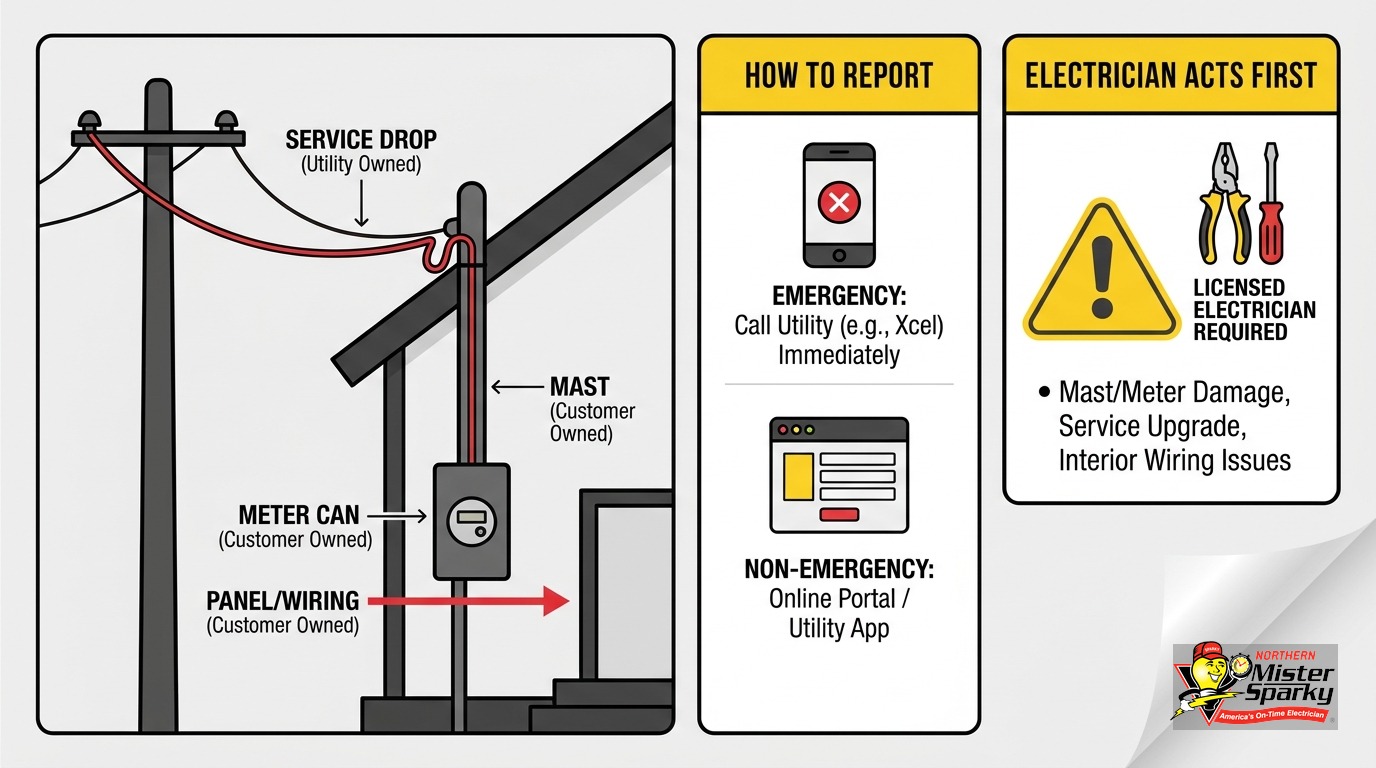
The service drop is the wire from the utility pole to your house. The mast is the pipe that holds that wire up at your roofline. The meter measures your use. The utility owns the drop and the meter. You own the mast and the meter enclosure.
Follow the path power takes. It leaves the pole on overhead wires and reaches your house at a connection point near the roof. From there it runs down a pipe, through the meter, and into your panel.
Family Handyman puts it this way: “The service mast is part of the house, but the conductors passing through it belong to the power company.” The same article says the meter belongs to the power company, while the meter enclosure is the homeowner’s.
Here is the breakdown:
- Service drop (wires, pole to house): Xcel Energy.
- Clamps and connectors on those wires: Xcel Energy.
- Service mast (the pipe and its supports): You.
- Weatherhead (the cap at the top of the mast): You.
- Meter: Xcel Energy.
- Meter enclosure or base: You.
- Panel and everything inside the house: You.
The owner decides who you call first. A sagging wire is a utility call. A bent pipe is an electrician call. Storm damage often involves both.
Who Is Responsible for Fixing Power Lines?
The utility is responsible for its own overhead wires and connectors. You are responsible for the mast, the weatherhead, and the meter base on your house. When damage crosses that line, Xcel makes its side safe, and your licensed electrician repairs yours.
A home-inspector article on HomesMSP covers the utility side well. It says Xcel owns the overhead conductors and the clamps that connect them. It also says exposed connectors and frayed or damaged insulation on Xcel-owned conductors are fixed at no cost to the owner. Treat that as the article’s account of how Xcel handles it.
Family Handyman covers the homeowner side. The utility “will handle the wiring,” but the homeowner “will likely be responsible for fixing any damage to the mast.”
What if a wire simply hangs too low? No page we reviewed gives a clear rule on who pays to raise a sagging drop, and we won’t invent one. Here is what we tell customers:
- Report the low wire to Xcel.
- Ask Xcel to inspect it.
- Ask Xcel to confirm in writing whether the work is covered.
That written answer protects you. It also gives your electrician a clear picture before mast work starts.
Is the Low Wire Actually Xcel’s?
Not always. Several lines can run to one house, and a low cable may belong to a phone or cable company. Look at where the wire attaches. If it ends at your mast and meter, it is likely the electric drop. A thinner line may be something else.
Power, cable, and phone lines often share a pole. One local news report in our search results said the lowest line on a pole is usually a communications line. We did not verify that, so treat it as a clue.
You can sort this out safely from the ground:
- Follow the thick wires. Electric service wires are usually bundled and heavier than a thin cable.
- Look at the mast. The electric drop connects at the top of the pipe near the weatherhead.
- Check where each line enters. A power line leads to the meter. A cable line leads to a small box.
- Take a photo from a safe distance. Photos help the utility or electrician identify the line fast.
Never walk under a sagging wire for a better look. Use a zoom lens. If you can’t tell whose wire it is, call Xcel anyway. They can sort out ownership faster than you can.
What Should You Do First When a Wire Hangs Low?
Stay away from it, keep others away, and call Xcel Energy. Do not touch, move, or try to lift the wire. Assume it is live. If it touches the house, a tree, or a car, treat it as an emergency and call 911 as well.
Xcel’s storm release is blunt: “Never touch or move a downed power line.” A low wire isn’t down yet. The next gust could change that, and a wire doesn’t need to be on the ground to be dangerous.
Take these steps in order:
- Back away. Keep kids, pets, and neighbors clear of the area under the wire.
- Do not use a ladder or pole. Never try to push the wire up or free a branch from it.
- Skip wet ground. Standing water can carry current. Stay out of puddles near the wire.
- Take photos from far away. Capture the wire, the mast, and the pole if you can.
- Call Xcel. Use the numbers in the next section.
- Call us if the mast looks damaged. We can plan the repair while Xcel handles the wire.
If power is still on, the wire may be energized. If power is out, don’t assume it is safe. Lines can re-energize when the utility restores service. Our guide on electrical safety after a power outage walks through what to check inside the house once it is safe.
How Do You Report a Low or Downed Wire to Xcel Energy?
Call Xcel Energy. Its storm release lists 1-800-895-1999 for residential customers and 1-800-481-4700 for business customers. Tell them the address, what you see, and whether the wire touches anything. Give a clear, short description and take photos only from a safe distance.
Those numbers come straight from Xcel’s Minnesota storm release. Xcel also keeps an outage checklist page with more reporting options. It would not load when we last tried, so check it yourself for current online and app choices.
When you call, have this ready:
- Your address and the nearest cross street.
- What you see: low, sagging, touching a tree, touching the roof, or on the ground.
- The mast condition: bent, leaning, pulled from the wall, or intact.
- Whether power is on or off.
- Any sparking, buzzing, or burning smell.
Ask three questions before you hang up:
- Is this wire Xcel’s?
- Can Xcel inspect it, and when?
- Will the repair be covered? Can you confirm that in writing?
You can also ask whether Xcel can offer a temporary connection while you arrange mast repairs. Some search snippets suggest that option exists, but we could not confirm it. Write down the answer and the name of the person who gave it.
If you smell burning or see fire, call 911 first. Then call Xcel.
When Must a Licensed Electrician Act Before Xcel?
When the mast is damaged. Xcel says a licensed electrician must make mast repairs, and the mast must be inspected before service can be restored. The utility will not reconnect to a broken mast. Your electrician has to fix it first.
Most people miss this step. Xcel’s release tells customers to check for damage to their mast, “which is the electric service connection to their home.” It says “If the mast is damaged, a licensed electrician must make repairs.” It adds that “the mast must be inspected before service can be restored.”
The order often looks like this:
- Xcel makes its wires safe, often by disconnecting them.
- Your licensed electrician repairs the mast, weatherhead, and meter base as needed.
- The work is inspected.
- Xcel reconnects the drop and restores power.
Signs that your mast needs an electrician:
- The pipe leans or bends away from the wall.
- The weatherhead is cracked, loose, or missing.
- The mast pulled away from the roof or siding.
- The meter base is loose, cracked, or twisted.
- Wires at the top are stretched or pulled tight.
- A tree limb or ice has struck the roofline.
Check a license before you hire. Our post on how to verify a licensed electrician in Minnesota shows how. In Minnesota, mast and meter work usually involves a permit and an inspection. We handle that paperwork as part of the job. You can also read how we approach weatherhead and service mast storm damage repair.
Need help right now? See our service mast repair page, or call 763-200-5956.
What About Trees Touching the Line?
Branches in contact with the wires between the pole and your house are the homeowner’s responsibility, according to a home-inspector article quoting Xcel. A branch that falls onto a line is handled by Xcel at no charge. Call the utility before any trimming near the wires.
The HomesMSP article says “tree branches in contact with the overhead powerlines between the pole and house are the responsibility of the homeowner.” It also says Xcel handles a branch that falls onto a line “at no charge to the owner.” This is an inspector’s blog, so we attribute the rules to the article. Confirm them with Xcel.
The same piece advises that before trimming near lines, “you should contact the power company to have your service temporarily disconnected.”
We go one step further:
- Do not trim near service wires yourself. A saw, a ladder, and a live wire do not mix.
- Hire a tree pro who works near power lines.
- Call Xcel first and ask about a temporary disconnect.
- Plan the order. If a limb has already damaged your mast, call your electrician too.
One fallen branch can pull on the wire, bend the mast, and crack the weatherhead. That means two repairs with two owners. Good planning keeps the outage short.
Why Do Twin Cities Winters Cause Sagging Drops and Pulled Masts?
Ice, heavy snow, wind, and falling branches put extra weight and pull on the wire and the mast. Over a Minnesota winter, that strain can stretch a drop, loosen clamps, and bend a mast. Spring thaw often reveals damage that cold weather hid.
Minnesota weather is hard on overhead service. Ice coats a wire and adds weight. Wind makes it swing. A limb that lands on the line pulls on the mast with real force.
Common causes in our service area:
- Ice buildup that weighs down the span.
- Snow sliding off a roof onto the mast or wires.
- Falling limbs during storms.
- Frost heave that shifts a mast or meter base over time.
- Old, worn parts that fail under load.
Height and bracing matter too. Family Handyman, in a national article, says conductors “must be at least 12 feet above final grade” except at the drip loop. It also says masts over 36 inches “usually require a mast brace or tie-back supports.” Those are general figures, not Xcel’s Minnesota rule. On every job we follow the current electrical code and Xcel’s requirements instead.
Check your roofline from the ground after every big storm. Look for a leaning mast, a sagging span, or a cracked weatherhead. Catching a small problem early beats losing power in January.
Should You Bury the Line Instead of Repairing the Overhead Drop?
Sometimes. Burying the line removes the wire that ice, wind, and branches attack. It costs more up front and needs planning with the utility. If you repair the mast often, ask us to compare repair against a switch to underground service.
An underground line is out of reach of falling limbs. It doesn’t suit every home. Trenching, landscaping, and utility coordination all affect the price and the timeline.
Our guide to burying your electrical service line lays out the tradeoffs for Twin Cities homes. It helps you decide between a one-time repair and a bigger upgrade.
If a mast repair also exposes an old meter base or a tight panel, look at the whole service. Our post on the Xcel meter pull and panel upgrade process explains how we coordinate with the utility. We also offer financing on larger jobs such as panel upgrades, generators, and EV chargers.
Decision Guide: Who to Call and in What Order
Find your situation below, then follow the steps.
The wire hangs low but your power is on.
- Stay clear and keep others away.
- Call Xcel to report the low wire.
- Ask for an inspection and a written answer on coverage.
- Check the mast from the ground. Call us if it looks bent or loose.
The wire touches a tree, the roof, or the house.
- Treat it as live and dangerous.
- Call Xcel right away. Call 911 if you see sparks or fire.
- Do not trim or move anything.
- After Xcel makes it safe, call us to inspect the mast and meter base.
The mast is bent, pulled, or the weatherhead is broken.
- Call Xcel to report the wire and any outage.
- Call a licensed electrician for the mast repair.
- Expect a permit and inspection before reconnection.
- Xcel then restores service.
The wire is down on the ground.
- Stay far away. Never touch or move it.
- Call 911 and Xcel.
- Wait for crews to clear the area.
- Call us once the scene is safe and the mast needs repair.
You do not know whose wire it is.
- Take a photo from a safe distance.
- Call Xcel and describe what you see.
- Ask whether the line is theirs.
- If it belongs to another company, ask Xcel who to call.
What Happens When We Arrive for a Mast Repair?
Here is what to expect when you call Northern Mister Sparky:
- We listen. You tell us what you see, and we ask a few quick questions.
- We schedule fast. We are America’s On-Time Electrician(R), so we show up when we say we will.
- We inspect safely. We check the mast, weatherhead, meter base, and the wiring that feeds your panel.
- We explain your options. You get clear pricing before work begins. No malarky.
- We repair the damage. That may mean a new mast, a new weatherhead, a new meter base, or all three.
- We handle the permit and inspection. We schedule the inspection so Xcel can reconnect.
- We check our work. Power comes back safely, and we explain what we did.
If the repair shows a bigger issue, we tell you plainly. A worn panel, an old meter base, or an undersized service may need attention too. You decide what happens next. To see how a service mast fits into a larger upgrade, read our panel upgrade page.
Everything we do is backed by the UWIN(R) 100% satisfaction guarantee. We are locally owned and operated, and our crews live and work in the communities we serve, from Minneapolis and St. Paul to Bloomington, Brooklyn Park, Woodbury, Blaine, Maple Grove, and Plymouth.
Call a Locally Owned Twin Cities Electrician Today
A low wire is a utility problem. A damaged mast is yours. Either can leave you without power, so work them in the right order.
- Stay away from the wire.
- Call Xcel to report it.
- Ask whether the wire is Xcel’s and whether the repair is covered.
- Call us for any mast, weatherhead, or meter base damage.
- Let us handle the permit and inspection so Xcel can restore service.
Call Northern Mister Sparky at 763-200-5956 or book online to schedule fast. We will get your service connection safe, inspected, and ready for Xcel to reconnect.
Frequently Asked Questions
What type of wire is used for a service drop? +
How much should a new electrical service cost? +
Can I fix a low hanging wire myself? +
Will Xcel Energy restore power if my mast is bent or pulled? +
Need an electrician now?