
Does Laundry Room Need GFCI Outlet? Minnesota Code Guide
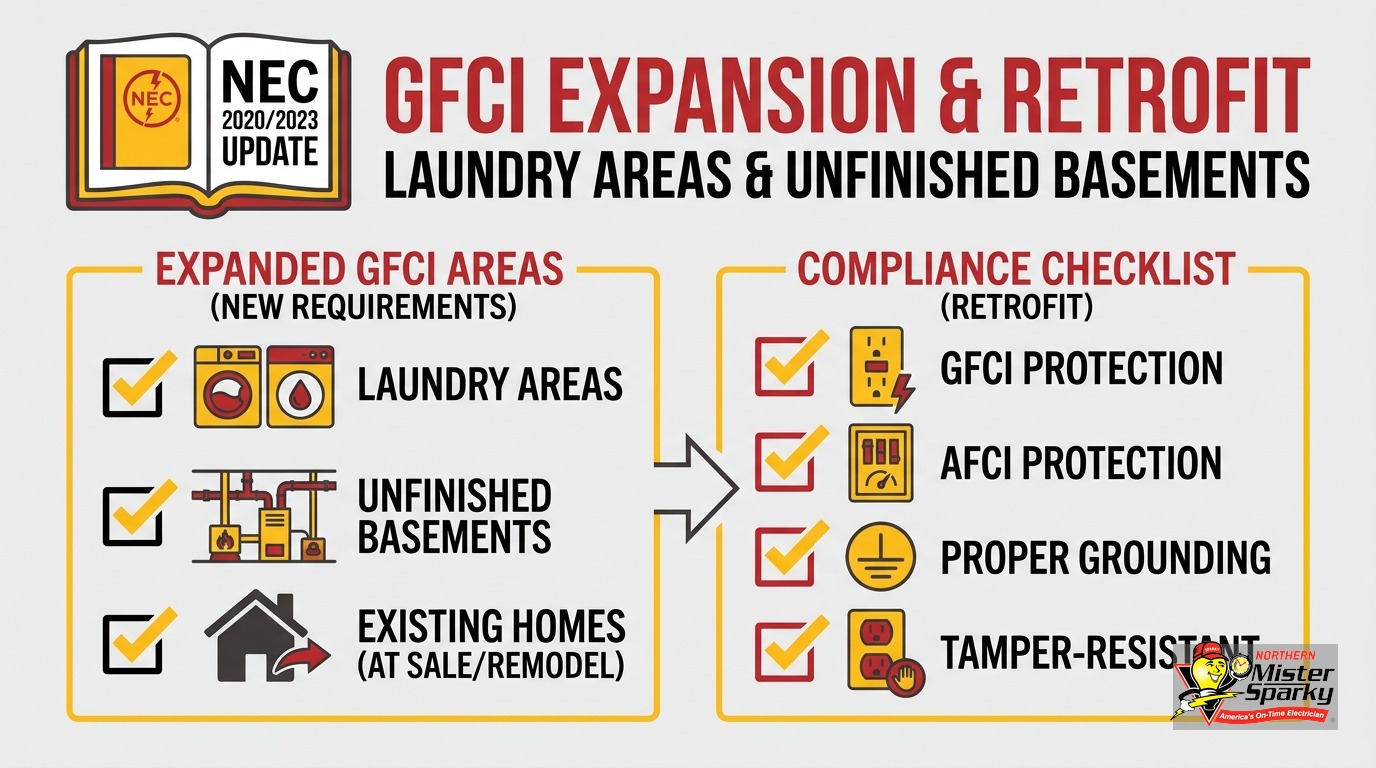
Key Takeaways
- Laundry-area receptacles in a home generally need GFCI protection under the National Electrical Code (NEC).
- Minnesota’s Board of Electricity adopted the 2026 NEC, effective Aug. 17, 2026. Permits filed before that date follow the 2023 NEC.
- Minnesota does not usually amend the NEC, so the national rule is the local rule.
- Dryer receptacles are part of the GFCI conversation now, so confirm the rule for your dryer type.
- Washers can plug into a standard receptacle, but that receptacle should still be GFCI-protected and on a proper circuit.
- Existing homes are not automatically forced to upgrade at sale. Remodel and permit work usually triggers current code.
- A GFCI breaker or a GFCI outlet can both do the job. The right choice depends on your layout.
Short Answer: Yes, Laundry Outlets Usually Need GFCI Protection
Yes, a laundry room needs GFCI protection. Modern electrical code expects ground-fault protection on receptacles in dwelling-unit laundry areas, because that is where water, metal appliances, and power meet.
We are a locally owned and operated Twin Cities electrician. Homeowners in Minneapolis, St. Paul, Bloomington, and Plymouth ask us this often. Most are remodeling, buying, or selling.
One caution. Code editions change, and your permit date decides which one applies.
Which Code Edition Applies to Your Laundry Room in Minnesota?
Your permit date decides which edition of the code your project must follow. Minnesota’s Board of Electricity adopted the 2026 NEC, effective Aug. 17, 2026. Permits filed before that date must comply with the 2023 NEC. Permits filed on or after it follow the 2026 NEC, according to the Minnesota Department of Labor and Industry.
Today is past that date. A project you start now falls under the 2026 NEC. A project permitted earlier may still follow the 2023 edition.
Much online advice still cites the 2020 NEC. That is out of date for Minnesota. The 2020 edition applied to permits filed before July 1, 2023.
Minnesota also keeps things simple. Under the 2023 adoption, the Board does not by practice adopt amendments to the NEC. The 2023 NEC took effect unamended on July 1, 2023.
The rulemaking cited Minnesota Rules, part 1315.0200. The comment period ended April 19, 2023, and the notice lists no amendments.
For you, that means the national text is the working rule. You don’t need to hunt for a quirky Minnesota exception on GFCI.
We cover the wider set of changes in our guide to NEC 2023 code changes for Minnesota homeowners.
What Did the 2026 NEC Change About GFCI?
Less than you might fear. Trade reporting says the GFCI requirements in the relevant section were not expanded in any significant way for 2026.
The same source notes that the requirement grew to include 60A circuits, not just 50A and lower. That mostly affects larger 240-volt equipment.
It does not discuss laundry rooms or basements, so we don’t claim the 2026 edition changed those rules.
The 2026 edition may also touch lighting rules for laundry areas. We haven’t confirmed the details, so we don’t rely on them here. Your electrician should check the current text for your permit.
Do All Outlets in a Laundry Room Need to Be GFCI?
Generally, yes. Receptacles in a dwelling-unit laundry area should be GFCI-protected. That covers the one behind the washer, the one for a utility sink, and the one you use for an iron or a small fan.
The reasoning is simple. Laundry rooms collect leaks, splashes, damp floors, and wet hands. A ground-fault device cuts power fast when current strays.
Here is how that plays out room by room:
- Behind the washer: Protect this receptacle. Hoses leak, and the outlet sits low.
- Near a utility sink: Protect it. Water and a plug share a small space.
- On the wall for general use: Protect it. People plug in anything.
- Overhead or ceiling receptacles: Check these too. A garage-door-style outlet above a washer still counts as a receptacle.
Many Twin Cities laundry rooms sit in basements. Older basements often have ungrounded or unprotected outlets left over from decades past.
One trade association article states plainly that all kitchen receptacles must be GFCI, regardless of distance from water. The code keeps trending toward more coverage.
For the full picture of where protection is required, read our explainer on GFCI outlet requirements.
Does a Dryer Need to Be GFCI Protected?
It can, and the trend points that way. The same association article says GFCI requirements now cover all clothes dryers, along with countertop cooking equipment, wall-mounted ovens, and microwaves.
That article is a trade blog, not the code itself. Treat it as a strong lead and confirm with your inspector or electrician.
Dryers are tricky for two reasons. Most electric dryers run on 240 volts, not 120. And the protection can come from a breaker instead of the outlet.
A few practical points:
- Electric dryers: The receptacle is a larger 240-volt type. A GFCI breaker usually protects it, since standard 240-volt GFCI outlets are rare.
- Gas dryers: These plug into a regular 120-volt outlet. That outlet falls under the usual laundry GFCI rule.
- Heat pump dryers: These have their own electrical needs. Our guide to dryer and range outlet installation explains the 240-volt side.
Ground-fault protection can cause nuisance trips on some dryer models. Heating elements and moisture sometimes leak a small amount of current. If that happens, don’t bypass the device. Call us, and we will find the cause.
Can a Washer Be Plugged Into a Regular Outlet?
Yes, a washer can plug into a standard 120-volt receptacle. It doesn’t need a special plug type. But standard doesn’t mean unprotected.
A regular three-prong grounded outlet works for the washer itself. In current practice, that outlet should also have GFCI protection.
Watch for these red flags:
- Two-prong outlets: These have no ground. A washer should never run on one.
- Adapters and cheater plugs: They defeat the safety ground. Remove them.
- Extension cords: A washer should not run through one. Cords overheat under steady load.
- Shared circuits: A washer on a circuit with other loads can trip often.
If your home has older wiring, see our post on ungrounded outlets in older homes. You can also ask us about grounding when we visit.
What Is the Difference Between a GFCI Outlet and a GFCI Breaker?
Both devices protect you the same way. A GFCI outlet sits at the receptacle. A GFCI breaker sits in your electrical panel and protects the whole circuit.
An outlet device is often cheaper and easy to reach. A breaker is better when many receptacles share one circuit, or when the outlet sits behind a washer you can’t easily move.
Here is a quick way to choose:
- Choose a GFCI outlet when one reachable receptacle needs protection and nothing is downstream.
- Choose a GFCI breaker when several outlets share a circuit or the outlet is hard to reach.
- Choose a GFCI breaker for most 240-volt dryer circuits.
We compare the two in detail in our post on GFCI breakers versus GFCI outlets. It includes a decision guide you can use before calling.
Does a Washer Need a 15 or 20 Amp Outlet?
A 20-amp laundry circuit is the safe standard. Electrical code calls for a dedicated laundry circuit rated at 20 amps. Many washers draw far less, so a receptacle on that circuit works fine.
The difference between 15-amp and 20-amp setups confuses many homeowners. Our post on the difference between 20-amp and 15-amp circuits walks through wire size, breaker size, and receptacle shape.
In short, the wire and breaker must match. A 20-amp breaker needs wire that can carry 20 amps. Never swap in a bigger breaker to stop trips. That hides the problem and creates a fire risk.
Check the washer’s nameplate for its rating. If you are unsure, send us a photo of the label and the panel.
What Must an Existing Home Upgrade at Remodel?
Remodel work is the usual trigger. If you add a circuit, move a laundry room, or finish a basement under a permit, the new work must meet current code.
Many homeowners miss this part. The code generally applies to the work you are doing, not to your whole house at once.
Here is how it often plays out:
- Adding a new laundry circuit: The new receptacles need current GFCI protection.
- Moving the laundry room: The new location is treated as new work.
- Finishing a basement: New outlets and circuits must meet the code in effect at permit time.
- Replacing a worn outlet: Replacement rules can differ from new-circuit rules, and we confirm the details for your case.
We couldn’t find a Minnesota source that spells out the exact replacement rule, so we don’t guess. We check the current code and your local inspector’s view before we price the job.
Permits matter here. For our Minnesota electrical permit guide, or to learn what your city requires, give us a call. Minneapolis and St. Paul can differ in small ways.
Does Selling My House Force a GFCI Upgrade?
We found nothing from Minnesota saying that a sale alone forces you to upgrade. The code is generally tied to work under a permit, not to the date of a closing.
Still, sales bring their own pressure. A buyer’s home inspector may note missing GFCI protection in the laundry room. That can lead to repair requests or a price talk.
Sellers often fix it early. A laundry room GFCI upgrade is usually a small, fast job compared with a stalled sale.
If you are listing soon, a quick check helps. We can walk through the laundry room, the basement outlets, and the panel, so you know what an inspector might flag.
How Do You Test a GFCI Outlet in Your Laundry Room?
Testing takes about a minute. Do it monthly.
- Plug a lamp or radio into the outlet and turn it on.
- Press the TEST button. The power should shut off.
- Press the RESET button. The power should return.
- If the power does not shut off, replace the outlet.
- If it will not reset, stop and call an electrician.
An outlet that won’t reset can mean a real fault, a worn device, or moisture in the box. Our post on what to do when a GFCI outlet won’t reset covers the basics.
One more point: a GFCI outlet can protect other outlets “downstream” on the same circuit. If your laundry outlet is dead, a tripped GFCI elsewhere may be the cause. Check nearby bathroom, garage, and basement outlets.
Why Do Laundry GFCIs Trip So Often?
A trip means the device did its job. It saw current leaking where it should not. Sometimes the cause is minor, and sometimes it is serious.
Common causes include:
- Moisture in the outlet box: Basement humidity and small leaks are frequent culprits.
- A failing appliance: Worn washer or dryer parts can leak current.
- A worn GFCI device: These devices age and can trip without a real fault.
- Shared circuits: Too many loads on one circuit add up.
- Damaged wiring: Rodent chewing or old insulation can cause faults.
Don’t tape the reset button or swap in a plain outlet. That removes your protection.
If the trips repeat, we trace the fault. We test the circuit, the appliance, and the wiring, then fix the real problem.
What About Laundry Rooms in Unfinished Basements?
Many Twin Cities laundry rooms live in unfinished basements. Concrete floors, floor drains, and damp corners make ground-fault protection even more useful there.
Some code summaries say a dwelling unit’s whole basement needs GFCI protection, while other locations only need it in unfinished areas. We haven’t verified that wording against the code text, so we take the safer approach.
If a basement outlet could meet water, we protect it. That includes the laundry area, the workbench wall, and the sump pump zone.
Sump pumps raise a special point. A pump on a GFCI that trips can leave a basement without drainage. We plan those circuits carefully so safety and flood protection work together.
If your basement has ever flooded, read our guide to flooded basement electrical safety in Minnesota. You can also ask us about it during your visit.
How Does Northern Mister Sparky Handle a Laundry Room GFCI Upgrade?
We keep it clear and on time. We are locally owned and operated, and we are backed by the national Mister Sparky brand. Our promise is America’s On-Time Electrician(R) service with a UWIN(R) 100% satisfaction guarantee.
Here is what a typical visit looks like:
- We look first. We check the laundry outlets, the panel, and the wiring.
- We test. We find which outlets have protection and which do not.
- We explain your options. You see outlet versus breaker choices and the price before we start.
- We do the work. We install, test, and label.
- We confirm permits. If your project needs a permit, we guide you through it.
Larger laundry jobs may involve a new circuit, a panel change, or a move to a 240-volt dryer. Financing is available for bigger projects, and we can explain the options.
Laundry Room Electrical Checklist Before You Call
A little prep saves time. Walk through this list first:
- Note every outlet in the laundry area and basement.
- Press TEST and RESET on any GFCI you already have.
- Check for two-prong outlets, adapters, and extension cords.
- Look for scorch marks, warm plates, or a burning smell.
- Write down your dryer type: electric, gas, or heat pump.
- Take a photo of the washer and dryer nameplates.
- Take a photo of your panel with the door open.
If you smell burning or see sparks, stop using that outlet. Turn off its breaker and call us right away.
For more on laundry circuits in general, our guide to laundry room electrical requirements covers lighting, circuits, and layout.
Should You Upgrade Even If You Are Not Required To?
Often, yes. Code sets the minimum. Ground-fault protection exists because water and electricity are a poor mix.
A laundry room is a high-risk spot. Wet hands, metal cabinets, and steady appliance use all raise the stakes. A small upgrade can prevent a serious shock.
The cost is usually modest next to the risk. And if you plan to sell, finished, protected outlets help a buyer’s inspection go smoothly.
We give you plain advice. If an upgrade isn’t needed, we say so. No malarky, just what your home needs.
Final Thoughts on Laundry Room GFCI Outlets
In nearly every case, a laundry room needs GFCI protection. Treat it as the rule for laundry receptacles, and confirm the details for dryers and older homes.
Minnesota now follows the 2026 NEC for permits filed on or after Aug. 17, 2026. The state does not usually amend the national code, so your answer stays consistent from one Twin Cities city to the next.
If you are unsure what your laundry room has, let us check. Call Northern Mister Sparky at 763-200-5956 or book online. We will test, explain, and fix it right.
Frequently Asked Questions
Does a washer need a 15 or 20 amp outlet? +
Do I have to upgrade my laundry outlets when I sell my house? +
Is a GFCI outlet the same as an AFCI breaker? +
Need an electrician now?