
Light Switch Buzzing Noise: Causes and When to Worry
Key Takeaways
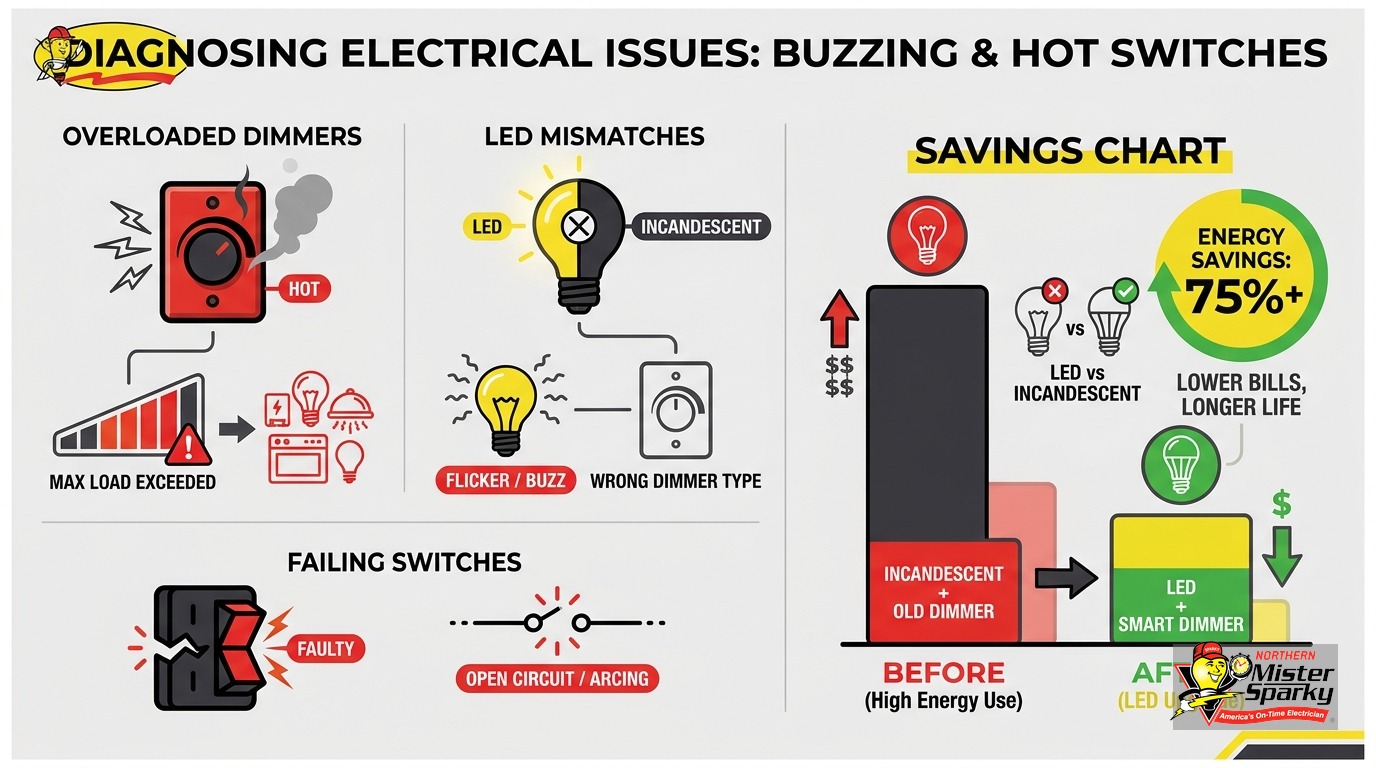
- A faint hum from a dimmer at low settings is often normal. A loud, growing, or crackling buzz is not.
- Heat matters more than noise. A switch plate that is too hot to hold your hand on needs attention now.
- Bulb and dimmer mismatch is the most common cause. LEDs need a dimmer listed for LEDs.
- Ganged dimmers in one box may need to be derated, which means a lower load limit.
- Crackling, sparks, a burning smell, or a discolored plate means turn off the breaker and call us.
- Do not guess about permits. Check with your local building department before you start wiring work.
- Call 763-200-5956 or book online if the buzz persists after a bulb swap.
Why Is Your Light Switch Buzzing?
Usually the cause is too much load, a bulb that does not match the dimmer, or a worn part. Most faint buzzes are annoying but not urgent. A loud buzz, a hot switch, or a burning smell is different. Shut off power and call a pro.
We are locally owned and operated here in the Twin Cities, and we hear about buzzing switches often. The cause is almost always findable in a few minutes if you know where to look.
Is a Buzzing Light Switch Dangerous?
Short answer: Not always. A faint buzz from a dimmer is often harmless. A buzz paired with heat, a burning smell, sparks, or crackling can signal a loose connection or overheating. Treat those signs as urgent. Turn off the breaker and call a licensed electrician.
The buzz is a clue. It tells you something is vibrating or struggling, but not how bad it is. Heat is the second clue. Smell is the third.
Here is a simple way to rank what you hear.
- Low risk: A faint hum that only shows up when the light is dimmed, and the plate stays cool.
- Medium risk: A steady buzz at all settings, or a buzz that gets louder over weeks.
- High risk: Crackling, popping, sparking, a hot plate, a brown or yellow plate, or any burning smell.
If you land in the high-risk group, do not wait. Our guide on what to do about a burning smell from an outlet or breaker walks through the next steps.
What Does an Electrical Hum Sound Like?
Short answer: A normal electrical hum is a low, steady drone, like a distant refrigerator. A buzz is higher and raspier. A crackle or sizzle is the worst sound, because it often means electricity is jumping a gap.
Your ears can sort most switch noises into four types.
- Hum: A low, even tone. It often comes from a dimmer at partial brightness.
- Buzz: A harsher, vibrating tone. It can come from a bulb, a fixture, or a switch.
- Click or tick: A sharp tap as parts heat and cool. It is usually minor.
- Crackle, pop, or sizzle: An irregular noise. It points to arcing, which is a spark across a loose or damaged connection.
Dimmers work by chopping the power wave many times per second. That chopping can make parts vibrate, and cheap or aging parts vibrate more. So a hum may change as you slide the dimmer up or down.
If the sound comes from your breaker box rather than a wall switch, read our post on an electrical panel making a humming noise. Panels have their own normal and not-normal sounds.
Is It the Switch or the Bulb?
Find out where the noise really lives before you blame the switch. This one step can save you money.
With the light on, put your ear near the switch plate. Then put your ear near the bulb or fixture and compare. Be careful, and do not touch any exposed wiring.
- Louder at the wall: The switch or dimmer is the likely source.
- Louder at the fixture: The bulb, the fixture, or the driver inside an LED is the likely source.
- Equal in both places: The sound may be traveling through the wall or box. Test further.
Now run a quick swap test.
- Turn the light off at the switch.
- Replace the bulb with a new bulb of the same type.
- Turn the light back on and listen at both spots.
- If you use LEDs, try one that is labeled dimmable.
A noisy bulb is a cheap fix. The online guide at SlashGear lists five common causes of switch buzz: incompatible bulbs, loose wiring, wattage imbalance, dimmers used without adjusting other components, and wear. That matches what we see in Twin Cities homes. It makes a fair starting point, but it gives no testing method. The rest of this post supplies one.
Do LED Bulbs Make a Dimmer Buzz?
Short answer: Yes, they can. Many older dimmers were built for hot-filament bulbs. LEDs draw very little power and behave differently. A mismatch can cause buzzing, flicker, or a bulb that will not dim smoothly.
An LED bulb has a small circuit inside called a driver. The driver does not always like the chopped power from an old dimmer. The result is a buzz, often from the bulb itself.
Two mismatches cause most of the trouble.
- A non-dimmable LED on a dimmer. The bulb was never built to dim. It may buzz, flash, or fail early.
- An old dimmer on LED bulbs. The dimmer was built for incandescent bulbs and may not hold a steady output at a tiny load.
The fix is to match the parts. Use bulbs labeled dimmable and a dimmer made for LEDs. Our post on LED dimmer switch compatibility explains how to read the labels and pick a pair that works.
Code covers this too. A code-commentary page at JAspector says a dimmer must be listed and installed per its listing. That covers load type, maximum and minimum load, and neutral wire needs. It states, “A dimmer is not a universal device.” It cites IRC 2024 section E4001.3 and NEC 404.14. It also says an incandescent-only dimmer used on LEDs is a code violation.
That page is commentary on the model code, not the code text, and local rules can differ. Still, read the dimmer’s label before you pair it with bulbs.
Flickering is a close cousin of buzzing. If your lights also blink or pulse, see our guide on why your lights are flickering.
Why Does an Overloaded Dimmer Buzz and Get Hot?
Every dimmer has a rated load, measured in watts. That is the most power it can safely control. If the bulbs on the circuit add up to more than the rating, the dimmer works too hard. It buzzes and gets hot.
Here is the math, step by step.
- Find the wattage printed on each bulb, or its incandescent equivalent if you use older bulbs.
- Multiply by the number of bulbs on that switch.
- Compare the total to the dimmer’s rating.
Chandeliers surprise people. A twelve-light chandelier with 60-watt bulbs draws 720 watts, according to Twin Cities home inspector Reuben Saltzman’s dimmer heat test. Many common dimmers are rated for 600 watts, so that chandelier would exceed the limit.
LEDs help here. They draw far less power than old bulbs, and a room full of LEDs often sits well under the rating. That is one reason we like LED upgrades.
What Is Derating?
Derating means lowering a dimmer’s load limit to keep it from overheating. It matters when you put dimmers side by side in one wall box.
Dimmers shed heat through small metal fins on their sides. In a shared box, the heat has nowhere to go. The maker of the dimmer may tell you to snap off fins or lower the load.
Leviton explains that derating may be needed when “two or more dimmers” share a wallbox, to “help dissipate the internal heat of the dimmer.” It adds that removing a heat fin “decreases the wattage capacity that the dimmer can control.” The same page notes that “Derating is NOT required when using dimmable LED or dimmable CFL bulbs.”
So a bank of dimmers in a dining room may need a lower limit if it runs incandescent bulbs. With dimmable LEDs, the rule often does not apply. Check the instruction sheet for your exact model.
How Hot Is Too Hot?
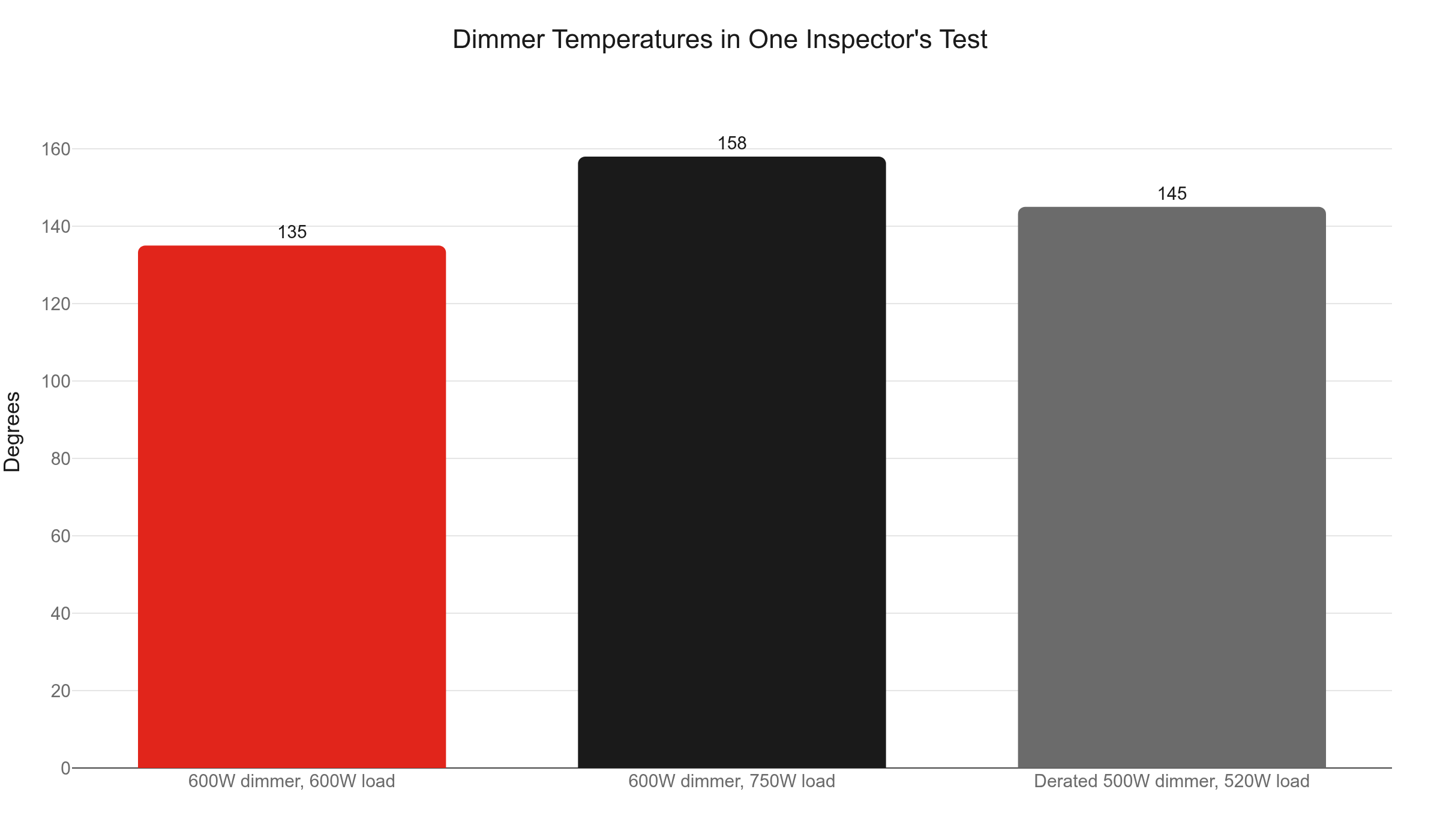
Some warmth is normal, since dimmers waste a little power as heat. In Saltzman’s test, the results looked like this:
- A 600-watt dimmer at a 600-watt load reached 135 degrees.
- The same dimmer at 750 watts reached 158 degrees.
- A derated 500-watt dimmer controlling 520 watts, using eight 65-watt bulbs, read 145 degrees.
He noted that a fully loaded dimmer getting “quite hot” is not necessarily a problem. He also did not mean for readers to repeat the experiment. We agree with that caution.
We found no official numeric safe-temperature limit for dimmer plates, so we use a practical rule. If you cannot comfortably rest your hand on the plate, something is wrong. Turn the load down or off and have it checked.
What Are the Signs of a Faulty Dimmer Switch?
Short answer: Watch for a buzz that is new or growing, a hot or discolored plate, flickering bulbs, a dimmer that will not hold its setting, a slider that feels gritty, and any burning smell. One mild sign may be a mismatch. Several together point to a failing dimmer.
Use this checklist.
- Buzzing that changes over time. A switch that was quiet and now hums is telling you something.
- Heat. The plate feels warm to hot, even with a light load.
- Flicker or pulsing. Lights blink at a steady setting.
- Dead zones. The light jumps from off to bright, or will not dim below a point.
- Mechanical wear. The slider or knob feels loose, rough, or sticky.
- Marks on the plate. Brown, yellow, or melted spots are a red flag.
- Smell. A hot plastic or fishy smell means stop.
Switches wear out. Contacts inside wear down with every use, and over years that wear can cause buzzing and heat. A worn switch is cheap to replace. Left in place, it can cost far more.
A simple rule helps. If a symptom goes away after you fix the bulb or lower the load, you had a mismatch. If it stays, the switch or the wiring is the problem.
Can a Faulty Light Switch Cause an Electrical Fire?
Short answer: Yes, it can. A switch with loose wiring, worn contacts, or a chronic overload can overheat. Heat can melt plastic and ignite nearby material. Fires from switches are not common, but the warning signs are clear. Act on them early.
The danger comes from resistance. A loose wire or worn contact makes electricity struggle to pass, and that struggle turns into heat. The heat builds in a small, closed wall box.
Here are the usual paths to trouble.
- Loose wire connections. Over time, screws and wire nuts can loosen. A loose joint can arc and heat.
- Overloaded dimmer. Too many watts for the rating adds heat on top of normal heat.
- Wrong switch for the load. A switch not listed for the bulbs or motors it controls can fail.
- Old or damaged wiring. Brittle insulation can crack and expose copper.
- Aluminum wiring. Homes with it need special connectors. Our post on aluminum wiring dangers and fixes explains the risk.
Heat shows up before a fire does, so we focus on temperature and smell. Our post on warm outlets and switch plates covers how to tell normal warmth from real danger.
If you see smoke or flames, leave the area and call 911. Do not use water on an electrical fire.
Why Is My Switch Buzzing Only at Certain Dimmer Settings?
Many dimmers buzz most at the middle of their range. At low brightness, the chopped power wave is thin. At mid-range, parts vibrate more. At full brightness, the dimmer often passes power straight through and goes quiet.
That pattern usually means normal dimmer behavior or a bulb mismatch. A faint hum at one setting does not mean the dimmer is failing.
Two things can make it worse.
- Cheap bulbs. Low-grade LED drivers often buzz more.
- Light loads. A dimmer with a very small load can behave oddly, especially an old model. Some dimmers have a minimum load rating.
Try these steps in order.
- Swap in a quality dimmable bulb.
- Check that the total load is not too low or too high for the dimmer.
- Try a dimmer made for LEDs.
- If the buzz stays, have us inspect the switch and wiring.
What Else Can Cause a Buzzing Switch?
Some causes sit behind the wall, not in the dimmer.
Loose Wiring
A wire screw that has backed off can buzz, crackle, or flicker. This is the cause that worries us most, because it can sit unseen for years. A loose connection can also affect other devices on the same circuit.
Shared Neutral Problems
Some circuits share a neutral wire between two hot wires. A fault there can cause odd noises and flicker. Our post on shared neutral circuits explains how they work.
Worn Switch Parts
Standard on-off switches can buzz too. Spring contacts wear. A switch that clicks loudly, feels loose, or buzzes when on is near the end of its life.
Other Loads on the Circuit
A circuit that also feeds a space heater, vacuum, or other big load can sag. Lights may buzz or dim when it kicks on. If that sounds familiar, see our guide on lights that dim when appliances turn on.
A Simple Diagnostic Path You Can Follow
Work down this ladder from cheapest to most involved. Stop as soon as the noise goes away.
- Locate the sound. Compare the switch and the fixture.
- Swap the bulb. Use a new, dimmable bulb of the right type.
- Do the watt math. Total the bulbs and compare to the dimmer rating.
- Check for gang heat. Note whether several dimmers share one box.
- Feel for heat. Use the back of your hand on the plate. Do not poke at the switch.
- Look for marks. Check for brown spots, cracks, or a loose plate.
- Call a pro. If the buzz stays, or any high-risk sign appears, stop and call.
Never remove a switch plate with the power on. If you do open a box, shut off the breaker first. Even then, confirm the power is off with a tester.
When Should You Stop and Call an Electrician?
Call us right away if you notice any of these.
- Crackling, popping, or sizzling from a switch
- A switch plate that is hot to the touch
- A burning, fishy, or hot plastic smell
- Brown, yellow, or melted plastic
- A breaker that trips when you use the switch
- Buzzing that keeps growing after you fix bulbs and load
- Aluminum wiring, cloth wiring, or an older panel in the home
Turn off the breaker for that circuit first, and leave it off until we arrive. If you cannot tell which breaker it is, turn off the main breaker.
A faint hum that disappears with a new bulb can wait. Anything else deserves a pro. Our repair team handles switch, dimmer, and wiring faults across the metro, from Minneapolis and St. Paul to Blaine, Plymouth, and Woodbury.
If the problem is bigger than one switch, such as many buzzing fixtures or flickering all over the house, you may have a wider wiring issue. We cover that kind of work under home wiring repair.
Do You Need a Permit to Replace a Switch in Minnesota?
Short answer: It depends on the work and your city. Minnesota lets homeowners pull a permit for their own home. We could not confirm a blanket exemption for swapping a switch. Check with your local building department before you start.
Here is what we can say with confidence. The state Department of Labor and Industry explains that a Minnesota homeowner who lives in the home can pull an electrical permit for their own home. Only the signing homeowner or a licensed electrical contractor may legally do the wiring. The page links the forms and lists the contact as 651-284-5026 or iMS.support.dli@state.mn.us.
That page does not say which jobs need a permit. Some Minnesota cities exempt minor repair work, and others are stricter. A quick call to your city before you begin settles it.
For more detail, read our posts on the electrical permit process in Minnesota and the homeowner permit exemption.
Hiring a licensed pro takes this off your plate. We handle the permit questions and the work.
How We Fix a Buzzing Switch
We do not guess. We follow a clear process and explain each step in plain words.
- Listen and ask. We learn when the buzz happens and what changed.
- Check the load. We match bulbs, dimmer rating, and circuit demand.
- Inspect the switch. We look for heat damage, wear, and loose parts with the power off.
- Test the wiring. We check connections, neutral, and the circuit as a whole.
- Fix it right. That may mean a new dimmer, a proper LED pairing, or a wiring repair.
- Explain and price. You hear the cause and the cost before we start the repair.
If you want a better lighting setup overall, we can help there too. Our indoor lighting services cover dimmers, fixtures, and LED upgrades that work together.
Why Choose Northern Mister Sparky?
We are locally owned and operated, and backed by the national Mister Sparky franchise. We live and work in the same Twin Cities neighborhoods you do, so we care about getting your fix right the first time.
Here is what you can expect.
- America’s On-Time Electrician(R). We show up when we say we will.
- UWIN(R) 100% satisfaction guarantee. If you are not happy, we make it right.
- Clear answers, no malarky. We tell you what is wrong and what it costs.
- Licensed pros. Your switch work gets done safely and to code.
Get Your Buzzing Switch Checked
A faint hum with a cool plate may just need a better bulb. A loud buzz, a hot switch, or any burning smell needs a pro.
Call us at 763-200-5956 or book online. We will find the cause, fix it safely, and leave your lights quiet and steady.
Frequently Asked Questions
Can I replace a buzzing dimmer myself? +
Will a new bulb stop the buzzing? +
Should I turn off a buzzing switch? +
How much does it cost to fix a buzzing switch? +
Need an electrician now?