
Landscape Lighting Installation in the Twin Cities
Key Takeaways
- Low-voltage (12V) landscape lighting is the most common residential option, but it still requires an electrical permit in Minnesota.
- Line-voltage (120V) systems are brighter and permanent, but they require a licensed electrician and a much deeper trench.
- Minnesota adopted the 2023 NEC on July 1, 2023. All new electrical permits must comply.
- The Twin Cities design frost depth is approximately 42 inches. Shallow-buried cable heaves in a Minnesota winter.
- Contractors installing low-voltage systems must hold a Power Limited Technician (PLT) license from Minnesota DLI. Most national guides do not mention this.
- About 66 Minnesota cities handle their own electrical inspections. Your suburb may file permits with the city, not the state.
- Many Twin Cities suburbs have adopted outdoor lighting ordinances requiring fixtures to direct light downward.
- Xcel Energy offers LED lighting rebates in Minnesota. Confirm current residential outdoor fixture eligibility before you buy.
Landscape lighting installation is one of the most impactful upgrades a Twin Cities homeowner can make. The right system adds curb appeal after dark, improves safety on driveways and paths, and removes the cover that porch thieves rely on. But landscape lighting in Minnesota comes with permit requirements, licensing rules, and frost conditions that most national DIY guides skip entirely. This guide covers all of it, from the low-voltage vs. line-voltage decision to the code realities of installing in a climate where frost can penetrate more than three feet into the ground.
What Is Landscape Lighting Installation?
Landscape lighting installation covers any permanent or semi-permanent outdoor lighting system connected to a power source. That ranges from low-voltage path lights on a plug-in transformer to 120V floodlights hardwired to a junction box. The scope determines the code requirements, the permit path, and whether you need a licensed electrician.
Two system types define most residential projects.
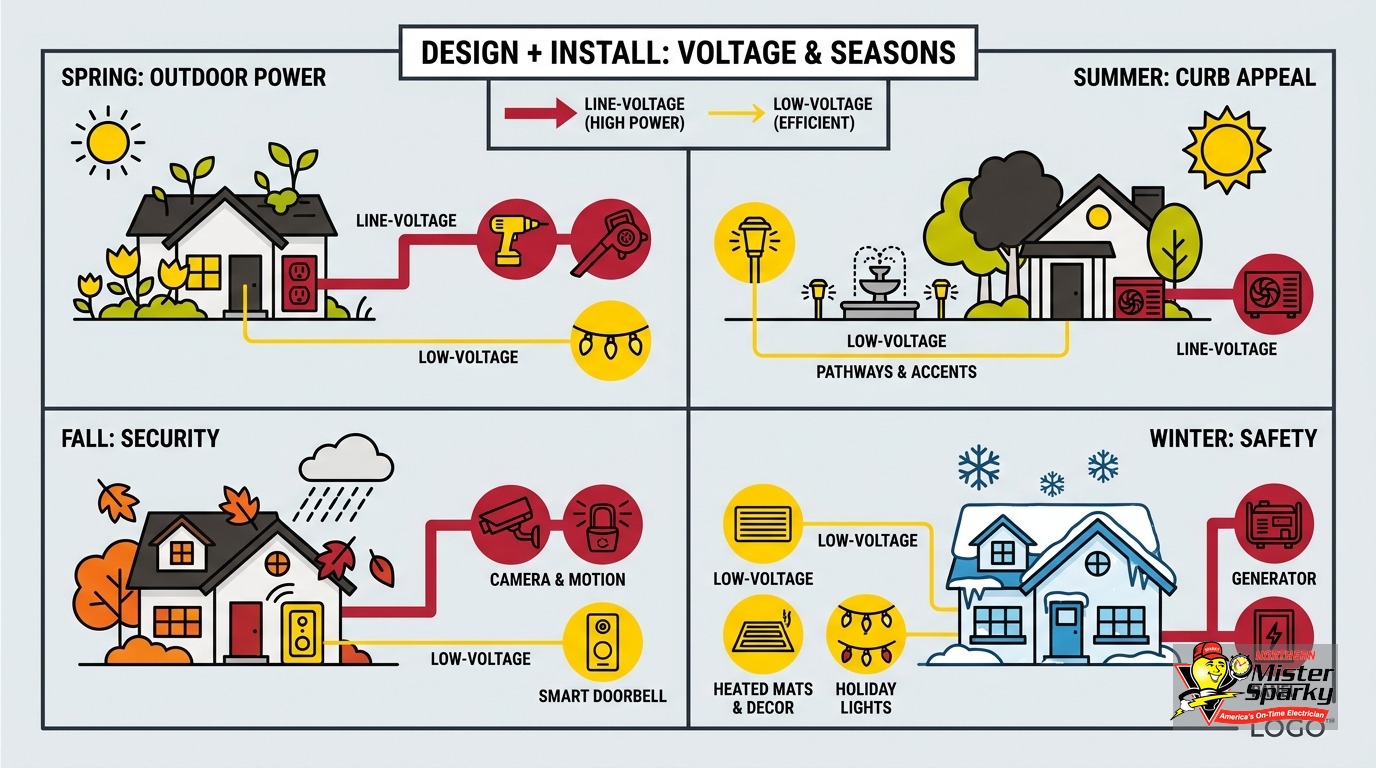
Low-voltage (12V-30V): The most common choice for residential yards. A transformer plugs into an outdoor receptacle and steps household current down to 12 volts. Path lights, uplights, deck post caps, and step lights all run on this system. Governed by NEC Article 411, which caps transformer output circuits at 25A and requires systems to be listed to UL 1838.
Line-voltage (120V): Used for brighter floodlights, large properties where voltage drop degrades low-voltage performance over long cable runs, and permanent hardwired fixtures. Requires conduit, deeper burial, GFCI protection on the circuit, and a licensed electrician for any work beyond the existing receptacle.
Both types deliver real curb appeal and security benefits. The right choice depends on your yard size, brightness goals, and how permanent you want the installation to be. We cover the full tradeoff below.
Is a Permit Required for Landscape Lighting Installation in Minnesota?
Yes. Minnesota requires an electrical permit for landscape lighting installation, including 12V low-voltage systems. The state’s permit fee schedule includes a $1.00-per-opening charge for sub-50V circuits, which confirms they are not exempt. Source: Minnesota DLI Skipping the permit creates problems at home sale time and can complicate insurance claims tied to electrical failures.
Here is what shapes your permit process.
Who files: Homeowners may pull their own electrical permit for work on a primary residence they own and occupy. The work must still pass inspection. Contractors installing low-voltage systems commercially must hold a Power Limited Technician (PLT) license from Minnesota DLI. Hiring a contractor who lacks that license means the work is being done illegally, and you could be on the hook for a redo.
Where to file: Approximately 66 Minnesota cities have adopted their own local electrical inspection authority. Minneapolis, St. Paul, and many suburbs are on that list. In those cities, you file with the city, not DLI. Source: Minnesota DLI The list changes. Confirm with your city before you assume DLI is the right contact.
Which code applies: Minnesota adopted the 2023 NEC effective July 1, 2023. All electrical work permitted on or after that date must comply with 2023 NEC standards. If you are adding to an older system, the new work still falls under current code.
When you hire Northern Mister Sparky, we handle the permit and coordinate the inspection. You do not have to research which desk your suburb uses or track down the right inspector.
Low-Voltage vs. Line-Voltage: Which Is Right for Your Landscape Lighting Installation?
Low-voltage is the right choice for most Twin Cities residential landscape lighting installations. It is safer to work with, costs less to operate, and meets most homeowners’ brightness needs for paths, trees, and architectural features. Line-voltage makes sense for large commercial-style floodlights, long cable runs where voltage drop becomes a real problem, or permanent hardwired fixtures that need a dedicated circuit.
Here is how the two systems compare on the factors that matter most in Minnesota.
Brightness: Low-voltage LED fixtures now reach 800 to 1,000 lumens per fixture. That is enough for most residential paths, trees, and facade details. Line-voltage fixtures run brighter and hotter, which matters for illuminating wide driveways, large mature trees, or commercial-scale applications.
GFCI and receptacle requirements: The outdoor receptacle a low-voltage transformer plugs into must be GFCI protected with a weatherproof “while-in-use” bubble cover. Source: Wolf Creek Company All outdoor 15/20A 125V circuits require GFCI protection under NEC 210.8, regardless of whether low-voltage or line-voltage. If your current outdoor outlet is not GFCI protected, that is a prerequisite fix before any landscape lighting goes in. Our post on GFCI outlet requirements covers what to look for.
Transformer rules: The low-voltage transformer cord cannot be cut and hardwired. It must plug into a receptacle. The transformer must mount at least 12 inches above grade. Source: Wolf Creek Company These are code requirements, not suggestions.
Conduit sharing: Low-voltage wires cannot share a conduit with 120V or 240V circuits. They can share the same trench, but they must run in separate conduits. Source: Wolf Creek Company This affects how you plan the trench layout for a yard that has both system types.
Operating cost: Low-voltage LED systems are inexpensive to run. Line-voltage systems cost more to operate, though LED fixtures minimize the gap. For most residential applications, the energy cost difference is not the deciding factor.
Our outdoor lighting services cover both system types. We will walk through the tradeoffs for your specific yard before we quote anything.
How Deep Does Landscape Wiring Need to Be Buried?
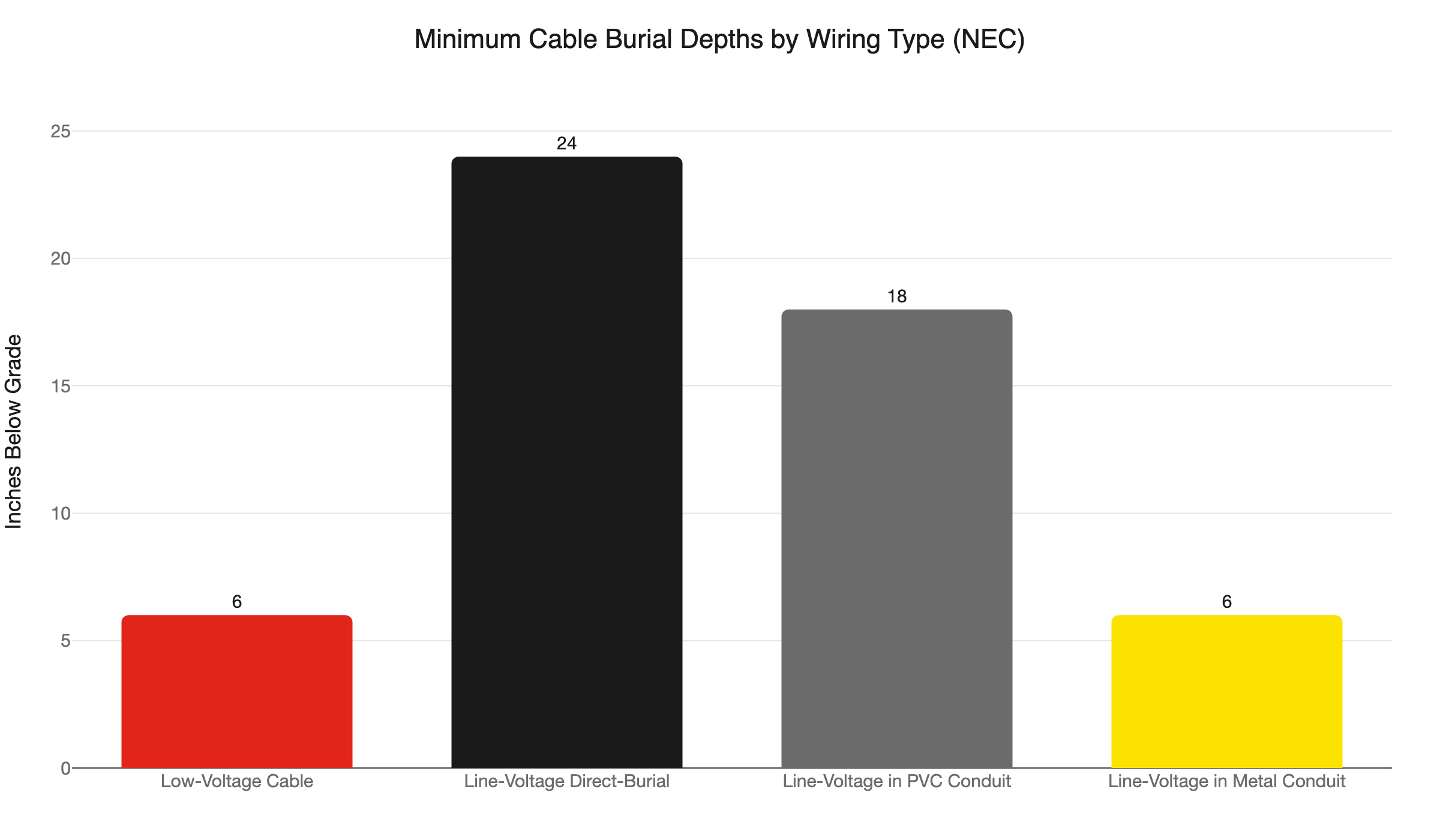
Low-voltage landscape cable requires a minimum 6-inch burial depth per NEC Article 411. Line-voltage wiring requirements are significantly deeper: 24 inches for direct-burial cable, 18 inches for PVC conduit, or 6 inches for metallic conduit. Source: Super Bright LEDs The chart on this page shows the comparison at a glance.
In Minnesota’s clay soils and frost conditions, the 6-inch minimum for low-voltage is a floor, not a target. Burying cable 10 to 12 inches adds meaningful protection at minimal extra cost, particularly in areas that lose snow cover early in the season. We cover the frost angle in detail in the next section.
One more rule that shapes trench planning: low-voltage and line-voltage cables can share a trench, but they must run in separate conduits. They cannot be bundled together.
How Does Minnesota’s Freeze-Thaw Cycle Affect Landscape Lighting?
Minnesota’s freeze-thaw cycle is the leading cause of tilted and displaced landscape lights in the Twin Cities. The state design frost depth for the Twin Cities is approximately 42 inches. Source: Minnesota DLI Frost Depth Map Frost heave pushes stakes, tilts fixtures, and can crack cable jacketing when it moves repeatedly through the soil.
The Minnesota DNR tracks frost depth annually. In bare-sod winters with low snowfall, Twin Cities frost has penetrated more than 35 inches below grade. Source: MN DNR Low-voltage cable buried at the NEC minimum of 6 inches is genuinely at risk when snow cover is thin or absent.
Two approaches protect fixtures and cable in Minnesota clay soils.
Compacted coarse gravel backfill. Excavate 12 to 18 inches for the cable run and backfill with coarse gravel. Gravel drains water away from the cable and resists frost heave better than clay. This is the most practical solution for path light runs and is far less expensive than deep footings. Source: River Bluff Landscaping
Concrete footings to frost depth. Appropriate for heavier architectural fixtures that cannot be pulled for winter storage. Footings should reach below 42 inches in exposed clay-soil areas to eliminate heave.
Seasonal storage. Plastic-staked path lights can be pulled and stored before the ground freezes. This is the simplest frost protection strategy for basic low-voltage systems. Fixtures that stay in the ground year-round must carry a wet-location listing. Confirm that rating before purchasing.
Planning a fall installation? A fall electrical safety check is a natural time to combine a landscape lighting project with a broader outdoor electrical review, before the ground hardens.
What Are Twin Cities Light Trespass Ordinances?
Minnesota Statutes Section 16B.328 is the state’s model outdoor lighting law. It addresses light trespass, sky glow, and glare. Many Twin Cities suburbs have adopted local versions of it. The core requirement in most adopted ordinances: fixtures must direct light downward rather than outward or upward toward the sky.
This matters practically for security floodlights and tree uplights. A wide-beam uplight aimed at a tall Norway spruce can spill enough light onto a neighboring lot to draw a complaint in a suburb with an active 16B.328 ordinance. Full-cutoff fixtures, lower lumen outputs, and careful aiming angles resolve most conflicts before they start.
Before you finalize fixture selection, check your city’s outdoor lighting ordinance. Some suburbs go beyond the state model: setback distances from property lines, maximum lumen output per fixture, or restrictions on certain fixture types in front-yard applications. This is not a step to skip, especially in higher-density neighborhoods where lots are close together.
When Northern Mister Sparky designs a lighting layout, we account for neighbor proximity and local ordinance requirements as part of the design conversation. You should not have to cross-reference each suburb’s municipal code yourself.
When Does Landscape Lighting Installation Require a Licensed Electrician?
Hire a licensed electrician for any line-voltage landscape lighting and for any low-voltage installation where a contractor pulls the permit. In Minnesota, contractors must hold a PLT license to install low-voltage systems. An unlicensed contractor doing this work is breaking state law. Any unpermitted or improperly licensed work will need to be redone before a home sale, and you will pay for it twice.
Beyond the licensing question, there are practical thresholds where a professional makes sense even for low-voltage work.
- Your system needs more than two or three transformer zones, or total wattage exceeds a single transformer’s rated capacity.
- You want hardwired in-ground fixtures connected to a junction box rather than plug-in transformer leads.
- Your outdoor receptacle is not GFCI protected, lacks a weatherproof cover, or sits on a shared circuit. We can handle outlet installation and GFCI upgrades on the same visit as the lighting work.
- You want a dedicated outdoor circuit for the transformer. This is the cleanest solution for larger systems and eliminates the risk of nuisance trips on a shared circuit.
- You want smart controls, color-adjustable fixtures, or app-based scheduling that require hardwired low-voltage drivers.
The risks of DIY electrical work go beyond the permit issue. A miswired outdoor circuit or improperly grounded transformer can create a shock hazard or fire risk. For a system that will sit outside through decades of Minnesota winters, getting it right the first time is worth the cost.
What Does the Landscape Lighting Installation Process Look Like?
A professional landscape lighting installation typically takes two to four hours for a standard low-voltage system on a residential lot. Larger properties, line-voltage work, or long trench runs through mature landscaping take longer. Here is the sequence a licensed installer follows.
Design walkthrough. We walk the property with you and mark fixture locations. We consider path coverage, feature spotlights, security zones, existing outdoor receptacle locations, and local ordinance requirements for your city.
Transformer sizing and receptacle check. The transformer must be sized for the total wattage of the system with headroom for future fixtures. We confirm the outdoor receptacle is GFCI protected, has a weatherproof cover, and is on an appropriate circuit.
Trenching and cable runs. Cable is trenched at the appropriate depth, deeper than the NEC minimum in exposed clay-soil areas for frost protection. Low-voltage and line-voltage cables run in separate conduits when they share a trench.
Fixture installation and aiming. Fixtures are installed, aimed, and tested. Stakes are set into compacted gravel where frost heave is a known risk based on soil type and exposure.
Permit and inspection. We coordinate the inspection. In cities that handle their own permits, we know which permit desk to call and what the inspector will be looking for.
Walkthrough. We walk through the completed system with you, confirm timer settings, and flag any seasonal maintenance: which fixtures should come out before a hard freeze, and what to watch for in the first winter after installation.
If you are also planning indoor lighting changes as part of a broader home improvement push, our indoor lighting and ceiling fan installation services can run on the same visit to reduce your total trip count.
Ready to Schedule Your Landscape Lighting Installation?
Landscape lighting is one of the highest-return improvements a Twin Cities homeowner can make. It adds curb appeal, deters package theft, improves path safety for guests, and gives your yard a finished look year-round. The Minnesota permit requirement, PLT licensing rule, and frost conditions make it worth doing correctly from the start rather than patching problems a few winters in.
Northern Mister Sparky is locally owned and operated in the Twin Cities. We hold the right licenses for both low-voltage and line-voltage landscape lighting work. We handle the permit and coordinate the inspection. As America’s On-Time Electrician(R), we show up when we say we will, and the UWIN(R) 100% satisfaction guarantee backs everything we do.
Before your installation, check Xcel Energy’s current LED lighting rebates. Qualifying LED fixtures may reduce your out-of-pocket cost. Confirm current residential outdoor fixture eligibility directly with Xcel before you purchase.
Call us at 763-200-5956 or book your landscape lighting installation online. We serve Minneapolis, St. Paul, Bloomington, Brooklyn Park, Woodbury, Blaine, Maple Grove, Plymouth, and the surrounding Twin Cities metro. No malarky, just a clean install that holds up through a Minnesota winter.
Frequently Asked Questions
Do I need a permit for landscape lighting in Minnesota? +
Can I install landscape lighting myself in Minnesota? +
How deep does landscape lighting wire need to be buried? +
Does Minnesota's freeze-thaw cycle damage landscape lighting? +
Need an electrician now?