Whole House Generator Installation: A Twin Cities Guide
Key Takeaways
- A whole house generator installation is a permitted, inspected electrical job in Minnesota, not a weekend project.
- A standby unit runs your home for days on natural gas or propane, while a portable unit burns gasoline and must be wheeled out every outage.
- Minnesota adopted the 2023 NEC on July 1, 2023, and an install here needs a state permit and a DLI inspection (DLI).
- The generator itself does not qualify for a federal tax credit, but the panel or service upgrade that comes with the install often can (ENERGY STAR).
- Western and central Minnesota average 12 to 15 hours of freezing rain a year, and a half-inch of ice can drop lines for days (MRCC).
- Call 763-200-5956 or book online to get a local, permitted install sized to your home.
Why Whole House Generator Installation Matters in a Minnesota Winter
A whole house generator installation is how a Twin Cities family stops treating outages as emergencies. The lights flicker, the furnace stops, the fridge thaws, and the sump pump goes silent. In Minnesota, that scene plays out every winter.
Western and central Minnesota sit in a high-frequency freezing-rain band that averages 12 to 15 hours of freezing rain each year, with most events in December and January (MRCC). A quarter-inch of ice brings down branches and causes outages. A half-inch or more cripples the grid for days, because that ice adds hundreds of pounds to every line and limb (MRCC).
We are locally owned and operated in the Twin Cities, so we see what these storms do to families in Minneapolis, St Paul, Blaine, and Woodbury. The homeowners who sleep through ice storms are the ones who planned ahead. That is the whole point of a standby system. It starts itself, switches your power, and runs until the utility comes back.
Standby or Portable: Which Generator Fits Your Twin Cities Home?
Short answer: A standby unit is permanent, auto-starts, and runs for days on natural gas or propane. A portable unit is cheap, gasoline-fueled, and needs you to roll it out and start it by hand every time the power drops. Most Twin Cities families who lose power in winter end up choosing standby.
The tradeoff is money versus convenience and safety. A portable generator puts out 3,000 to 8,500 watts, costs $400 to $1,500, and burns 12 to 20 gallons of gasoline a day (Consumer Reports). You must store stabilized fuel, wheel the unit out in the storm, run extension cords or a manual transfer setup, and refuel it around the clock.
A standby, or whole house, generator puts out 8,000 to 20,000 watts and sits outside like a central air conditioner (Consumer Reports). It runs on natural gas or propane, auto-starts within seconds of an outage, and runs for days to weeks on propane, or indefinitely on natural gas. The unit itself runs $2,000 to $5,000, and the full installation runs from a few thousand dollars to $10,000 or more once you factor in the electrician, the gas or plumbing subcontractor, and the pad (Consumer Reports).
For a Minnesota winter, that convenience is a safety feature. The day after an ice storm, the gas station down the street may not have power either, and its pumps will not run. A gasoline portable is only as good as the fuel you stored. A natural gas standby keeps drawing from a buried main that rarely fails.
How Much Does Whole House Generator Installation Cost?
Short answer: Plan on the generator unit plus the install. The unit runs $2,000 to $5,000, and a full, permitted installation runs from a few thousand dollars up to $10,000 or more, depending on the size, the transfer switch, the gas line, and whether your electrical service needs an upgrade.
Several line items drive the total:
- The generator itself: Sized by kilowatts. More kW means more loads running at once and a higher equipment cost.
- The transfer switch: Required by code and for life safety, covered below. A panel upgrade is often done at the same time.
- Fuel connection: Natural gas needs a gas-fitter. Propane needs a tank sized for multi-day outages.
- The electrical service: If your panel or service is too small for the generator, that work rolls into the job. See our guide on signs you need an electrical panel upgrade.
- Permit and inspection: Required in Minnesota. We pull the permit and schedule the DLI inspection.
The honest, no-malarky version: the sticker price hurts once, and the comfort pays off every outage for the next 15 to 20 years.
What Size Whole House Generator Do You Need?
Short answer: Add the running watts of every load you want on at the same time, add the starting surge for motor loads like furnaces and well pumps, then add about 20 percent headroom. Divide by 1,000 to get kilowatts. Most whole-home installs land between 16 and 24 kW.
Sizing is where national guides and local reality meet. The method is consistent across sources. List what must run during an outage: furnace, refrigerator, well pump, sump pump, lights, freezer, internet, and a few kitchen circuits. Note the running watts for each. Then double or triple the running watts for anything with a motor, because motors need a surge to start (Consumer Reports).
Add it all up, then add about 20 percent as headroom so the generator is not maxed out (Home Depot). Divide the total by 1,000 to convert watts to kilowatts.
In a Twin Cities home, the loads that bite you are the furnace blower, the sump pump, and, in summer, the central air. A gas furnace uses less than a portable can supply, but a backup electric heat strip can spike the surge. We size to your actual panel, not a guess. An undersized generator trips offline the first cold night. An oversized one costs more to buy and to run.
If your panel is already the bottleneck, the generator install becomes a panel job too, and that is the part of the work that may qualify for a tax credit.
Why Is a Transfer Switch Code, Not an Accessory?
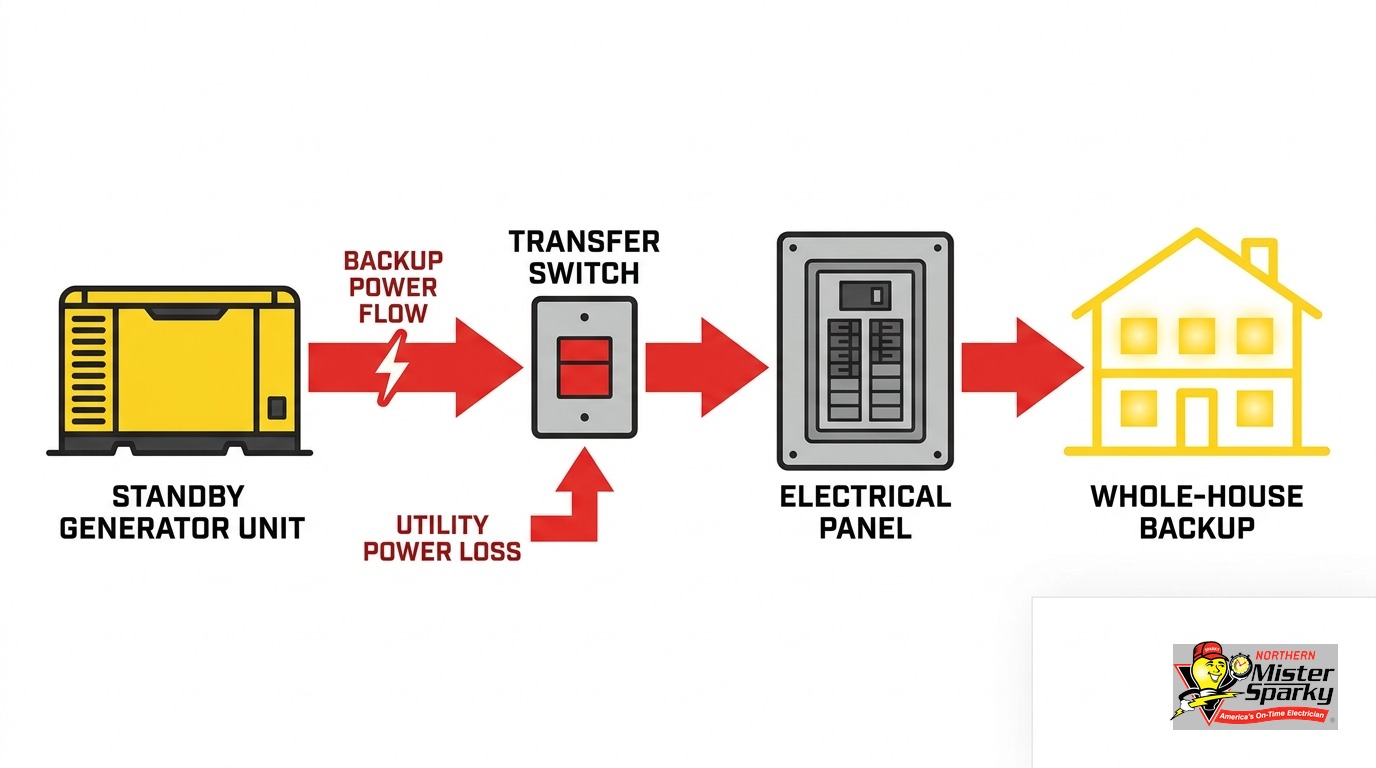
Short answer: A transfer switch isolates your house from the utility grid when the generator runs. Without it, your generator backfeeds the utility lines and can kill a lineman working to restore your power. That is why code requires it, and why we will not install a generator without one.
The transfer switch is the part of the job that makes it electrical work. It breaks the connection to the utility before it connects your generator, so your power cannot flow backward onto the street. That backfeed is deadly. A lineworker upstream, repairing a line they believe is dead, can be killed by a home generator feeding the grid the wrong way.
There are two common types. An automatic transfer switch, or ATS, is what a standby generator uses. It senses the outage, starts the generator, and flips the source, all without you out of bed. A manual transfer switch is what a portable generator uses. You flip it yourself after you wheel the unit out.
The thing we will never allow is a male-to-male cord, sometimes called a “suicide cord,” plugged from a generator straight into a wall outlet. That setup backfeeds the panel through a receptacle, energizes the dead utility line, and is a serious fire and electrocution hazard (Consumer Reports). It is also illegal for this exact reason.
The Minnesota Permit and Inspection Reality
A generator install in Minnesota is a permitted, inspected electrical job. The state adopted the 2023 National Electrical Code on July 1, 2023, and permits filed on or after that date must meet the 2023 NEC (DLI). Permits filed before that date fall under the 2020 NEC. The Minnesota electrical code is the NFPA National Electrical Code, adopted through Chapter 1315 of the State Building Code (DLI).
That means a licensed electrician does the work, the state gets an electrical permit, and a DLI inspector signs off. We pull the permit and schedule the inspection as part of the job. If you have a code or permit question, the DLI electrical program answers at dli.electricity@state.mn.us or 651-284-5026 (DLI).
This is the gap national cost guides skip. A homeowner who reads only the price tags never learns that the install is a code job. A local electrician is the only source that owns this honestly, because we are the ones who pull the paper and meet the inspector.
The 2023 NEC also carries clearance and setback rules. The generator must sit a set distance from openings like windows and doors, for both fire safety and exhaust intake. We locate the pad to satisfy code and to keep exhaust away from where your family sleeps.
Does a Whole House Generator Qualify for a Tax Credit?
Short answer: No, the generator itself does not qualify for either federal home-energy credit. But the panelboard or service upgrade that almost always comes with the install can qualify under the Energy Efficient Home Improvement Credit. That is a real dollar figure no national cost guide surfaces.
Two federal credits cover home energy work, and a fossil-fuel standby generator is on neither list. The Energy Efficient Home Improvement Credit, section 25C, runs through 2025 at 30 percent up to $1,200 per year, and its qualifying list covers windows, doors, insulation, central air, water heaters, furnaces, boilers, heat pumps, and biomass stoves, but not generators (IRS). The Residential Clean Energy Credit, section 25D, runs from 2022 through 2025 and covers solar, wind, geothermal, solar water heaters, fuel cells, and battery storage, but again, not fossil generators (IRS).
Here is the opening most homeowners miss. ENERGY STAR confirms that improvements to panelboards, sub-panelboards, branch circuits, and feeders count as energy property under 25C, with no lifetime limit, claimable each year through 2025 (ENERGY STAR). So the service or panel upgrade portion of your generator install, which we usually do anyway, can be claimed even though the generator cannot.
A note on timing. The IRS page references One Big Beautiful Bill guidance that may change these credits. Before you file, confirm the credit is still live for the tax year you are filing. The current page still lists 25C through 2025 and 25D from 2022 through 2025 (IRS).
What Fuel Should Your Generator Run?
Short answer: For a Minnesota winter, natural gas is the most reliable choice, because it draws from a buried main and runs indefinitely. Propane is a strong second if you size the tank for multi-day ice events. Gasoline, used in portables, is the weakest option, because the gas station may have no power to pump it.
Fuel choice is a local decision, not a national one. A national guide can tell you propane burns cleaner than gasoline. Only a Minnesota guide can tell you why that matters in January.
A standby generator burns 13 to 48 gallons of propane or natural gas per day, depending on load (Consumer Reports). On natural gas, that supply is effectively unlimited, because the fuel comes from a buried distribution main that rarely loses pressure in a storm. On propane, you are limited by tank size, so we size the tank for the worst case, a three or four day ice outage.
Gasoline, used in portable generators, burns 12 to 20 gallons per day (Consumer Reports). You must store stabilized fuel and rotate it. And when the storm is bad enough to knock out your block, it is often bad enough to knock out the gas station down the road, which means no pump, no fuel, and a cold, dark house.
Natural gas also avoids the carbon monoxide risk of refueling a hot, gasoline unit from a jerrican in the dark.
The Battery Alternative: What a Fossil Generator Forfeits
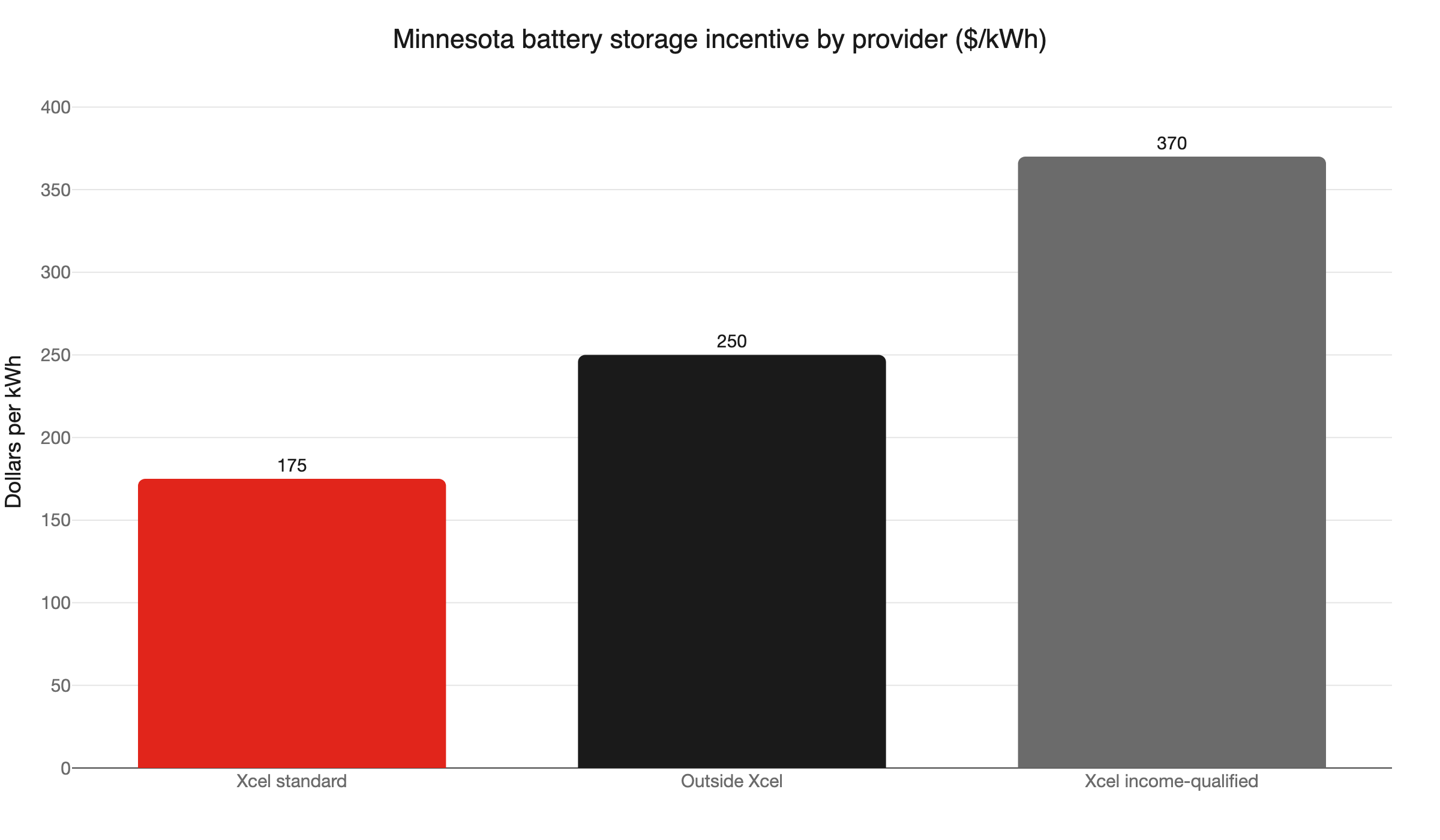
There is a real, money-on-the-table alternative to a fossil standby, and it is solar paired with battery storage. Minnesota’s Energy Storage Incentive pays for battery storage up to 50 kWh when it is paired with solar, not for fossil generators. In Xcel territory, the incentive pays $175 per kWh standard and $370 per kWh income-qualified, capped at $5,000. Outside Xcel, the Department of Commerce pays $250 per kWh up to $7,000 (MN Commerce). The chart shows how that per-kWh rate varies by provider and territory.
That is not a reason to skip a generator if your goal is to run a furnace and a well pump through a four-day outage. Batteries are sized in hours, not days. But it is a reason to know the tradeoff before you buy. A homeowner adding solar anyway can bank incentive dollars toward storage that also covers short outages silently and with no fuel.
We do not sell solar. We install electrical systems, and we size them honestly. If you are weighing a generator against storage, we can wire either one safely to code. Pair this conversation with our winter energy efficiency upgrades to shrink the load either system has to carry.
How Do You Run a Generator Safely?
Short answer: Keep any portable at least 20 feet from the house with the exhaust pointed away from windows, doors, and the AC unit. Never run one indoors or in a garage. Use a working, battery-powered carbon monoxide detector. And never backfeed your panel with a suicide cord.
The safety rules for a portable are simple and non-negotiable. Place the generator at least 20 feet from the house, with the exhaust pointed away from windows, doors, and the air conditioner (Consumer Reports). Never run a gasoline generator indoors, in a garage, or in a shed, even with the door open. Keep a working, battery-powered carbon monoxide detector on every floor, because CO is colorless and odorless and kills people in their sleep.
A standby generator handles most of these risks by design. It is permanently mounted outside, cleared from openings per code, and wired through a transfer switch that makes backfeed impossible. That is the core safety case for spending more on a standby.
The Midwest Regional Climate Center puts it plainly: use a qualified electrician to connect a generator to the house wiring, and never run a gasoline generator indoors (MRCC). For more on the household side, see our rundown of the top electrical hazards in older Twin Cities homes.
How We Handle Your Whole House Generator Installation
Our process is built around the code and the climate. We are America’s On-Time Electrician(R), and the UWIN(R) guarantee means the job meets your satisfaction or we make it right.
- Load assessment. We walk your home, list the loads you want covered, and calculate the kW size you actually need.
- Panel and service review. We check whether your existing service can carry the generator. If it cannot, we fold in the panel or service work, and we flag the part that may qualify for the 25C credit.
- Permit. We pull the state electrical permit under the 2023 NEC.
- Fuel coordination. We work with your gas or propane provider to size the supply for multi-day outages.
- Install and transfer switch. We set the pad, mount the generator, and wire the automatic transfer switch that keeps your power off the utility line.
- Inspection. We schedule and meet the DLI inspector.
- Walkthrough. We show you how the system starts, what it covers, and what to expect in an outage.
If your home is in Minneapolis, St Paul, Bloomington, Brooklyn Park, Woodbury, Blaine, Maple Grove, or Plymouth, we are your local team. Call 763-200-5956 or book online to get a sizing visit on the calendar.
Frequently Asked Questions
Does a whole house generator add value to a Twin Cities home? +
How long can a standby generator run continuously? +
Will a whole house generator run my entire home? +
Do I need a permit to install a generator in Minnesota? +
Can I install a standby generator myself? +
Need an electrician now?