
Signs Electrical Panel Is Overloaded: Check and Fix
Key Takeaways
- Frequent trips, dimming lights, a warm panel, buzzing, and burning smells are the main warning signs.
- Overload and bad connections look alike but need different fixes, so testing matters.
- A thermal scan lets an electrician see hot spots without touching live parts.
- Minnesota winters add electric heat, heat tape, block heaters, and EV charging to your load.
- A full panel is not always a maxed-out service. A sub-panel, splitter, or smart load management may solve it.
- Panel work needs a permit in Minnesota. The state panel grant has not launched, so do not delay safety repairs.
- Call 763-200-5956 or book online. We are locally owned and operated.
What Are the Signs an Electrical Panel Is Overloaded?
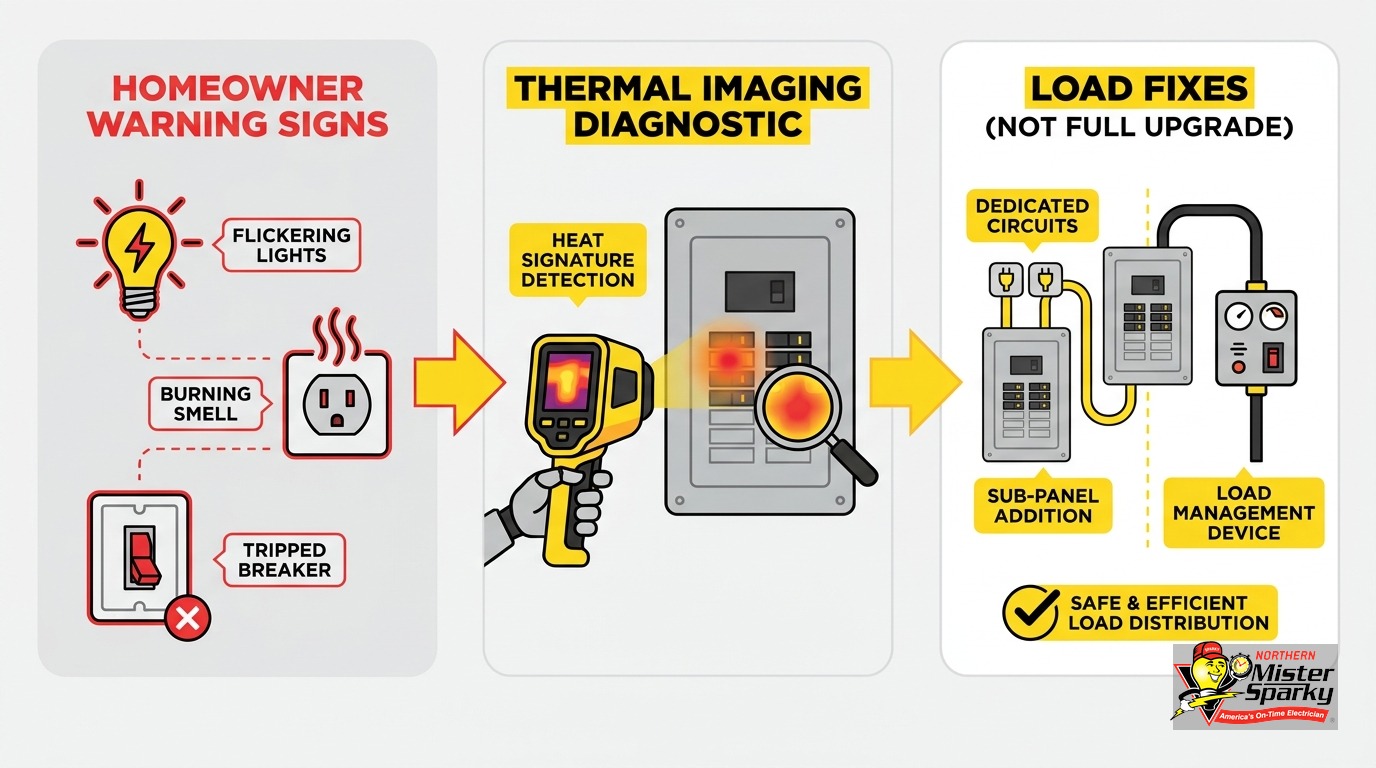
The most common signs are breakers that trip often, lights that dim when big appliances start, a warm panel cover, buzzing, burning smells, and appliances that struggle. You may also lean on extension cords. Any one sign deserves attention. A burning smell or scorch mark means stop and call right away.
Here is what each sign looks like in a Twin Cities home.
- Breakers trip often. A breaker trips to protect the wire behind it. If it trips on the same busy mornings or cold evenings, that circuit is carrying too much.
- Lights dim or flicker. Lights that dim when the dryer, microwave, or furnace blower starts can mean heavy demand on the system.
- The panel feels warm. A panel cover should feel close to room temperature. Noticeable warmth is a reason to call us, not a reason to wait.
- Buzzing or humming. A faint hum can be normal. Loud buzzing or crackling is not.
- Burning smells or scorch marks. Check the panel, outlets, and switch plates. Any burnt odor or dark mark needs a professional right away.
- Appliances struggle. A space heater that cuts out or a dryer that takes forever to dry can point to a strained circuit.
- Extension cords everywhere. If power strips keep a room working, the house is short on circuits.
Never open the panel cover yourself. The parts inside stay live even when a breaker is off. Leave that work to a licensed electrician.
One or two signs may mean a single weak circuit. Several signs may mean the whole panel is running out of room or capacity. Either way, the next step is a proper look, not guesswork.
Is It an Overloaded Panel or a Bad Connection?
An overload means your circuits ask for more power than the wiring or service can supply. A bad connection is a loose or damaged contact that makes heat even under a light load. Both can cause warmth, trips, or odd smells. Only testing tells them apart.
The fixes do not match. Tighten a loose connection on an overloaded panel and the real problem stays. Add a bigger service to a panel with a failing breaker and you pay for the wrong job.
A simple way to think about it:
- Overload tends to show up when many things run at once. The signs come on during dinner prep, laundry day, or a deep freeze with every heater running.
- A bad connection can show up at any time. One outlet, switch, or breaker acts up even when the house is quiet.
- Both can exist together. An older panel under heavy demand often has worn parts too.
Age plays a role as well. Homes with under 100-amp service, or homes built before 1965, “likely need more amperage,” according to the NYSERDA guide to assessing residential electrical service. Many Twin Cities neighborhoods have plenty of homes from that era. They were wired for far fewer devices than we own today.
You can gather clues before we arrive. Write down which breaker trips, what was running, and the time of day. Note whether anything felt warm. That log helps us find the cause faster.
Our post on how to label a circuit breaker panel also helps here. A clear panel map speeds up every visit.
What Does a Thermal Scan Show Inside Your Panel?
A thermal camera turns heat into a color picture. That lets an electrician spot hot areas without touching live parts. One hot breaker or wire end often points to a loose connection. Broad warmth across many breakers points to heavy load. We read the picture alongside other tests.
Many homeowners have never heard of this step. It is one of the most useful tools we carry for panel checks.
A scan usually goes like this:
- We ask what you have noticed, such as trips, smells, or dimming lights.
- We run the house normally so the panel carries a real load. A scan of an idle panel shows less.
- We scan the panel with the cover off, using proper safety gear.
- We compare each breaker, wire end, and connection point with its neighbors.
- We explain what we see in plain language and show you the image.
Patterns matter. A single bright spot at one connection usually means a loose or damaged contact. Heat spread across the bus and many breakers suggests the panel is working hard. A breaker much hotter than the ones beside it may be failing.
A scan is not a guarantee. It captures one moment, and a problem can hide until the house draws more power. That is why we pair it with a visual check, tightening where needed, breaker testing, and a review of your loads.
Ask any electrician who offers a scan what they will do with the results. A picture only helps if it leads to a clear plan. We give you a written plan with options and costs.
Why Minnesota Winters Push Panels Harder
Many panels show their limits in winter. Our heating season is long, and many of the extra loads are electric. The same panel that coped in July can struggle in January.
Common winter loads in our area include:
- Portable and baseboard electric heaters
- Heat tape on pipes and roof heat cables
- Engine block heaters in the driveway
- Garage heaters and workshop tools
- Heated floors and bathroom heat lamps
- Holiday lights and longer evenings of lighting
- EV charging overnight in the cold
Heat pumps are also becoming common here. The NYSERDA guide notes that a heat pump “can draw up to 60-amps during startup.” That surge can expose a tight panel.
A note on scope. We handle the electrical side of any heating project, including the circuit, the disconnect, and the panel capacity. For the equipment itself, our sister company Northern One Hour HVAC is the right call. For plumbing, call Northern Benjamin Franklin Plumbing.
We cover this more in our January winter electrical demand guide. The short version: count your winter loads before you add another one. If you plan to add heat or an EV charger, have us check the panel first.
How Many Breakers Can Fit in a 200 Amp Panel?
It depends on the panel’s spaces, not only its amp rating. NYSERDA says 40 spaces indicate a 200-amp panel, 30 spaces indicate 150 amps, and 20 spaces indicate 100 amps. Double-pole breakers use two spaces. Open spaces do not prove spare capacity, so a load calculation decides.
The NYSERDA guide states it this way: “Twenty spaces indicate 100-amp rated capacity, 30 spaces indicate 150-amp rated capacity, and 40 spaces indicate 200-amps.” That gives you a quick guess at your service size from the panel itself. The panel label and the main breaker give the final answer.
Spaces and capacity are two separate limits. You can run out of one while you still have plenty of the other.
- Out of spaces, with capacity left. The panel is full, but the house does not use much power. A sub-panel or splitter may fix this.
- Spaces open, out of capacity. The slots are empty, but the total load is already near the limit. Adding circuits here is a bad idea.
- Both limits reached. The service needs an upgrade.
A load calculation adds up your real demand, appliance by appliance. It is the proper way to decide what your panel can carry. We have a plain-language home electrical load calculation guide if you want the method.
What Is the 80% Rule for Circuit Breakers?
The 80% rule says a circuit should not carry more than 80% of its breaker rating for a continuous load. A continuous load runs for three hours or more. A 20-amp breaker should carry about 16 amps continuously. A 15-amp breaker should carry about 12.
Two points trip people up.
First, the rule applies to individual circuits, not to your whole panel. A 200-amp panel does not mean you may only use 160 amps in total. Your total demand comes from the load calculation.
Second, the rule matters most for equipment that runs for hours, such as EV chargers, space heaters, heat cables, and some pumps. An EV charger is a classic case. A charger that pulls 32 amps needs a breaker rated for 40 amps.
Here is an example. Say you plug a 1,500-watt space heater into a 15-amp circuit that also feeds a TV and lamps. The heater alone pulls about 12.5 amps. Add anything else, and the circuit sits above its comfortable limit. The breaker may trip, or the wire may run hot for hours.
A bigger breaker is not the fix. A larger breaker on thin wire removes the protection and creates a fire risk. The fix is a proper circuit sized for the load. Our guide to wire gauge and breaker size explains how the two must match.
Can I Add More Breakers to a Full Electrical Panel?
Sometimes. A full panel may still have spare capacity but no open spaces. A sub-panel, a load-sharing splitter, or a load-managed panel can add circuits without a new service. If the service itself is maxed out, an upgrade is the safe fix. Your electrician decides after checking the load.
NYSERDA describes this case well. A home may have capacity but “no space for new breakers.” That is a space problem, not a power problem, and it has several fixes before you reach for a full upgrade.
Do not try this yourself. Squeezing in extra breakers or doubling up wires on one breaker creates real hazards. Some breakers are not allowed to hold two wires. Some slots are not approved for slim breakers. The panel label tells us what is permitted.
The honest answer is that it depends on three things:
- The size of your service
- Your real calculated load
- The type and condition of your panel
We will tell you which case you are in. If an upgrade is not needed, we say so. That is the no malarky promise behind our work.
Load Fixes Short of a Full Upgrade
A full upgrade is not the only answer. These are the options we weigh with homeowners, based on the same NYSERDA guidance.
A sub-panel. A sub-panel adds breaker spaces fed from your main panel. It helps when you are out of slots but have spare capacity. It also suits a garage, workshop, or addition.
A load-sharing splitter. NYSERDA says a splitter “allows two devices to share one circuit.” Its example is an EV charger that is blocked while the dryer runs. The charger and dryer take turns. One caution applies: “Each device must have a power draw equal to or less than the associated breaker.”
Smart panels and breakers. These tools “automatically prioritize which loads receive power and when, providing real-time response.” In plain terms, the system decides what runs when demand peaks. That keeps you under your limit without rewiring the house.
Appliance swaps. Replacing older appliances “can create substantial additional electrical capacity.” Newer models often draw less power for the same job. A heat pump water heater or a modern dryer can free up room.
Smarter EV charging. Many EV chargers can limit their draw or share power with other loads. We cover this in our guide to EV load management that avoids a panel upgrade.
Habit changes. Run the dryer and oven at different times. Do not stack space heaters on one circuit. These cost nothing and they help.
Each option has limits. A splitter will not help if your service is already full. A sub-panel will not add capacity. The load calculation picks the right choice, not a sales pitch.
When Does a Full Upgrade Make Sense?
A full upgrade makes sense when your service is the limit, or when the panel itself is unsafe. That includes homes with under 100-amp service, a panel with known problems, or plans for big new loads. The load calculation and a hands-on inspection settle the question.
Look for these triggers:
- Your calculated load is near or over the service rating.
- You plan to add an EV charger, heat pump, hot tub, or addition on top of a full panel.
- The panel is a known problem brand or shows rust or damage.
- You have repeated trips on many circuits, not one.
- A thermal scan shows heat that tightening cannot fix.
- Your insurer or a home inspector has flagged the panel.
The most common upgrade size is 200 amps. That is enough for most single-family homes, including many with electric heat or an EV. Our guide to upgrading a panel to 200 amps in Minnesota covers costs, steps, and timing.
Larger jobs like a panel, generator, or EV charger can add up. We offer financing on those projects so you can fix the problem now instead of putting it off. Ask us about it when we quote.
When you are ready, our panel upgrade service covers the full job. We handle the permit, the utility coordination, and the inspection.
Do I Need a Permit to Upgrade My Electrical Panel?
Yes, in most cases. Panel work in Minnesota needs an electrical permit, and a licensed contractor normally pulls it for you. Permits go through the state’s iMS online system, or through your city if it runs its own inspections. The inspector directory shows which one applies to your address.
The Minnesota Department of Labor and Industry explains the process. You apply online through its iMS system, which needs an account. Then check the inspector directory. If the AHJ column says “State,” file with DLI. If it says “Local,” contact your city or township. AHJ stands for authority having jurisdiction, the office that approves and inspects the work.
Twin Cities homeowners notice the differences here. Minneapolis, St. Paul, and many suburbs run local programs, and rules and forms vary by city. We know them and file the right paperwork.
Code is changing as well. The Board of Electricity adopted Chapter 1315 amendments that bring in the 2026 National Electrical Code with Minnesota amendments. According to the DLI rulemaking docket, “The rules will be effective as of Aug. 17, 2026.” Work you plan now falls under the new edition. Be careful with older checklists and forms, because some still carry outdated edition names in their file names.
For more detail, see our guide to the Minnesota electrical permit process. When we upgrade a panel, we handle the permit and the inspection so you are not left with open paperwork.
What to Know About Minnesota’s Panel Grant and Rebates
Minnesota has a planned grant for panel upgrades, but it has not launched. The Minnesota Commerce Department page, updated Oct. 12, 2026, says “There is no estimated program launch date.” It is awaiting federal approval and will likely start with or after the federal HEAR program.
The page describes the plan this way:
- Who can apply: owners of single-family homes at or below 150% of area median income.
- Larger grant: “$3,000 for an owner whose annual household income is less than 80% of area median income.”
- Smaller grant: “$2,000” for owners above 80% but below 150%.
- Qualifying work: a panel of at least 200 amperes, or a smart panel.
- Funding: approximately $5.8 million.
One line matters most for your timing: “Grants will not be issued retroactively.” Work you finish before the program opens will not qualify.
Please do not hold off on a safety repair to wait for this money. A warm panel, a burning smell, or constant trips should be fixed now. If your project can safely wait, we can talk about the timing. We will never push you either way.
Utility rebates are a separate matter. Xcel Energy offers some electrical incentives, but amounts change. Check Xcel’s current rebates before you buy equipment. Our post on Xcel Energy electrical rebates in Minnesota is a good place to start.
Get Your Panel Checked by a Local Team
You do not have to guess whether your panel is overloaded. A short visit can tell you what is happening and what it will take to fix it. We will check the load, scan for hot spots, and lay out your options in plain English.
Northern Mister Sparky is locally owned and operated. We serve homeowners across the Twin Cities, including Minneapolis, St. Paul, Bloomington, Brooklyn Park, Woodbury, Blaine, Maple Grove, and Plymouth. We are backed by the national Mister Sparky franchise, and we are proud to be America’s On-Time Electrician(R).
When you hire us, you get:
- A clear explanation of what we find
- Options from small fixes to a full upgrade
- Honest pricing and financing for larger jobs
- Our UWIN(R) 100% satisfaction guarantee
If your breaker trips often, your lights dim, or your panel feels warm, act now. Call 763-200-5956 or book online today. If you smell burning or see scorch marks, call right away and keep clear of the panel.
Frequently Asked Questions
Is a warm electrical panel normal? +
Can an overloaded panel start a fire? +
Should I wait for the state panel grant before fixing my panel? +
Need an electrician now?