
Lighted Bathroom Mirror Wiring: What You Need to Know
Key Takeaways
- Lighted bathroom mirror wiring must connect to a GFCI-protected circuit. No exceptions under Minnesota or federal code.
- A GFCI outlet hidden behind the mirror fails inspection. The device must remain readily accessible.
- Mirrors that fall within 3 feet horizontally or 8 feet vertically of a tub rim or shower threshold are in the NEC wet zone. A cord-connected mirror in that zone is a code violation.
- Minnesota adopted the 2026 NEC on August 17, 2026. Bathroom circuits on permits pulled after that date require both AFCI and GFCI protection.
- A permit is required for any bathroom electrical work in Minnesota, including a mirror swap that involves touching wiring. Northern Mister Sparky pulls the permit and coordinates the DLI inspection.
- The junction box behind an old medicine cabinet is often too small for a lighted mirror’s additional wires. This is the most commonly missed issue in a DIY mirror install.
Lighted Bathroom Mirror Wiring: Hardwired vs. Plug-In
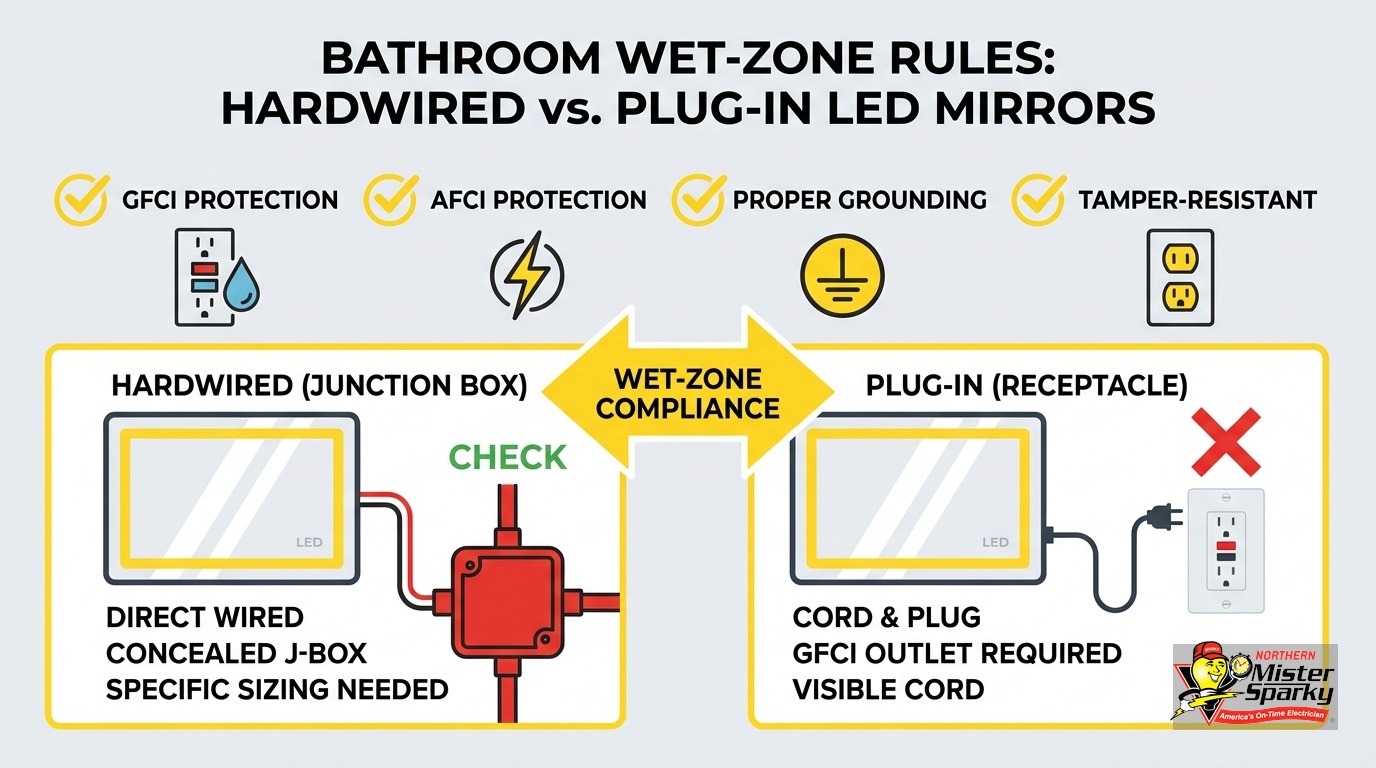
Short answer: Hardwired is the cleaner option and the only compliant choice in many bathroom layouts. Plug-in works where a GFCI outlet already exists, stays accessible after the mirror is mounted, and sits outside the wet zone.
Both types can pass a Minnesota inspection. The deciding factors are outlet position, mirror size, and proximity to the tub or shower.
Hardwired mirrors terminate inside a permanent junction box mounted in the wall. The mirror’s lead wires connect there with wire nuts or push-in connectors. No cords are visible. GFCI protection comes from a breaker at the panel or a GFCI outlet positioned outside the mirror footprint. The look is clean, the accessibility problem disappears, and wet-zone compliance is straightforward.
Plug-in mirrors need an outlet that stays reachable after the mirror is hung. This is where most plug-in installs fail. Vanity outlets often sit directly behind the mirror’s mounting area. Once the mirror is in place, the outlet is buried between mirror and wall. The GFCI reset button is no longer accessible. That fails inspection.
The choice is often driven by what is already in the wall. If your bathroom has an existing switched circuit feeding a medicine cabinet, hardwired is usually more practical than relocating an outlet.
Does Lighted Bathroom Mirror Wiring Require a GFCI Circuit?
Short answer: Yes. NEC 210.8(A) requires GFCI protection on all 125-volt, 15- and 20-ampere receptacles in bathrooms, with no exceptions. For hardwired mirrors, the circuit feeding the fixture must be GFCI-protected at the breaker or through a GFCI outlet upstream of the mirror.
GFCI protection for a hardwired mirror can come from two places:
- A GFCI circuit breaker at the panel that protects the entire bathroom circuit.
- A GFCI outlet mounted outside the mirror footprint, with standard wire running from there to the mirror’s junction box.
The GFCI breaker is the cleaner solution for most hardwired installs. It removes any question about outlet placement, eliminates accessibility concerns, and leaves the junction box simpler. For plug-in mirrors, the outlet itself must be GFCI-protected and must remain reachable after the mirror is mounted.
See our detailed walkthrough of GFCI outlet placement and code requirements for more on which circuits and locations require protection and why.
Why GFCI Placement Matters More Than Most Guides Tell You
Short answer: NEC requires GFCI devices to be “readily accessible.” An outlet buried behind a lighted mirror fails that test. The inspector will require a correction before the permit can close.
The phrase “readily accessible” in the code means you can reach the GFCI reset button without moving furniture, removing the mirror, or using a tool. That standard is harder to meet than it sounds in a bathroom where mirror width often equals vanity width.
Two scenarios trip homeowners up:
The plug-in mirror that covers its outlet. You mount the mirror, run the power cord behind it, and the outlet is now pinned between mirror and wall. The reset button is completely blocked. This is the most common field correction on plug-in installs, according to commentary from working electricians on NEC forums.
The hardwired mirror with a GFCI device inside the junction box. Some installers wire a GFCI outlet into the junction box and then cover everything with the mirror. The GFCI outlet is still code-required to be accessible. Covering it with the mirror body voids that requirement.
The fix in both cases is the same: move the GFCI protection to a location that stays reachable. A GFCI outlet outside the mirror footprint works for plug-in installs. A GFCI breaker at the panel is the cleanest solution for hardwired mirrors. Our comparison of GFCI breakers vs. GFCI outlets covers how to choose between them.
What Is the Bathroom Wet Zone, and Does It Affect Your Mirror?
Short answer: NEC 410.10(D) prohibits cord-connected or pendant-style luminaires within 3 feet horizontally and 8 feet vertically of a bathtub rim or shower threshold. If your mirror falls inside that zone, a hardwired connection is the only compliant option.
Most homeowners know there are special rules near a tub or shower. The geometry catches them off guard. Measure 3 feet horizontally from the nearest tub rim or shower threshold. Measure 8 feet vertically from the same starting point. Any luminaire with a cord or a hanging pendant whose parts fall inside that box must be rated for damp or wet locations and cannot use a cord or pendant connection.
This matters most in bathrooms with a combined tub-shower centered on the wall. A wide mirror above that unit may straddle the wet-zone boundary. Even if the center of the mirror clears the 3-foot mark, the mirror’s edge, its power-supply assembly, or its mounting hardware may not.
Hardwired mirrors inside the wet zone must connect to a permanent junction box. No trailing cord from the back of the mirror to a wall outlet. No pigtail to a surface receptacle behind the unit. The wiring has to be enclosed all the way to the box.
Our post on bathroom light and wet-zone code requirements covers the geometry in more detail. The same rules that govern vanity fixtures apply to lighted mirrors.
Will a Standard Junction Box Hold the New Wires?
Short answer: Often no. Retrofitting a lighted mirror over an old medicine-cabinet circuit is the most common source of box overfill in bathroom electrical work. NEC 314.16 requires you to calculate box fill before you splice.
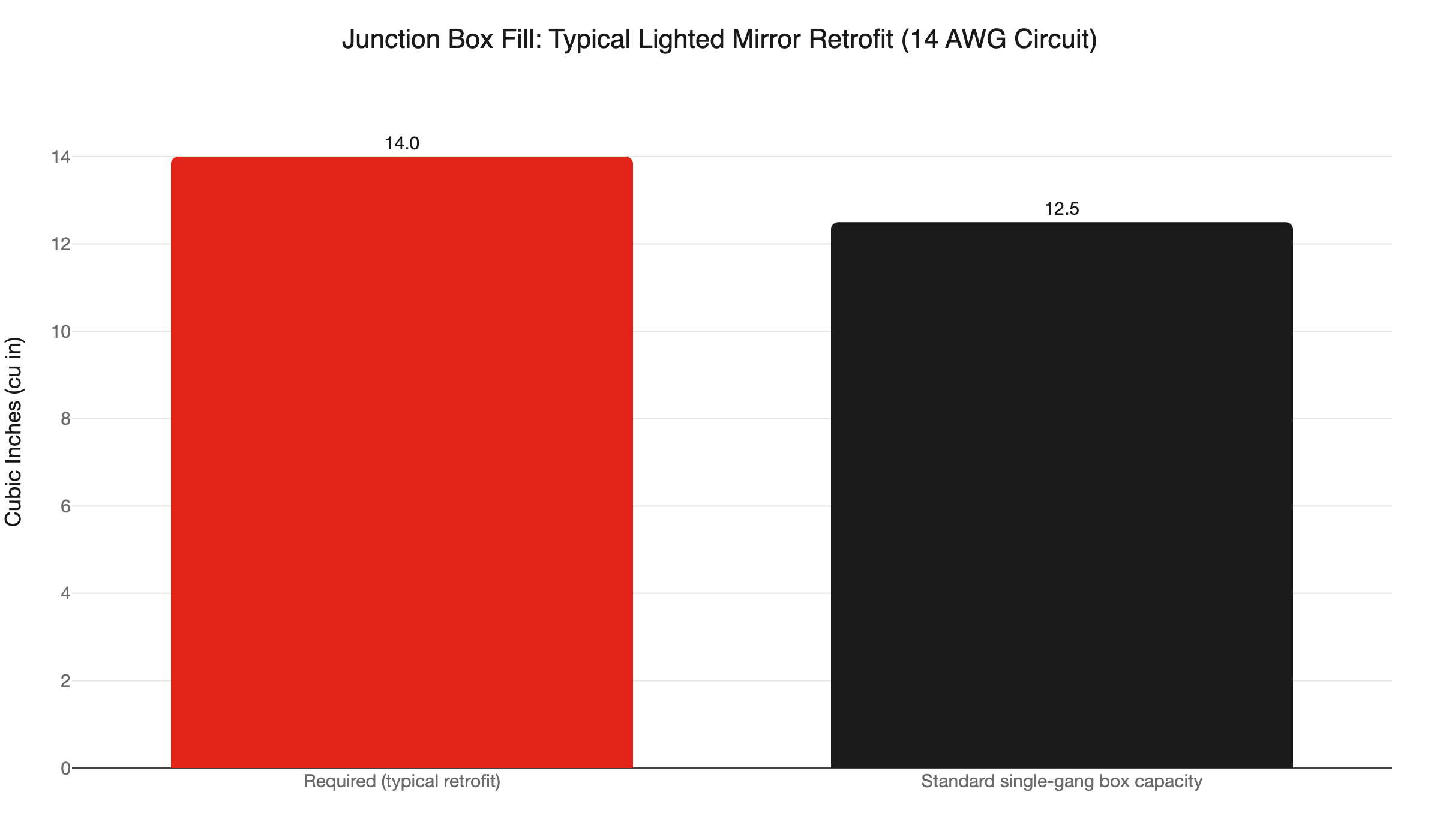
A standard single-gang box mounted 2.5 inches deep holds 12.5 cubic inches. Under NEC 314.16(B), each 14 AWG conductor counts as 2.0 cubic inches. A GFCI outlet counts as double the largest conductor connected to it, which works out to 4.0 cubic inches on a 14 AWG circuit.
Here is what a typical retrofit looks like:
- Three existing conductors (hot, neutral, ground): 3 x 2.0 = 6.0 cu in
- Two mirror lead wires (hot, neutral): 2 x 2.0 = 4.0 cu in
- GFCI outlet device: 4.0 cu in
- Total required: 14.0 cu in
- Standard box capacity: 12.5 cu in
That is over-limit by 1.5 cubic inches. An inspector will write it up. The two fixes are: upgrade to a larger box (a 4-inch square box with a single-gang plaster ring is the standard move), or push the GFCI protection upstream to a breaker and remove the device from the junction box entirely.
The mirror goes in, the wiring looks fine from the outside, and the box fill violation only surfaces when an inspector opens the junction box. Catching it before you close the wall costs nothing. Catching it after costs drywall repair on top of the electrical work.
What Did Minnesota’s 2026 NEC Adoption Change for Bathroom Wiring?
Short answer: Minnesota adopted the 2026 NEC effective August 17, 2026. Permits pulled on or after that date require AFCI protection in bathrooms on top of the existing GFCI requirement. A combination AFCI/GFCI breaker is the practical solution for new work.
Before August 17, 2026, bathroom circuits in Minnesota needed GFCI protection only. The 2026 NEC adds arc fault circuit interrupter (AFCI) protection to bathrooms. Any new circuit or substantial modification on a permit dated August 17 or later now needs both.
In practice:
- Permit pulled before August 17: you are under 2023 NEC. GFCI protection only.
- Permit pulled August 17 or after: you are under 2026 NEC. Both AFCI and GFCI required.
- Best solution for new work: a combination AFCI/GFCI breaker at the panel. One device handles both requirements at the source.
Minnesota adopts the NEC without state amendments, so the federal code sections cited in this post apply directly. No state carve-outs to work around. The licensing exam transitioned to the 2026 NEC on September 8, 2026, so any licensed electrician you hire now should be current on the new rules.
For more on how arc fault and ground fault protection work together, see our breakdown of combination AFCI/GFCI breakers.
Do I Need a Permit to Install a Lighted Bathroom Mirror in Minnesota?
Short answer: Yes. Minnesota requires a permit for any bathroom electrical work that involves opening a junction box and connecting wires. A homeowner exemption from the licensing requirement exists, but it does not exempt you from pulling a permit or passing a DLI inspection.
This surprises a lot of homeowners. Swapping a lighted mirror feels like a simple fixture replacement. But the moment you open a junction box and splice wires, the work requires a permit in Minnesota. DLI (the Minnesota Department of Labor and Industry) handles residential inspections for most electrical work statewide. It is not a city inspection. It is a state inspection.
The homeowner exemption works like this. You can legally perform electrical work on your own owner-occupied single-family home without holding an electrical contractor license. The permit is still required. The DLI inspection is still required. And you must perform all the work yourself. Bringing in an unlicensed helper to do any part of the work voids the permit.
DLI inspectors work from the 2026 NEC Residential Inspection Checklist, which covers box fill, GFCI/AFCI compliance, and wet-zone requirements in the same visit. Knowing that list before you start is exactly why hiring a licensed electrician to pull the permit and handle the inspection saves time and money.
When Northern Mister Sparky does the install, we pull the permit under our master license, schedule the DLI inspection, and coordinate everything. You do not track deadlines or chase the inspector. For a deeper look at what the permit process involves, read our overview of Minnesota electrical permits.
When Should You Call a Licensed Electrician Instead?
Short answer: Call before you start if the mirror covers an existing outlet, the install is near a tub or shower, your bathroom has no existing GFCI protection, or you are not certain how the existing circuit is wired. The code requirements stack up quickly and corrections after the fact cost more than getting it right the first time.
Most lighted mirror installs that go sideways share a few warning signs. Watch for these:
The mirror will cover an existing outlet. You will need to move the outlet or change your GFCI strategy. Both options require opening the wall and pulling wire.
The bathroom has no GFCI protection. Older homes built before GFCI requirements commonly lack it entirely. Adding GFCI for the first time means panel work or running new wire, not just swapping a device at the vanity.
The mirror is near the tub or shower. Wet-zone rules add layers the mirror’s instruction sheet does not mention. The wiring method, the junction box location, and the luminaire’s listed rating all have to satisfy NEC 410.10(D).
You are not sure how the existing switch leg is wired. A common medicine-cabinet setup runs a switched hot to the box. A lighted mirror with its own built-in switch may need a constant hot plus a switch leg. Mis-identifying a switched leg and connecting it as a constant hot leaves you with a mirror that loses power every time the main light switch goes off.
The existing wiring is aluminum. Homes built between the mid-1960s and mid-1970s often used aluminum branch-circuit wiring. Connecting aluminum wire to a device rated only for copper is a fire hazard that demands a different solution entirely.
If any of these apply, call a licensed electrician before you open the wall. The cost of a professional install is predictable. The cost of correcting a failed inspection, repairing drywall, and re-doing mis-wired work is not.
What to Expect When Northern Mister Sparky Does the Install
We start by confirming which code applies to your permit date and measuring wet-zone geometry before any screws come out of the wall. Then:
- Check box fill before opening the junction box. If the box is undersized for the mirror’s lead wires plus the existing conductors, we upgrade the box in the same trip. No second visit, no wall left open.
- Confirm or install GFCI protection in a location that stays accessible after the mirror is hung. If the 2026 NEC applies to your permit, we install a combination AFCI/GFCI breaker at the panel so both requirements are met at the source.
- Verify the mirror’s luminaire rating if the install falls inside the wet zone. Not all lighted mirrors carry a damp- or wet-location listing. If yours does not and it needs to, we catch that before the mirror goes on the wall.
- Pull the permit, complete the install, and coordinate the DLI inspection. You do not have to manage a single step of that process.
We are locally owned and operated in the Twin Cities. We back every job with our UWIN(R) 100% satisfaction guarantee. And as America’s On-Time Electrician(R), we show up when we say we will.
Ready to Get Started?
Lighted bathroom mirror wiring is one of those projects where the mirror costs $200 and the code mistakes can cost multiples of that to correct after an inspection. Getting it right the first time means knowing the wet-zone geometry, the GFCI accessibility requirement, and the box fill calculation before the first screw goes into the wall.
Call us at 763-200-5956 or book online. We pull the permit, handle the DLI inspection, and leave your bathroom wiring exactly as it should be.
Frequently Asked Questions
Do I need a permit to install a lighted bathroom mirror in Minnesota? +
Can I plug a lighted mirror into a regular bathroom outlet? +
What is the wet zone rule for bathroom mirrors? +
Do Minnesota bathrooms now require AFCI protection? +
Need an electrician now?