
Motorized Window Shade Wiring Installation: Twin Cities
Key Takeaways
- Motorized shades can be hardwired. Common options are 24 V DC and 120 V AC systems, according to a vendor guide to retrofit and new-build shades.
- Battery motors suit many retrofits. Hardwired power suits new builds and open walls.
- A neutral wire at the switch box makes smart controls far easier. Older boxes often lack one.
- Check your motor’s wiring diagram before you buy. Motor types differ in which wires they need.
- Minnesota adopted the 2026 NEC effective Aug. 17, 2026, per the state’s electrical code page.
- Permit rules for new circuits and inspections vary by job and city. Confirm before you cut into a wall.
- Plan wiring before drywall closes. Adding it later costs more.
The Short Answer on Motorized Window Shade Wiring
You have one choice to make: power the motor from a battery, or feed it from your home’s wiring. Battery shades need no new wires. Hardwired shades need a safe power source at the window, and that is a job for a licensed electrician.
We are Northern Mister Sparky, a locally owned and operated electrician serving the Twin Cities. We see these projects most often during remodels and new builds. We also see them when homeowners add smart controls to rooms that already have wiring.
Can Motorized Shades Be Hardwired?
Yes. Motorized shades can be hardwired to your home’s electrical system. Some motors run on low-voltage 24 V DC from a power supply. Others run on 120 V AC straight from a circuit. Either way, you have no batteries to charge or replace.
The Home Controls guide describes the power options as “Hardwired 24 V DC or 120 V AC systems.” It recommends hardwired power for new builds.
That matches what we see in the field. Open walls make wiring easy and cheap. Finished walls make it harder.
Here is how the two hardwired types differ:
- 24 V DC systems. A transformer or power supply steps down household power. Thin low-voltage cable runs to each motor. Installers can often snake that cable more easily.
- 120 V AC systems. The motor takes household voltage directly. It needs a proper box, proper cable, and a safe connection. This is standard electrical work.
Either way, someone has to bring 120 V power to a spot near the window or to a central power supply. That part is electrical work. It is not a blind installer’s job.
Should You Choose a 120V Feed or a Battery Motor?
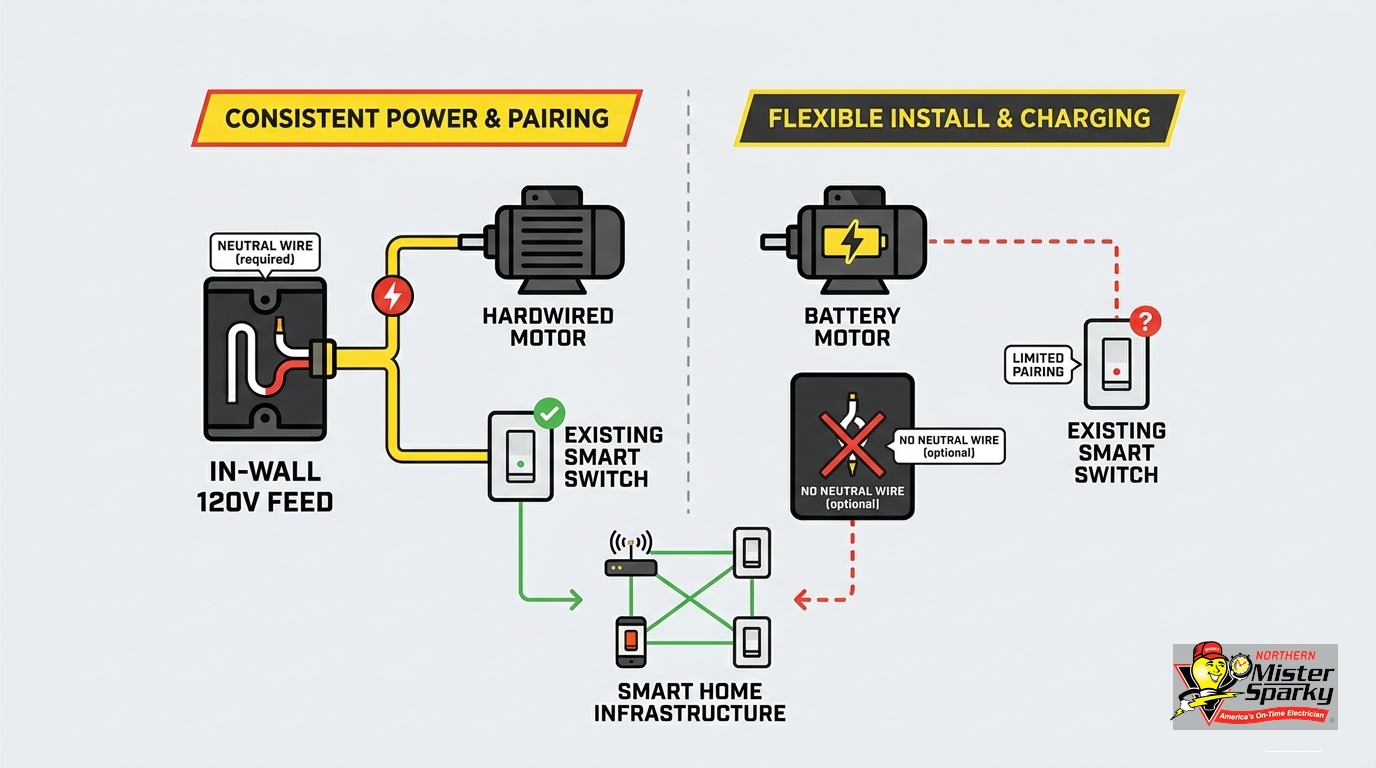
Choose battery power for a finished room where opening walls is not worth it. Choose a 120V or low-voltage hardwired feed for new construction, remodels with open walls, or large windows you will run daily. Hardwired shades remove battery upkeep. Battery shades cut installation cost and mess.
Vendor guides compare these options on cost, battery life, and retrofit versus new build. The same vendor guide recommends battery or solar for retrofits and hardwired power for new builds. We agree with the logic.
Price is only part of it.
Battery life and Minnesota winters
The guide gives battery runtime of “6-12 months with 4-6 daily cycles.” It also notes reduced battery performance “below ~5°C.”
The cold matters here. Window headrails sit against cold glass in January. A shade that works fine in October may slow down in a drafty north-facing room.
Battery shades also need attention. Someone has to remember to charge or swap them. Across a house with many windows, that chore adds up.
Cost
The vendor puts retrofit motor kits at “$150-$400 per window” and hardwiring at “$150-$400 per opening.” Treat those as one vendor’s claims, not Twin Cities pricing.
Your real cost depends on wall access, distance to a power source, and how many openings you have. We quote each job after we see the space.
A simple way to decide
- Pick battery if walls are finished, the shades are few, and you will not mind occasional charging.
- Pick hardwired if you are building, remodeling, or opening walls anyway.
- Pick hardwired if you have many windows or tall windows that are hard to reach.
- Pick hardwired if you want shades tied into a whole-home smart system.
If you are already pre-wiring a home for smart features, read our guide to smart home pre-wiring. Shade power fits well into that plan.
Does a Motorized Shade Need a Neutral Wire at the Box?
It depends on the motor and the control. A 120V motor typically needs a hot, a neutral, and a ground to run. Smart switches and shade controllers often need a neutral too, because their electronics draw power all the time. Check the wiring diagram for your exact model.
Online shade advice rarely covers this. The vendor guide mentions “code-compliant junction boxes” and “code compliance.” It never mentions neutrals or permits.
Here are the three wires in plain terms.
- Hot (line). This wire brings power from the panel.
- Neutral. This wire completes the circuit and carries current back to the panel.
- Ground. This wire is a safety path. It gives fault current somewhere safe to go.
A basic wall switch only breaks the hot wire. It does not need a neutral to do its job. So many older switch boxes have no neutral at all.
Smart controls are different. They have a small circuit that stays awake, waiting for your phone or voice. That circuit needs a neutral to complete its path.
What the code says about neutrals at switches
The ECM trade magazine reads the 2017 NEC section 404.2(C) as requiring a grounded conductor at lighting switch locations. You can read the article on Article 404 for the details.
The same article lists exceptions. They include:
- conductors entering through a raceway large enough to hold a grounded conductor;
- a box accessible for adding or replacing cable without removing finish materials;
- lighting controlled by automatic means;
- a switch controlling a receptacle load.
The article says the connection requirement took effect Jan. 1, 2020. It also lists a limit of five electronic lighting control switches on a branch circuit and 25 on a feeder.
Two cautions apply. First, that is the 2017 edition. Minnesota now uses the 2026 NEC, so we confirm current wording before we rely on any of it. Second, that rule speaks to lighting switch locations. A shade motor is not a light.
So the code does not settle the question. The practical point stands. A neutral in the box gives you far more control options, now and later.
For a deeper look, read our post on a smart switch with no neutral wire. It covers the workarounds and when to skip them.
How Do You Power a Shade From an Existing Switch Box?
An electrician checks which wires reach the box, then picks a safe path. If the box has a neutral, a smart control can often go in with little new cable. If it lacks one, the options are to run a new cable, use a low-voltage power supply, or pick a different control.
Here is how we approach it on a service call.
- Turn off the power and test. We shut off the breaker. We confirm the wires are dead with a tester before we touch anything.
- Open the box and identify the wires. We look for hot, neutral, and ground. We note what else shares the box.
- Check the box itself. The box must have room. A crowded box is a fire and shock risk.
- Read the shade’s wiring diagram. Motors differ. We match the control to the motor.
- Choose the cleanest power path. That may be a new cable, a neighboring circuit, or a small power supply near the window.
- Make and secure connections. We use the right connectors and close the box properly.
- Test the shade and the circuit. We run the shade through its full travel and check the breaker.
Why we do not just tap a nearby wire
It is tempting to grab power from a nearby light or outlet. We do not recommend it.
Shade motors add a load to that circuit. Taps in the wrong box can also break code. We want every connection in an accessible, properly sized box.
If you hit a snag with an old switch loop, our guide to smart lighting control wiring explains how pros plan these systems from the panel on out.
When the wall is already closed
Fishing new cable through finished walls is harder. A pro can often work from the attic, basement, or a nearby closet. Plaster and lath walls in older Twin Cities homes need extra care.
Sometimes the answer is a battery motor, and we will say so. We would rather save you from opening a wall you do not need to open. That is the “no malarky” approach.
Can Shades Pair With Your Smart Switches?
Yes, often. Many shade systems work with wireless hubs, apps, and voice assistants. Your smart switches can sit beside them in the same system. You need to match the control protocol and give each switch box the power it needs.
Pairing works at two levels.
- Control level. The shade responds to a hub, app, or remote. It does not matter if your lights use the same brand.
- Power level. Each device needs a proper power source. This is where the electrician comes in.
If your home already has smart switches, you may have neutrals in those boxes. That helps. You may be able to place a shade controller in a box that already has the wiring it needs.
If you have no smart switch infrastructure yet, a shade project is a good time to plan it. Pull a neutral to boxes where you may want smart controls later. Cable is cheap when walls are open. It is expensive when they are not.
We also suggest grouping controls. A single wall plate near the door can handle lights and shades together. That keeps the look tidy and the wiring simple.
Homes with several smart systems need one wiring plan. Security cameras, doorbells, and shades all pull from it. Our guide to hardwired security camera installation shows how we plan power and low-voltage runs for another smart device. The same thinking applies to shades.
How Difficult Is the Electrical Wiring During Installation?
The wiring is easy in an open wall and hard in a finished one. Mounting the shade is simple. Bringing safe power to the window is the part that takes skill. Connecting 120V wiring is not a good DIY job unless you are qualified and know the local rules.
Split the job into pieces and the line is clear.
The easy parts
- Mounting the bracket and headrail.
- Installing a battery pack.
- Pairing the shade to a remote or app.
- Setting travel limits.
A careful homeowner can handle these steps. Follow the maker’s instructions.
The hard parts
- Running new cable inside finished walls.
- Making 120V connections in a box.
- Adding a neutral where none exists.
- Sizing and loading a circuit.
- Keeping power wiring and low-voltage wiring apart.
- Meeting code and passing inspection.
These tasks need training. Mistakes can cause shocks, fires, or failed inspections. Our post on DIY electrical dangers explains the risks in more detail.
Time and mess
In new construction, we wire shade locations during rough-in. It adds little time. The same is true in a remodel with open walls.
In a finished room, expect patching and paint. We work to keep that small. We protect floors, and we clean up when we finish.
A word on low-voltage wiring
Low-voltage shade wiring feels safer, and it is gentler than 120V. It still needs care. The power supply at the other end connects to household voltage. That connection must be right.
Cable routing also matters. Pinched or stapled cable can fail later. Poor routing near power wires can cause interference or code problems.
What Needs a Permit and Inspection in Minnesota?
New circuits, new boxes, and new wiring in walls generally call for a permit and inspection in Minnesota. Simple plug-in battery shades do not. Rules vary by project and city, so confirm with your local building department before work begins. A licensed electrician handles the permit for you.
Here is what we can say with confidence. The Minnesota Department of Labor and Industry says Minnesota adopted the 2026 NEC effective Aug. 17, 2026. Permits filed before that date follow the 2023 edition. Permits filed on or after it follow the 2026 edition. You can read the DLI electrical codes page for yourself.
Because today is after Aug. 17, 2026, new permits fall under the 2026 edition. If you read older advice that says 2023 is current, it is out of date.
The same page says the electrical code is Chapter 1315 of the Minnesota State Building Code. It describes the code as the NEC as published by NFPA. It mentions no Minnesota amendments.
What we cannot promise
We will not guess at the fine print. Permit rules for homeowners can differ between the state, Minneapolis, and St. Paul. Some cities require a rough-in inspection before walls close. Ask your city to confirm for your project.
For plain-language background, see our guides on the Minnesota electrical permit process and the homeowner permit exemption in Minnesota. They explain who can pull a permit and when.
Why this matters to you
Unpermitted work can surface when you sell. It can also cause trouble with insurance. A licensed electrician pulls the permit, does the work to code, and schedules the inspection. That protects your home and your resale.
What Should You Plan Before Walls Close?
Plan power at every window you may motorize, even if you start with batteries. A box or a pulled cable now costs little. Adding wiring later costs far more. Walk each room with your electrician before drywall goes up.
Here is a checklist we use with homeowners and builders.
- List every window. Mark which ones get shades now and which might later.
- Choose the power type. Decide between 120V and low-voltage hardwired, or battery.
- Pick the power spot. Many installers place power near the top of the window or in a nearby wall.
- Pull a neutral to switch boxes. Do it where you might add smart controls.
- Leave access. Keep power supplies and junction boxes reachable. Buried boxes cause code problems.
- Group the controls. Decide where wall controls will go.
- Check the circuit. Make sure the circuit has room for the new load.
- Confirm the permit. Ask your city what it requires.
- Save the diagrams. Keep the shade maker’s wiring diagram with your project file.
Think about the whole room
Shade power is rarely a stand-alone project. It often rides along with lighting, outlets, and other low-voltage runs.
In a bath remodel, you might add a heated towel rack and a motorized shade in the same wall. Our guide to heated towel rack wiring shows how we plan circuits for bath upgrades. In a finished basement, shades share the plan with lights and outlets.
Think about cold, too. Windows in Minnesota homes run cold in winter. A hardwired motor avoids the battery slowdown noted earlier in cold conditions.
Know what we cannot cover
We cover the electrical side. We do not sell blinds or shades. The shade vendor handles the product, sizing, and fit.
We also do not do HVAC or plumbing. If your window project touches those, our sister brands can help. Northern One Hour HVAC covers heating and cooling. Northern Benjamin Franklin Plumbing covers plumbing.
We also did not find an Xcel Energy rebate for shade motors. Do not count on one.
Why Call Northern Mister Sparky
We are locally owned and operated in the Twin Cities. We serve homeowners in Minneapolis, St. Paul, Bloomington, Brooklyn Park, Woodbury, Blaine, Maple Grove, Plymouth, and nearby.
We show up on time. That is why we are known as America’s On-Time Electrician(R). We back our work with the UWIN(R) 100% satisfaction guarantee.
For a shade project, we can:
- check your switch boxes for a neutral;
- plan 120V or low-voltage power to each window;
- add outlets, boxes, and cable in new or finished walls;
- pull the permit and schedule the inspection;
- tie shade controls into your smart switch setup.
Our home wiring service covers the cable and box work behind projects like this one. For larger jobs, ask us about financing.
Ready to plan your shades? Call 763-200-5956 or book online. We will walk the rooms, check your boxes, and give you a straight answer on the best way to power each window.
Frequently Asked Questions
Do battery motorized shades need an electrician? +
Can I use my existing light switch to run a motorized shade? +
Should I run low-voltage and 120V wiring together? +
Need an electrician now?