Are Smart Plugs Safe for Space Heaters? Not Usually
Key Takeaways
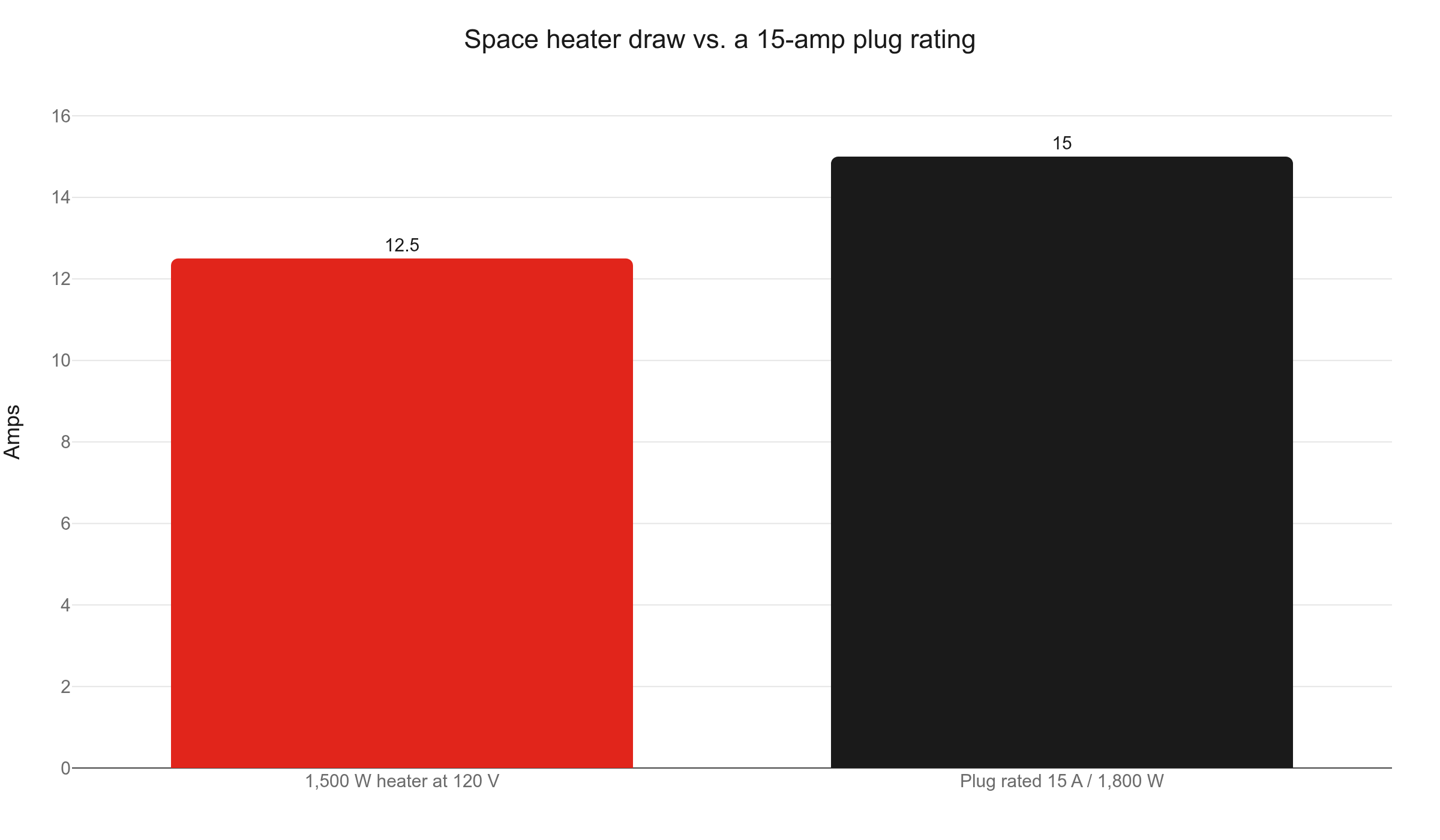
- A 1,500-watt heater at 120 volts draws 12.5 amps. That is close to the limit of a 15-amp smart plug.
- Heaters run for hours, so heat builds at the plug’s blades and internal switch.
- Federal fire agencies say to plug space heaters directly into a wall outlet.
- Never use an extension cord or power strip with a heater.
- Never put ovens, ranges, dryers, or other large appliances on a smart plug.
- A remote “on” command can start a heater when nobody is home.
- A hardwired smart switch or a thermostat-controlled heater is the better path to remote control.
- Older Twin Cities homes often have worn outlets that make this risk worse.
Are smart plugs safe for space heaters?
For most homes, no. We advise against plugging a space heater into a smart plug. A heater pulls close to the plug’s maximum for hours, and the plug adds one more hot connection. Plug the heater straight into a wall outlet instead. If you want remote control, use a hardwired option.
A space heater is one of the hungriest things you can plug in. A smart plug is built for lamps, fans, and coffee makers. They are a poor match.
We are a locally owned and operated Twin Cities electrician, and we see heater-related damage every winter.
How much power does a space heater actually pull?
Most plug-in heaters draw 1,500 watts on high. Divide watts by volts to get amps. At 120 volts, 1,500 watts equals 12.5 amps. That is a big, steady load on one outlet.
One popular smart home guide says typical heaters need “one to two thousand watts.” The same guide says popular smart plugs are inexpensive. The plug is a small, cheap device. The heater is a heavy load.
Now the high end. A 2,000-watt heater would draw about 16.7 amps. That is more than a 15-amp plug can carry. Some heaters sit right at the edge of what a standard outlet can handle.
Compare that with the things people usually put on smart plugs:
- A table lamp with an LED bulb draws a fraction of an amp.
- A fan draws one or two amps.
- A coffee maker draws more, but only for a few minutes.
A heater does not cycle off after a few minutes. It runs for hours on cold Minnesota nights. That long run time turns a heavy load into a heat problem.
What does the amp rating on a smart plug really mean?
The amp rating is the most current the plug is built to carry. Many smart plugs are labeled 15 amps and 1,800 watts. That label is a ceiling, not a target. A plug run near its ceiling for hours has little margin.
Take a plug rated for 15 amps and 1,800 watts, paired with a 1,500-watt heater. It has about 17 percent headroom. The heater draws 12.5 amps, and the plug’s limit is 15. That is not much room for a device that never rests.
Check the rating printed on your own plug. Ratings vary by brand and model. We could not confirm one manufacturer’s rating for this post, so read the label or the box instead of trusting a number from a web page.
Heat builds in two places inside a smart plug:
- The blades and contacts. A loose or dirty connection adds resistance, and resistance makes heat.
- The internal relay. This is the tiny switch that turns power on and off. It carries the full load every time.
The heater is built to handle its own heat. The plug is not. A smart plug also packs a circuit board and wireless parts into a small case, so there is little space to shed heat.
Look for a safety certification mark from a recognized testing lab. A plug without one is a bad bet for any load. A certified plug is still not a green light for heaters. The mark means the plug passed tests at its rated load. It does not mean the plug suits a heater that runs all night.
What do federal fire agencies say about plugging in heaters?
Both the Consumer Product Safety Commission (CPSC) and the U.S. Fire Administration say the same thing. Plug space heaters directly into a wall outlet. Never use an extension cord or power strip. The advice we read does not name smart plugs, but it points the same direction.
The numbers show why the advice exists. The CPSC says portable heaters, a group that includes electric space heaters, were involved in an average of 1,700 fires per year from 2017 to 2019. Those fires caused an average of 70 deaths and 160 injuries each year, according to the agency’s 2023 winter safety release.
The same release tells people to “plug electric space heaters directly into a wall outlet.” It says never to connect a heater to an extension cord or power strip. Those can overload the wiring and cause a fire.
The U.S. Fire Administration gives matching advice. It says to plug space heaters into wall outlets, not extension cords or power strips. It also says to inspect your heater for cracked or damaged cords and broken plugs.
There is a gap here. That advice does not name a smart plug. A smart plug is not a power strip, and it is not quite an extension cord. Whether it counts as one is debatable. But it is still an adapter sitting between the heater and the wall. It adds a link the rule is trying to remove.
We take “directly” at face value, and a smart plug is not direct.
Is it safe to plug a space heater into an extension cord?
No. Federal fire agencies say never to use an extension cord or power strip with a space heater. Cords are often thinner than the wiring in your wall. A heater’s steady, heavy draw can overheat a cord and start a fire. Plug heaters directly into the wall.
An extension cord is only as strong as its thinnest part. Many household cords are made for lamps and chargers. They are not made for 12 amps all night.
Cords also hide damage. A cord can look fine on the outside and be frayed under a rug or behind a couch. Heat from the heater can bake the cord insulation over time.
If your heater cord does not reach an outlet, do not stretch it with another cord. Move the heater, or call us to add an outlet where you need it. Our post on extension cord dangers and when to add an outlet explains how to spot the warning signs.
A smart plug works like a short, fancy adapter in the same path. It is not the same as a long cord. But it has the same weak point: another link between your heater and the wall.
Which appliances should never go on a smart plug?
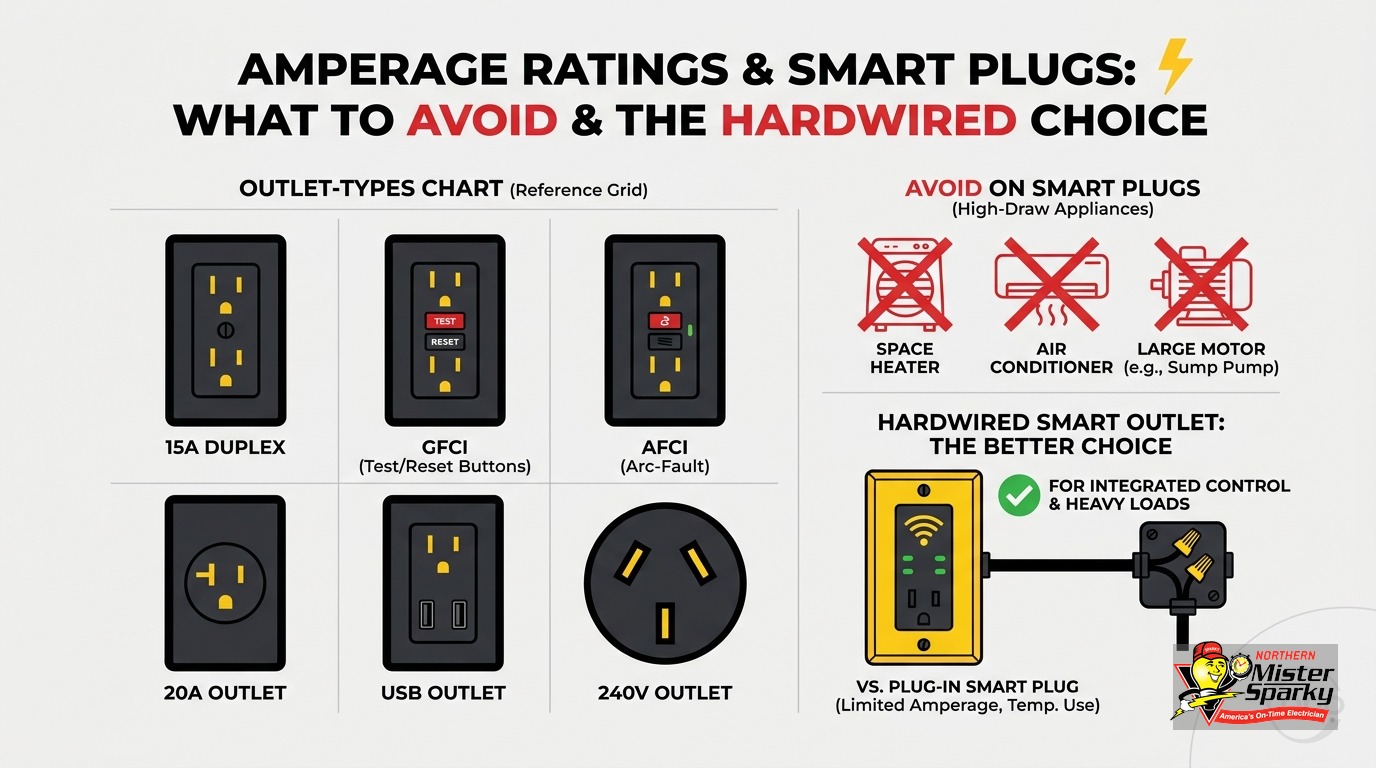
Keep high-wattage and heat-producing appliances off smart plugs. Heaters top the list. Large appliances that need their own dedicated circuits also do not belong there. Smart plugs are meant for low-power devices like lamps, fans, and small electronics.
Here is our “never” list for smart plugs:
- Space heaters. They draw heavy current for hours.
- Portable air conditioners. These pull a big surge at startup. See our guide to portable air conditioner circuits for details.
- Hair dryers and curling irons. They are high-wattage and easy to forget about.
- Toasters, toaster ovens, and electric kettles. They make intense heat in a short time.
- Electric blankets and heating pads left on unattended. A remote “on” is the wrong idea for these.
- Refrigerators and freezers. An accidental “off” can spoil food, so use a plain outlet.
- Medical equipment. A switched-off plug can have serious results.
- Anything that needs a dedicated circuit. Window air conditioners, microwaves, and similar units belong on their own wiring.
A good rule of thumb: if the label says 1,000 watts or more, skip the smart plug. If the device makes heat on purpose, skip it too.
Safe picks are small and low-draw. Think lamps, holiday decor, a fan, a phone charger station, or a coffee maker you check before leaving.
Why can a remote “on” command be dangerous with a heater?
A smart plug lets you turn a device on from anywhere. With a heater, that is a hazard. Someone could switch it on when nobody is home. A heater may then run near a blanket, a curtain, or a pile of laundry with no one watching.
Here are a few ways this goes wrong:
- A schedule runs while you are away, and a pet knocks the heater near a bed.
- Someone taps the wrong device in the app.
- A power outage ends, and the plug restores power on its own.
- A software glitch flips the plug on at the wrong time.
Heaters need a clear space around them. Fire safety groups often advise keeping combustibles at least three feet away, but we could not verify a specific Minnesota source for that distance. Check your heater’s manual for its own clearance rule.
A heater should be on only when you can see it. A smart plug is built for the opposite.
Wear and tear matters too. A worn receptacle (the socket in your wall) plus a heavy load is a real risk. If an outlet feels loose or warm, stop using it for heaters. Our guide on warm outlets and switch plates covers what to look for.
When is a hardwired smart outlet the better choice?
A hardwired smart option is better when you want remote or timed control of a heavy load. A smart switch on a dedicated circuit, or a hardwired heater with a thermostat, removes the plug-in link. The wiring is built for the load, and a licensed electrician installs it.
A smart plug is a pass-through. It sits between the heater and the wall, so current flows through it. A hardwired smart switch is part of the circuit itself. It is rated and installed for the job.
Here are the safer paths to remote control:
- A smart switch on a dedicated heater circuit. The circuit is sized for the heater, with nothing else sharing it.
- A hardwired electric heater with a built-in thermostat. Baseboard and wall units tie into the home’s wiring. Our post on electric baseboard heater wiring explains how that works.
- A smart thermostat tied to a hardwired heater. You control the temperature, not just on and off.
- A new outlet where you need heat. A better-placed receptacle ends the urge to use cords.
We covered when code calls for separate wiring in our guide to a dedicated circuit for a space heater. If your heater trips breakers or shares a circuit with other loads, read that post next.
A dedicated circuit also helps the rest of your house. It keeps the heater from fighting with lights, TVs, and other devices on the same line.
If you plan to heat a room all winter, the plug-in route may not fit. A hardwired heater can be cleaner, quieter, and safer.
Do smart plugs increase the electricity bill?
A smart plug itself adds very little to your bill. It uses a small amount of power to stay connected to Wi-Fi. The device on the plug is what costs money. A space heater on a smart plug costs the same as that heater on a wall outlet.
You can estimate heater cost with simple math. Multiply the heater’s kilowatts by the hours it runs. That gives kilowatt-hours. Then multiply by the rate on your utility bill.
For example, a 1,500-watt heater is 1.5 kilowatts. Run it for eight hours, and that is 12 kilowatt-hours. Multiply 12 by your own rate to see the daily cost.
We are not quoting a Minnesota rate, since rates change. Check your latest Xcel Energy bill for your current price per kilowatt-hour.
A smart plug can help your bill through scheduling. For low-power devices, timers can cut waste. With a heater, the safety risk outweighs any savings.
A better way to cut heating costs is to improve the home itself. Sealing drafts and upgrading insulation helps more than any plug. Our post on winter energy efficiency upgrades lists the steps worth taking first.
What should Twin Cities homeowners know about older homes and permits?
Many Twin Cities homes were built long before heaters, space-hungry electronics, and smart devices. Older homes often have 15-amp circuits, fewer outlets, and worn receptacles. Winter pushes those circuits harder. That is our experience on the job, not a statistic.
Here is what we often see in older homes:
- A single circuit feeding a whole bedroom, with lamps, a TV, and a heater on it.
- Loose outlets that no longer grip a plug tightly.
- Scorch marks or discoloration around a receptacle.
- Two-prong outlets with no ground.
- Breakers that trip every time the heater kicks on.
Any of those is a reason to call an electrician before the next cold snap. A heater is a stress test for old wiring. If a circuit trips under a heater, it is telling you something.
Permits matter too. Swapping a receptacle or adding a hardwired smart outlet may need a permit, depending on where you live. The Minnesota Department of Labor and Industry (DLI) says it is the inspection authority only where a municipality has not adopted local inspection. The page also says work cannot begin until the permit application and fees are approved.
The Twin Cities mix state and city inspection, so confirm with your city before any work. We could not confirm whether simple device replacement is exempt, so ask first. Our guide to the Minnesota electrical permit process walks through the basics.
Hiring a licensed electrician also takes the guesswork out. We handle permits and inspections as part of the job.
How can you use a space heater more safely this winter?
If you use a plug-in heater, follow a short checklist. Plug it into a wall outlet, keep it clear of anything flammable, and never leave it running unattended. Skip the smart plug and the extension cord. Check the cord and plug often.
Use this checklist before every cold season:
- Inspect the cord and plug. The U.S. Fire Administration says to look for cracked or damaged cords and broken plugs.
- Plug directly into the wall. No cords, power strips, or smart plugs.
- Give it space. Keep blankets, curtains, and furniture well back.
- Use a flat, hard surface. Never set a heater on a rug or bed.
- Turn it off when you leave. Also turn it off when you go to sleep.
- Test your smoke and carbon monoxide alarms. They are your backup.
- Feel the outlet. If the plug or wall plate is warm, stop and call us.
Pay attention to what your home tells you. Flickering lights, buzzing, or a burning smell are not normal. Our guide on burning smells from outlets or breakers covers what to do right away.
If a circuit keeps tripping, do not just reset it and carry on. A tripping breaker is protecting you, so find out why.
When should you call a licensed electrician?
Call us if you want remote heat control, if an outlet feels warm, or if your heater trips the breaker. We can add an outlet, run a dedicated circuit, or wire a hardwired heater. The right fix depends on your home.
Here are common jobs we handle for this exact problem:
- New outlets where you keep reaching for a cord. Learn more about our outlet installation service.
- Dedicated circuits for heaters and other heavy loads.
- Hardwired heater installation with a smart thermostat.
- Worn receptacle replacement in older homes.
- Panel checks when breakers are full or tripping often.
For larger jobs, ask us about financing. Bigger projects, like a new circuit or panel work, do not have to wait.
Heating and cooling equipment is outside our scope. For furnaces and heat pumps, we point you to our sister company, Northern One Hour HVAC. We stay in our lane: electrical only.
Call Northern Mister Sparky
Northern Mister Sparky is locally owned and operated in the Twin Cities. We serve Minneapolis, St. Paul, Bloomington, Brooklyn Park, Woodbury, Blaine, Maple Grove, Plymouth, and nearby towns. As America’s On-Time Electrician(R), we show up when we say we will.
Every job is backed by our UWIN(R) 100 percent satisfaction guarantee. We explain the problem in plain language, give you clear options, and do the work right. No malarky.
Want safe, remote-ready heat this winter? Call 763-200-5956 or book online. We will look at your circuits, your outlets, and your heater plan. Then we will recommend the safest fix for your home.
Frequently Asked Questions
What is the best portable heater to heat a room? +
Can I use a smart plug with a small heater? +
Can a smart plug start a fire? +
What can I use for remote heater control instead? +
Need an electrician now?