
Three Season Porch Electrical Outlets: Minnesota Code Guide
Key Takeaways
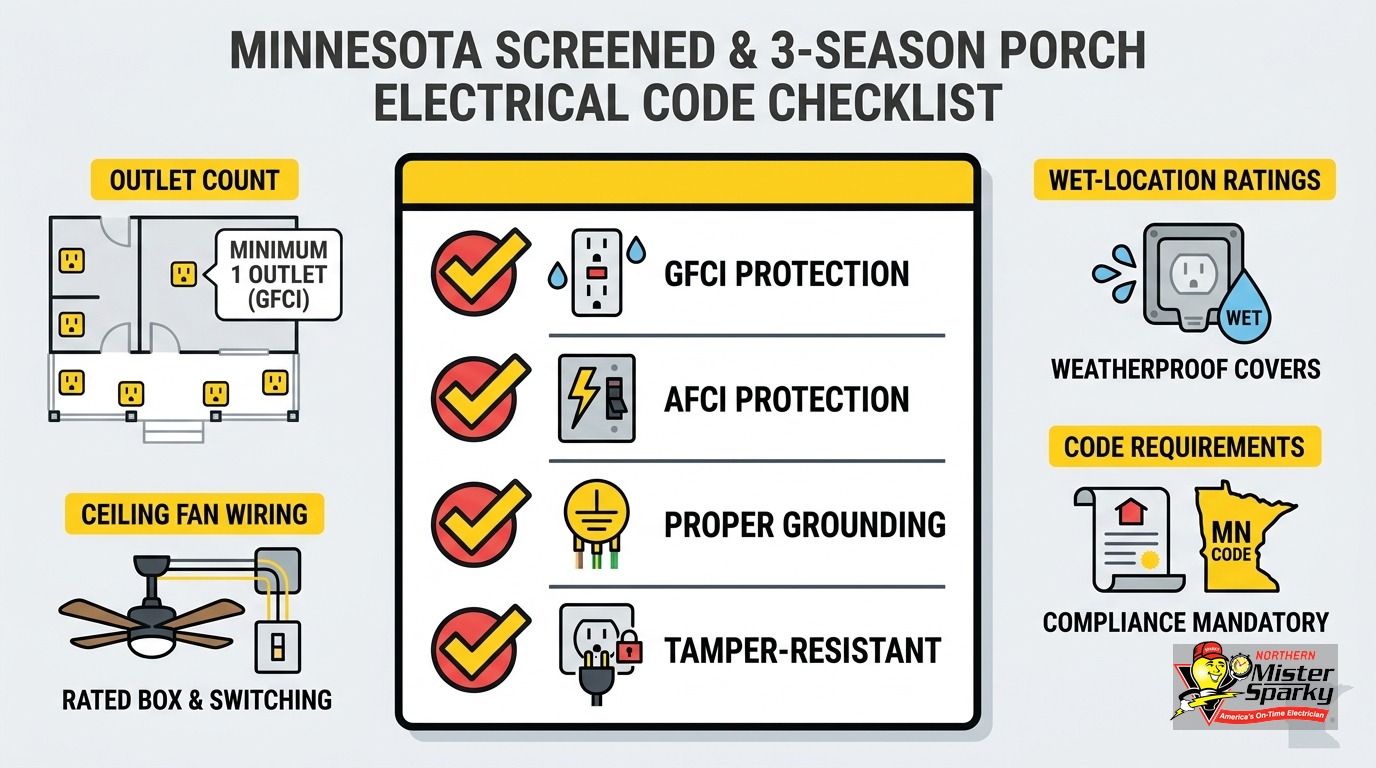
- Three season porch electrical outlets fall under different code sections depending on porch type. Screened porches and enclosed 3-season rooms are not the same in the eyes of the NEC.
- All outdoor receptacles require GFCI protection. Enclosed 3-season rooms also require AFCI protection. Screened-only porches typically do not.
- Standard Romex (NM cable) is prohibited on screened porches. Correct wiring methods include UF cable, THWN conductors in conduit, or MC cable with damp-location jacketing.
- Ceiling fans on covered porches must carry a “Suitable for Damp Locations” listing. A dry-location fan is a code violation and an insurance liability.
- Minnesota adopted the 2026 NEC on August 17, 2026. Permits pulled today fall under the new edition.
- Minneapolis and St. Paul operate their own permit departments. All other Twin Cities addresses file through the Minnesota DLI.
- Call 763-200-5956 or book online to get your porch electrical done right the first time.
What Kind of Porch Do You Have? The Fork That Changes Everything
The code applies differently based on porch type. A screened porch is an outdoor damp location - NEC 210.52(E)(3) applies, requiring one minimum outlet. An enclosed 3-season room with glass or vinyl windows is treated like an interior room - NEC 210.52(A) applies, requiring full wall-spacing coverage. That single distinction drives your entire electrical scope.
This classification is the first question an inspector asks when your permit is pulled. A screened porch and a glass-enclosed 3-season room sit on opposite sides of a code line. Everything downstream - outlet count, wiring method, AFCI protection, device ratings - follows from which side you land on.
A screened porch remains open to outdoor air through mesh or screen panels. The NEC treats it as a damp location: exposed to humidity, temperature swings, and condensation even when it is covered and protected from direct rain.
An enclosed 3-season room is a different classification entirely. Add glass or vinyl panels that seal the space from outdoor air, and the room crosses into habitable-space territory. The NEC now treats it like a bedroom or living room - not an outdoor space. The electrical requirements that come with that classification are substantially more demanding.
One project type that catches homeowners off guard is converting a screened porch into a 3-season room. What was code-compliant for the screened version is often not compliant for the enclosed version. If glass panels are going into an existing screened porch, get an electrical assessment before the windows are ordered. Finding gaps before the walls close is far cheaper than opening them after the fact.
How Many Three Season Porch Electrical Outlets Does Code Require?
A screened-only porch needs at least one GFCI-protected outlet, accessible from the porch and no more than 6.5 feet above the walking surface. That minimum comes from NEC 210.52(E)(3). An enclosed 3-season room follows interior room rules under NEC 210.52(A): no wall point may be more than six feet from an outlet. A 12x16 room typically needs five to six outlets to satisfy that spacing.
One outlet is the code floor, not a design target. Think about how a covered porch actually gets used in Minnesota from May through October. A ceiling fan, string lights, a phone charger, a small beverage refrigerator, and a television can all be running at the same time. Feeding all of that through a single outlet and a daisy chain of extension cords is not a plan. It is a fire hazard - and one that a home inspector will flag.
The six-foot wall-spacing rule for enclosed 3-season rooms requires measuring the perimeter of the room carefully. Every accessible stretch of wall must fall within six feet of an outlet. Fixed window panels that are two feet wide or wider count as wall space and factor into that calculation. A room loaded with windows can still need five or six outlets to clear code.
Circuit capacity is worth planning during the rough-in. A single 15-amp circuit has limited headroom once a ceiling fan, patio lights, and a compact refrigerator are drawing from it simultaneously. A 20-amp circuit - or two separate circuits for different sides of the porch - gives the space room to function without nuisance breaker trips. If you are opening walls to run new wiring anyway, upgrading the circuit capacity in the same pass is far cheaper than coming back to it later.
Does a Screened Porch Need GFCI Outlets?
Yes, every time. NEC 210.8(A) requires GFCI protection on all outdoor receptacles, including covered and damp-location porches. There is no exception for a roofed or covered porch. Every outlet on a screened porch must be GFCI-protected.
GFCI stands for ground-fault circuit interrupter. It monitors current continuously and trips within milliseconds when electricity begins flowing along an unintended path - including through a person. Outdoor spaces pair people with wet surfaces, damp hands, metal furniture, and power tools. That combination is exactly the scenario GFCI protection is designed for.
You can satisfy the requirement two ways. A GFCI receptacle at each outlet carries the TEST/RESET button directly on the device face. A GFCI breaker in the panel protects every outlet on the circuit from a single point. Either method satisfies code. When multiple outlets share a circuit, a GFCI breaker is typically the cleaner installation - one device protects the whole run.
For a full breakdown of where GFCI protection is required throughout your home - bathrooms, kitchens, garages, and more - see our post on GFCI outlet requirements explained.
Do Three Season Porch Electrical Outlets Need AFCI Protection?
It depends on porch type. Screened porches are outdoor locations and typically fall outside the AFCI requirement. Enclosed 3-season rooms are treated as habitable interior spaces, and NEC 210.12 requires AFCI protection for those circuits. This is one of the most commonly missed distinctions during porch electrical inspections.
AFCI stands for arc-fault circuit interrupter. Standard breakers trip on overloads and short circuits. AFCI breakers detect a different problem: arcing. A loose wire connection, a staple driven through a cable jacket, or worn insulation can cause arcing at current levels too low to trip a standard breaker - but high enough to ignite material inside a wall over time. AFCI protection detects that signature and trips before a fire starts.
For screened porches, the outdoor classification keeps them outside the AFCI scope under current NEC editions. But that is not a permanent pass. If the space is ever enclosed, the AFCI requirement follows the new classification. That is one more reason to get the electrical right before glass panels go in.
For enclosed 3-season rooms, combination AFCI/GFCI breakers are the practical solution. One breaker installed in the panel covers both requirements. You get arc-fault protection for the enclosed space and ground-fault protection for the outdoor-rated receptacles, from a single device. For more on how these breakers work and what to do when they trip unexpectedly, see our post on AFCI breaker requirements explained.
What Wiring Method Can You Use on a Screened Porch?
Standard NM cable - Romex - is not permitted on a screened porch. NEC 334.10 restricts NM cable to normally dry locations. A screened porch is a damp location. Correct wiring methods include UF cable, THWN conductors in weatherproof conduit, or MC cable with a damp-location-rated jacket. Using Romex on a screened porch is a rough-in inspection failure.
This is the most common mistake on porch electrical additions. A crew runs standard white NM cable through the ceiling because it is what they had on the truck. The inspector flags it at rough-in. The ceiling has to come open, the cable has to be replaced, and the inspection has to be rescheduled. That adds real cost and schedule time to a project that was otherwise on track.
UF cable is the practical first choice for most screened porch installs. It carries a moisture-resistant jacket, is rated for damp locations, and is approved for direct burial. THWN conductors in PVC or aluminum conduit offer more routing flexibility - useful for multiple outlet positions at different heights or for runs along a finished ceiling. MC cable works when the product specifically carries a damp-location rating. Not all MC cable products do, so confirm the listing before ordering.
For an enclosed 3-season room treated as a dry-location interior space, NM cable is permitted within the room itself. The catch is the run from the main house. Any segment of wire that passes through a wall cavity, ceiling section, or space classified as damp must use a damp-rated wiring method for that stretch. The wiring method must match the environment it passes through, not just the destination.
For a detailed breakdown of residential wiring method options and when each applies, see our post on conduit vs. Romex for residential projects.
Ceiling Fans on a Covered Porch: What the Code Requires
The fan must be rated “Suitable for Damp Locations.” Any ceiling fan installed on a covered screened porch occupies a damp location. A fan marked only for dry-location use is a code violation - full stop. The UL damp-location listing means the fan is built to handle consistent humidity, condensation, and the temperature cycling of an outdoor-adjacent space. In Minnesota, that cycle includes hard freezes from November through April.
The label is what matters, not the marketing language. Terms like “patio-style,” “outdoor-inspired,” or “moisture-resistant” are not code-equivalent to a damp-location listing. The fan’s label or installation manual must state “Suitable for Damp Locations” or “Listed for Damp Locations.” A dry-location fan installed on a covered porch is a code violation. If that fan fails due to moisture exposure and causes a fire or injury, your homeowner’s insurance may deny the claim on the basis of a non-compliant installation.
The support box is part of the installation, not an afterthought. Standard light-fixture boxes are rated for static load only. A ceiling fan requires a fan-rated box - typically listed for 35 or 70 pounds of dynamic load - because the spinning motor and blades create movement that a static-load box cannot handle reliably over time. The box must also carry a damp-location rating under NEC 314.15, separate from its fan-rated listing.
If your porch ceiling has gaps or openings that allow rain to contact the fan directly, the classification changes. Direct rain exposure at the fan location pushes the requirement from damp to wet. A wet-location fan is a substantially smaller and more expensive product category. Before purchasing any fan, look at the ceiling and determine whether rain can reach the mounting point. If it can, the fan and the box both need wet-location ratings.
For what a professional ceiling fan installation includes - product selection, box replacement, and wiring - see our post on ceiling fan installation costs and tips.
Does the Outlet Cover Matter in Minnesota’s Climate?
Yes, and Minnesota winters make it matter more than in most states. NEC 406.9 requires weather-resistant (WR) receptacles in damp locations. All covered porch outlets must use WR-rated receptacles. A flip-cap cover is sufficient for a roofed porch where the outlet is not exposed to direct rain spray. If the outlet faces direct rain, use an in-use cover: the type designed to seal around a plugged-in cord.
Minnesota’s freeze-thaw cycle degrades covers and gaskets faster than in warmer climates. A cover gasket that seals correctly in October can be cracked and brittle by April. A cracked gasket lets moisture into the outlet box. Moisture inside an outdoor box corrodes the receptacle face, creates arcing paths, and eventually produces a dead outlet - or a dangerous one.
When we inspect older porch wiring across the Twin Cities, cracked WR receptacle faces and deteriorated gaskets are among the most common findings. They are inexpensive to fix and easy to ignore until a nuisance trip or a failed outlet forces the issue. A new porch installation should spec quality WR receptacles and properly fitted covers from the start. A follow-up service call to replace a failed outdoor outlet in November costs more than doing it right during the original install.
Do You Need a Permit for Porch Electrical Work in Minnesota?
Yes, and two separate permits are required. Minnesota classifies three-season porches as structural additions, requiring both a building permit and a separate electrical permit. The electrical rough-in must be inspected before walls, ceilings, or floors are covered. That inspection is not optional - it is the mechanism that protects both homeowner and electrician if something fails later.
Where you pull the electrical permit depends on your address. Minneapolis and St. Paul each operate their own electrical permit departments, separate from the state system. Every other Twin Cities-area city - Bloomington, Plymouth, Woodbury, Maple Grove, Brooklyn Park, Blaine, Eagan, and the rest - files with the Minnesota Department of Labor and Industry through ims.dli.mn.gov/ims.
Minnesota adopted the 2026 NEC on August 17, 2026. Permits filed on or after that date fall under the 2026 edition. Permits filed before that date use the 2023 NEC. Inspectors track which edition governs each permit number. If your project straddles the cutover date - permit pulled earlier, rough-in scheduled now - confirm with your inspector which cycle applies before the work starts.
Homeowners can pull their own electrical permit on a single-family home they own and personally occupy. But the homeowner must perform all the electrical work. If any hired person touches the wiring, that person must be a licensed electrical contractor. Rental property owners must use a licensed contractor regardless of who occupies the property.
Skipping the permit creates problems at resale. Open electrical permits are a routine flag on home inspection reports and can stall or kill a closing. No malarky: the cost of pulling the permit is a fraction of what unpermitted work costs to remediate when a buyer’s inspector finds it years down the road.
Let Northern Mister Sparky Handle It
Three season porch electrical outlets look straightforward on paper. The code details say otherwise. The wrong wiring method, a dry-location fan in a damp-location space, a missed GFCI, an outlet count that does not satisfy the six-foot rule for an enclosed room - each one is an inspection failure. Each one costs more to fix after the ceiling is closed than before.
We are locally owned and operated in the Twin Cities, backed by the national Mister Sparky brand and the “America’s On-Time Electrician(R)” reputation. Our team knows Minneapolis and St. Paul permit offices, Minnesota DLI requirements, and what the 2026 NEC edition demands for your specific project type. Every job comes backed by the UWIN(R) 100% satisfaction guarantee.
If your porch project is on the schedule this season, get the electrical right before the walls close. Call 763-200-5956 or book online to get a licensed Twin Cities electrician on the job.
Frequently Asked Questions
How many outlets does a three season porch need in Minnesota? +
Can I use Romex on a screened porch? +
Do I need a permit to add outlets to my three season porch in Minnesota? +
Need an electrician now?